
- Comparisons
LiveKit alternative: Your practical 60db Agent guide
LiveKit alternative guide: compare 60db Agent on phone workflows, deployment, latency testing, costs and a reversible migration.
- Author
 Udit Goenka
- Published
- Reading time
- 20 min
TL;DR: 60db Agent is a LiveKit alternative to evaluate when your main requirement is an outbound phone agent with a managed call workflow. LiveKit remains a strong choice for programmable realtime rooms, custom media applications and infrastructure control; choosing between them requires testing your call path, tools and operational requirements.
A search for a LiveKit alternative often starts after the first successful demo. The voice works, but the team now needs dependable call outcomes, a review process and a clear answer to who operates each part of the system.
Start by naming what you want to replace. A media server, an agent framework and a managed phone agent solve different problems, even when they all produce a conversation that sounds similar to a caller.
60db Agent is worth considering for a phone workflow where your application supplies instructions, approved business actions and customer data. It does not establish that an existing LiveKit room application can move unchanged, or that every programmable media feature has an equivalent.
This comparison reflects public documentation reviewed on November 9, 2026. It is a technical evaluation guide, published by 60db, rather than a head-to-head benchmark; example workloads and acceptance tests below are proposed evaluation methods, not measured customer results.
Table of contents
- What are you replacing?
- When is 60db Agent a relevant LiveKit alternative?
- How do the architectures compare?
- How should you measure latency and interruptions?
- How do tools, memory and call outcomes change?
- What should a cost comparison include?
- How do you migrate without losing working behavior?
- Which option fits your team?
- Frequently asked questions
- Conclusion and next step
What are you replacing?
A LiveKit alternative must replace the layer your application really depends on. Before comparing features, separate the room transport, the code that controls the conversation and the hosted services that deploy or observe that code.
LiveKit Agents lets Python and Node.js programs participate in realtime rooms, with either a self-hosted environment or LiveKit Cloud. Its documentation covers model integrations and voice pipelines, while the wider platform also handles media applications beyond ordinary phone conversations. Source: LiveKit Agents introduction.
That distinction changes a migration estimate. A callback assistant that reads a script and books a slot has a smaller dependency surface than a collaborative application with several participants, screen sharing and agent-generated audio.
For the callback assistant, the business contract is relatively clear: reach a permitted number, identify the customer, complete an approved action and leave a usable result. The supporting room abstraction may be incidental to that contract.
For the collaborative application, rooms and participants are part of the product. Replacing the conversation engine alone does not replace track subscriptions, client permissions, reconnection handling or the user interface built around those events.
Use the 60db developer documentation to check the proposed interfaces, then write an inventory before opening a new account. Record each frontend SDK, carrier connection, agent tool, recording destination, transcript consumer and deployment dependency that an actual customer workflow touches.
Include operational dependencies too. A support team may depend on a particular recording URL format, and a finance job may depend on one final status event; those contracts can matter more than the prompt that starts the conversation.
A useful inventory distinguishes required behavior from implementation history. "The caller can request a person" is a requirement, while "our current agent uses a particular Python class" is usually an implementation detail.
Keep requirements specific enough to test. Replace "good handoff" with a description of who is rung, what happens if nobody answers and what the system tells the caller when the result is uncertain.
If your needs are primarily speech recognition or speech synthesis, changing the entire agent platform may be unnecessary. Review the realtime transcription service and text-to-speech API separately before committing to a wider rewrite.
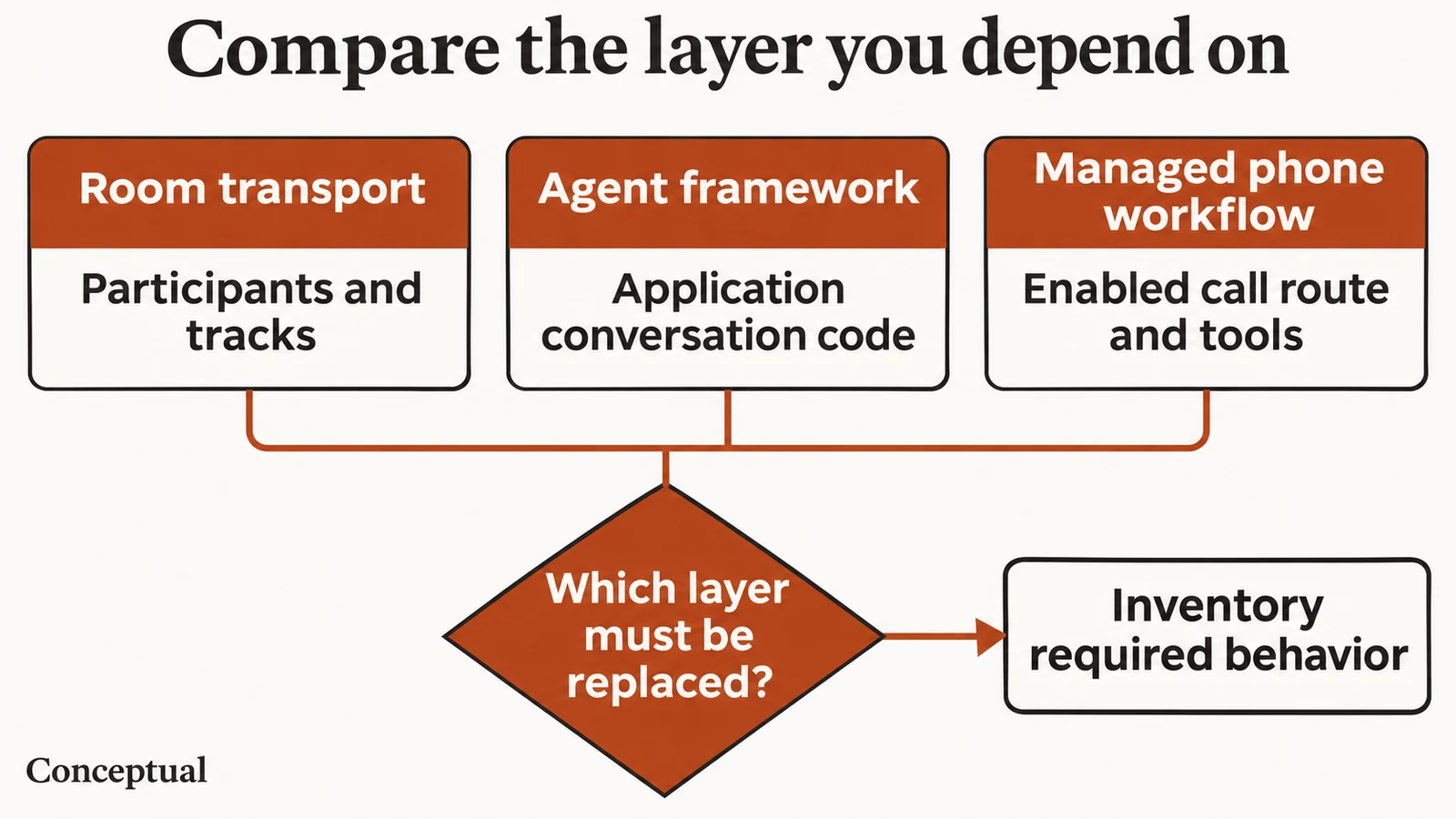
Conceptual: Inventory whether the replacement must cover room behavior, agent code, or the managed call workflow.
When is 60db Agent a relevant LiveKit alternative?
60db Agent deserves a pilot when your target is a managed phone conversation rather than a general media application. Evaluate the public agent workflow against the tasks your operators perform every day, including review and escalation.
The public product page describes outbound calling, dashboard configuration, phone lines, browser testing and streaming connections. Confirm inbound availability and access for your workspace before depending on either. Sources: 60db Agent product page, agent documentation.
That availability check matters. A team replacing an inbound support queue should stop at the availability check, while a team piloting appointment reminders can continue evaluating the documented outbound path.
The table below compares documented evaluation surfaces, rather than awarding an overall winner. A check means the cited documentation describes that capability; a cross means the specific promise is unavailable or not established by the public evidence reviewed.
| Evaluation question | LiveKit | 60db Agent | Practical qualification |
|---|---|---|---|
| Programmable realtime room framework? | ✓ Core platform design | ✗ Equivalent room framework not established | Keep media-heavy applications in a separate evaluation |
| Managed deployment option? | ✓ LiveKit Cloud | ✓ Managed agent workflow | Compare responsibility boundaries, limits and support |
| Self-hosting path? | ✓ Documented | ✗ Public agent self-hosting path not established | Hosted API access does not imply downloadable infrastructure |
| Outbound phone workflow? | ✓ Telephony integration | ✓ Publicly described | Carrier setup and destination availability still matter |
| Inbound phone workflow? | ✓ Documented telephony path | ✗ Public availability not confirmed | Verify access before designing an inbound queue |
| Browser interaction? | ✓ Client and room platform | ✓ Dashboard testing described | A test interface is not feature parity with a custom client |
| Backend actions during conversation? | ✓ Framework tools | ✓ Signed webhook tools described | Verify business authorization and retries yourself |
| Complete end-to-end latency winner established here? | ✗ | ✗ | No controlled comparative test was performed |
LiveKit's telephony documentation covers both receiving and making calls. Its deployment documentation also describes managed scaling, so avoid treating infrastructure management as something only one side offers.
The practical attraction of 60db Agent is its phone-focused workflow. LiveKit also offers a no-code Agent Builder and managed deployment, so browser-based configuration is available on both paths. Source: LiveKit Agents introduction.
That benefit is conditional on your requirements. If you need custom model routing, advanced media behavior or a particular enterprise control, require specific documentation and a working pilot before assuming the managed workflow supplies it.
Evaluation rule: LiveKit supports both managed and self-hosted deployment. Compare the operating responsibility, not just the presence of hosting. Source: LiveKit deployment overview.
Language fit deserves its own decision. Test actual accents, names and mixed-language utterances with your approved voice library, rather than treating a supported-language label as evidence of correct customer conversations.
How do the architectures compare?
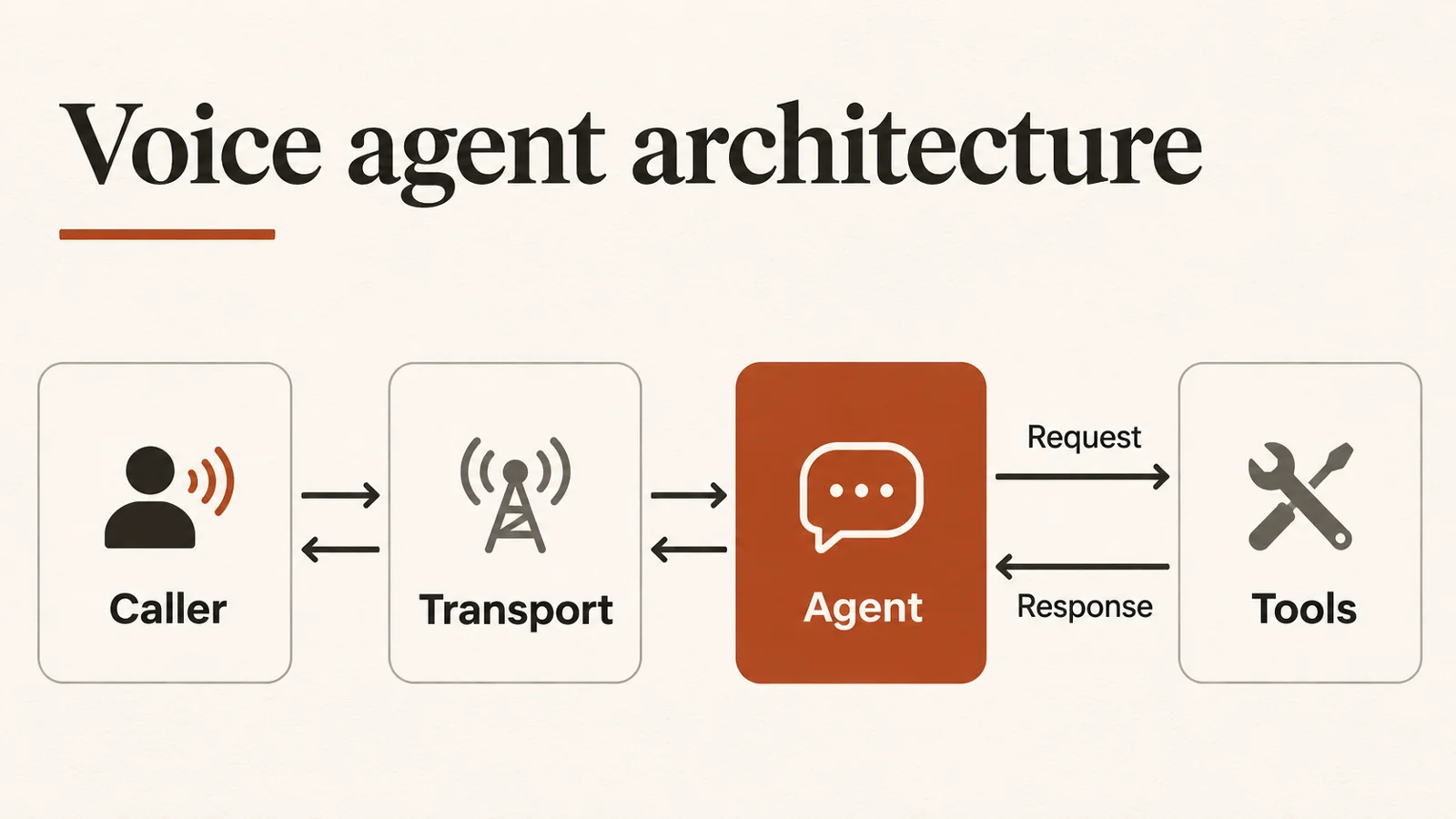
The central architecture question is where your application stops and the platform starts. A deployment diagram should make responsibility for audio, conversation state, external actions and final outcomes visible enough that an engineer can explain a failure without guessing.
In a room-based system, clients and agents communicate through the media platform. Your agent code often controls how speech services, language models and backend tools participate in the conversation.
A managed phone workflow places more of the conversation path behind a product interface. Your application still controls business data, tool authorization, customer eligibility and what constitutes a successful outcome.
The following diagram is a conceptual responsibility map. It does not claim to describe proprietary internals or imply that the two paths share an implementation.
Keep the business backend independent of conversational wording. If a booking is valid only after checking account status and available capacity, the backend must enforce those checks even when a model produces a plausible request.
The same rule applies to transfers. Ringing a destination, establishing a connection and completing a useful handoff are separate outcomes, and your customer support policy should define how each appears in the final record.
Infrastructure control has a cost as well as a benefit. LiveKit publishes a self-hosting guide, which gives teams an operating path when they need to own more of the deployment; it also means somebody must maintain that environment.
A hosted workflow changes that work rather than eliminating operational responsibility. You still need to understand service limits, account access, provider failures, credential rotation and the consequences of a missing event.
Review 60db privacy information alongside the data map, and ask each vendor which data leaves your environment. Include audio, transcripts, tool arguments, retrieved passages and logs, because a familiar network diagram can hide a surprisingly broad data path.
Use 60db's API documentation to confirm supported interfaces before estimating integration effort. Product descriptions establish an evaluation starting point; executable requests, permissions and observed responses establish whether the workflow fits your system.
How should you measure latency and interruptions?
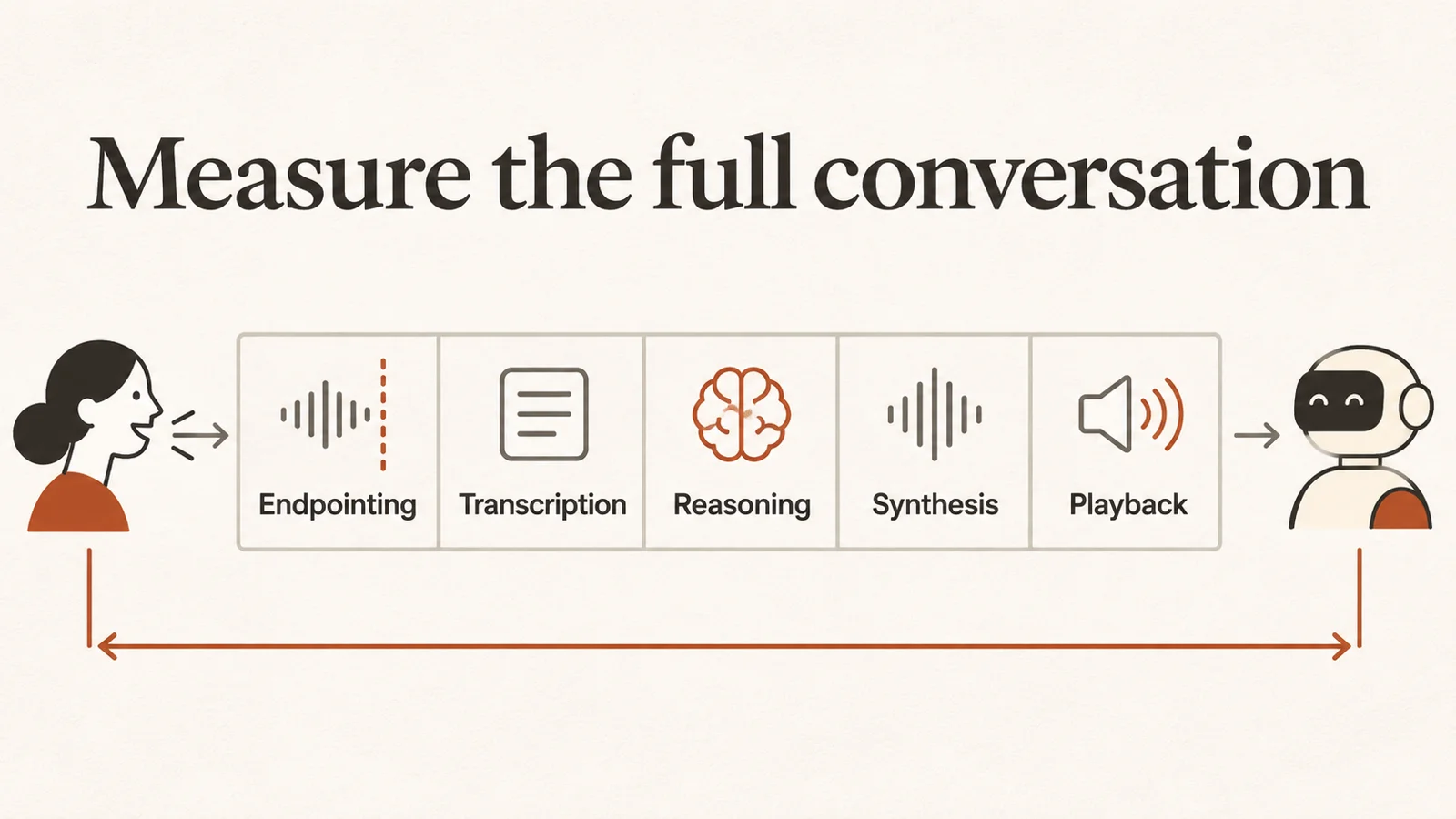
End-to-end voice latency is the interval between a defined user event and a defined audible response. A speech service's first chunk, an agent's first token and the first sound a caller hears are different measurements.
For a practical test, mark the end of the caller's utterance and the first audible agent response on the same recording timeline. Record how you identify both boundaries so another engineer can reproduce the measurement.
Then inspect the intermediate stages. Turn detection, transcription, retrieval, model inference, speech generation, transport and playback can all contribute to the pause, while some stages overlap through streaming.
Do not add unrelated vendor headline numbers and call the sum a conversation benchmark. A model measured on a warm connection with short text says little about a cold phone call that needs a customer lookup.
LiveKit documents turn detection and interruption controls, including strategies for handling conversational timing. An evaluation that describes LiveKit as lacking interruption support would misrepresent the current product. Source: LiveKit turns overview.
Build a small scenario set with different conversational shapes. Include a short question, a hesitant answer, a corrected phone number, overlapping speech, background audio and a tool result that arrives late.
A caller saying "yes" during an explanation is different from a caller saying "stop, that is the wrong address." Listen for whether the agent yields appropriately, and record whether it resumes an obsolete answer after the correction.
Use the same source audio where replay is technically possible, then run live calls to test network effects. Replay helps isolate conversation behavior, while real connections reveal carrier and device conditions that files cannot reproduce.
Report the median and a high percentile alongside failures. A system with a responsive typical turn can still create frustrating calls if a meaningful minority of turns stalls or loses the caller's correction.
Separate simple answers from tool-dependent answers. Otherwise, one platform can appear faster because it produced an immediate acknowledgment while another waited to verify the action that the caller really requested.
Acknowledge what you have not measured. This guide provides no controlled evidence that 60db Agent or LiveKit is faster overall, and 60db benchmark reports should be read within their own stated measurement boundaries.
For multilingual calls, retain the original utterance and assess whether the answer preserved dates, amounts and names. A quick response that acts on the wrong appointment is an unsuccessful response, regardless of its timing.
How do tools, memory and call outcomes change?
A voice agent becomes operationally useful when it can retrieve approved information and perform bounded actions. Those capabilities also create a failure surface that deserves more attention than the quality of the greeting.
Start with a read-only lookup. Test whether the agent asks for enough information, sends only the necessary fields and explains a backend failure without turning missing data into a confident answer.
For a state-changing action, write the business contract before connecting the model. Define authorization, required arguments, duplicate detection, timeout behavior and the evidence needed to tell a caller that the action succeeded.
A signed webhook request establishes an integration security mechanism, not the customer's right to perform an action. Your backend should still verify the relevant account, allowed operation and current business state.
Consider an appointment change. The caller requests Tuesday, the tool creates a reservation, and the connection drops before the response arrives; retrying the request must not create another reservation simply because the agent lacks a response.
A backend idempotency key tied to the intended operation is one common safeguard. Preserve the final operation result so a retry can return evidence of the existing booking rather than treating a lost response as proof of failure.
The agent should distinguish "I have submitted the request" from "your appointment is confirmed." Your success criteria should examine the authoritative booking record, because a fluent confirmation in the transcript cannot prove an external write occurred.
Knowledge retrieval introduces a different contract. Use the memory service only with approved documents and access controls, and test questions where no relevant passage exists so the agent has to explain its limit.
Do not combine customer records and public policy text without checking access boundaries. A correct retrieval answer for one account can still be a disclosure if the same context reaches a different caller.
Retain enough call evidence to investigate these cases. Audio and transcripts show what the caller heard, while backend operation records show what really changed; both are necessary when those stories diverge.
The 60db Agent documentation describes call resources and events. Confirm the actual event payloads, authentication and delivery behavior in a test environment instead of assuming your existing LiveKit event handlers can be copied directly.
Your review queue should prioritize uncertainty. Calls with ambiguous tool completion, failed transfers or missing final records deserve attention even when the conversation sounded natural and ended politely.
What should a cost comparison include?
A fair LiveKit alternative comparison uses the same workload and the same cost boundary. Framework licensing, hosted runtime charges, model usage and phone line charges are separate categories that should not be collapsed into a single unexplained per-minute figure.
Cost per completed task is often more useful than cost per connected minute. A longer call that completes the appointment can be less expensive operationally than several cheap calls that require a person to repair the result.
Create a worksheet with connected minutes, generated speech, recognized audio, model tokens, retrieval requests, recordings, phone numbers and engineering time. Include idle capacity where you operate your own infrastructure and plan commitments where you use hosted services.
Use observed conversation ratios. A reminder call with a long introduction consumes speech differently from a troubleshooting call in which the customer talks for most of the session.
The public 60db Agent pricing explanation gives an approximate AI usage figure of $0.016 per conversation minute and a $0.003 line-minute figure for a 60db number. These are product estimates with stated conditions, not a fixed quote for every workload or a measured advantage over LiveKit.
For planning only, multiplying those two minute figures by 10,000 minutes produces $160 in estimated AI usage and $30 in estimated line usage. That arithmetic excludes number rental, additional services, plan terms and any difference between the example's assumptions and your actual calls.
Read the current pricing page before budgeting. It explains credits and usage boundaries, which matter when a busy campaign exhausts the balance or a plan limits how the next usage purchase can occur.
Do not compare that estimate with a LiveKit subtotal that excludes speech providers or includes a different model. Likewise, do not charge a managed option for engineering time while pretending self-hosted monitoring and upgrades require none.
Track cost during the pilot alongside outcomes. Record successful tasks, escalations, failed calls and retries so the final spreadsheet reflects how the system behaves with your actual customers.
Include a stress case. Repeated tool timeouts, unusually long calls and simultaneous starts can expose a cost or quota limit that remains invisible in a friendly demonstration.
Use the 60db contact route for account-specific answers, because commercial terms need their own confirmation. Destination rates, supported number inventory, minimum commitments, taxes and support obligations should come from current account terms rather than a rounded comparison table.
A sound decision can favor either architecture. The useful result is a cost model that another person can inspect and update when traffic, model choice or pricing changes.
How do you migrate without losing working behavior?
Treat migration as a controlled change to an existing customer workflow. Your first objective is to preserve the successful behavior that customers already rely on, while proving that the new operating model solves a specific problem.
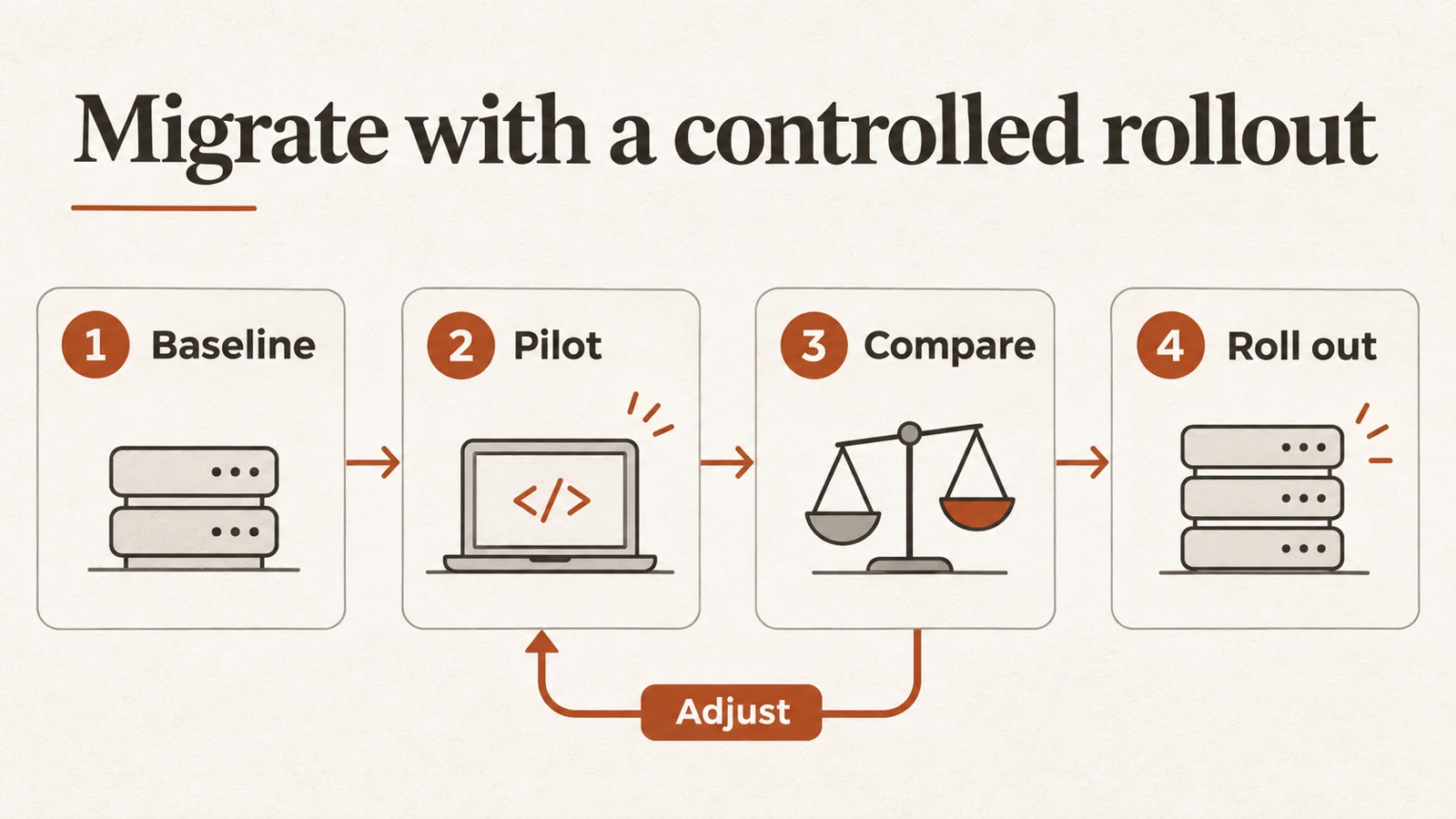
- Choose one workflow. Pick an outbound workflow with a clear success condition, such as confirming an existing appointment, and keep unrelated media features outside the first pilot.
- Record the contract. Document inputs, required disclosures, supported languages, tool behavior, handoff rules and the final records downstream systems consume.
- Build the smallest integration. Configure the new agent, connect a test phone line and begin with read-only backend actions.
- Test failures deliberately. Exercise timeouts, duplicate events, caller interruptions, insufficient permissions, invalid destinations and unavailable transfer targets.
- Compare evidence. Review recordings, backend outcomes, timing and cost against the same written acceptance criteria.
- Roll out gradually. Route only the agreed traffic segment, keep a visible rollback path and leave in-progress calls on their original path.
Avoid porting the prompt word for word and declaring the migration complete. Different tool schemas, context handling and conversation controls can change what identical instructions produce.
Keep your backend's business operations stable where possible. A thin integration at an existing endpoint is easier to validate than changing the booking service, customer database and conversation platform in one release.
Create a mapping for final statuses before connecting production analytics. A call ending normally, a task completing and a customer requesting a human are different facts, even when the previous integration represented them with one label.
Make webhook consumers safe to replay. Store a durable event identifier when available, acknowledge delivery according to the documented contract and reconcile missing outcomes against the authoritative call resource.
Use the agent dashboard to give support staff a review exercise. Ask them to locate a recording, understand an uncertain outcome and identify the corresponding business operation without engineering help.
Capacity testing comes after the single-call contract works. Start enough simultaneous test calls to exercise expected peaks, and observe how admission failures, slow starts and account limits appear to operators.
Your rollback plan must cover both traffic and data. Stopping new calls does not undo a completed booking, so define which records remain authoritative and how operations staff handle tasks created during the pilot.
Before expanding, review access and retention with the people responsible for the customer data. Read 60db's privacy policy and obtain any contractual answers your deployment requires; an article cannot establish suitability for a regulated workload.
Which option fits your team?
Choose on the basis of the product you are operating. An outbound agent attached to an existing business backend and a realtime application with custom participants require different controls, even if they share the same speech models.
Continue with LiveKit when room behavior and media integration are central to your application, or when its documented hosting options fit a concrete infrastructure requirement. An established deployment also has value that should appear in any migration estimate.
Pilot 60db Agent when you want to evaluate a managed calling workflow and can express your requirements through its documented interfaces. Confirm workspace access and any ambiguous capability before investing in a full integration.
Ask your engineering lead to identify the ownership change in a single paragraph. If nobody can explain who handles call initiation, tools, failure recovery and the final record, the platform comparison is still too vague.
Ask your operations lead a different question: can someone find and resolve a failed customer interaction? That test catches gaps that a polished voice demo and a favorable latency chart cannot reveal.
Keep the decision reversible until the pilot supplies evidence. The 60db contact page is the right place to resolve account-specific requirements; the working integration is where you verify the answer.
Frequently asked questions
What is a LiveKit alternative for outbound voice agents?
60db Agent is one option to evaluate for a managed outbound phone workflow. Compare the required conversation, tools, call records and carrier path against the current product rather than assuming feature parity from the word "agent." A representative pilot is the right basis for the final choice.
Is 60db Agent a replacement for the LiveKit media server?
This comparison does not establish that replacement. LiveKit's media server and room model support a wider set of realtime applications than the managed phone workflow discussed here.
If your product depends on multiple participants, tracks or custom media behavior, evaluate those requirements separately before planning a migration.
Does LiveKit support managed agent deployment?
Yes. LiveKit's current deployment documentation describes LiveKit Cloud hosting, scaling and deployment management.
The choice is for that reason not simply managed versus self-managed software. Compare the specific responsibility boundary, plan limits and operational interfaces offered by each path, including the deployment you already have.
Can I self-host 60db Agent?
A public self-hosting path for 60db Agent was not established by the sources reviewed for this guide. Do not interpret API access as a self-hosting license or deployment package.
If owning the runtime is mandatory, request explicit documentation and compare it with LiveKit's published self-hosting instructions.
Does 60db Agent support inbound calls today?
The public product page lists inbound as coming soon. Confirm availability for your workspace before choosing it for an inbound queue.
Until that confirmation and a successful test, treat inbound support as an unresolved requirement rather than a delivered capability.
Can I keep my current SIP carrier?
60db Agent publicly describes a bring-your-own-SIP route, and LiveKit documents SIP telephony integration. Keeping a carrier still requires checking trunk settings, codecs, authentication, caller identity and routing.
Run an actual call through the proposed path because a compatible protocol label does not establish every carrier-specific behavior.
Is 60db Agent faster than LiveKit?
No controlled result in this guide establishes that claim. A comparison needs the same geography, caller audio, model workload, tool behavior and measurement boundary.
Measure the audible response on representative calls and report tail latency and failures alongside typical timing, instead of comparing unrelated component marketing figures.
What latency should a migration pilot measure?
Measure caller end-of-speech to first audible agent response, then inspect the intermediate stages where possible. Separate tool-dependent answers from immediate acknowledgments and retain failed turns.
Use one measurement definition across both systems so changes in turn detection or response wording do not distort the comparison.
Does LiveKit handle barge-in and turn detection?
Yes. Its current documentation covers turn detection and interruption controls.
Test those controls with your own scenarios before deciding they are a reason to migrate. Include short acknowledgments, corrections and background noise because each can expose a different conversational timing problem.
Can 60db Agent call my backend during a conversation?
The public product documentation describes signed webhook tools for backend lookups and actions. Your application remains responsible for authorization, input validation and business correctness.
Verify signatures with the documented method, then test rejected requests, slow responses and uncertain outcomes before connecting an action that changes customer data.
How do I prevent duplicate bookings or refunds?
Enforce duplicate protection at the authoritative business service. Tie retries to a stable operation identity and return the existing result where appropriate.
A transcript or a successful network response alone cannot guarantee that an external action happened once, especially when connections fail after the service has committed the change.
Can the agent answer from my knowledge base?
60db Agent describes attaching its memory service for knowledge retrieval, while LiveKit documents external data and retrieval patterns. Evaluate source quality, permissions and missing-answer behavior with your own material.
Retrieval support does not establish that every answer is grounded or that customer records are isolated correctly.
How should I test Hindi and English code-switching?
Use utterances that mix the languages in the way your callers really speak, including names, addresses and corrections. Ask reviewers familiar with the target audience to assess the full conversation.
Language coverage and speech recognition accuracy are useful inputs, but the decisive question is whether the correct task was completed.
What does the advertised 60db Agent minute price include?
The product page provides approximate AI usage and line-minute figures with stated conditions. Treat them as budgeting inputs and read the current credit and telephony terms before committing.
Number rental, other services, carrier bills and your actual speaking ratio can change the final cost of a call.
Is open-source LiveKit free to operate?
A software license does not cover the full operating cost. Hosting, model inference, phone connectivity, recording storage and engineering work can still be required.
Managed offerings also have their own pricing boundaries, so compare the same workload and record which costs each subtotal includes.
Should I migrate the frontend at the same time?
Only if that is necessary for the workflow being changed. A phone-focused pilot can often be evaluated separately from a custom media frontend.
Keep changes bounded so a failed trial has a clear cause and rollback does not require reverting unrelated client behavior or customer-facing features.
What call evidence should support teams receive?
Give reviewers the call outcome, transcript, recording when permitted and relevant business operation references. Make uncertainty visible instead of hiding it behind a completed call status.
The support workflow should allow someone to determine what the caller heard and what the backend really did without reconstructing the conversation from scattered logs.
Can I copy my existing prompt unchanged?
You can use it as a starting point, but identical text does not guarantee identical behavior across platforms. Tool definitions, available context and turn controls affect the conversation.
Re-run your acceptance scenarios and rewrite only the instructions that need to fit the new documented interface.
What is the safest first migration use case?
Choose a bounded outbound workflow with approved recipients, a clear success condition and limited backend permissions. Begin with read-only behavior before enabling writes.
Preserve the original route and call evidence so you can compare outcomes and stop the pilot without losing track of customer tasks.
When should I stay with LiveKit?
Stay when its room model, media capabilities or deployment controls are central requirements and the existing system meets your goals. Migration needs a concrete benefit supported by a pilot, such as a better-fitting operating workflow.
A different dashboard or a vendor's isolated benchmark is insufficient evidence on its own.
Conclusion and next step
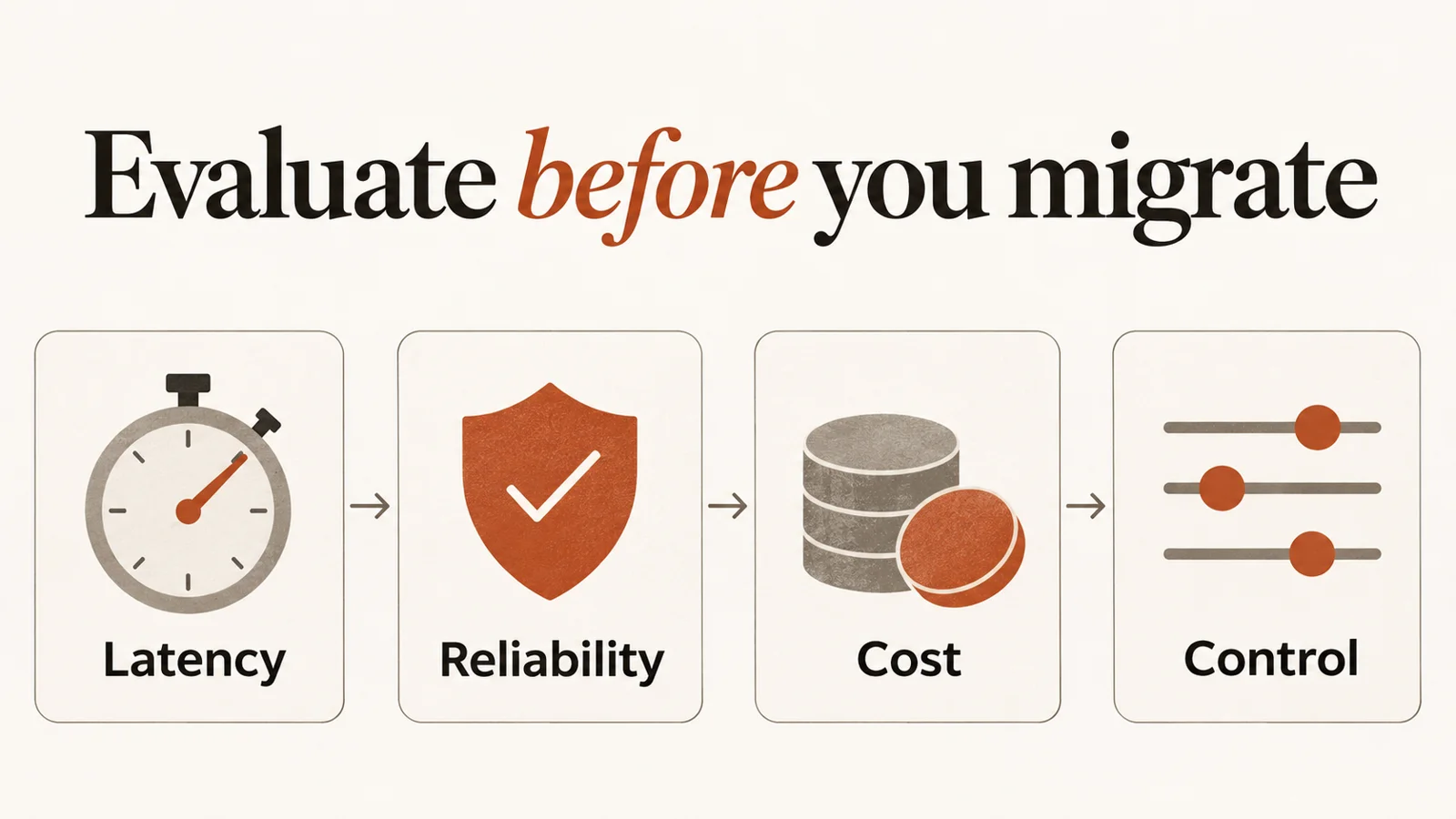
A useful LiveKit alternative evaluation starts with a narrow question: which part of your current system needs to change? Write that requirement before comparing SDKs, prices or voice samples, because the answer determines whether 60db Agent belongs on the shortlist.
- Keep room and media requirements visible when LiveKit is part of the customer-facing product.
- Evaluate 60db Agent against a bounded outbound workflow and confirm workspace-specific availability.
- Measure audible response, task outcomes, operational review and complete cost on the same workload.
- Preserve business authorization, duplicate protection and a reversible traffic route throughout migration.
Start with 60db Agent, review the integration documentation, and bring one real call scenario to the pilot. Expand only after the evidence shows that the new workflow meets the requirements your customers and operators rely on.
About this article: The 60db editorial team prepared this vendor-authored comparison from the linked public documentation. No customer trial or controlled performance test is claimed, and product availability and commercial terms should be confirmed before deployment.