
- Comparisons
Pipecat alternative: Your practical 60db Agent guide
Pipecat alternative guide: evaluate 60db Agent for phone calls, pipeline ownership, tools, costs and a measured migration.
- Author
 Udit Goenka
- Published
- Reading time
- 21 min
TL;DR: 60db Agent is a Pipecat alternative to evaluate when you want a managed outbound phone workflow instead of owning the conversation pipeline. Pipecat remains a strong fit when custom processors, provider choice or multimodal behavior are central requirements; compare the complete deployment and call outcome before migrating.
A working voice pipeline is an achievement. Turning that pipeline into a service that your operations team can trust is a different job, especially once the agent can book appointments, update records or connect callers to people.
If you are searching for a Pipecat alternative, identify which job is causing the problem. Replacing a framework can help when its ownership model no longer fits your team, but it can also remove custom behavior that made the product useful.
60db Agent belongs in an evaluation focused on managed phone conversations. Your application supplies the business workflow and integrations, while the product exposes a calling interface that can be assessed against your existing workflow.
This guide uses public documentation reviewed on November 9, 2026 and is published by 60db. It contains no controlled comparative performance test, customer testimonial or claim that one architecture wins every workload.
Table of contents
- What does replacing Pipecat really mean?
- When is 60db Agent a relevant Pipecat alternative?
- How does pipeline ownership change?
- What happens to tools and business state?
- How do you compare conversational performance?
- How should you compare production costs?
- How do you move a Pipecat workflow safely?
- What should decide the final shortlist?
- Frequently asked questions
- Conclusion and next step
What does replacing Pipecat really mean?
A Pipecat alternative can change the conversation framework, the hosting model or the entire agent workflow. Those changes have different consequences, so label the intended replacement before comparing feature lists.
Pipecat is an open-source Python framework within a broader platform of clients and deployment services. Its introduction describes a BSD-2 license, provider flexibility and a client-server architecture for voice and multimodal applications. Source: Pipecat introduction.
Your application combines the framework components, supplies business context and decides what happens when a provider fails or a caller interrupts.
That control is valuable when the pipeline is part of your product. It can be expensive when a small team mainly wants to operate routine phone calls and must maintain integration details that customers never see.
Do not infer the current operating model from the word "Pipecat." A locally hosted application, a custom Kubernetes deployment and a Pipecat Cloud deployment can have different responsibilities even when their conversation code looks similar.
Pipecat Cloud accepts an agent image and manages deployment, session starts, scaling and observability. Pipecat Enterprise describes agents running in a customer-operated cluster with a shared control-plane model, so managed operation is already an option in the platform. Source: Pipecat Cloud and Enterprise.
Your initial investigation should for that reason compare three possibilities: repair the current pipeline, move its hosting or replace the workflow. A hosting problem does not automatically justify rewriting conversation behavior, and a missing business capability does not automatically require a different media transport.
List the code your application owns today. Include custom processors, transport adapters, model configuration, retrieval, tools, recording handlers, event consumers and any user interface tied to pipeline state.
Then classify each component by purpose. Some code expresses a customer requirement, while other code merely adapts a service to the current framework; the latter is where a managed workflow can remove work if its documented interface meets the same need.
The 60db product overview can help separate speech services from the agent workflow. If the actual problem is one speech provider, evaluate that component independently before replacing a working application around it.
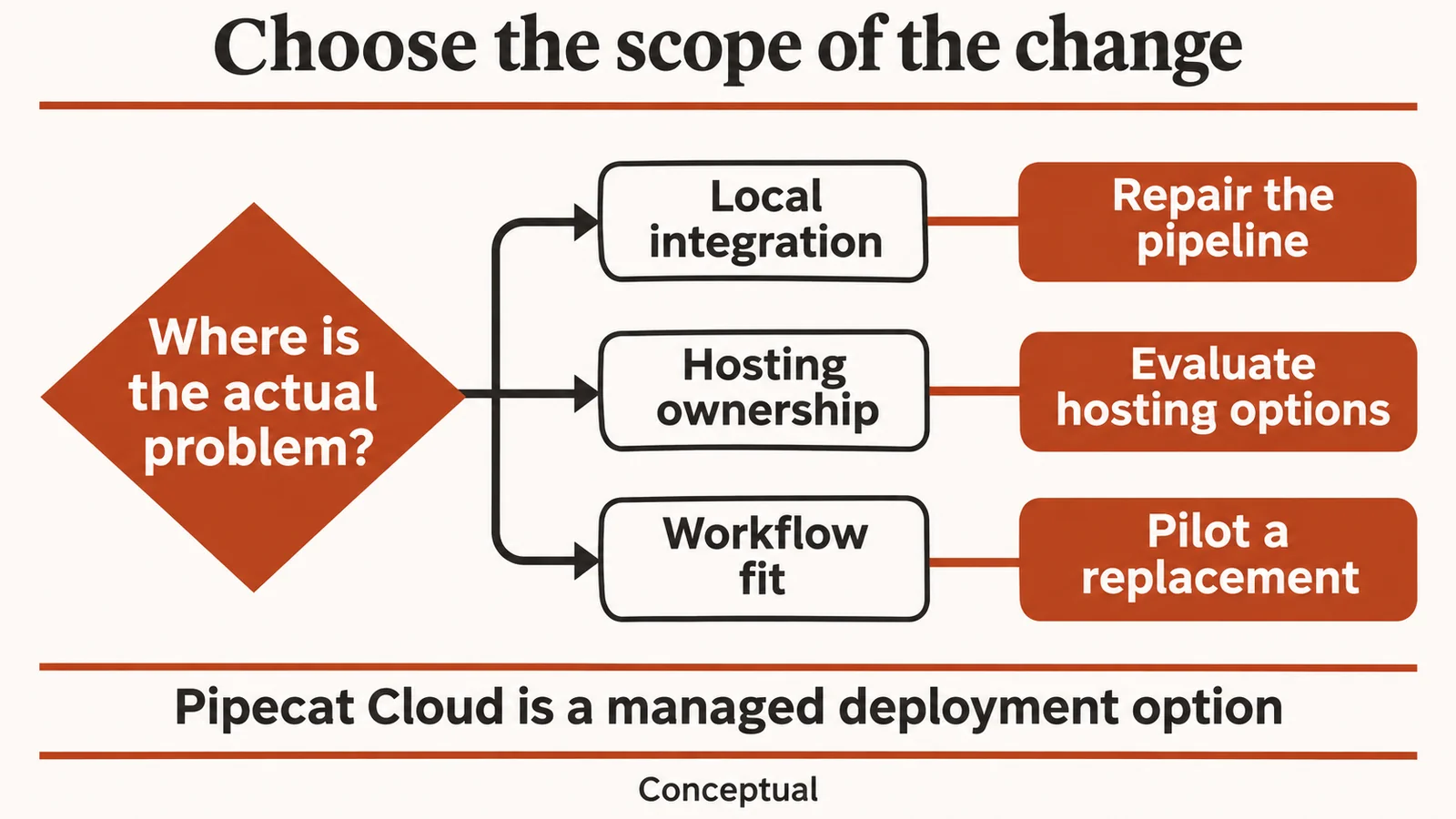
A hosting problem and a workflow mismatch justify different evaluation scopes.
When is 60db Agent a relevant Pipecat alternative?
60db Agent is relevant when the desired product is an operational phone conversation with a defined outcome. It deserves a pilot when you prefer a configured calling workflow and backend integrations to maintaining the full processing pipeline.
The public agent page describes outbound calls, tools, call review and several ways to supply audio or a phone connection. Confirm inbound availability and workspace access before depending on either, because a production queue needs explicit account-level capability rather than an assumption. Source: 60db Agent product page.
An appointment confirmation is a useful example. The required behavior is to reach an eligible customer, confirm the correct appointment, record the response and escalate an exception; it does not necessarily require a custom audio processor.
A voice-controlled application with video, bespoke signal processing and local model experiments is a different case. Pipecat's composable design may be the reason that application is practical, so removing it could create work rather than reduce it.
Read the following matrix as an evidence map. A check means the cited public material describes the specific surface, while a cross means the promise is absent or unconfirmed in the material reviewed; neither symbol is a universal quality score.
| Requirement | Pipecat platform | 60db Agent | What you must validate |
|---|---|---|---|
| Custom Python frame-processing pipeline | ✓ Framework concept | ✗ Equivalent public extension model not established | Whether your custom processor is a real requirement |
| Broad provider composition | ✓ Published service integrations | ✗ Equivalent provider matrix not established | Required models and supported configuration |
| Managed deployment path | ✓ Pipecat Cloud | ✓ Managed calling workflow | Limits, responsibility and failure visibility |
| Self-hosted application path | ✓ Documented platform option | ✗ Public agent self-hosting path not established | Your infrastructure and data-control requirements |
| Outbound phone workflow | ✓ Integration-dependent | ✓ Publicly described | Carrier, destination and account access |
| Browser testing | ✓ Browser clients and testing paths documented; deployment dependent | ✓ Dashboard testing described | Whether the test reflects the production audio path |
| Calls to your backend during conversation | ✓ Function-calling support | ✓ Signed webhook tools described | Authorization, retries and durable outcomes |
| A comparable performance winner established here | ✗ | ✗ | Same-workload testing is still required |
Pipecat's public service catalog shows integrations across recognition, synthesis, models and transports. Its introduction documents browser clients and testing paths; availability depends on deployment. Do not portray composability as a missing feature simply because your current deployment requires maintenance.
Likewise, do not portray a managed workflow as automatically easier for every team. An undocumented requirement, a missing deployment control or an incompatible event consumer can outweigh the time saved configuring a first call.
Evaluation rule: Pipecat Cloud already provides a managed deployment path. Compare the work each platform really owns. Source: Pipecat Cloud overview.
For a credible shortlist, write the reason to switch as an observable outcome. "Operations can locate failed calls without engineering help" is testable; "the platform is simpler" is too vague to justify moving customer traffic.
Begin with the 60db Agent workflow, then check the exact agent interfaces. A product page gets a candidate onto the shortlist; a successful representative call keeps it there.
How does pipeline ownership change?
Pipecat organizes conversation processing around frames and processors. Its pipeline documentation explains how processors receive and pass frames, making the order and behavior of those processors part of the application design. Source: Pipecat pipeline and frame processing.
That arrangement supports precise customization. It also means that a bug can involve interactions among transcription, context updates, generated text, speech output and interruption handling rather than one isolated service call.
When evaluating a managed alternative, identify which of those decisions become platform behavior. You should know whether a control remains configurable, changes shape or is no longer exposed before promising that the migrated agent will behave identically.
The following conceptual diagram compares ownership boundaries. It is not a diagram of vendor internals, and it does not imply that a managed product exposes Pipecat's frame-processing interfaces.
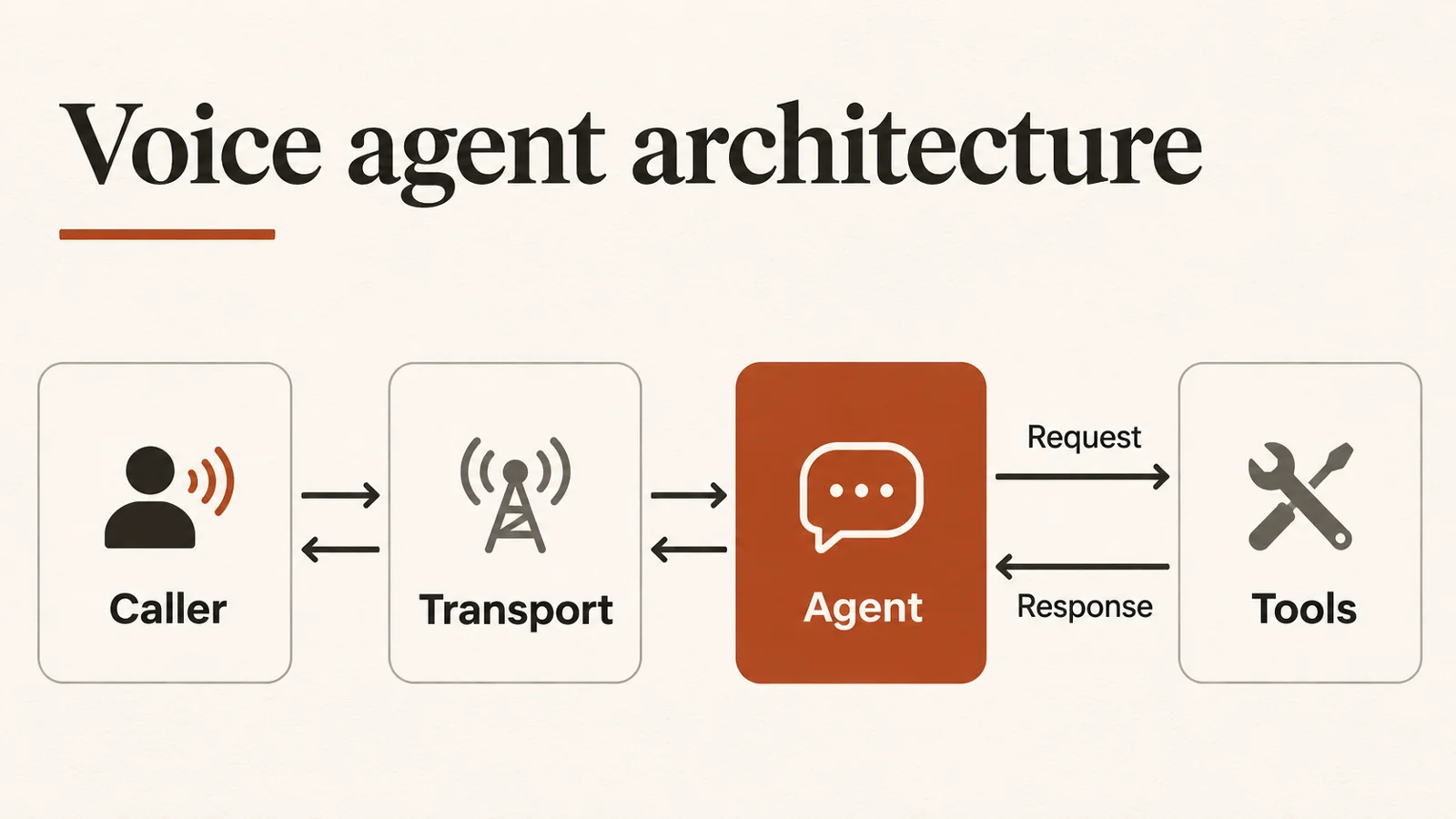
Check the supported 60db phone connection options, because transport deserves its own line in the inventory. Pipecat documents different transport choices, and WebRTC or WebSocket connections can have different implications for the client, media path and operational setup. Source: Pipecat transports.
If you already have a stable carrier integration, preserve it where the supported target path allows. Moving the conversation workflow and the carrier simultaneously creates extra variables when audio quality or call completion changes.
Preserve domain logic too. A rules engine deciding which appointment slots are valid should remain in your business backend, even if the current Pipecat tool calls it through a framework-specific function.
The same separation helps rollback. If the authoritative business service remains stable, you can compare two conversational interfaces without maintaining two competing interpretations of account eligibility or booking policy.
Ask what the operator can inspect when the managed path fails. A high-level call status may be enough for routine reporting, but debugging an interrupted backend action requires correlation between the call and the actual operation.
Use 60db's telephony overview to frame connection questions and its API documentation to verify supported integration paths. Treat unspecified controls as questions to resolve rather than silently assuming the framework's capabilities transfer with the prompt.
What happens to tools and business state?
The business service should remain the authority on whether an external action succeeded. A conversation framework can request an operation and report its result, but the authoritative system owns the actual booking, payment or customer record.
This boundary matters during migration because the most serious bugs can produce a successful-sounding conversation. A caller may hear that an appointment moved while the booking service rejected the change or completed it under a different customer record.
Start by classifying every existing tool. Read-only lookups, reversible changes and actions with financial or customer consequences deserve different permissions and recovery rules, even if they all appear as functions to the model.
For each tool, record its allowed inputs and required evidence. Define how the caller is identified, which backend authorization applies, how a duplicate request is recognized and which result permits the agent to claim completion.
Pipecat documents function calling as part of its learning path. Migration requires mapping that existing behavior to the target interface, rather than treating tool names and argument shapes as portable business contracts. Source: Pipecat function calling.
For 60db Agent, the public documentation describes webhook-based tools with signed requests. Verify the documented signature before processing a request, then apply your own business authorization; authenticity does not establish that a requested action is allowed for the current customer.
A duplicate booking illustrates the recovery problem. The service commits the booking, the network loses the response and the agent tries again; without stable operation identity, the second request can create a second record.
Keep duplicate protection in the backend where the write occurs. Return the existing outcome for a recognized retry and retain enough evidence for a reviewer to distinguish "not attempted," "failed" and "completed but response lost."
Treat unknown outcomes explicitly. If the system cannot confirm a write, the agent should say that confirmation is unavailable and route the case for reconciliation instead of guessing based on conversational context.
Retrieval also needs a contract. A 60db memory collection can supply reference material, but your application must decide which documents a caller is allowed to use and how stale policies are removed.
Test a question whose answer is missing from the knowledge base. An agent that correctly explains the limit is safer than one that produces a polished answer unsupported by the approved material.
Finally, connect the conversation record to the business record. A call transcript explains the interaction, while a booking identifier or other durable operation reference explains the effect; operators need both when a customer reports that the promised change did not occur.
How do you compare conversational performance?
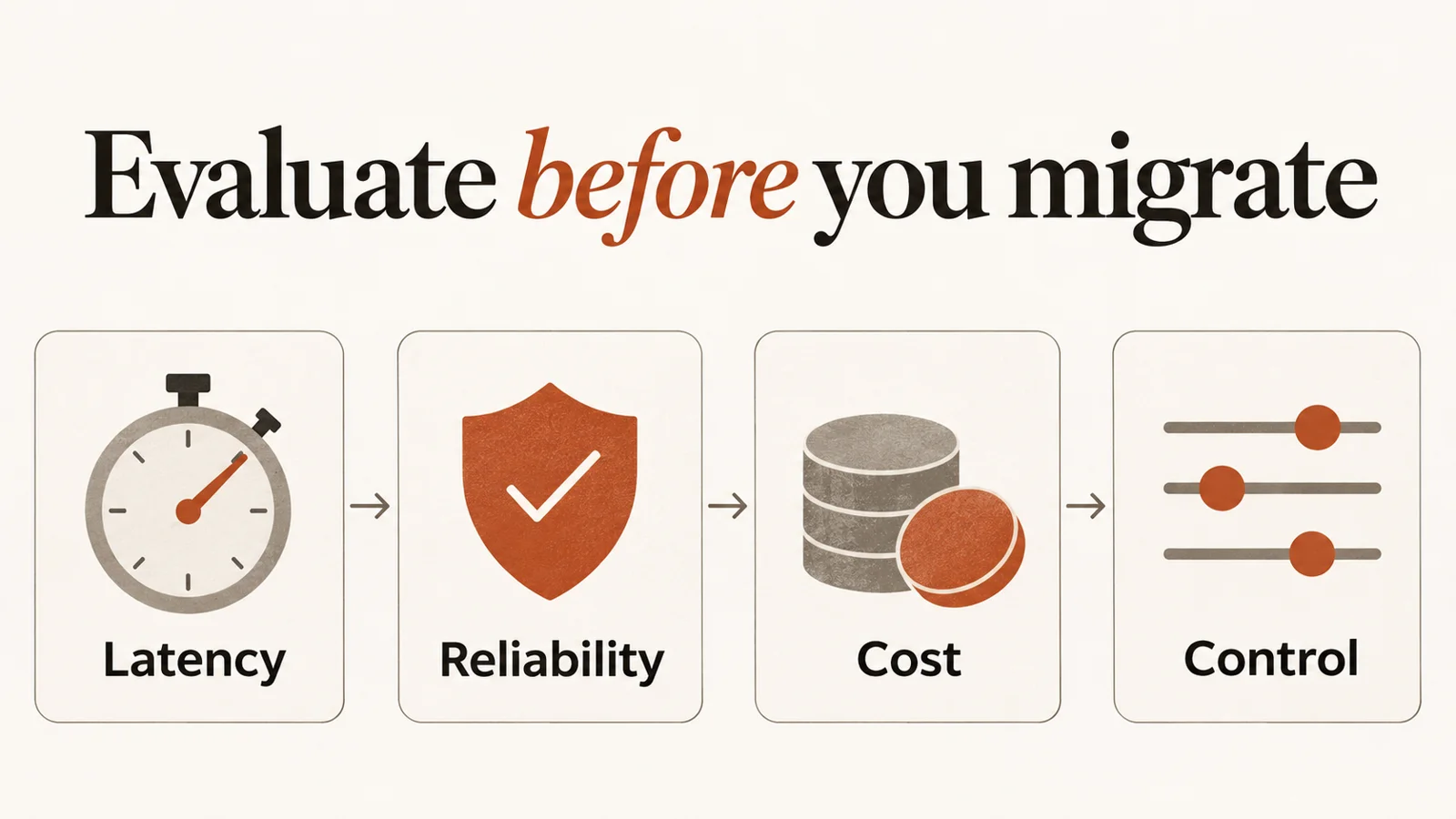
A useful Pipecat alternative test measures the customer's conversation rather than a collection of component speed claims. Start with a consistent definition of the turn boundary and keep the measurement method visible beside the results.
For example, measure from the end of a caller utterance to the first audible agent response on the same recording timeline. Then distinguish an acknowledgment from an answer that really depends on a completed tool operation.
A fast acknowledgment is not the same measurement as a verified task result. An agent can say "one moment" quickly while still taking much longer to retrieve the account or confirm the appointment.
Break the path into turn detection, recognition, retrieval, reasoning, synthesis and media delivery where instrumentation allows. These stages can overlap, so avoid adding unrelated timing numbers from different product pages and calling the result an end-to-end benchmark.
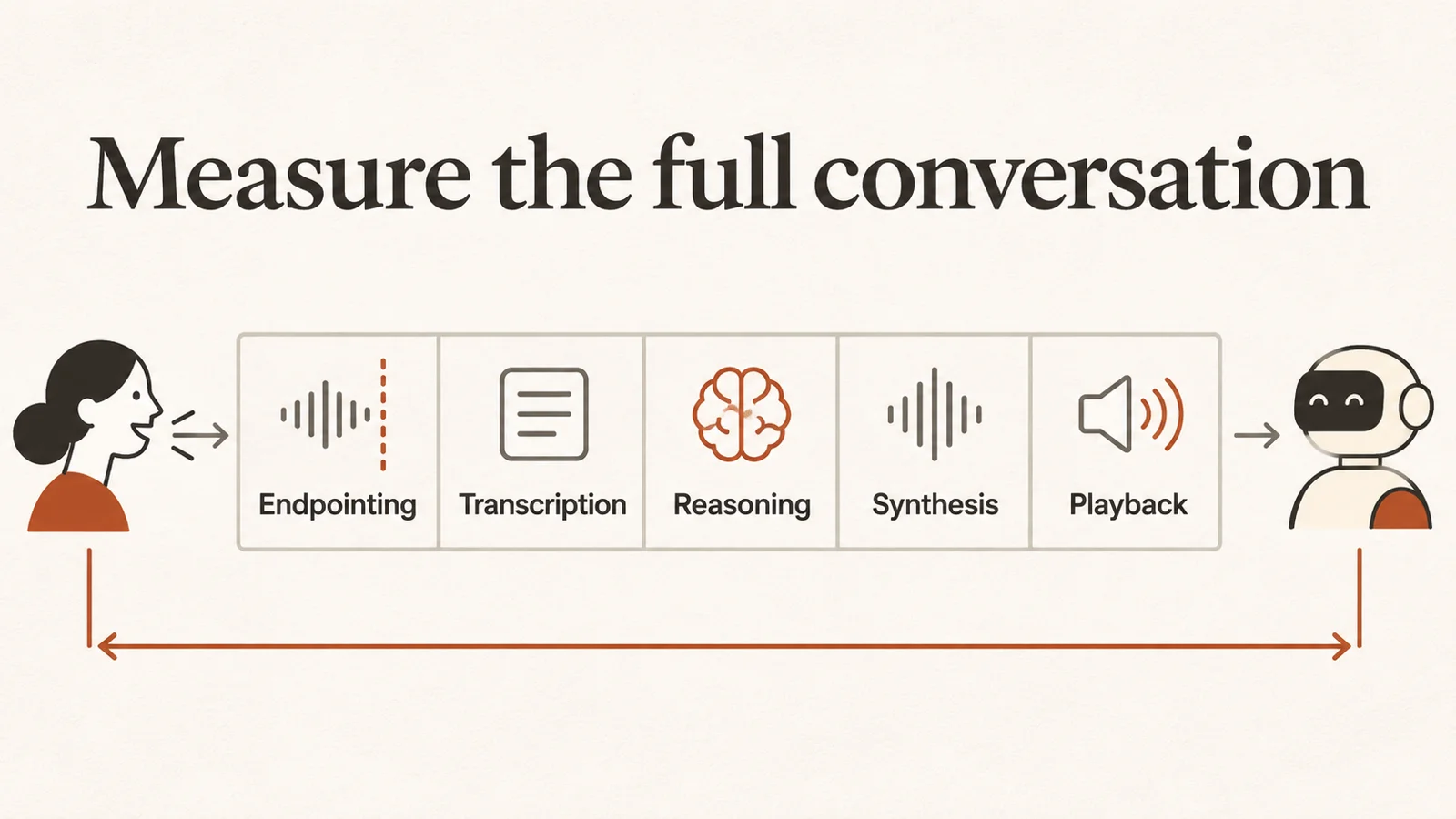
Use a small scenario set with different turn shapes. Include a caller who pauses halfway through an address, someone who corrects a date, a short acknowledgment during agent speech and a request to stop the current action.
Interruptions should affect state as well as sound. If the caller changes Tuesday to Thursday while the agent is speaking, check which date reaches the business service and whether any obsolete reply continues after the correction.
Pipecat's documentation includes interruption and turn-detection material. Evaluate the current features before deciding that a conversational problem is inherent to the framework rather than your processor order, service settings or application logic. Source: Pipecat speech input and turn detection.
Keep language evaluation separate from a generic speed test. Names, numbers and mixed-language phrases can determine task accuracy even when the overall transcript looks reasonable.
For Hindi-English workflows, use natural customer phrases rather than translating an English script mechanically. The 60db realtime speech page and voice library provide starting points for a trial, but the full conversation must prove suitability.
Run both replayable scenarios and live calls. Replay makes inputs repeatable, while real connections expose device microphones, carrier paths and network variation that a stored file will not reproduce.
Report median timing, a high percentile, failed turns and task completion. Preserve the recordings and test definition so someone else can check whether a claimed improvement reflects a changed workload rather than a better system.
Use 60db's benchmark collection only within each report's stated scope. A speech component result does not establish that 60db Agent beats Pipecat on complete calls, and this guide makes no such comparative claim.
How should you compare production costs?
Production cost includes the software you operate, the services the conversation consumes and the work required to resolve failures. A free framework license is one line in that model, not a complete operating budget.
Pipecat's open-source framework, Pipecat Cloud hosting and third-party model or telephony services have different pricing boundaries. Compare the deployment you really intend to run instead of assigning one universal minute price to every Pipecat application.
For a useful worksheet, record connected minutes, generated speech characters, recognized audio, model tokens, memory requests, recordings and phone numbers. Add infrastructure commitments and the engineering time needed to maintain the integration.
A calling workflow also has failed attempts and incomplete tasks. If one route needs repeated calls or manual correction, the cheapest connected minute may not produce the lowest cost per successful customer outcome.
The 60db Agent page advertises approximate AI usage of $0.016 per conversation minute, with $0.003 per line minute on a 60db number. Treat those figures as conditional product estimates and confirm current account terms before using them in a financial commitment.
A transparent planning example can still help. At 5,000 conversation minutes, those stated minute assumptions produce $80 of estimated AI usage and $15 of estimated line usage, before number rental, other services and differences in the actual workload.
That example is arithmetic, not a quote or a cost advantage over Pipecat. It becomes comparable only after the other deployment is priced for the same model behavior, audio path, workload and included services.
The 60db pricing page explains credits and service rates. Read the balance, top-up and plan constraints carefully, because an exhausted usage balance is an operational event when a campaign depends on calls continuing.
Include the caller's speaking ratio in your assumptions. A brief reminder and a detailed support call can consume very different amounts of generated speech and model context during the same connected minute.
Model memory usage as well. Repeated retrieval, document ingestion and long context can affect the final bill, so a design that reduces one provider charge can still increase another.
For self-managed deployments, record idle capacity and on-call ownership explicitly. For managed deployments, record plan minimums, concurrency limits and any support terms; both models have costs outside the happy path.
Finish the comparison with cost per completed task and a failure rate. That view gives product, engineering and finance a common outcome to inspect, while preserving the supporting usage data needed to update the model later.
How do you move a Pipecat workflow safely?
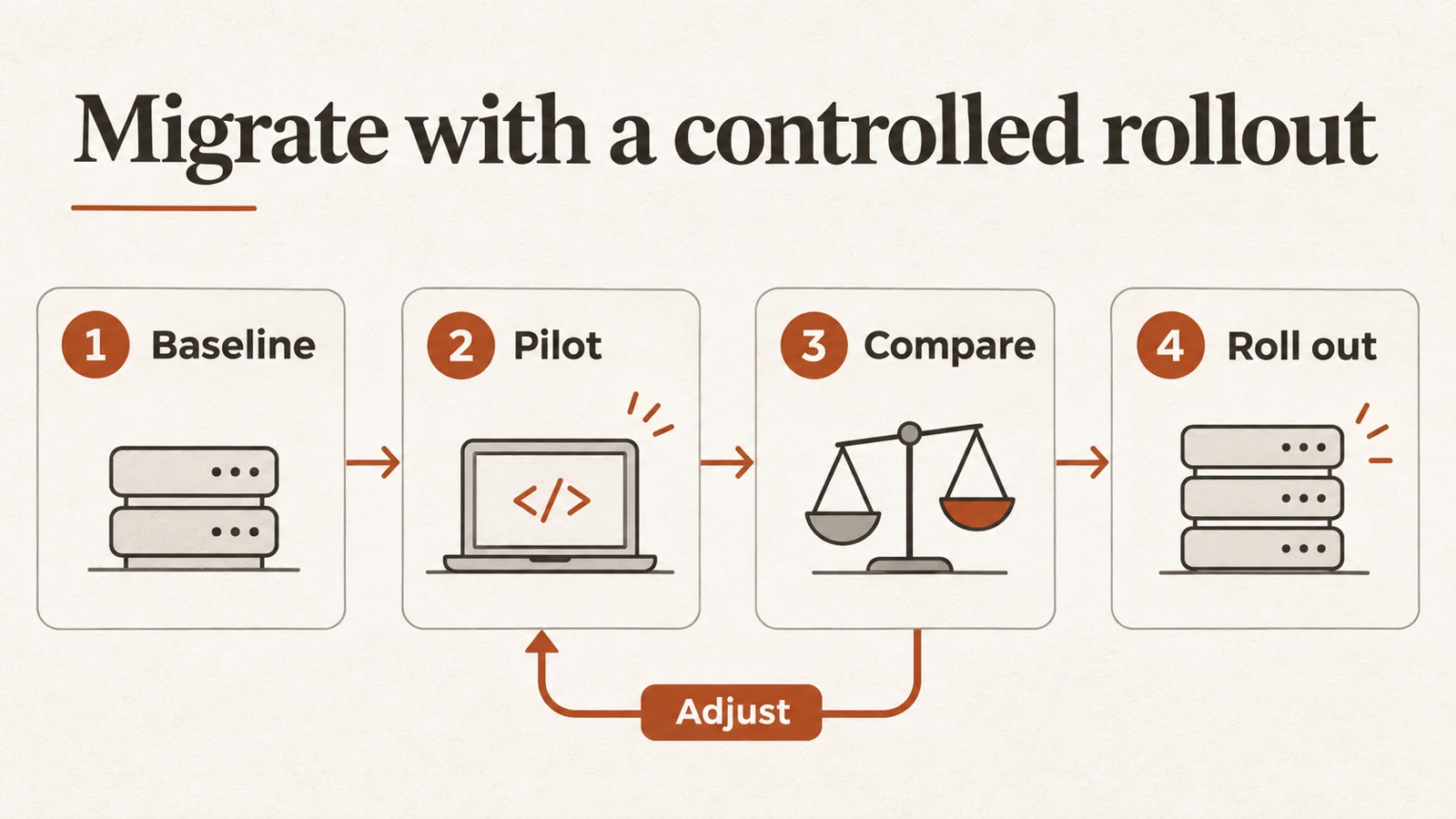
Migration should preserve the customer contract while changing the smallest necessary integration surface. Choose one workflow, prove its behavior, and leave unrelated pipeline capabilities in place until there is a concrete reason to move them.
- Capture the baseline. Retain approved sample calls, task results, failure cases, usage and the current deployment's operating responsibilities.
- Map processors to requirements. For every custom processor, identify the customer-visible behavior it protects and whether the target workflow documents an equivalent control.
- Connect read-only tools first. Confirm request authentication, account lookup, missing data and timeout behavior before enabling writes.
- Validate the final record. Check that call outcomes, transcripts and business references remain understandable to downstream systems and operators.
- Route a controlled pilot. Select an approved traffic segment, define the stop condition and preserve the original path for new calls if the pilot fails.
- Expand from evidence. Review call quality, task accuracy, failures, cost and support effort before increasing traffic.
Do not migrate a processor merely because it exists. Some processors are adapters that disappear when a managed interface supplies the same behavior; others contain critical policy or media logic that requires an explicit replacement.
Keep the business backend stable. Reusing the same booking or lookup endpoint makes it easier to tell whether a difference comes from the conversation platform rather than a simultaneous change in domain behavior.
Translate tools carefully. A function signature in a Python application, a webhook payload and an asynchronous business operation can express the same intent while requiring different validation and error handling.
Preserve data types that matter. Dates need a timezone, money needs an unambiguous unit, and phone numbers need the representation expected by the authoritative backend; spoken phrasing should never silently decide those contracts.
Review event consumers before rollout. A call finishing, a recording becoming available and a business task completing may happen at different times, so an analytics job must not infer all three from the first event it sees.
Test duplicate and delayed delivery. A durable consumer should recognize already processed work and reconcile missing final state through the supported API or operational process, rather than assuming webhook arrival is perfectly ordered.
Test the operator workflow too. Ask someone outside the implementation team to find a failed call, identify the customer-visible outcome and determine whether the backend action needs correction.
Capacity comes after correctness. Exercise the expected burst of starts and simultaneous conversations, then inspect rejection behavior, service limits and what happens when usage or a downstream dependency becomes unavailable.
Keep rollback explicit. Stop routing new calls to the pilot when its stop condition is met, preserve existing records and reconcile actions already committed; moving traffic back does not undo a booking created during the trial.
Before production, verify data handling against your own requirements. Review the privacy policy, retention settings and any required contractual controls with the responsible team, since neither framework flexibility nor a hosted dashboard establishes compliance by itself.
What should decide the final shortlist?
The strongest reason to keep Pipecat is that its pipeline control solves a real requirement. If custom media processing, provider composition or a specialized multimodal client is central to the product, count that value before estimating any migration benefit.
The strongest reason to pilot 60db Agent is a better fit between its managed calling workflow and the service your team wants to operate. That fit needs evidence from your account, your backend and your callers.
A useful decision record contains the original problem, the tested workflow and the observed result. Include unresolved requirements and the rollback route so the next engineer understands both the benefit and the conditions under which it was accepted.
Avoid selecting a platform solely because its first demo has fewer lines of code. The production comparison includes authentication, error handling, support review and downstream records, and those obligations remain even when the conversation setup is short.
Avoid rejecting a framework solely because your current implementation is hard to maintain. A provider setting, deployment change or smaller integration repair may solve the actual problem with less customer risk than a complete migration.
Bring one concrete workflow to the 60db contact team when you need account-specific answers. Require a demonstration of the missing capability and verify it in a pilot before treating the answer as a migration dependency you can rely on.
Frequently asked questions
What is a Pipecat alternative for phone agents?
60db Agent is one option to evaluate when the goal is a managed outbound calling workflow. Compare the required conversation, backend actions, phone connection and review process with your current application.
A similar voice demo is insufficient evidence that the complete product contract will survive a migration.
Is Pipecat only a self-hosted framework?
No. The platform includes Pipecat Cloud and Pipecat Enterprise deployment paths in addition to applications hosted by their owners.
Determine which operating model you use before comparing alternatives. A hosting concern may be addressable within the platform without replacing the framework or changing customer-visible conversation behavior.
Does 60db Agent replace custom Pipecat processors?
An equivalent public processor-extension model was not established by the reviewed sources. Map each processor to the behavior it protects and verify that the target interface can express that requirement.
Remove unnecessary adapters, but retain or explicitly replace logic that controls business policy, audio handling or conversation state.
Can I keep using my preferred speech providers?
Pipecat documents a broad integration catalog, while an equivalent provider matrix for 60db Agent was not established here. If a particular recognition, model or synthesis service is mandatory, confirm support before proceeding.
Do not assume a managed agent exposes every component choice available in a custom pipeline.
Can I self-host 60db Agent?
This guide does not establish a public self-hosting path for 60db Agent. Hosted API access and a self-hostable runtime are different delivery models.
Ask for explicit deployment documentation if infrastructure ownership is mandatory, and compare the answer with the application and hosting options already available in your Pipecat setup.
Is 60db Agent suitable for inbound support calls?
Confirm inbound availability and access for your workspace before relying on it. The public product page still labels inbound as coming soon, so an inbound support queue needs a specific capability check and working test.
Begin with the documented outbound path if that matches the actual use case you need today.
Can I keep my existing phone carrier?
60db Agent describes bringing your own SIP trunk, while Pipecat supports telephony through documented integrations and transports. Verify your particular carrier, number, authentication and media requirements.
A pilot should include the exact destination and route you intend to use rather than a convenient test line on a different carrier.
Does a managed agent remove all infrastructure work?
No. It changes the responsibility boundary, but your team still owns business integrations, credentials, access policy and failure recovery.
You also need to understand account limits and event behavior. Compare the work that really moves to the platform with the work that remains inside your application and operating process.
How do Pipecat tools migrate to webhooks?
Map the intended operation, arguments, authorization and result into the supported webhook contract. Preserve backend validation and duplicate protection even if the request format changes.
A function name alone is not the contract; the important behavior includes failure, timeout, retry and the evidence required to report success to the caller.
Are signed tool requests enough to authorize a booking?
No. A valid signature can establish the request's source and integrity under the documented mechanism, but your backend must still determine whether the action is permitted.
Verify customer identity, allowed operation and current business state before writing data, then return a result that accurately reflects the authoritative system.
How should I handle a timed-out backend action?
Treat the outcome as uncertain until the authoritative service confirms it. Retry only under a contract that recognizes the same intended operation, and reconcile a committed result whose response was lost.
The agent should explain the uncertainty rather than claiming success or failure based only on the network timeout.
Can an agent use my existing knowledge base?
60db Agent describes attaching its memory service, while Pipecat applications can integrate retrieval through their own pipeline and tools. Evaluate document ingestion, permissions and missing-answer behavior with your actual material.
A successful search is only one step; the spoken answer must remain consistent with the approved source and customer access.
What should I measure when comparing latency?
Use one clearly defined boundary, such as caller end-of-speech to first audible response, and keep that definition unchanged across both systems. Separate acknowledgments from verified answers and record failed turns.
Median timing alone hides the slow or unsuccessful conversations that operators will have to resolve later.
Is 60db Agent faster than Pipecat?
This guide provides no controlled evidence for that claim. Pipecat performance depends on the application, providers, transport, deployment and workload, while the managed path also needs a defined test.
Compare representative calls under matched conditions and inspect outcomes before treating a component timing claim as a platform advantage.
How do I test interruptions fairly?
Use the same conversational intentions, including acknowledgments, corrections and requests to stop. Inspect whether output stops appropriately and whether the corrected information reaches the backend.
A fair test checks conversation state and task outcome as well as the audible pause, because a quiet agent can still act on an obsolete request.
Should I migrate video and voice together?
Only when the accepted requirements make that necessary. A phone-agent pilot is easier to assess when custom video behavior and client integration remain stable.
If multimodal features are central to the product, verify them explicitly rather than assuming a phone-focused managed workflow replaces the broader Pipecat application.
How should I compare per-minute pricing?
Use the same workload and list every included service. Account for model usage, speech, transport, numbers, recordings, hosting and operating work, then calculate cost per completed task.
An approximate product minute figure and a framework-only infrastructure subtotal are different boundaries and should never be presented as a direct saving.
What happens if usage credits run out?
Read the current plan and top-up rules for the account you intend to use. The 60db pricing page describes balance behavior and plan constraints, which should become part of your operating runbook.
Test how usage exhaustion or an unavailable dependency appears to both the call initiator and the support team.
What should a migration rollback preserve?
Preserve the original traffic route, call evidence and authoritative business records. Moving new calls back does not undo actions that completed during the pilot, so reconcile those separately.
Document who can stop the rollout and how operators identify customer tasks whose final state remains uncertain.
When should I keep Pipecat?
Keep it when its composability, provider integrations or deployment choices meet requirements the alternative has not proved. Also consider repairing the current integration when the problem is local and well understood.
Migration should deliver a demonstrated operational benefit that justifies the transition and the behavior you may need to rebuild.
Conclusion and next step
A Pipecat alternative should change the ownership that is causing real work for your team while preserving the customer behavior that already works. Start with the workflow and its authoritative outcomes, then decide whether framework composition or a managed calling workflow is the better fit.
- Retain Pipecat where custom processors and provider composition are product requirements.
- Evaluate 60db Agent on a bounded outbound workflow with confirmed workspace access.
- Preserve backend authorization, duplicate protection and clear handling of uncertain results.
- Compare full call outcomes, audible timing, operational review and complete usage cost.
Review 60db Agent, read the agent documentation, and run one representative call before expanding the integration. The right migration result is a workflow your customers can use and your operators can explain when something goes wrong.
About this article: The 60db editorial team prepared this vendor-authored guide using the linked public documentation. The proposed scenarios are evaluation methods, not reported customer tests, and account availability and commercial terms require confirmation before production use.