
- Engineering
Backchannels without stealing the floor
Build a backchannel policy with labeled overlap fixtures, explicit floor ownership, and tests for missed caller corrections.
- Author
 Udit Goenka
- Editorial date
- Reading time
- 25 min

TL;DR: Backchannels such as "mm-hmm" often mean the caller is listening, while an equally short "wait" can mean the caller needs the floor. Classify overlap using conversational context, preserve uncertain speech, and evaluate false interruptions separately from missed corrections before connecting the policy to playback cancellation.
An agent explains a delivery option. The caller says "right," and the agent stops halfway through its explanation, apologizes, and starts again. The caller was acknowledging the explanation; the software treated acknowledgment as a new conversational turn.
The inverse failure is more serious. The caller says "no" during an incorrect read-back, and the agent continues because a duration filter rejected the word as too short. Both failures can come from the same attempt to reduce interruptions.
Your useful boundary is floor ownership: which participant currently has permission to advance the conversation. A speech detector observes sound; a floor policy decides whether that sound should stop output, add evidence, or open a new user turn.
This guide provides a provider-independent policy, a runnable Python fixture suite, and an evaluation contract. The examples are synthetic, the figures are conceptual, and no accuracy, latency improvement, or behavior of 60db Agent is claimed from them. Public documentation was reviewed on November 9, 2026.
Table of contents
- Define the decision boundary
- Separate listener cues from answers
- Preserve evidence during uncertainty
- Implement a conservative policy
- Build labeled overlap fixtures
- Evaluate both kinds of mistake
- Connect decisions to playback
- Operate across languages and devices
- Frequently asked questions
- Ship one defensible boundary
Define the decision boundary
A backchannel is a listener contribution that supports the current speaker without claiming a full turn. Its function depends on its placement: "okay" during an explanation can acknowledge understanding, while "okay" after a direct question can supply the requested answer.
Do not define the class as a dictionary of short expressions. You need the preceding agent action, whether question playback completed at the observed endpoint, the timing of the overlap, and the surrounding user speech. Each input can be incomplete when the decision is first requested.
Begin by writing the consequences of a classification. A listener cue lets the current explanation continue; an intentional interruption transfers the floor to the caller and invalidates the current response; an ambiguous event preserves the speech and holds consequential interpretation until more evidence arrives.
That last state matters. If your API only exposes "interrupt" and "ignore," engineers often make uncertainty disappear by choosing one of them. The resulting dashboards look decisive while the conversation silently loses evidence.
The LiveKit adaptive interruption documentation explicitly distinguishes intentional interruptions from listener cues and documents mistakes near turn boundaries. That establishes a useful public example of the problem, rather than a measured guarantee for any deployment or a reason to copy its configuration into a different runtime.
Separate the policy's input boundary from its output boundary. The input can be an audio segment, an ASR revision, an acoustic event, or a model classification; the output should be a small application decision with a reason, response identity, and evidence identity.
For example, continue means only that the current output may continue. It does not mean that the caller agreed to a booking, accepted a price, or authorized a tool operation. Those decisions belong in the workflow authorization boundary.
State this invariant in the implementation: a backchannel decision cannot write a business field or confirm an action. Once that is true, you can tune conversational smoothness without accidentally widening authorization.
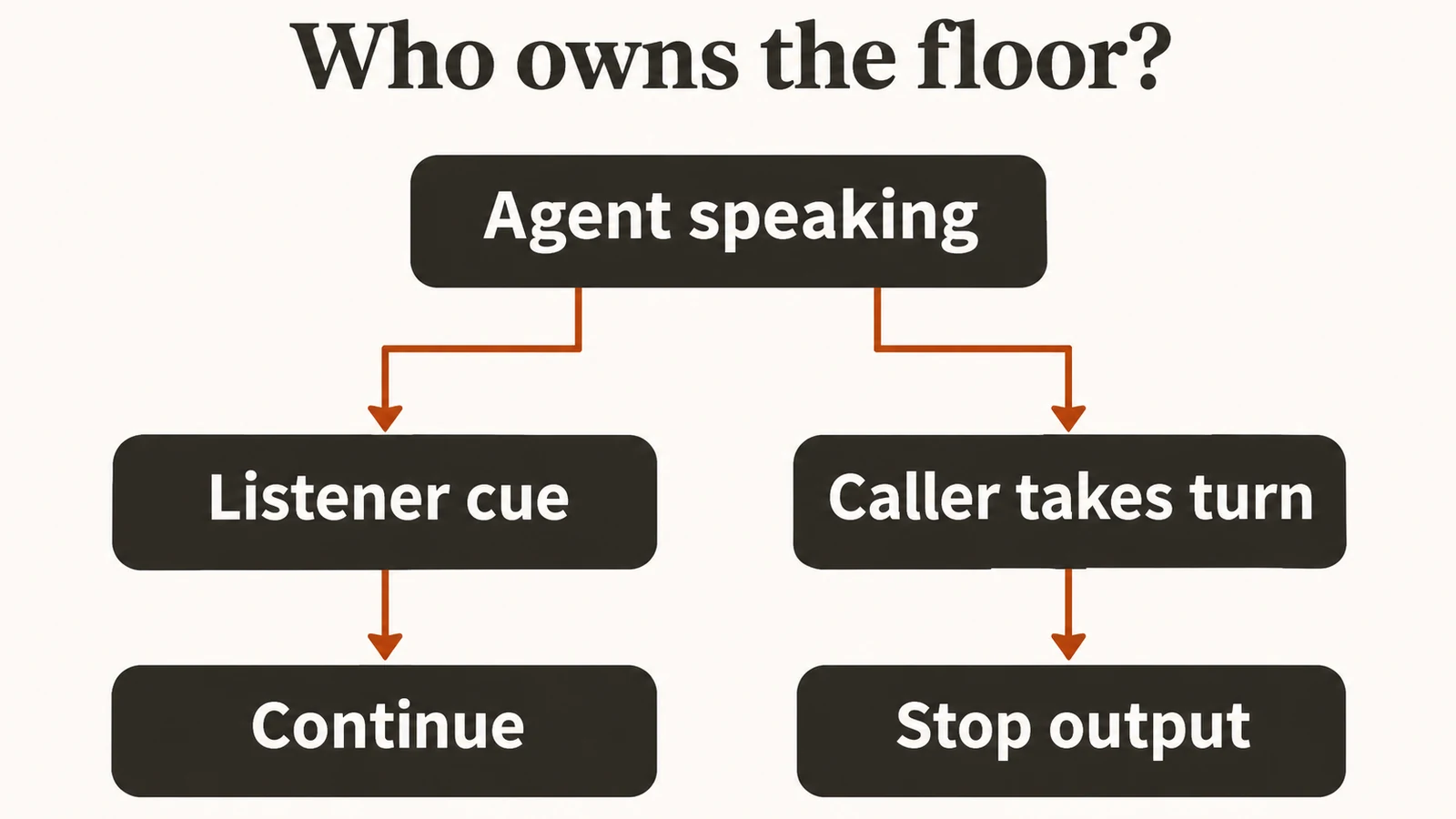
The left path preserves agent speech when the evidence supports a listener cue. The right path stops output when the caller claims the turn. Uncertain events stay available for review and later interpretation rather than being deleted by either path.
Assign one owner to the policy
Choose a single component that owns floor transfer. Provider VAD, a media SDK, the application, and a realtime model may each include interruption behavior; allowing all of them to cancel independently creates several competing policies.
The OpenAI client-event reference exposes separate controls for automatic response creation and interruption while preserving speech events. When using any comparable interface, inspect whether its events remain observable after automatic actions are disabled, and test that behavior with your chosen transport.
A controller may delegate classification to a model, yet it should still own the application consequence. Model output becomes evidence tied to the audio segment, and deterministic state checks decide whether that evidence is still current.
Keep the decision local to a response generation. A delayed classifier answer about an acknowledgment during an old explanation must never resume that explanation after the caller has changed the task.
Separate listener cues from answers
The same words need different labels in different conversational positions. Annotation must capture that difference before you choose thresholds or train a classifier.
Consider the synthetic exchange "There are two delivery options..." followed by "yes." If the caller overlaps the explanation and does not add content, listener-cue is plausible. Now consider "Should I use the saved address?" followed by "yes" after the question is heard: the word is an answer to a pending question.
The audio alone can still be ambiguous. Rising intonation, stressed negation, speaker identity, and a following clause can change the interpretation, so your fixtures need the surrounding exchange and an explicit ambiguous label where reviewers cannot agree.
Use a decision table to make the policy reviewable. Here ✓ means the described action is allowed by this example contract; ✗ means that action is prohibited. These are proposed application rules, not comparative vendor capabilities.
| Observed situation | Continue explanation | Transfer floor | Confirm business action | Required evidence |
|---|---|---|---|---|
| Clear listener cue during explanation | ✓ | ✗ | ✗ | Context and overlap support cue label |
| "Wait" or a spoken correction | ✗ | ✓ | ✗ | Caller intention to stop or revise |
| Answer after a completed question | ✗ | ✓ | ✗ | Pending question identity and observed playback boundary |
| Unclear short vocalization | Conditional | Conditional | ✗ | Retain audio and seek more context |
| Background speaker without caller attribution | Conditional | ✗ by default | ✗ | Attribution or clarification |
| Acknowledgment plus new information | ✗ | ✓ | ✗ | Full utterance, including continuation |
The table deliberately keeps confirmation separate even for a clear "yes." A business controller still needs a valid proposal, complete input, an authorized caller, and any required read-back before it can accept that answer.
That distinction prevents a common architectural shortcut: passing all recognized acknowledgment words into a global affirmative intent. The Amazon Lex confirmation slot documentation includes acknowledgment-like phrases among its normalized values, which makes scoping that interpretation to the pending question especially important.
Give short corrections priority
A caller does not need a long sentence to stop a mistake. "No," "wait," and "stop" can be complete interventions, so a minimum word count creates an avoidable blind spot unless another path catches them.
The LiveKit turn-taking tuning reference lists duration and word-count controls alongside other interruption options. These are controls with trade-offs; their presence does not establish safe values for your caller population.
Use safety-sensitive negative fixtures when considering such a filter. A rule that reduces accidental pauses while suppressing a correction during a read-back has changed the task risk, even if its aggregate interruption count looks better.
There is also a cost to overreacting. If the agent stops whenever a caller breathes or murmurs, the call becomes a sequence of abandoned sentences; the user may start repeating themselves because they cannot tell whether the system is still listening.
A useful policy distinguishes the semantic importance of the intervention from the acoustic confidence that speech occurred. Those signals answer different questions, and multiplying them into one unnamed score makes failures harder to diagnose.
Model mixed contributions explicitly
"Mm-hmm, and can you send that by email?" begins as a listener cue and ends as a new request. Classifying the first syllable as a backchannel must not permanently suppress the rest of the segment.
Treat a cue label as revisable until the relevant utterance boundary closes. Preserve incoming speech after the initial classification, and allow continuation evidence to upgrade the event to a floor claim.
The same rule applies when the caller starts with "right" and then corrects an address. An initial acknowledgment is not a commitment to ignore all later words in that audio turn.
See qualified confirmations and repairs for the downstream decision. The overlap policy decides who gets to speak; the repair controller decides which proposal remains valid.
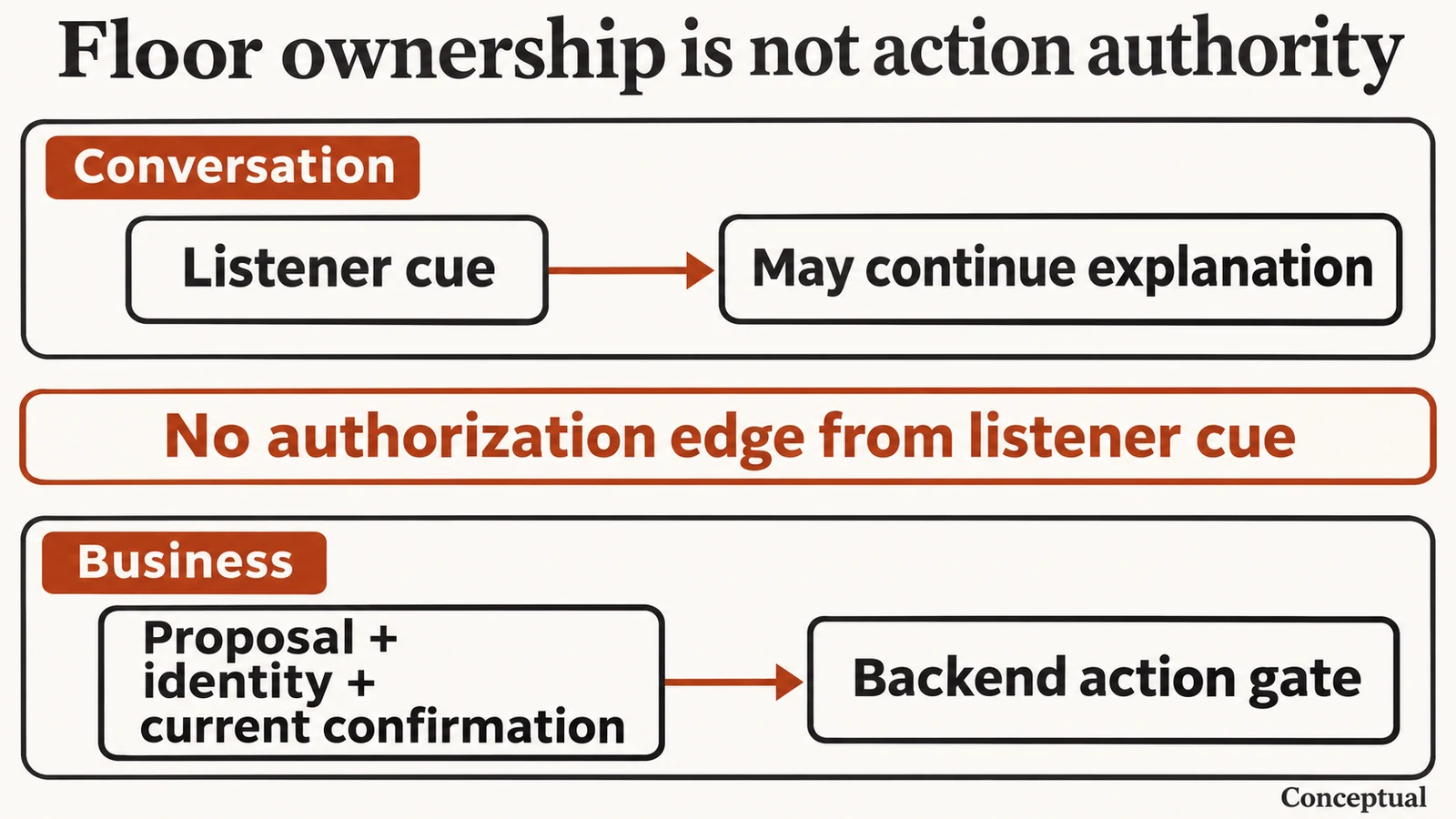
Conceptual: A listener cue can affect conversational flow without confirming any business action.
Preserve evidence during uncertainty
An uncertain overlap event should leave enough evidence to explain the decision without retaining unnecessary sensitive content. Store application identities, timestamps with clock domains, classifier version, floor state, and the action chosen.
Avoid putting full transcripts into ordinary metrics labels. That creates high-cardinality telemetry and can expose caller content to systems that were intended to store operational counters. Use a governed replay store for consented evidence when audio review is needed.
A compact event might record segment_id, response_epoch, agent_phase, question_id, decision, and reason. agent_phase describes whether output was explaining, asking, or completing a question; it should come from the dialogue controller rather than being reconstructed from a convenient local timestamp.
The question boundary needs playback evidence. A generated question can still be queued or partly heard when the caller begins speaking. Playback acknowledgments explain why generated, sent, and played are separate states.
An ASR final result is another limited fact. Google's streaming result reference defines finality for a particular recognition result; it does not establish that the caller has completed the conversation or answered the pending question.
For a speech-to-speech system, the transcript can also be a parallel observation rather than the exact representation used by the model. OpenAI's server-event reference documents asynchronous transcription and warns that it can diverge from the model's interpretation.
Keep these limitations visible in the event schema. An asr_final flag, a turn_closed flag, and a question_playback_confirmed flag should not be aliases for one another.
The example's question_playback_confirmed flag means an adapter observed completion at its explicitly named playback endpoint. It does not prove acoustic audibility, attention, comprehension, or informed consent. Missing or uncertain playback evidence leaves the flag false, and business authorization remains a separate decision tied to the current proposal.
Define a bounded provisional action
When uncertainty occurs during low-risk explanation, continuing briefly while collecting more context can be acceptable. During a sensitive read-back, a pause may be safer because talking over a correction can make the wrong information appear confirmed.
Choose that behavior by task phase and document it. Do not hide the policy inside a universal backchannel confidence threshold that has no relationship to the cost of a missed correction.
A provisional pause must be reversible without duplicating speech. Preserve the response identity and the last reliable playback position so that the controller can resume, summarize, or restart deliberately.
The post-interruption resumption guide covers that choice. Resuming is a new authorization to send still-relevant audio, not a default consequence of a classifier eventually deciding that an earlier pause was unnecessary.
Use a maximum evidence wait as an operational bound, then route unresolved events to clarification. The bound limits resource use and prevents indefinite indecision; it does not turn the unresolved event into a proven backchannel.
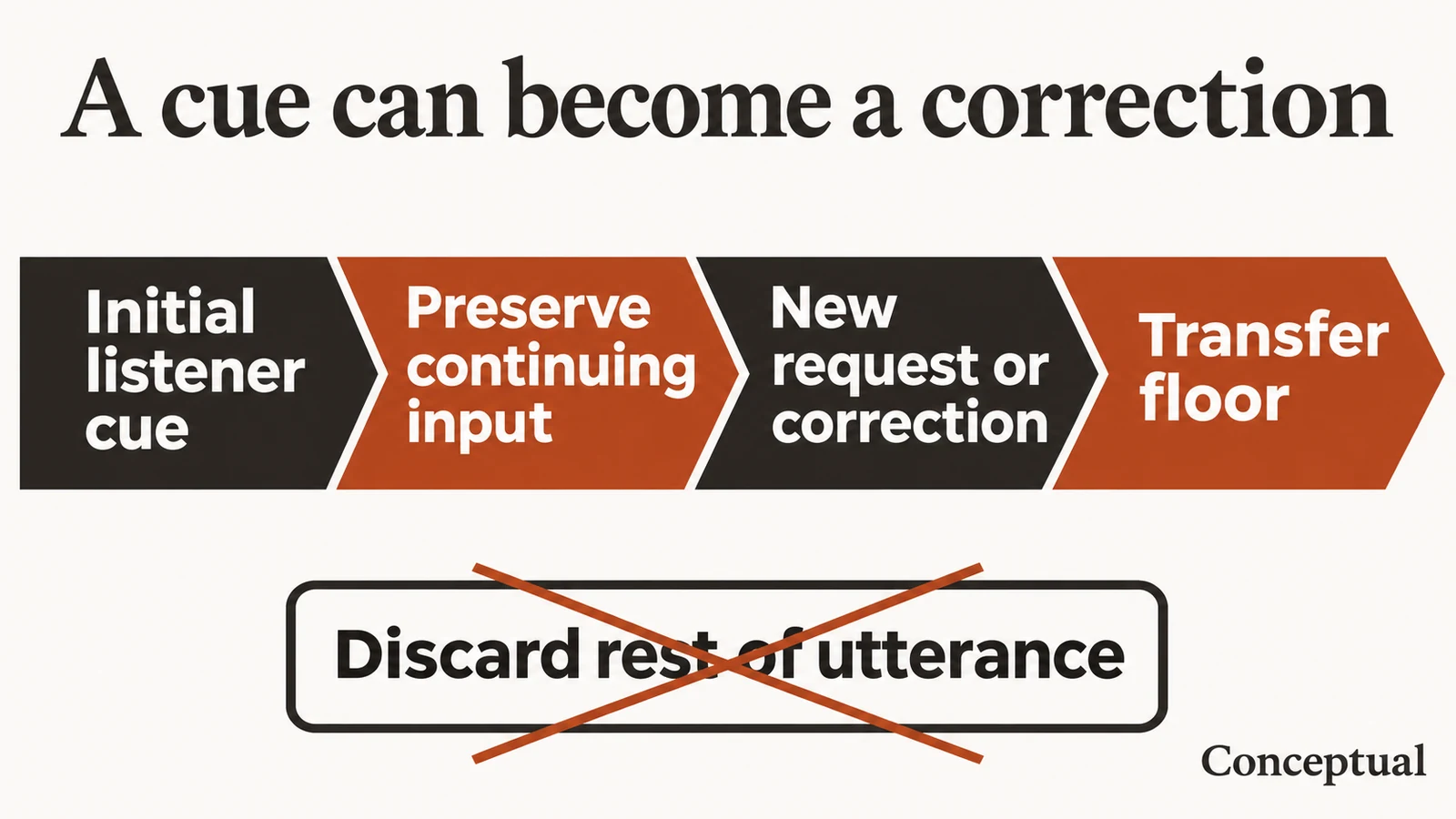
Conceptual: Preserve the continuation of a provisional listener cue so a later correction can claim the floor.
Implement a conservative policy
The following Python program is a runnable policy exercise, not an acoustic detector. It consumes explicit, already-labeled evidence so you can test the floor consequences without pretending that string matching solves conversational classification.
Save it as backchannel_policy.py and run python3 backchannel_policy.py. All fixtures are synthetic. In production, replace the labeled input adapter with your chosen acoustic and semantic evidence source, while preserving the state and identity checks.
from dataclasses import dataclass
from enum import Enum

class Decision(str, Enum):
    CONTINUE = "continue"
    TAKE_TURN = "take_turn"
    HOLD = "hold"
    STALE = "stale"

@dataclass(frozen=True)
class Evidence:
    segment_id: str
    response_epoch: int
    label: str
    phase: str
    question_playback_confirmed: bool = False
    continuation: bool = False

@dataclass
class Floor:
    response_epoch: int
    speaking: bool
    seen: dict

    def apply(self, e: Evidence) -> Decision:
        if e.response_epoch != self.response_epoch:
            return Decision.STALE
        if not self.speaking:
            return Decision.HOLD
        key = (e.segment_id, e.label, e.continuation, e.question_playback_confirmed, e.phase)
        if key in self.seen:
            return self.seen[key]
        if e.label in {"correction", "stop", "request"} or e.continuation:
            result = Decision.TAKE_TURN
        elif e.label == "answer" and e.question_playback_confirmed:
            result = Decision.TAKE_TURN
        elif e.label == "listener_cue" and e.phase == "explaining":
            result = Decision.CONTINUE
        else:
            result = Decision.HOLD
        if result == Decision.TAKE_TURN:
            self.speaking = False
        self.seen[key] = result
        return result

if __name__ == "__main__":
    f = Floor(7, True, {})
    cue = Evidence("s1", 7, "listener_cue", "explaining")
    assert f.apply(cue) == Decision.CONTINUE
    assert f.speaking
    assert f.apply(cue) == Decision.CONTINUE
    repair = Evidence("s1", 7, "request", "explaining", continuation=True)
    assert f.apply(repair) == Decision.TAKE_TURN
    assert not f.speaking
    assert f.apply(repair) == Decision.HOLD
    assert f.apply(cue) == Decision.HOLD
    assert f.apply(Evidence("other", 7, "listener_cue", "explaining")) == Decision.HOLD
    g = Floor(8, True, {})
    assert g.apply(repair) == Decision.STALE
    assert g.speaking
    assert g.apply(Evidence("s2", 8, "answer", "asking")) == Decision.HOLD
    assert g.apply(Evidence("s2", 8, "answer", "asking", True)) == Decision.TAKE_TURN
    h = Floor(9, True, {})
    assert h.apply(Evidence("s3", 9, "stop", "explaining")) == Decision.TAKE_TURN
    assert h.apply(Evidence("s4", 9, "unknown", "asking")) == Decision.HOLD
    print("Synthetic floor-policy checks passed")
Notice what the program leaves outside the decision. It does not normalize words, infer speaker identity, estimate duration, or decide whether a caller is authorized. Those jobs need evidence and tests of their own.
The duplicate key includes the evidence state because a segment may acquire new meaning as speech continues. While the agent still owns the floor, identical evidence returns its cached decision without repeating side effects; updated evidence can produce a different decision.
After floor transfer, the terminal guard takes precedence over the cache. Every same-epoch retry returns nonplayable HOLD, including the event that originally returned TAKE_TURN and any earlier cue that returned CONTINUE. This state-aware contract prevents cached permission from reviving canceled output.
The epoch check blocks a late event from affecting a replacement response. This is a generic application pattern; it makes no claim about how any product internally represents generation or cancellation.
The program uses an in-memory dictionary to keep the example short. Bound or discard that dictionary at response closure in a service, and use a durable event identity only if your transport or recovery contract requires replay across processes.
Extend the adapter rather than the policy
A provider adapter should translate its concrete event types into this small evidence shape. Keep provider-specific confidence scales, timestamp formats, and partial-result semantics in that adapter so that changing a recognizer does not silently redefine floor ownership.
Do not convert a missing classifier answer into listener_cue. Missing evidence is unknown, and the policy must handle it visibly. The distinction allows a timeout test to prove that a service outage does not become permission to talk over callers.
If your model emits a probability, validate its type and range and attach its model version. A probability-shaped number still needs calibration against labeled overlap; it is not a substitute for the negative fixtures below.
The partial-transcript gate addresses the related adapter problem. A revised transcript should update evidence, while a deterministic controller preserves the business boundary.
Build labeled overlap fixtures
A useful fixture contains the agent's preceding output, the caller segment, the overlap position, a reference label, and the expected floor consequence. Keep acoustic observations separate from the expected policy action so that annotators can disagree about one without changing the other.
Start with a small hand-reviewed corpus that covers ordinary cases and expensive mistakes. Every entry should answer a specific question: can the policy preserve acknowledgment, catch correction, retain a mixed contribution, or survive delayed evidence?
| Synthetic fixture | Prior agent act | Caller contribution | Reference label | Expected consequence |
|---|---|---|---|---|
| Listener during explanation | Describes delivery choices | "Mm-hmm" | Listener cue | Continue explanation |
| Correction during read-back | Reads wrong day | "No" | Correction | Stop and open repair |
| Answer at question end | Asks for permission | "Yes" | Answer | Transfer to answer handling |
| Mixed overlap | Explains next step | "Right, can I change it?" | Request | Transfer floor |
| Incomplete acoustic evidence | Explains policy | Unclear vocalization | Ambiguous | Retain and apply phase policy |
| Competing speaker | Reads an option | Nearby conversation | Attribution uncertain | Avoid business interpretation |
| Late classification | Old explanation ended | Earlier cue result arrives | Stale | Leave current response unchanged |
The reference label should be established from the permitted evidence, including the surrounding exchange. A reviewer who sees the entire call may know facts the online classifier did not have; distinguish retrospective truth from the information available at the decision instant.
That distinction supports causal debugging. If the policy acted before a key word arrived, the failure may be an evidence-wait decision rather than a classifier misunderstanding. If the word was available and ignored, the adapter or policy becomes the likely owner.
Record disagreements instead of forcing consensus on every item. Keep an adjudicated set for regression gates and an ambiguity set for reviewing how the application handles uncertainty.
For reusable fixture organization, follow the voice regression testing guide. Hold out recordings by speaker or session where possible so that a familiar voice does not make your evaluation look easier than real deployment.
Include timing and transport variants
Replay each semantic case with different evidence ordering. The audio may precede its transcript, a partial transcript may arrive before the question's playback acknowledgment, and a classifier result can return after cancellation.
Keep time measurements within their clock domains. A browser playback timestamp and a server receive timestamp cannot be subtracted without an explicit synchronization or correlation method.
The voice latency measurement guide gives the larger timing context. For this policy, the first useful measurement is the time between sufficient interruption evidence becoming available and the application requesting output stop on the same observed clock.
Add a separate media measurement for when output becomes quiet at the caller. The difference captures queues, transport, and playback behavior that a fast policy callback cannot remove.
Test partial failures as fixtures. A disconnected classifier, absent transcript, missing playback marker, or duplicate event should produce an expected state and a reason. Otherwise your corpus tests only the path where every service answers promptly.
Evaluate both kinds of mistake
Measure false interruption and missed floor claim separately. A single accuracy score can reward a classifier that labels every event as the majority class while repeatedly ignoring the corrections that matter.
Define the denominator for each metric. False-interruption rate uses reference listener-cue opportunities; missed-floor-claim rate uses reference caller interventions; ambiguous cases should have their own handling outcome rather than being hidden in whichever class is convenient.
Do not present these rates without counts. A change on a small correction set can look large as a percentage, and a release decision needs to know whether it reflects one disputed event or a repeatable behavior across several callers.
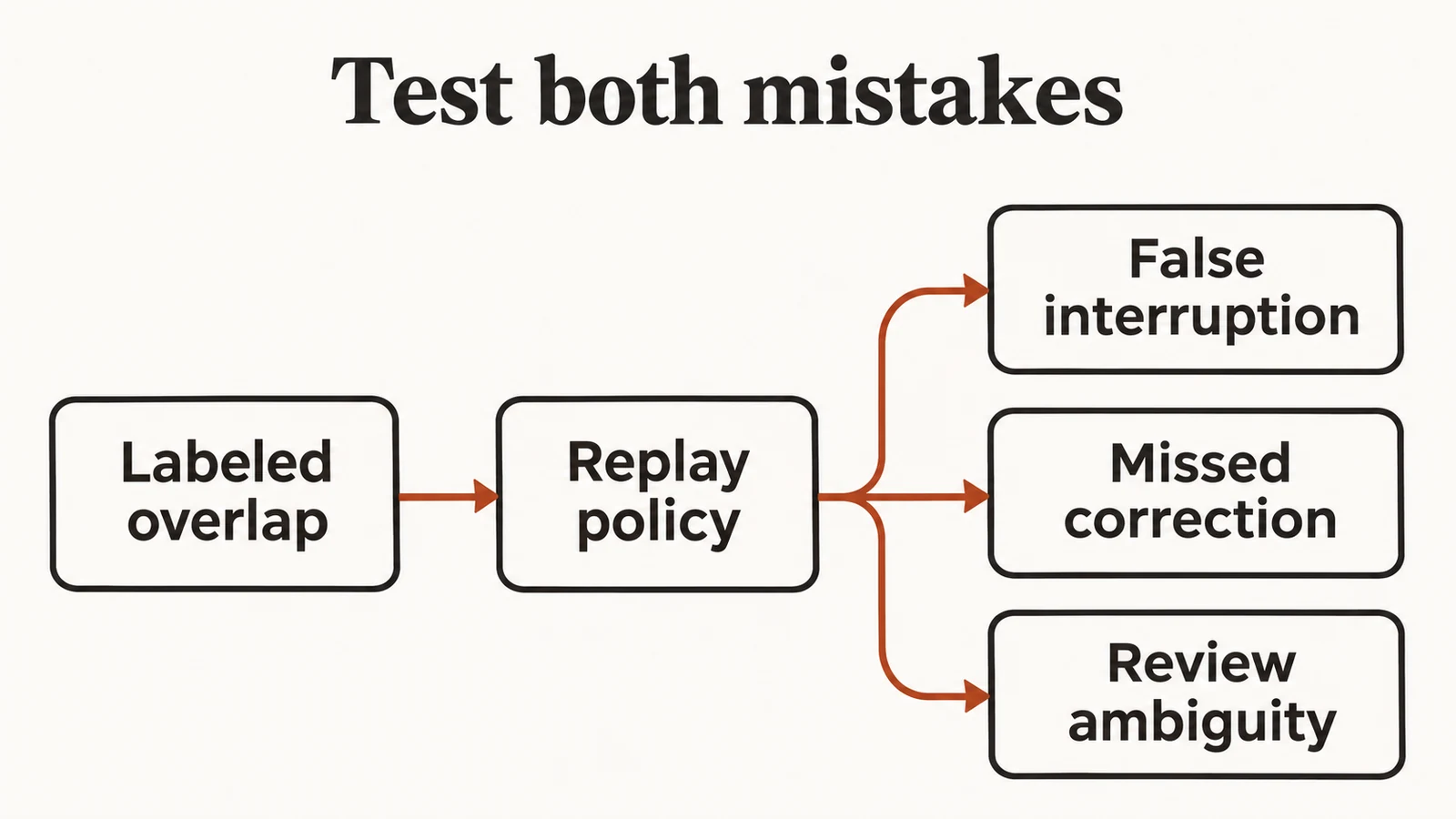
The figure describes an evaluation plan. It contains no measured rates and does not claim a benchmark result. Labeled overlap feeds the policy replay, after which each error family and unresolved case receives separate review.
Use paired replay to compare policy versions on the same fixtures. Freeze the audio, labels, provider version where feasible, task phase, and event schedule; change only the parameter or policy under investigation.
A fixed transcript replay tests application logic. Audio replay tests the recognizer and classifier as well. A live device session adds capture, echo cancellation, network, and playback effects, so report those experiments separately.
A deployment should have explicit acceptance criteria. For example, require all mandatory correction fixtures to transfer the floor, require stale events to leave current output untouched, and require every ambiguous event to remain inspectable. Choose numerical error budgets from your own risk and observed population rather than borrowing an unsupported universal threshold.
The outcome metrics guide helps connect these component checks to task results. A conversation can sound smoother while losing a corrected field, so preserve both interaction and task evidence.
Review a failure as a sequence
When a fixture fails, inspect the ordered evidence rather than the final transcript alone. Ask when caller speech began, what portion of the agent was heard, which classification was available, what state changed, and which audio remained queued.
A final transcript that reads "right, change the day" cannot prove that the first online decision had access to "change the day." Your trace must show the revision and its arrival boundary.
Keep the test verdict tied to the expected consequence. If a classifier produces the wrong label but the conservative controller still stops safely, record the classifier error and the policy outcome separately. The distinction tells you which layer needs repair.
Do the same for missed acknowledgments. A controller that always pauses may pass correction safety checks while failing the conversational objective; that trade-off belongs in the release discussion, not in a renamed metric.
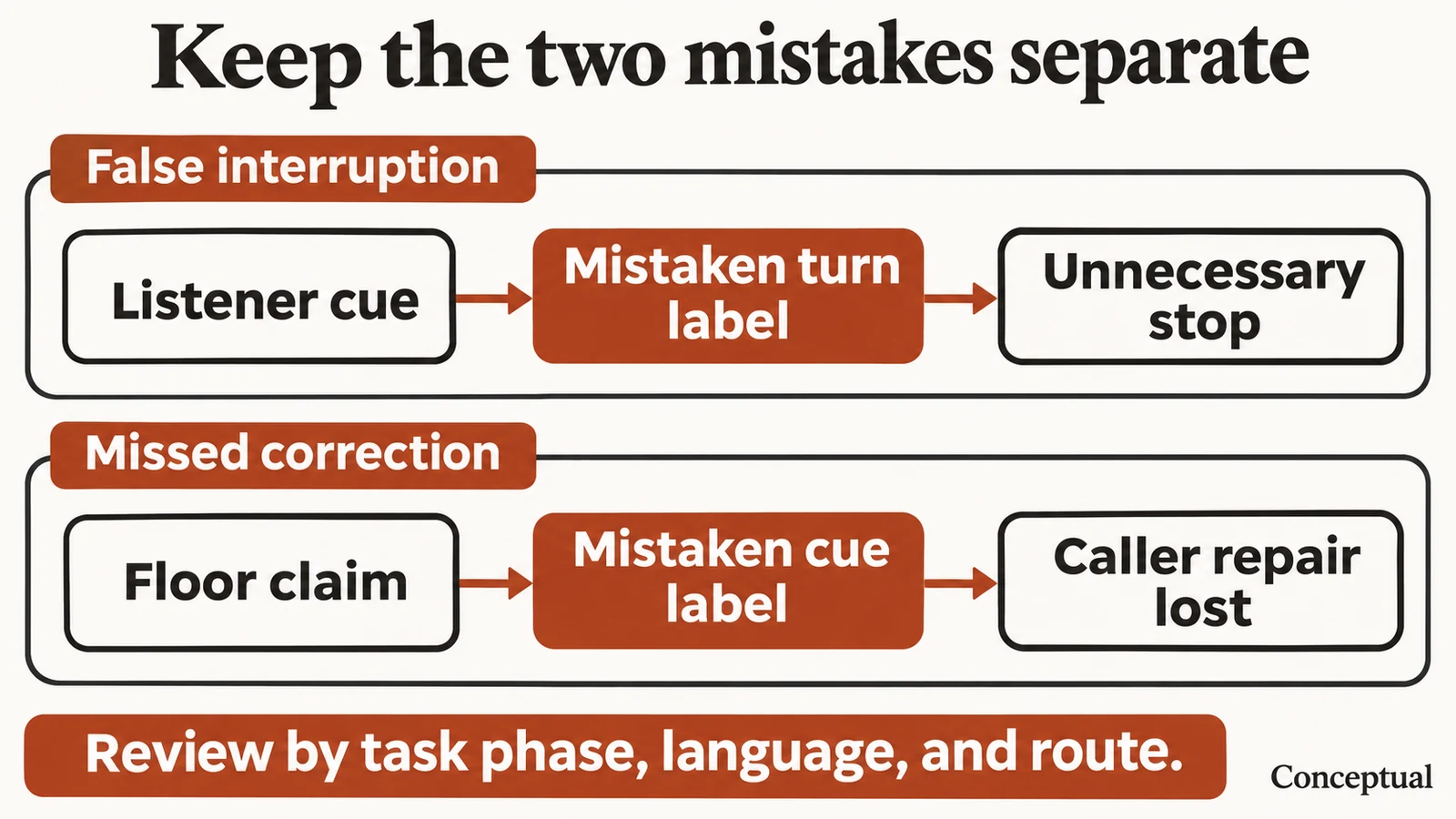
Conceptual: Evaluate unnecessary stops separately from missed corrections and inspect the affected task cohorts.
Connect decisions to playback
A correct floor decision must reach the actual media path. Stopping generation without clearing already-queued audio can leave the caller hearing the very sentence they tried to correct.
Use the response identity to invalidate output in every queue you control. Track generation cancellation, queue invalidation, provider clear requests, and playback evidence as separate observations, because each can fail independently.
The interruption-safe voice agent guide covers that lifecycle in more detail. Backchannel classification is only the upstream trigger; the downstream cancellation mechanism still needs race tests.
A delayed continue decision must never undo a newer take_turn. Once the caller owns the floor, a stale acknowledgment classification cannot reactivate the abandoned explanation.
This is why the example policy does not include automatic resumption. Resumption needs current dialogue state and current relevance, and those facts may have changed while the classifier was deciding.
Use a monotonic cancellation rule within a response. After a response is invalidated, later callbacks may add diagnostic evidence but cannot make its audio playable again. Starting a replacement explanation creates a new response identity.
The audio backpressure guide addresses the queue side. Bounded age and identity checks prevent an apparently healthy producer from filling the conversation with obsolete speech.
Avoid overlapping confirmations
A backchannel during an explanation can be harmless. A backchannel during a confirmation prompt is harder because the caller may be answering before the agent has finished the sentence.
Keep the pending proposal and prompt identity explicit. If a caller answers before hearing a material condition, the application should clarify rather than treating the overlap as informed confirmation.
The end-of-turn guide for structured answers covers another source of premature action. Both problems improve when a conversational boundary remains separate from the business commit boundary.
For example, "yes" after the first half of a price read-back does not establish acceptance of a later fee. The controller must know which proposal was presented and whether the answer applies to that complete proposal.
Operate across languages and devices
Backchannels are language- and context-dependent. Do not translate an English keyword list and assume the same acoustic duration, conversational placement, or social meaning applies to another language.
Build fixtures with speakers who use the language in the intended setting. Include code-switching, regional acknowledgment forms, polite overlap, and brief corrections. Label uncertainty when an annotator cannot determine whether the caller intended to take the turn.
The multilingual voice benchmark guide gives a useful reporting frame. Publish per-language evidence and omissions instead of presenting a pooled number that conceals a weak language or accent group.
Devices change the evidence too. Speakerphone echo can make the agent hear its own output; headset microphones may attenuate short caller cues; backgrounding can delay browser callbacks even while audio continues.
Before tuning a backchannel policy around these symptoms, run the echo versus barge-in diagnostic. An acoustic loop should be repaired at the media boundary rather than taught to the conversation classifier as a normal listener behavior.
For browser callers, include the mobile browser latency matrix. A late control event and a late audio segment are different failures, even if both appear as an agent talking over the caller.
Keep deployment claims narrow
A synthetic corpus can prove deterministic policy invariants. It cannot prove that real callers will prefer the interaction or that a classifier generalizes to untested languages and microphones.
Separate your release record into what was tested, what was observed, and what remains unknown. If you tested only text-derived evidence, say that acoustic classification and caller-perceived interruption latency remain unmeasured.
Use staged exposure with a bounded rollback. Watch correction misses, repeated caller restarts, unnecessary agent pauses, and unresolved ambiguity alongside business outcomes; changes in one counter are useful diagnostic signals rather than automatic proof of quality.
For 60db Agent or any other voice system, ask for an observable contract at these boundaries. Public documentation, testable interfaces, and your own controlled fixtures are a stronger basis for adoption than an unqualified claim that a system handles natural conversation.
Review the release as an operator
Keep a release packet that an on-call engineer can use without the original author. Include the fixture revision, policy version, selected provider settings, known ambiguous cases, and the exact rollback action. A dashboard link alone cannot explain why a short correction was suppressed or which response a late callback referenced.
During rollout, sample decisions by reason rather than looking only at totals. A sudden increase in unknown labels can indicate a missing transcript field, while a change concentrated around question boundaries can indicate delayed playback evidence. Those symptoms need different owners and should not trigger the same threshold adjustment.
Define an escalation path for repeated caller corrections. If the user repeatedly tries to stop an explanation, continuing to classify those events as acknowledgments is a conversation failure regardless of the classifier score. Allow the dialogue controller to pause and ask what needs changing, while keeping the observed uncertainty in the trace.
Review retention at the same time as instrumentation. A replay identifier should resolve only within the governed evidence system, and deleting the associated recording must not leave a raw transcript copied into an unrestricted incident note. Useful diagnosis depends on a clear evidence boundary as much as on a clear floor boundary.
Frequently asked questions
What is a backchannel in a voice agent conversation?
A backchannel is a listener contribution that acknowledges the current speaker without taking over the conversation. Typical examples include short acknowledgment sounds or words during an explanation, but context determines their role. The same word after a direct question can be a complete answer, so the implementation needs the preceding dialogue act and playback boundary.
Why does "yes" sometimes interrupt the agent incorrectly?
The policy may treat every detected speech segment as a floor claim or route every affirmative word into an answer handler. During an explanation, "yes" can simply show attention. Preserve the segment and inspect the pending question, overlap position, and continuation before choosing its consequence; do not let that classification confirm an unrelated business action.
Can a word list solve backchannel detection?
A word list can supply one feature, but it cannot establish conversational function. "Right" can acknowledge an explanation, answer a question, or begin a correction. Use lexical evidence alongside context and audio, then keep uncertain cases explicit. The runnable policy in this guide intentionally consumes evidence labels rather than pretending a dictionary is a complete detector.
Should every short utterance be ignored?
No. A short "stop" or "no" can be the caller's entire correction. Ignoring speech below a duration or word-count threshold creates a known blind spot. Include those interventions in mandatory negative fixtures and provide another path that can transfer the floor when the meaning is consequential, even if the acoustic segment is brief.
Is voice activity detection enough to classify listener cues?
Voice activity detection establishes that a segment resembles speech according to its acoustic policy. It does not establish whether the caller is listening, answering, or correcting. Keep VAD events available as observations, and put floor transfer in an explicit controller that can use context and handle incomplete evidence without silently discarding caller input.
What should happen when the classifier is uncertain?
Preserve the event and apply a bounded task-aware policy. Continuing a low-risk explanation briefly may be acceptable, while pausing a consequential read-back may be safer. If the evidence remains unresolved, clarify. A classifier timeout or missing transcript should remain unknown rather than being relabeled as a listener cue for convenience.
Can an acknowledgment later become a request?
Yes. A caller can say "mm-hmm" and continue with a new question or correction. Keep the classification revisable until the relevant utterance boundary closes, and allow later evidence to transfer the floor. Deduplicating solely by segment identity can lose this update, which is why the example tracks the evidence state as well.
Why does the question's playback position matter?
An answer can arrive while a question is generated, queued, or partly heard. Those are different states. The caller may be answering a previous clause or interrupting before hearing a material condition. Associate the pending question with playback evidence and clarify when the answer cannot safely be attached to the complete proposal.
Does an ASR final result prove that the turn ended?
No. Finality generally describes a recognition result for a particular audio portion. The caller can continue with another portion, and the dialogue can still be incomplete. Preserve separate flags for recognition finality, application turn closure, and confirmation validity so that a transport or recognizer boundary does not become a business authorization boundary.
Which metrics should a backchannel evaluation report?
Report false interruptions on reference listener cues, missed floor claims on reference interventions, ambiguous-event handling, and their underlying counts. Add policy decision delay and caller-observed stop delay when you can measure their clock boundaries. Keep task correctness nearby because smoother speech alone cannot prove that corrected values survived into the final action.
Should ambiguous fixtures count as classifier errors?
Keep them in a separate evaluation slice unless your annotation contract establishes an adjudicated reference label. Forcing a disputed event into a binary class can make the score look precise without improving its meaning. You can still test whether the application preserves evidence, avoids unauthorized action, and uses clarification when the ambiguity remains unresolved.
Can synthetic fixtures replace real speech evaluation?
Synthetic fixtures are useful for repeatable state-machine and race tests. They do not cover the full acoustic and social variation of real conversations. Add consented, appropriately governed speech evaluation across intended devices and languages, and report which layers were exercised. A text replay does not measure microphone capture, echo behavior, or acoustic classification.
How should multilingual backchannels be tested?
Use language-specific annotation guidance and speakers familiar with the intended setting. Include code-switching and short corrections as well as acknowledgments. Report per-language counts and disagreement rather than hiding difficult groups inside one pooled score. Translation of an English cue list is a starting hypothesis, not evidence that the conversational policy transfers unchanged.
Can echo look like a backchannel?
Yes. Agent output leaking into the input path can create short recognizable segments that resemble caller speech. Diagnose the media path with controlled loopback and device tests before changing semantic policy. The classification layer should not become a workaround for a recurring acoustic feedback failure that belongs in capture or playback handling.
Should the agent resume after a false interruption?
Resume only after checking that the original response remains relevant and its playback position is known. The caller may have continued speaking or changed the task while evidence was pending. A new response identity or explicit resumption decision prevents a delayed classifier callback from replaying speech that a newer turn already invalidated.
How do duplicate events affect this policy?
While the agent still owns the floor, identical evidence returns the same cached decision without repeating side effects. After floor transfer, all same-epoch retries return nonplayable HOLD, including a retry of the original TAKE_TURN event or an earlier CONTINUE cue. Updated evidence remains eligible only while the floor is active; old epochs return STALE. This state-aware rule keeps cancellation monotonic.
Should backchannels update task fields?
A listener-cue classification should not write task fields or authorize an action. It answers a floor-ownership question only. If the segment contains an actual answer, route it through the pending question and field validation contract. This keeps conversational smoothness tuning from changing business behavior through an accidental global affirmative intent.
What information belongs in operational telemetry?
Prefer allowlisted identities, phase, model version, decision reason, and clock-qualified timing. Keep raw audio and transcript content out of routine metric labels. If debugging requires content review, use a governed evidence store with appropriate consent and retention. Record enough provenance to reconstruct the decision without making every observability system a transcript archive.
How should a classifier outage behave?
Treat missing evidence as unknown and use the configured fallback for the task phase. Do not allow an outage to label every overlap as harmless. Test timeouts, disconnects, and late recovery explicitly, including the rule that a late result from an invalidated response cannot resume or cancel the current response.
What is the smallest useful first implementation?
Start with one floor owner, explicit response identity, clear correction handling, and a small labeled fixture corpus. Add a provisional uncertainty state and separate error counters before tuning a model. This gives you a testable contract early while leaving acoustic classification replaceable and keeping business authorization outside the backchannel policy.
Ship one defensible boundary
Choose one high-value interaction, such as an explanation followed by a confirmation, and label its ordinary acknowledgments alongside its shortest corrections. Run the policy and media cancellation tests together, then inspect every disagreement before expanding the corpus.
Keep the release claim tied to the evidence: which fixtures passed, which devices and languages were exercised, and which behaviors remain unmeasured. Start with the turn-detection foundation, then make floor ownership observable before tuning conversational smoothness.