
- Architecture
Voice workflows: enforce every consequential action
Voice workflows need runtime checks. Build evidence-backed disclosures, confirmations, authorization, and safe tool execution.
- Author
 Udit Goenka
- Published
- Reading time
- 24 min
TL;DR: Enforce voice workflows in application state and at the final action boundary, with explicit evidence for required steps and confirmation bound to the exact proposed action. Prompts guide conversation, while authenticated backends decide whether an action is valid, authorized, current, and safe to execute.
A caller interrupts a required explanation, changes an appointment date, and then says "yes" after the agent asks a different question. If the backend treats that single word as approval for the earlier proposal, a fluent conversation has become an unsafe command path.
Voice workflows need a precise contract between conversation and execution. The system should know which policy version applies, which steps have evidence, what the caller confirmed, and whether the action still matches that confirmation when the tool reaches the owning service.
This is an engineering guide, not a legal checklist. Your policy owner defines required disclosures and verification steps; the architecture below makes those requirements testable alongside the interruption state machine and safe tool speculation boundary.
Published: November 9, 2026. Last updated: November 9, 2026. Examples are proposed vendor-neutral application designs, not claims about a private product implementation or measured compliance rates.
Table of contents
- Separate conversation from action authority
- Define evidence for each required step
- Bind confirmation to a specific proposal
- Validate at the resolved tool boundary
- Handle interruptions and revisions
- Make execution durable and retry-safe
- Keep policy understandable to developers
- Build adversarial replay tests
- Observe failures without exposing the caller
- Frequently asked questions
- Start with one protected action
Separate conversation from action authority
The model can propose an action; the application must decide whether that action may execute. This boundary lets conversational flexibility coexist with deterministic business rules, even when recognition is wrong or the caller asks to skip a required step.
A prompt is useful for explaining the workflow, choosing helpful wording, and collecting information. It is a poor place to store the only authoritative record that a required disclosure was completed or a particular customer authorized a change.
Build the action path around trusted inputs. The authenticated workspace, participant permissions, current business object, active workflow revision, and validated confirmation should come from application-owned state rather than from model-generated tool arguments alone.
For example, an agent may propose moving an appointment to a different slot. The backend should load the actual appointment through the authorized account, confirm that the slot remains available, and verify that the caller's approval covers this exact change before committing it.
A well-formed request does not prove permission. The JSON Schema object reference describes shape constraints such as properties and required fields; business authorization still needs checks against the caller's rights and the current application state.
Keep conversational memory and execution evidence distinct. A transcript can help an operator investigate what happened, but a durable evidence record is easier to validate consistently than repeatedly asking a model to infer whether a long conversation satisfied the policy.
That record should be narrow. Store the step identifier, policy version, evidence source, result, relevant turn or media reference, time, and any conditions that invalidate it; avoid copying an entire conversation into each workflow step.
Decide which actions require stronger controls. A public information lookup, a draft note, an appointment cancellation, and a financial operation have different consequences, so they should not share an undifferentiated Boolean called safe.
Keep the initial scope small. Protect one consequential action thoroughly before inventing a generic policy language that nobody can reason about or test.
The action owner should remain authoritative. If the scheduling service rejects a stale appointment version, the conversational application must explain the conflict rather than overriding the version check because an earlier turn sounded confident.
Human handoff follows the same rule. The warm handoff design transfers task responsibility and context, but it does not grant the receiving actor permissions they did not already hold.
A good architecture makes this boundary visible in code review. Reviewers should be able to identify the function that rejects unauthorized execution without reading the prompt or knowing which model produced the request.
Define evidence for each required step
Required workflow steps need operational definitions. A requirement such as "explain the change" is too vague for a runtime gate until you define the content, completion boundary, and response expected from the caller.
For a disclosure, separate text preparation, audio production, audio delivery, and any required acknowledgment. These stages answer different questions, and a log showing generated text does not prove the caller heard the final sentence.
Your platform may not expose client playback evidence. In that case, record the supported observation and its limitation rather than upgrading an audio-generated event into proof of delivery.
If the requirement only demands an attempted announcement, label it that way. If the requirement demands acknowledgment or comprehension, define the corresponding conversational evidence with the actual policy owner instead of treating silence as agreement.
A step can be missing, in_progress, satisfied, invalidated, or unobservable. The last status matters because unavailable instrumentation should block unsupported certainty rather than silently becoming success.
Use explicit evidence types. A verified identity result comes from the authorized verification process, an availability check comes from the owning scheduling service, and an acknowledgment comes from an interpreted caller response tied to a specific question.
Keep a distinction between a model classification and a deterministic fact. A classifier can estimate that a caller agreed, while the application can deterministically verify that the classified response belonged to the active confirmation turn and that the proposal did not change afterward.
Policy versioning prevents historical confusion. If your disclosure changes, a step satisfied under an earlier version remains evidence of what happened then, but it should not automatically satisfy a newly required step in an active workflow.
Define invalidation conditions near the requirement. Changing an amount can invalidate financial confirmation, changing the destination can invalidate a transfer permission, and switching the task can invalidate an explanation that addressed the old task.
| Evidence stage | What it establishes | Proves complete caller understanding? | Suitable action gate by itself? |
|---|---|---|---|
| Prompt contains the disclosure | Desired instruction exists | ✗ | ✗ |
| Model generated disclosure text | Text was produced | ✗ | ✗ |
| TTS returned complete audio | Audio asset was produced | ✗ | ✗ |
| Playback completion observed | Supported client reports playback end | ✗ | Depends on the policy requirement |
| Caller acknowledged active proposal | A classified response is bound to that proposal | ✗ Understanding needs its own definition | Depends on authorization and freshness |
| Backend authorization and commit checks passed | Action met backend rules at execution | ✗ | ✓ For the rules explicitly checked |
This table is a reasoning aid, not a legal conclusion. A checkmark applies to the stated engineering property, and the application still needs the complete set of required checks for its workflow.
The latency guide explains why server timing and audible playback are different boundaries. The same distinction determines whether your disclosure evidence supports the claim you put in an audit record.
Keep evidence durable before executing the protected action. If a crash can leave the business write committed but its authorization evidence missing, the operational review will be unable to establish why the write was allowed.
Bind confirmation to a specific proposal
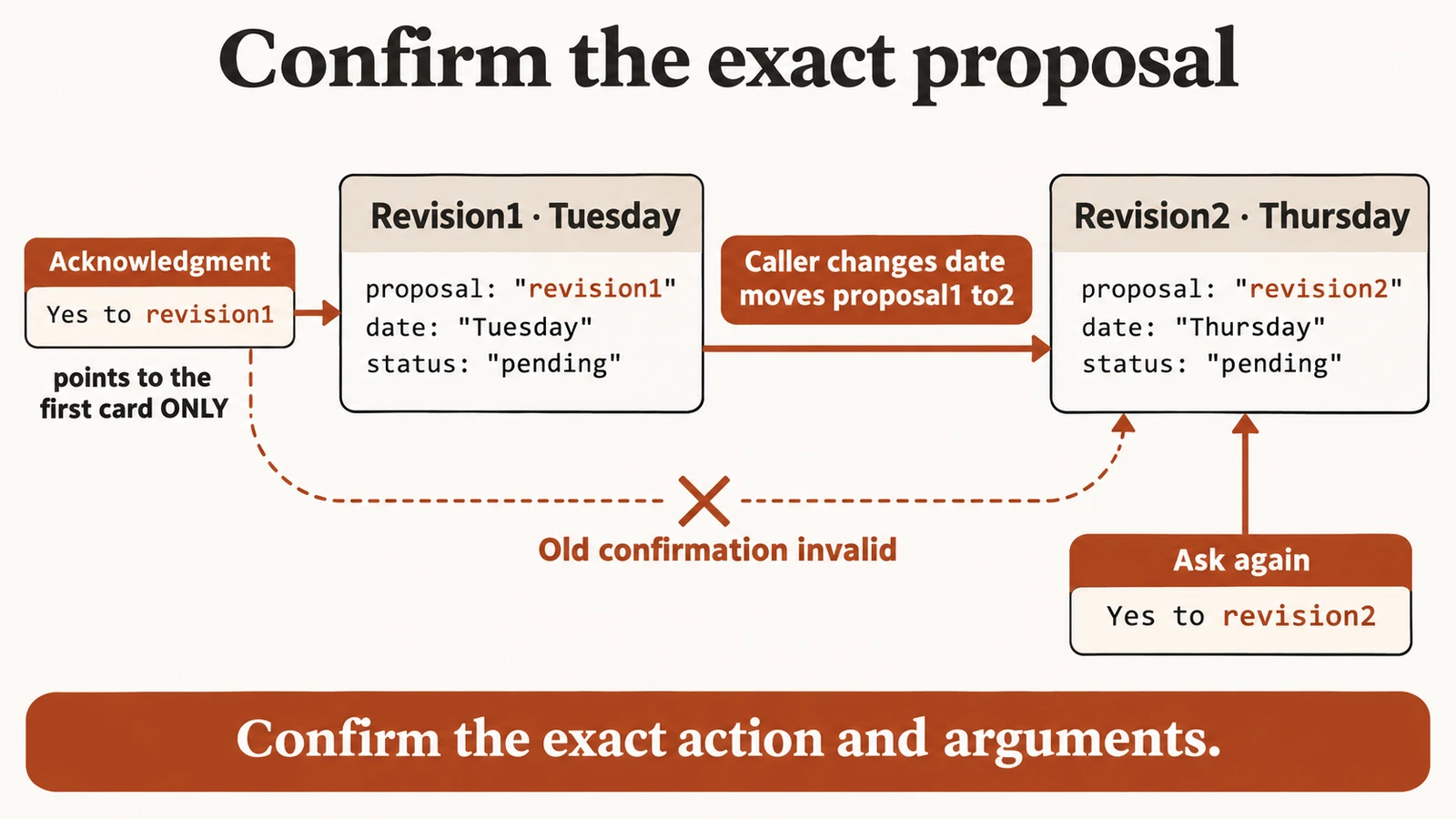
Confirmation is valid only for the action, arguments, and workflow revision that the caller was asked to approve. A free-floating confirmed: true flag becomes stale as soon as the proposal changes.
Represent a proposal as an application-owned object. It should identify the action type, authorized target, normalized business arguments, relevant object version, workflow revision, and expiration rule.
The model can help collect those values, but the application should normalize and validate them before presenting the final question. An ambiguous spoken date or amount must be resolved before it can become a meaningful proposal.
Give the proposal an opaque identifier. The confirmation record refers to that identifier and revision, while the backend reloads the canonical proposal rather than accepting a model-supplied replacement that happens to carry the same label.
When the caller says yes, inspect the conversational context. Was the active question an approval request, did another speaker intervene, did a new proposal supersede it, and did the response arrive before the confirmation expired?
Those checks do not require pretending natural language is deterministic. You can use a bounded classifier for the semantic judgment and still enforce proposal identity, actor identity, revision, and expiration through code.
An uncertain answer should produce clarification. "I think so," background speech, a partial recognition, and overlapping audio should not be converted into certainty merely because a successful path needs a Boolean.
Read back consequential fields in an accessible form. An appointment time needs its date and timezone context, an amount needs its currency, and a destination needs enough description for the caller to recognize what they are accepting.
The representation must also survive language changes. The multilingual benchmark protocol treats dates, numbers, negation, and code-switching as task-critical cases because a readable transcript can still encode the wrong action.
Invalidate confirmation when the proposal changes. If the caller replaces Tuesday with Thursday, create a new revision and ask again; do not preserve the earlier approval because the action type remains "reschedule."
Also invalidate when relevant backend state changes. A previously available slot can disappear, a price can change, or an authorization can expire, and the application must reconcile that difference before execution.
Avoid hashing raw conversational text as the business identity. Two equivalent requests can have different wording, and two dangerous requests can share superficial text; proposal identity should come from normalized application state.
Hashes can help detect accidental mutation of a canonical representation, but they do not provide permission. Access checks and evidence validation still belong to the backend that owns the action.
The caller should hear an accurate result after execution. "I have requested the change" is different from "Your appointment is changed," and the system should choose wording based on the owning service's receipt rather than the model's expectation.
Validate at the resolved tool boundary
Tool execution is the final practical place to enforce action eligibility before external effects occur. Validate the resolved operation and its real arguments after aliases, routing, and wrappers have been applied.
A logical tool name can hide different targets. If a model calls update_record and a wrapper resolves it to cancellation, a gate that approved only the original label has checked the wrong operation.
Build the final gate around the action descriptor the backend will execute. Include the target resource, effect class, authorized actor, proposal revision, and canonical arguments, then reject mismatches before contacting the external service.
Input and output guardrails have different timing. OpenAI's Agents SDK documentation distinguishes initial input checks, final output checks, and function-tool checks; it also notes that parallel input validation can allow work to begin before a late rejection arrives.
That timing matters for irreversible effects. A policy check that runs after a payment or cancellation can suppress the narration, but it cannot undo the external action.
Treat authentication as one part of the gate. A valid request signature can establish that a trusted sender created the message under the signing contract, while authorization decides whether this caller may perform this operation on this resource now.
The current 60db tools and webhooks documentation describes schema-defined tools, signed requests, and tool_call_id deduplication. Those mechanisms support request validation and duplicate handling; your backend still owns business authorization and the meaning of a successful result.
Verify signatures against the exact bytes required by the documented contract. Parsing and reserializing a body before verification can change its representation, and silently accepting an unsigned fallback defeats the authentication boundary.
Apply input limits before expensive work. Reject oversized bodies, unsupported content types, invalid fields, unknown operations, and unauthorized resource references without passing them into an unrestricted execution path.
Separate tool-result data from instructions. An external service response or caller-supplied note can contain text that looks like a command, but it must not modify the application's authorization policy or permit another tool by implication.
Return structured denial reasons that the conversational layer can explain safely. A user-facing clarification can say that the appointment changed and needs a fresh confirmation, while detailed internal security reasons remain in restricted logs.
The speculative tools guide adds a related optimization: read-only work can sometimes begin before confirmation. The final resolved write still needs the complete action gate, even if earlier read results made the proposed action look likely.
Do not rely on a tool schema to prevent all harmful combinations. A valid enum and correctly typed amount can still represent the wrong account, wrong currency, stale quote, or unauthorized action.
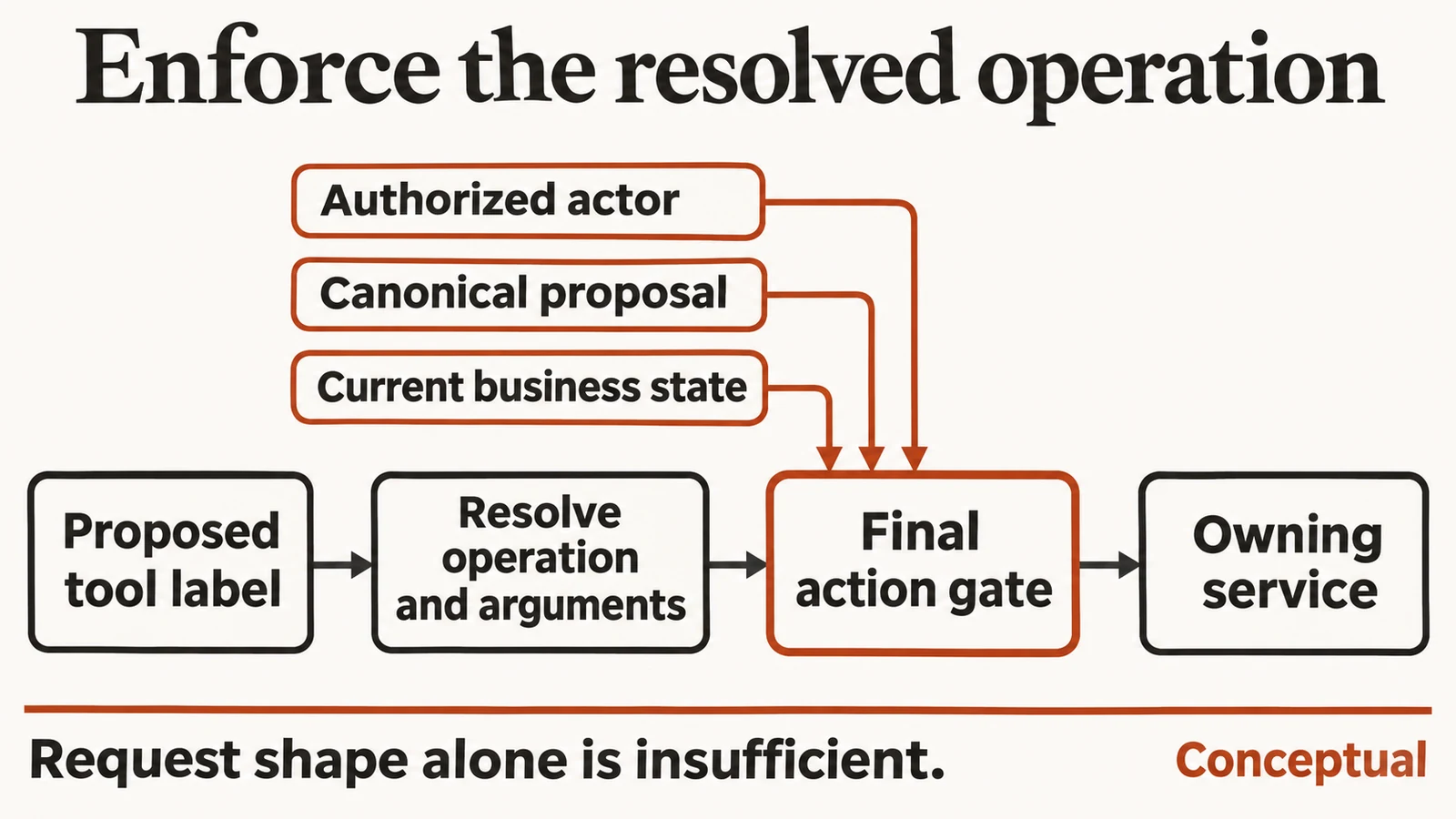
Conceptual: Validate the operation and canonical arguments after routing resolves the action that will execute.
Handle interruptions and revisions
Interruptions change which conversational evidence remains valid. Treat them as state transitions that can invalidate pending speech and confirmation, rather than as an instruction to replay the same script from the start.
A caller who interrupts a disclosure may be asking a clarification, changing the task, or asking to stop. Your runtime should classify the new intent while preserving the policy step as incomplete until its actual completion condition is met.
Avoid a rigid loop that restarts a long disclosure after every noise event. The VAD and turn detection guide explains why speech activity, meaningful interruption, and a finished user turn require different evidence.
Make speech ownership explicit. When a new turn cancels the old response, audio chunks from the canceled response must be rejected even if they arrive later from the synthesis or transport layer.
The same generation identity should appear in disclosure evidence. If playback completion belongs to a canceled output, it must not satisfy the active step merely because the text had the same wording.
A useful design tracks both workflow revision and speech generation. The workflow revision identifies the current business proposal, while the generation identifies the specific audio attempt used to deliver a step.
When delivery is interrupted, choose a policy-approved resumption strategy. You may repeat the interrupted clause, summarize and ask acknowledgment, or restart the required text, but the strategy must be explicit rather than improvised by a model that does not know the delivery evidence.
Confirmations need stricter turn binding. A late yes to an old question should not approve a new proposal, and an acknowledgment such as "right" during an explanation should not be treated as acceptance of an action that has not yet been presented.
Background speakers complicate that distinction. If the channel cannot reliably establish who answered, use clarification or a stronger authorized interaction rather than inferring identity from conversational confidence.
Interruption during an external write is a separate case. Once the owning service accepted a valid command, stopping the audio does not cancel the business operation; reconcile its result and then explain the current state.
Do not promise rollback unless the action contract provides it. A cancellation request, compensating operation, and reversible draft are different mechanisms, and the application should expose those differences in state.
Handoff also invalidates conversational ownership. When a human takes over, the automated model should stop proposing writes unless the workflow explicitly grants a separate supporting role with its own permissions.
The shutdown guide covers the final interruption boundary: hangup ends live participant work, while an already accepted business operation may still need durable reconciliation. Closing the media session should not erase that obligation.
Make execution durable and retry-safe
A protected workflow needs durable evidence and safe execution under retries. Network failure can occur after a service commits an action but before your caller receives the result, so a timeout cannot be treated as proof that nothing happened.
Separate the local authorization decision from external execution. Store the validated proposal, evidence revision, operation identity, and current execution status before scheduling the outbound command through an existing durable mechanism.
For a modest system, an outbox row in the same database transaction as the authorized intent can provide that boundary. The worker later delivers the command and records the receipt; the article proposes this pattern rather than prescribing a specific queue product.
The outbox alone does not guarantee a single external effect. The destination must support deduplication, idempotent operations, or a reliable reconciliation query, and your worker must use those contracts consistently.
Stripe documents idempotent request behavior, including how a service recognizes repeated requests. Read the actual target service's rules, because key retention, argument matching, and failure behavior differ across APIs.
Use one stable operation identity for retries of the same authorized action. A new network attempt is not a new user intent, and generating a new identity on every timeout can defeat the destination's duplicate protection.
A changed proposal is different. If the caller modifies the requested action, create a new authorized operation after invalidating the earlier confirmation; do not silently reuse an operation key with different business arguments.
Keep execution statuses expressive. authorized, dispatch_pending, in_flight, committed, rejected, and unknown tell an operator what recovery remains, while success: false hides whether retrying would be safe.
An unknown result should trigger reconciliation. Query the owning service by operation identity where supported, inspect the recorded receipt, or route to an operator when the interface cannot establish the result safely.
Coordinate concurrent executors through your existing database semantics. PostgreSQL's locking documentation describes row-level locking tools, but the important application invariant is that only the current authorized revision can claim an operation for execution.
Do not hold a transaction open while waiting on a model, caller, or remote service. Commit a small state change, perform external work outside the lock, and reconcile the result through versioned updates.
Hangup may change eligibility before dispatch. If policy requires the caller to remain present until the operation begins, check participant state at the final boundary; if durable authorization survives disconnection, record that policy explicitly.
The cost model should include failed attempts and reconciliation work. Counting only committed calls hides the operational burden of an action path that repeatedly enters unknown states.
Diagram source (Mermaid)
flowchart LR
    A[Conversation proposal] -->|Normalize fields| B[Canonical proposal]
    B -->|Present active revision| C[Caller confirmation]
    C -->|Bind evidence| D[Runtime action gate]
    D -->|Reject stale or unauthorized| E[Clarify or hand off]
    D -->|Authorize exact action| F[Durable operation]
    F -->|Deliver with stable identity| G[Owning service]
    G -->|Receipt or reconciliation| H[Recorded result]
    H -->|Explain observed status| I[Caller or follow-up]
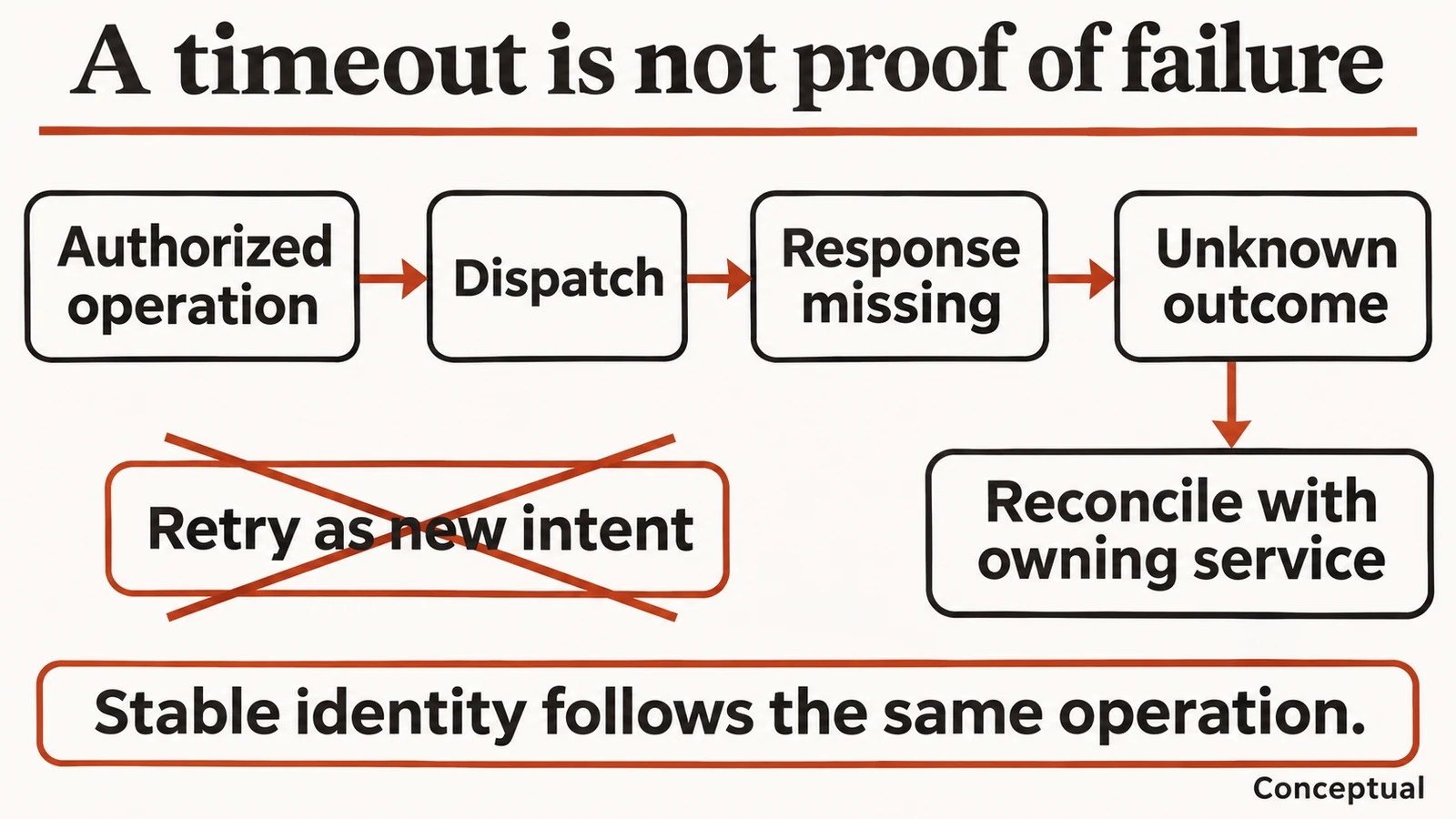
Conceptual: Keep unknown outcomes explicit and reconcile under the owning service contract before issuing another effect.
Keep policy understandable to developers
Enforcement becomes fragile when the policy model is harder to understand than the workflow itself. Start with explicit states and checks in the application's existing language, then generalize only after repeated workflows expose the same stable boundary.
A policy step needs a name that describes the invariant. confirm_reschedule_details is more useful than a numbered compliance label because a reviewer can understand what must hold without consulting a separate phase plan.
Keep legal interpretation outside developer guesses. The responsible owner should define required content, accepted evidence, retention, exceptions, and the conditions under which a human must take over.
Translate that policy into testable engineering rules. For example, "do not execute after the caller withdraws" becomes an execution check on current consent state, a replay fixture for withdrawal before dispatch, and a reconciliation rule for withdrawal after an operation has already committed.
Version the rules alongside the application artifacts they control. Store enough history to understand old decisions without making every historical policy version an active execution path forever.
Plan migrations for active calls. A deployment that changes policy halfway through a conversation needs a declared strategy: pin the existing workflow version, require a new step, or end and restart the protected interaction safely.
No strategy is universally correct. The choice depends on whether the change repairs a security defect, adds a new business requirement, or only improves wording, and the operational owner must know which active sessions are affected.
Prefer clear failure reasons over a single opaque risk score. A backend can report proposal_changed, authorization_expired, or required_delivery_missing, which tells the conversational layer what next step is possible.
A probabilistic classifier can still assist with bounded semantic decisions. Evaluate it against labeled examples, preserve an uncertain outcome, and keep deterministic identity and permission checks independent of its judgment.
Do not let a model grade its own authorization record as the only release gate. Independent labels and backend receipts are needed to establish whether the action was allowed and what happened.
Document the exception path. If an authorized operator can override a normal requirement, the override should have an actor, reason, scope, and audit record, rather than being encoded as a special phrase a caller can repeat.
The observability guide provides a trace vocabulary for connecting policy decisions to turns and operations. Those links help operators diagnose failures without requiring sensitive transcript text in ordinary metrics.
Build adversarial replay tests
A workflow gate should be tested by trying to cross it without the required evidence. Positive examples demonstrate the happy path; negative examples establish whether the enforcement boundary exists.
Create a small corpus of synthetic conversations and runtime events. Include a normal confirmation, an ambiguous acknowledgment, a background yes, a changed date after confirmation, an interrupted disclosure, an expired authorization, and a tool alias that resolves to a different effect.
Each fixture should define the allowed business result. A test is weak if it only checks that the model produced a polite refusal while the backend still executed the write.
Assert both state and effects. Verify the evidence revision, operation identity, calls made to the owning service, persisted receipt, and the absence of prohibited writes.
A deterministic model-free test can prove proposal binding. Authorize revision one, change a consequential argument to revision two, and assert that the old confirmation is rejected before any external command is emitted.
Here is a runnable, vendor-neutral check for proposal binding. Save it as proposal_gate.py and run python3 proposal_gate.py; the test has no network access and does not claim to implement a product API.
from dataclasses import dataclass

@dataclass(frozen=True)
class Proposal:
    identity: str
    revision: int
    slot: str

@dataclass(frozen=True)
class Confirmation:
    proposal: Proposal
    actor: str

def permitted(current, confirmation, actor, authorized):
    return (
        authorized
        and confirmation.actor == actor
        and confirmation.proposal == current
    )

original = Proposal("change-a", 1, "synthetic-slot-a")
changed = Proposal("change-a", 2, "synthetic-slot-b")
evidence = Confirmation(original, "synthetic-actor")
assert permitted(original, evidence, "synthetic-actor", True)
assert not permitted(changed, evidence, "synthetic-actor", True)
assert not permitted(original, evidence, "other-actor", True)
assert not permitted(original, evidence, "synthetic-actor", False)
print("proposal gate checks passed")
The comparison includes every field in the canonical proposal, so changing a consequential value invalidates the old evidence even if an implementation accidentally forgets to increase the revision. A production record should include the complete authorized action and freshness conditions, and the backend should load that record from trusted storage rather than trusting a client to construct it.
Notice what this fixture does not infer. It accepts a confirmation record as an input and tests binding, while interpreting speech and authenticating the participant remain separate responsibilities with their own evidence and tests.
Use this separation when triaging a failed replay. If a stale confirmation passes the deterministic gate, repair the gate; if a correctly bound response was misclassified as agreement, improve the semantic decision and its uncertainty handling instead of weakening proposal identity.
Use the same strategy for authorization. Present a validly signed tool request that references a resource outside the caller's permitted scope and assert denial; this separates request authenticity from business permission.
Test stale results after interruption. Deliver audio completion and tool results from a canceled generation, then prove that neither event satisfies the active disclosure step or restores a superseded proposal.
Test duplicate delivery. The same tool invocation should not create two operation records or two external effects, and retries with changed arguments should fail rather than silently inherit the earlier authorization.
The regression harness guide extends those checks through the actual audio route. Real-call trials should verify that critical readbacks are audible, interruption behavior matches the evidence model, and the accepted response belongs to the intended caller turn.
Keep stochastic evaluation separate from deterministic gates. Repeat model-dependent cases and report their distributions, while deterministic safety invariants should pass every time under the defined event sequence.
Include deliberate service failures. A timeout after external commit, a duplicate completion event, an unavailable authorization service, and a process restart between local authorization and command delivery should all produce an explainable state.
Use failure injection in an authorized sandbox. Do not test irreversible operations against production accounts merely to obtain realistic screenshots or a more persuasive article.
Write release criteria before running the suite. Specify which failures block deployment, which require human review, and which represent unavailable measurements, so a favorable average cannot conceal a prohibited action.
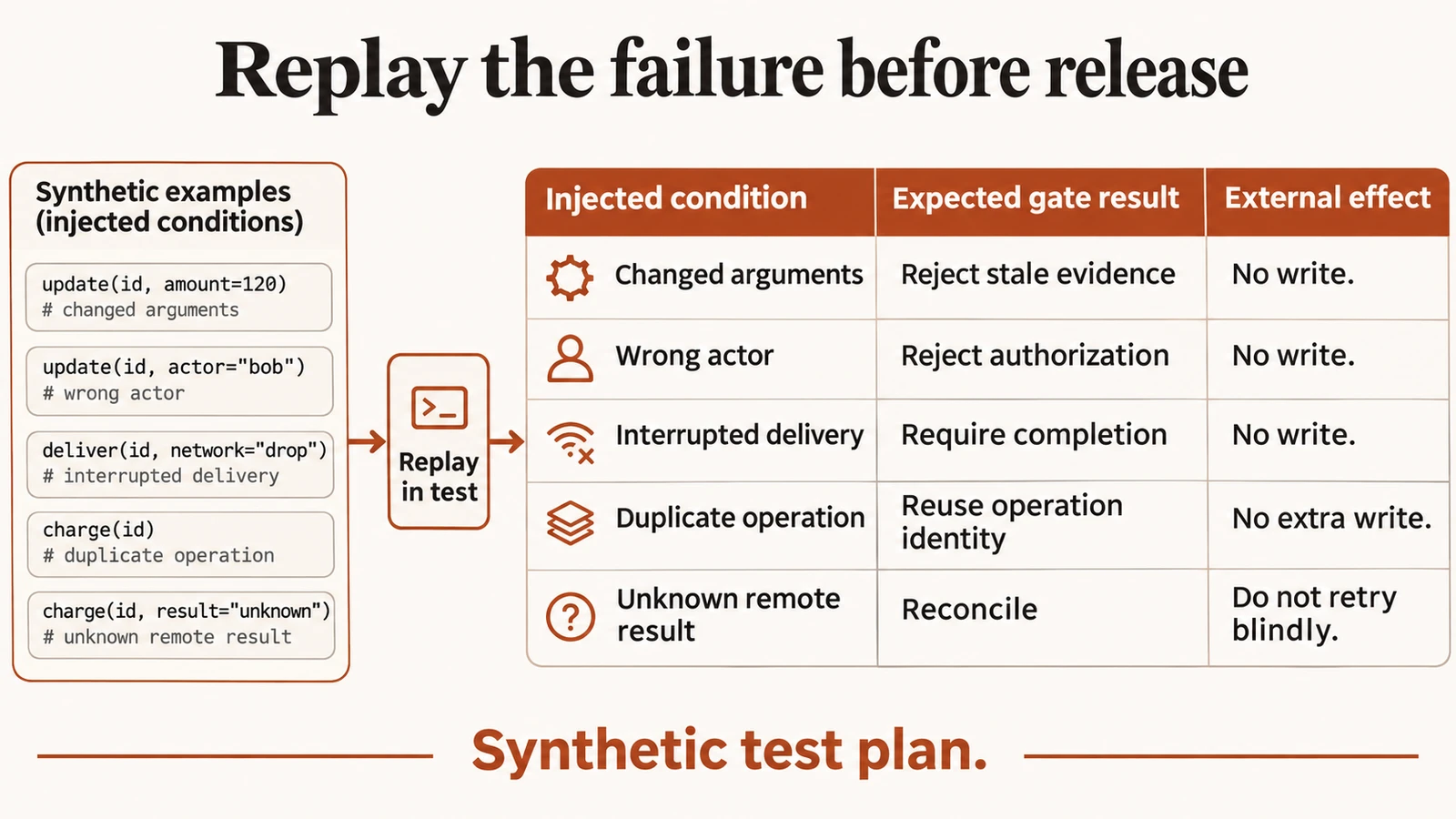
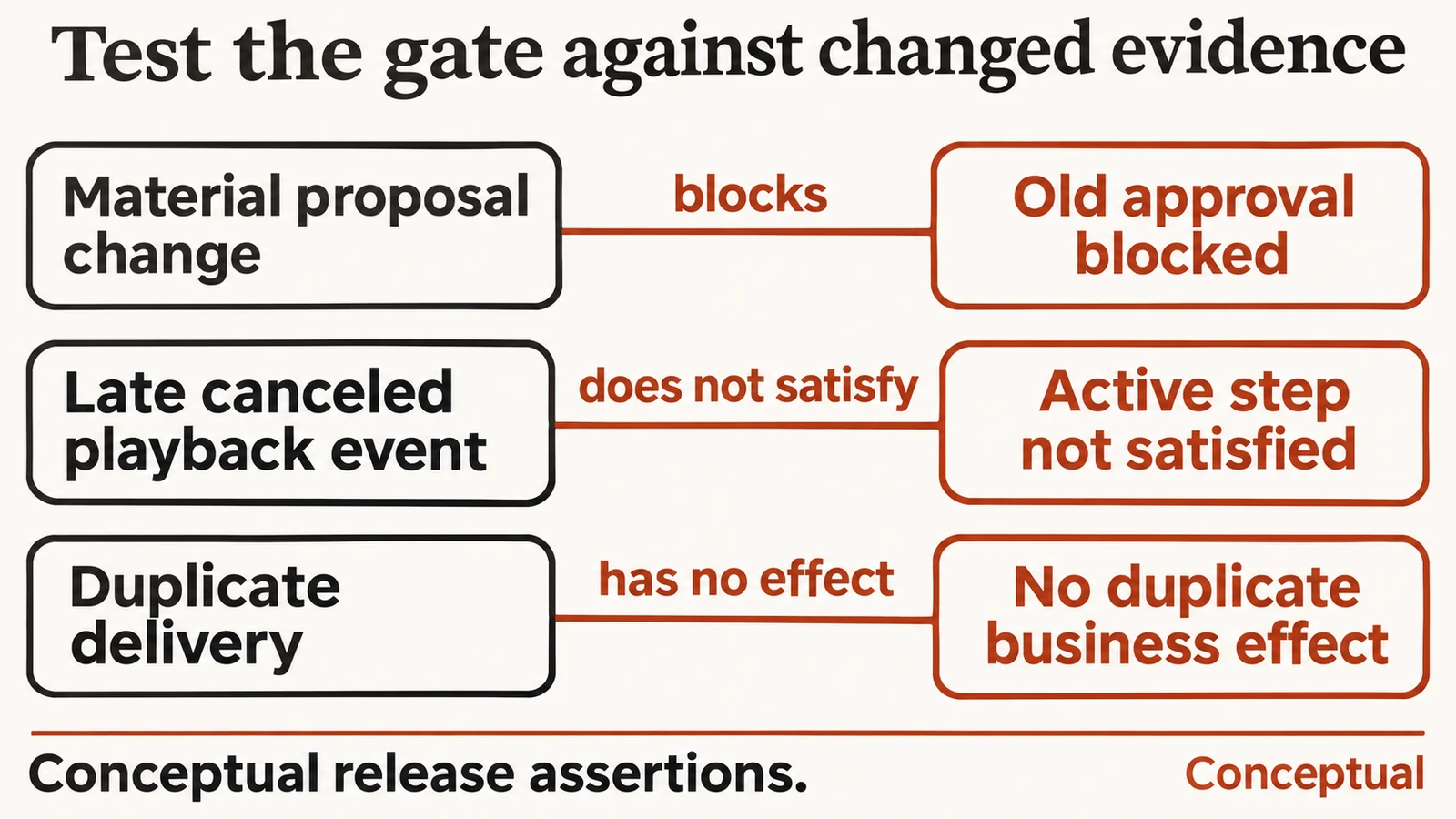
Conceptual: Replay changed proposals, late playback evidence, and duplicates against their distinct action invariants.
Observe failures without exposing the caller
Enforcement needs evidence that operators can inspect without turning every log into a copy of the conversation. Emit structured state transitions and reason codes, while keeping protected content in restricted storage under its own retention rules.
Useful identifiers connect the call, workflow revision, proposal, evidence record, tool invocation, and business operation. They should be opaque references rather than personal information embedded in log keys.
Record which check denied execution. A spike in required_delivery_missing suggests a different problem from authorization_expired, and combining them into a generic guardrail-failure counter prevents targeted repair.
Keep modeled and deterministic observations separate. An intent classifier's confidence, a backend permission result, and an owning service's committed receipt are different evidence classes and should not share a field named verified.
Track the cost of safe denial as well as prohibited actions. A workflow that blocks everything may avoid unauthorized writes while failing every caller, so evaluate task completion, clarification burden, handoff rate, and abandonment alongside action correctness.
The outcome scorecard explains how to preserve those dimensions. Your engineering target is useful completion within the accepted policy, not a low denial rate or a high tool-call count alone.
Review samples across failure categories. If you inspect only calls flagged by the same model that made the decision, its blind spots can remain invisible; include random and targeted human-reviewed samples under an approved privacy process.
Use aggregate counts for product reporting. Never publish raw confirmations, account references, recordings, or unusual combinations of fields that can identify a person through context.
Retention needs a concrete owner. A provider's tool-event log retention period does not automatically define your application's authorization evidence retention, business audit requirements, or recording deletion obligations.
The data boundary guide helps map those independent stores. A managed voice platform, your webhook service, the business system, and the operator console may each keep different artifacts.
Plan an operational fallback for unavailable enforcement services. If the permission service fails, the protected action should remain unexecuted until a defined recovery path exists; conversational politeness must not become a permissive default.
Be equally honest about missing evidence in a report. This design provides a protocol and test plan, not a measured compliance rate, legal certification, or guarantee that all natural-language misunderstandings have been eliminated.
Frequently asked questions
Why cannot a prompt enforce a voice workflow alone?
A prompt guides model behavior but does not own the external action or durable business state. Backend checks can reject a prohibited write even when the model produces a valid-looking request after a misunderstanding or interruption.
What belongs in the runtime action gate?
Check the resolved action, authorized actor, target resource, active proposal revision, required evidence, and current business conditions. The exact set depends on the action's contract and the policy defined for that workflow.
Is a JSON schema enough for safe tool calling?
No. A schema validates request shape, while authorization and business validation establish whether the requested operation is permitted and meaningful for the current actor, resource, and state.
Does a signed webhook mean the caller authorized the action?
No. Signature verification authenticates the request under the provider's signing contract; caller authorization and approval of the specific business operation require separate evidence checked by your backend.
How should I store caller confirmation?
Bind it to an application-owned proposal identifier and revision, with the relevant response evidence and validity conditions. Avoid a call-wide Boolean that remains true after the action or arguments change.
What if the caller says yes to a different question?
The response should not approve the protected action. Verify that the active conversational question requested confirmation of the current proposal, and clarify when the reference is ambiguous.
Can silence count as consent?
Only if the actual policy contract defines an accepted mechanism that supports that conclusion. Engineering should never invent such a rule because waiting for a response is inconvenient or the model expects agreement.
What happens when a disclosure is interrupted?
Keep its evidence incomplete until the defined completion condition is satisfied. Resume through a policy-approved strategy and ensure that completion events from canceled speech cannot satisfy a newer generation.
Should I repeat the whole disclosure after every interruption?
That depends on the policy and the evidence available about delivery. A clause-level repeat or clarification may be appropriate, but the runtime should use an explicit rule rather than improvising a completion claim.
Can a model classify whether the caller agreed?
Yes, as a bounded semantic judgment evaluated against labeled examples. Code should still enforce proposal identity, turn binding, actor permissions, expiration, and invalidation when the proposal changes.
What should happen when tool authorization is unavailable?
Keep the protected action unexecuted and use a defined recovery or handoff path. An unavailable permission check is missing evidence, not a reason to assume the operation is allowed.
How do I handle a timeout after a write?
Record an unknown result and reconcile against the owning service before retrying. A timeout can occur after commit, so repeating a non-idempotent request can perform the action twice.
Does idempotency remove the need for confirmation?
No. Idempotency addresses duplicate execution of the same operation, while confirmation addresses whether the caller approved that operation; both controls are needed when the workflow requires approval.
Should changed arguments reuse the same operation identity?
Retries of the same canonical operation should reuse its identity. A changed consequential proposal needs fresh validation and confirmation, and the backend should reject mismatched arguments under an existing authorized operation.
What does an output guardrail protect?
An output guardrail can inspect or reject output before it is returned through the supported workflow. It does not automatically reverse an external action that already executed, so action checks must occur earlier.
How should a human override work?
Define an authenticated operator action with an explicit reason, scope, and audit record. A hidden phrase in the conversation is not a reliable override boundary and can be repeated by an unauthorized caller.
Which tests should block release?
Any defined invariant that permits an unauthorized or stale action should block release. Set the criteria before running tests and separately report model-dependent uncertainty, unavailable measurements, and user-experience regressions.
Is workflow enforcement a legal compliance guarantee?
No. It implements the policy requirements supplied to the system, while legal applicability, disclosure wording, consent standards, and retention obligations require qualified owners for the actual operating context.
Can 60db Agent tools fit this architecture?
The documented tool and webhook surfaces can connect conversation to your backend, subject to workspace availability. Your backend must verify the documented request contract and enforce the application-owned authorization and execution rules.
What is the smallest useful first implementation?
Choose one consequential action and define its proposal, required evidence, final gate, durable operation record, and negative tests. Reuse existing database and queue patterns before introducing a general workflow framework.
Start with one protected action
A reliable voice workflow makes every consequential action explainable. You should be able to identify the active proposal, show why its required steps were satisfied, prove who was authorized, and connect execution to a receipt from the owning service.
Keep the conversational layer flexible around that contract. The caller can ask questions, interrupt, switch languages, or change their mind while deterministic application checks preserve the action boundary.
Start with a single protected operation and a small adversarial replay suite. Prove that changed arguments, stale confirmation, missing delivery evidence, and duplicated requests cannot create an unauthorized write, then test the same workflow through actual audio.
When evaluating 60db Agent, use its documented tool surfaces to connect to that backend contract. Bring the evidence model and failure tests to the evaluation rather than treating a persuasive prompt or a successful demonstration as proof of enforcement.