
- Architecture
Choose audio chunk sizes without hiding latency in buffers
Choose audio chunk sizes with a runnable queue simulator, explicit clock boundaries, and a playback-focused validation plan.
- Author
 Udit Goenka
- Editorial date
- Reading time
- 25 min
TL;DR: Choose audio chunks by measuring how long samples wait at each boundary, including packet assembly, transport admission, and playback. Compare chunk durations against queue age, gaps, cancellation, and resource use on the same workload before adopting a setting.
A voice application can send smaller messages and still make callers wait longer. If the producer runs ahead of the consumer, every message joins the same queue, and a smaller envelope does nothing to make old audio useful again.
Start with the oldest waiting sample. Record when it became available, when the application admitted it to transport, and when the receiver scheduled it for playback. Those observations tell you whether a chunk setting changes responsiveness or simply moves waiting between buffers.
This guide provides a deterministic, standard-library Python experiment and a measurement contract you can extend to a real transport. Its fixtures are synthetic. They illustrate accounting and failure cases, rather than measured results for a provider, browser, or 60db Agent.
As checked on November 9, 2026, RFC 6716 describes a trade-off between Opus packet duration, header overhead, delay, and loss exposure. Application chunks add another boundary above that codec decision. Keep those boundaries separate when evaluating a speech-to-playback latency benchmark.
Table of contents
- Define which chunk you control
- Budget waiting in samples and milliseconds
- Build a queue experiment
- Run a controlled transport trial
- Handle overload and cancellation
- Interpret the evidence
- Frequently asked questions
- Choose a setting you can explain
Define which chunk you control
A chunk is an application-defined unit of data. It can contain raw samples, an encoded frame, several frames, or part of a container, depending on the interface. A duration such as "twenty milliseconds" is meaningful only after you name the representation and the boundary.
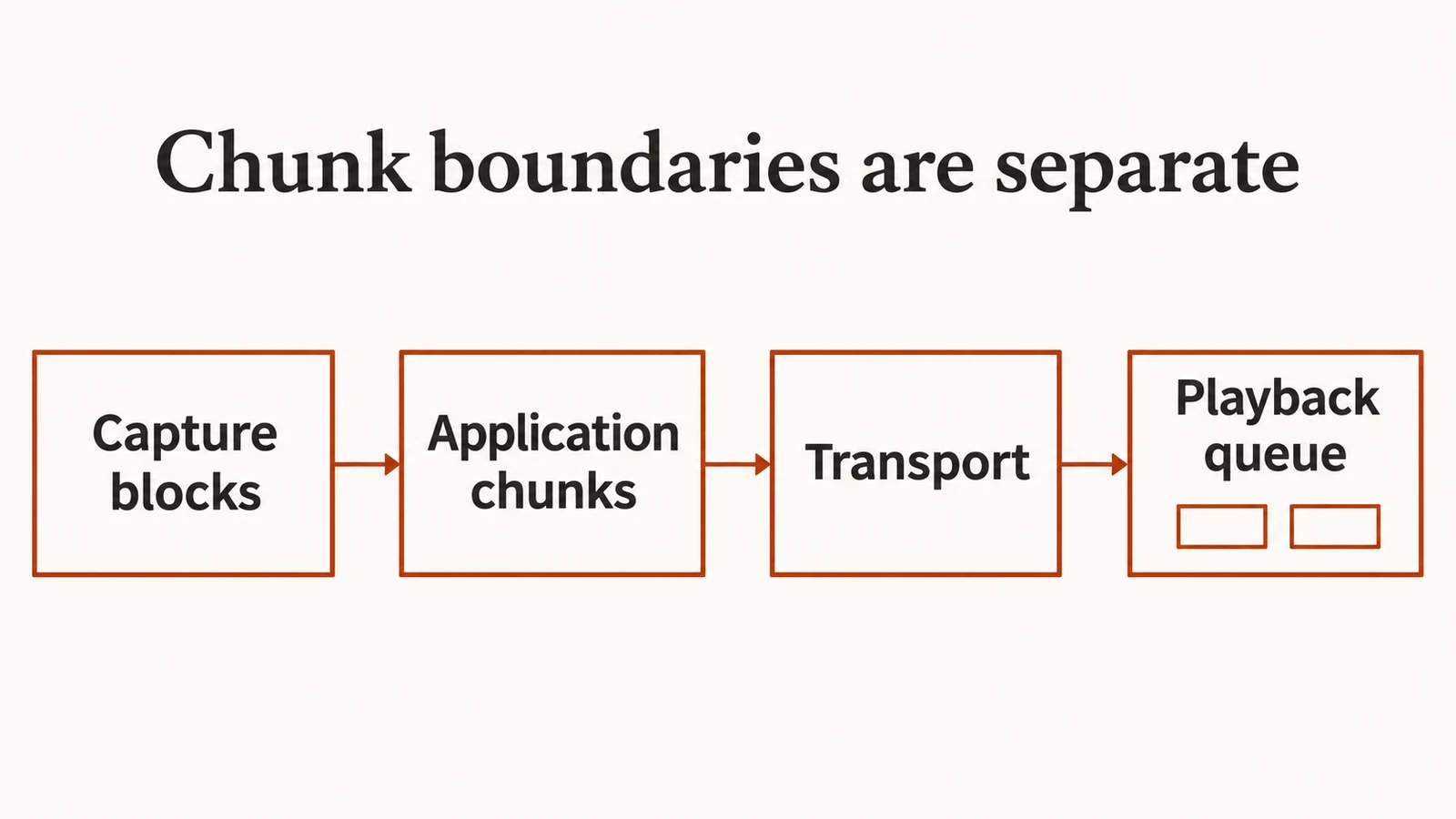
A microphone callback delivers capture blocks. An application combines or splits those blocks into messages. A codec encodes frames. A transport packetizes bytes. The receiver decodes frames and supplies samples to a playback scheduler. None of those units must match another merely because every component calls its input a chunk.
Use a small contract at the application boundary: sample rate, channel count, sample format, byte order, frame alignment, sequence number, stream epoch, and media duration. An application that accepts arbitrary bytes without checking those properties can report smooth message arrival while producing distorted or incorrectly timed sound.
For uncompressed signed sixteen-bit mono PCM, each sample occupies two bytes. A synthetic twenty-millisecond chunk at a sample rate of 16,000 samples per second contains 320 samples and 640 payload bytes. That calculation describes the fixture format, excluding transport headers, serialization, encryption, and any container bytes.
The same duration has a different payload size for stereo, another sample rate, or a compressed codec. Variable-rate encoding makes byte count a poor substitute for media duration, so carry duration or sample counts explicitly whenever the interface permits it.
Capture blocks and application messages
Do not assume the audio callback size is your network cadence. A capture block might arrive from an audio worklet while the application sends several blocks together. Conversely, a model can return a large audio segment that your application divides before transmission.
The AudioWorklet processing documentation is a useful reminder to inspect actual buffer lengths rather than hardcoding assumptions about a processing block. Your adapter should derive sample counts from the buffers it receives and reject a partial multibyte sample at a byte-oriented boundary.
When capture and networking use different execution contexts, include the handoff between them in the timing model. A worklet can be producing correctly while the main thread is too busy to forward its messages. Calling that delay "network latency" directs the investigation toward the wrong owner.
Record both media position and observation time. Media position says which part of the stream a chunk represents; observation time says when a particular component saw it. Preserving both makes a stalled application distinguishable from silence in the source audio.
Codec frames and transport packets
Codec framing has its own constraints. RFC 7587 defines the RTP payload format for Opus, including how an Opus packet relates to the RTP payload. Splitting an encoded packet at arbitrary byte offsets does not produce independently decodable audio units.
If an SDK owns packetization, tune only the settings it exposes and measure the resulting behavior. An application-level knob can change how quickly bytes reach the SDK without changing the codec's frame duration or the browser's jitter-buffer policy.
RTP and a reliable byte stream also expose different failure behavior. A lost packet and a delayed portion of an ordered stream need different recovery reasoning. The WebRTC, WebSocket, and SIP comparison provides the transport context for choosing a test rather than assuming one chunk policy applies to every route.
Avoid turning a documented codec recommendation into a universal application setting. The format specification gives you valid framing and trade-offs. Your workload, hardware, network, and cancellation requirements determine the application setting worth deploying.
Containers and complete files
An audio file is another boundary. A complete WAV or compressed file can contain headers and metadata that a raw-media endpoint does not accept. A decoder designed for complete files may also wait for data that a streaming consumer would process incrementally.
Check the receiving contract before shortening the sender's files. For example, Twilio Media Streams documents the outbound raw audio representation and warns against including file header bytes. That is an interface rule, separate from deciding how much audio each message should carry.
A chunk-size investigation should first establish that the representation is correct. Otherwise, decoding failures, silence, and delayed file completion can masquerade as a buffering trade-off. Save a tiny consented or synthetic fixture and verify its samples through the entire path before running a large matrix.
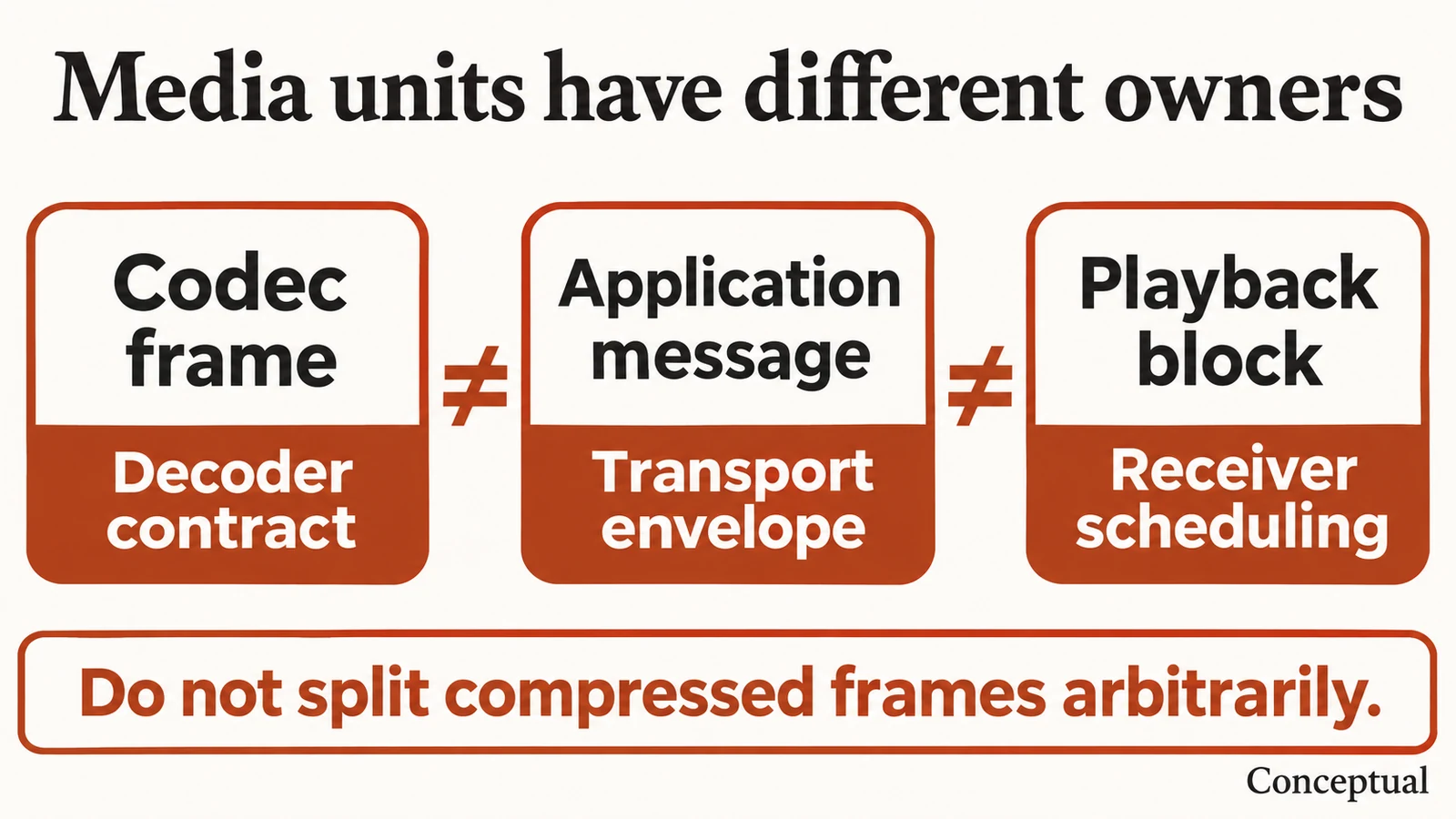
Conceptual: Codec framing, application messages, and playback scheduling are separate contracts.
Budget waiting in samples and milliseconds
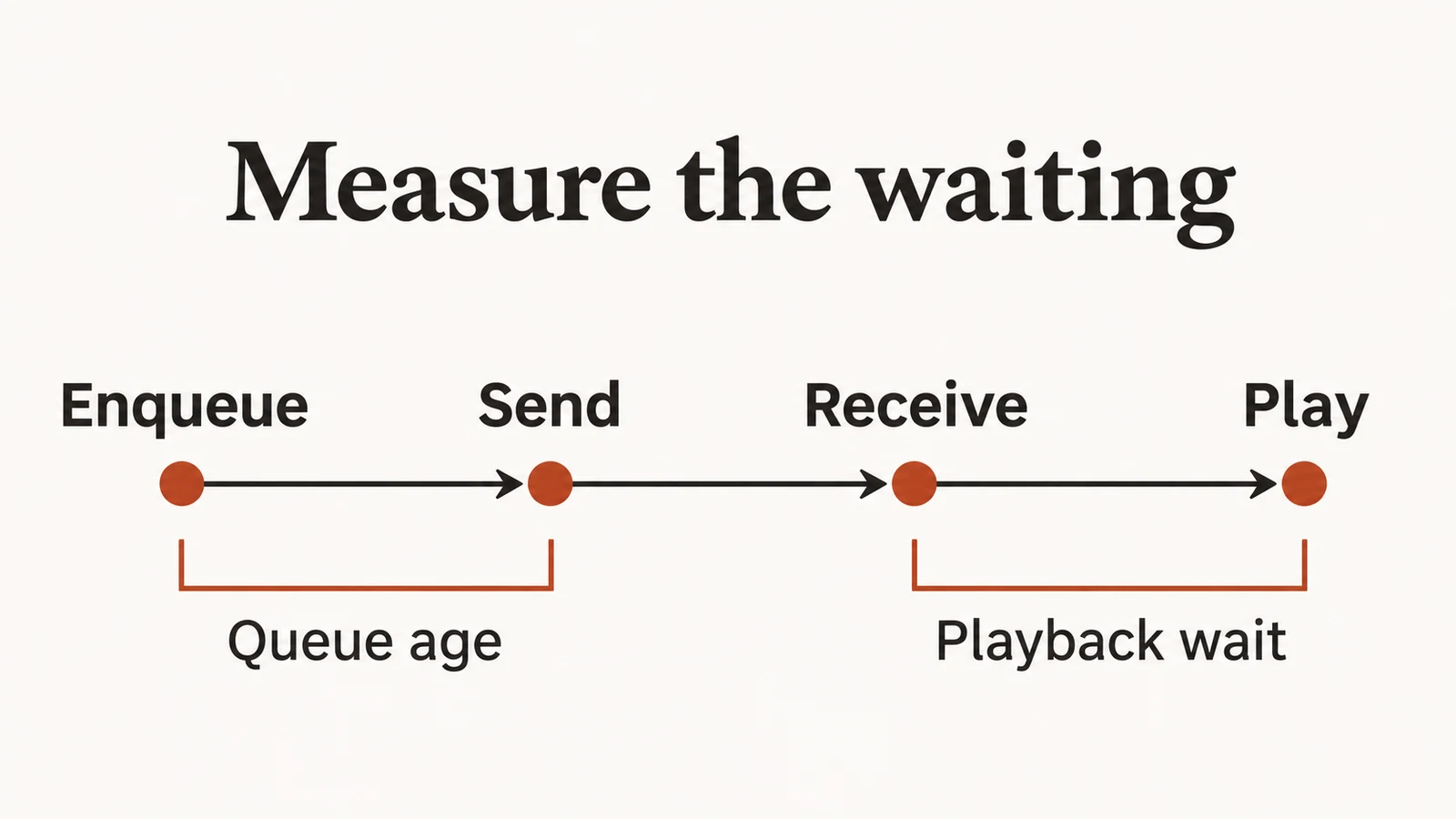
Audio queues need two measurements: media backlog, the duration of queued audio, and queue age, the time an item has already spent waiting. They answer different questions.
A queue can hold a short burst that just arrived, or the same amount of audio that has been stuck for a long time. Backlog is identical in those cases; age reveals whether the consumer is making progress. Record the oldest age as well as an age distribution at dequeue.
Packet assembly introduces waiting before an item enters a queue. If samples arrive continuously and the application waits for a complete chunk, the first sample waits longer than the last sample. A larger chunk changes that delay even when transport admission is immediate.
For a synthetic twenty-millisecond chunk assembled from a continuous source, the earliest sample waits about twenty milliseconds before the chunk is ready. The latest sample waits close to zero. These are idealized assembly bounds, excluding capture scheduling and processing, rather than a measured browser result.
Name the clocks
Use a monotonic clock for durations within one process. A wall clock can change after synchronization or an administrator action. Do not subtract server monotonic timestamps from browser monotonic timestamps; their origins are unrelated.
A trace can join events across machines through a stream identifier and sequence number without pretending their clocks share an exact origin. Calculate queue residence locally. Use a synchronized-clock method with stated uncertainty if you need a cross-machine one-way estimate.
At the receiver, record arrival and scheduled playback separately. Scheduled playback remains a software boundary. Sound leaving a speaker adds a device path that needs its own measurement if the product claim concerns what a human hears.
Keep a metric name honest by including its finish boundary. "Capture to server admission" and "capture to acoustic playback" are different measurements. The clock-domain rules in voice observability make this distinction useful in incident analysis as well as benchmark reports.
Count waiting that existed before the first chunk
A first-chunk metric can omit connection setup, source buffering, and synthesis preparation. Start the overall turn timer at the chosen caller event, then report chunk assembly and queue delays as components within that turn.
For generated speech, text availability is part of the path. If a segmenter waits for an entire paragraph before submitting text, reducing audio messages downstream cannot recover that earlier delay. The streaming sentence-boundary guide addresses that upstream decision.
This is why you should keep acknowledgment latency and useful-answer latency separate. A short filler clip can begin immediately while the substantive answer waits elsewhere. A chunk-size change should not receive credit for a different conversational policy introduced during the same trial.
Define overload before collecting percentiles
Every finite queue needs an overflow policy. You can pause a producer when its interface supports backpressure, reject new work, end a degraded session, or discard data under an explicit semantic rule. Continuing to enqueue until memory runs out is also a policy, though rarely an acceptable one.
A raw microphone stream cannot pause the caller. Backpressure at that boundary means deciding how to handle incoming media when processing cannot keep pace. A generated response can sometimes pause production, but the decoder or vendor stream may impose its own buffering and timeout rules.
Write the action beside the threshold. An alert without a recovery behavior does not prevent old speech from accumulating. A threshold expressed only in bytes is incomplete when the queue contains different encodings or sample rates.
Build a queue experiment
The following model isolates application assembly and sender service. It uses a single synthetic producer, a serial service queue, a fixed per-message service overhead, and a variable service multiplier. It does not model codecs, retransmission, acoustic playback, or a real browser.
Save it as chunk-experiment.py and run it with Python 3. The output is explicitly labeled synthetic. Changing the service profile lets you test whether the report detects waiting and failures before you trust a real collection pipeline.
from dataclasses import dataclass
from math import ceil

@dataclass(frozen=True)
class Report:
    chunk_ms: int
    messages: int
    admitted: int
    rejected: int
    oldest_wait_ms: float
    p95_wait_ms: float
    p95_first_sample_ms: float


def p95(values):
    if not values:
        return None
    ordered = sorted(values)
    return ordered[ceil(0.95 * len(ordered)) - 1]


def simulate(chunk_ms, *, duration_ms=4000, service_ratio=0.7,
             overhead_ms=2.0, age_limit_ms=100.0):
    if chunk_ms <= 0 or duration_ms <= 0:
        raise ValueError("positive media durations required")
    if service_ratio < 0 or overhead_ms < 0 or age_limit_ms < 0:
        raise ValueError("non-negative service settings required")
    free_at = 0.0
    waits, first_sample = [], []
    rejected = 0
    messages = ceil(duration_ms / chunk_ms)
    for start in range(0, duration_ms, chunk_ms):
        media_ms = min(chunk_ms, duration_ms - start)
        ready_at = start + media_ms
        begin = max(ready_at, free_at)
        wait = begin - ready_at
        if wait > age_limit_ms:
            rejected += 1
            continue
        service_ms = overhead_ms + media_ms * service_ratio
        done = begin + service_ms
        free_at = done
        waits.append(wait)
        first_sample.append(done - start)
    return Report(chunk_ms, messages, len(waits), rejected,
                  max(waits, default=0), p95(waits), p95(first_sample))


if __name__ == "__main__":
    fast = simulate(20, service_ratio=0, overhead_ms=0)
    assert fast.rejected == 0
    assert fast.oldest_wait_ms == 0
    assert fast.p95_first_sample_ms == 20
    overloaded = simulate(10, service_ratio=1, overhead_ms=2)
    assert overloaded.rejected > 0
    assert overloaded.oldest_wait_ms <= 100
    tail = simulate(30, duration_ms=95, service_ratio=0,
                    overhead_ms=0)
    assert tail.messages == 4 and tail.admitted == 4
    assert tail.rejected == 0
    for ratio in (0.7, 1.0):
        print("Synthetic example; service ratio:", ratio)
        for size in (10, 20, 40, 80):
            print(simulate(size, service_ratio=ratio))
The model considers an item rejected when its predicted service-start age exceeds the configured limit. Rejection here is a reporting exercise, not a recommendation to drop arbitrary chunks from a real conversation. A deployment must choose a semantically valid action and record the resulting failure.
The first-sample metric ends at service completion. It includes assembly, queue waiting, and service time for that message. Rename the field if you replace the simulated service with another boundary; leaving an old label in place is a common way to create an attractive but uninterpretable chart.
Why this small model helps
A per-message overhead penalizes very small chunks because the service repeats work more often. A large chunk adds more assembly waiting. A service ratio at or above the arrival rate creates sustained pressure, and the bounded-age policy exposes rejected items instead of allowing an unlimited backlog.
Those relationships are sufficient to check the measurement logic. They do not establish an optimum for a real system. The program's constants describe a synthetic fixture chosen to exercise the report, not a claim about CPU time, gateway capacity, or network behavior.
The tail test matters because real streams rarely end on a perfect chunk boundary. A chunker that silently drops a final partial chunk can look fast by deleting the last syllable. Treat end-of-stream flushing as a correctness property and test it independently of the latency distribution.
The zero-service test checks the assembly boundary. If the first-sample number becomes zero under that fixture, your code has probably started timing too late. A measurement harness should fail when you remove a delay that belongs inside the contract.
Extend only the boundary under study
For a transport trial, retain sequence numbers and replace simulated admission with actual enqueue and send observations. Add receiver arrival and playback observations under their own clocks. Keep the synthetic experiment intact as a fast self-check for your reporting code.
Do not replace every parameter at once. If you simultaneously change codec, chunk size, connection reuse, and playback policy, a changed result has several plausible causes. Use the regression testing guide to preserve fixed fixtures and version provenance around each trial.
A useful extension replays a burst profile rather than assuming even production. TTS commonly supplies data in bursts, while playback consumes media at its sample cadence. Record how much audio each burst introduces and how quickly the queue returns to its intended range.
Another extension pauses the consumer for a synthetic interval. Observe whether age reporting rises, whether the selected overload action occurs, and whether recovery emits stale speech. The purpose is to prove that the instrumentation detects the failure you care about before testing unstable real networks.
Run a controlled transport trial
Choose candidate durations supported by the actual interface. Keep the audio fixture, model settings, route, concurrency, and receiver implementation fixed. Run both steady and bursty input, because a setting that survives smooth input can still build a backlog after a large synthesis burst.
Record every attempt, including connection failure, invalid framing, queue rejection, cancellation, underrun, and missing playback evidence. Successful-attempt percentiles alone reward a configuration that discards its hardest work. Use a failure ledger next to the latency table.
Randomize or interleave candidate runs when conditions change over time. Running every small-chunk trial before every large-chunk trial can confound the comparison with a device warming up, network congestion, or a server scaling event.
Keep warm and cold cohorts distinct. A warm transport trial answers a different question from initial connection setup. The same distinction applies to decoder initialization, microphone permission, and audio-context activation on a browser.
Required observations
For each chunk, preserve media start, media duration, stream epoch, sequence, enqueue time, dequeue time, payload bytes, and disposition. At the receiving side, record whether the chunk was accepted, decoded, scheduled, played under available evidence, or invalidated.
Avoid retaining raw speech merely to count queue residence. A content-free trace can carry durations and identifiers scoped to the test. Use synthetic audio for harness development and apply your approved retention rules before introducing consented human recordings.
The browser's WebSocket.bufferedAmount measures application data queued by send() that has not yet been transmitted to the network. It does not prove remote decoding or playback. Use it as one local pressure signal with a carefully named field.
Classic WebSocket also lacks the automatic receiving backpressure behavior described for stream-based alternatives in the WebSocket API documentation. A successful send() is insufficient evidence that the downstream system can consume more audio at the intended rate.
Comparison criteria
The table compares evidence, not products. A check means the observation directly addresses the question; a cross means another measurement is required. Availability depends on the SDK and transport you use.
| Observation | Local pressure | Remote receipt | Playback completion | Cancellation proof |
|---|---|---|---|---|
| Application queue age | ✓ | ✗ | ✗ | ✗ |
| Socket buffered bytes | ✓ | ✗ | ✗ | ✗ |
| Receiver sequence acknowledgment | ✗ | ✓ | ✗ | ✗ |
| Player completion event | ✗ | ✗ | ✓ | ✗ |
| Explicit clear plus invalidation ledger | ✗ | ✗ | ✗ | ✓ |
Even a playback-completion event needs interpretation. Some protocols acknowledge both played and cleared media through related messages. Keep an explicit clear ledger so that clearing a queued chunk does not later count as a successfully heard answer.
Listening checks belong beside timing
A queue can be short while audio clicks, repeats, or loses words. Add a listening rubric for boundaries: clipped consonants, gaps between chunks, repeated samples, missing tail audio, and incorrect playback order. Confirm findings against sample continuity where possible.
Use a fixed listening set for paired comparisons, then a held-out set for a final check. A synthesized fixture is useful for deterministic timing, but it does not represent every speaker, device, or acoustic condition. Label that coverage gap in the report.
For multilingual output, include speech with different speaking rates and pause patterns. Do not assume equal text length creates equal audio duration. The multilingual benchmark guide explains how cohort definitions prevent a pooled average from hiding a language-specific problem.
Handle overload and cancellation
Cancellation changes the meaning of queued audio. Once the user interrupts or the session switches to a new response, old audio may remain valid bytes while becoming invalid content. A chunk-size policy needs a way to prevent that content from being admitted or played later.
Attach a response epoch to every generated chunk. Increment or replace the epoch when a response is invalidated. Check it before enqueueing, before transport admission where possible, and before playback in a receiver you control. Closing one local queue does not retroactively remove bytes already accepted downstream.
Smaller messages can reduce the amount of audio attached to each cancellation decision. They cannot guarantee immediate silence after the receiver has buffered or scheduled earlier messages. Measure the invalidation-to-last-old-audio boundary rather than claiming a stop from the sender's cancellation time.
The interruption-safe agent guide treats this as ownership across a response lifecycle. Your chunk experiment should include the same principle without assuming that canceling synthesis cancels transport or playback.
Choose an overload action by stream meaning
For live caller input, dropping old audio can change words and remove a negation. Ending the stream with an explicit degraded-state signal can be safer than silently passing a shortened command to recognition. The action depends on the product's purpose and supported recovery path.
For assistant output, replacing a whole invalid response can preserve meaning better than removing arbitrary middle chunks. Keep response boundaries and epochs available to the queue manager so that it can invalidate a unit of speech instead of guessing from byte positions.
Do not solve persistent overload by increasing the buffer indefinitely. More storage changes how long the system can hide its deficit; it does not make the consumer faster. A bounded backlog also gives operators a finite recovery target and a clear reason for the session's degraded outcome.
Recovery needs an explicit boundary
After a connection resumes, determine whether the receiver expects continuation, a fresh stream, or a new media timestamp origin. Replaying old chunks without that contract can duplicate words or produce a burst of obsolete speech.
A resumed call can keep the same business task while creating a new media epoch. Those identities serve different purposes. Reuse the task's verified state, but reject late media from an earlier stream unless the protocol explicitly permits and orders that continuation.
The shutdown semantics guide provides a related drain-and-stop model. A clean shutdown must decide which queued work completes and which work becomes invalid, just as an interruption must decide which response still owns playback.
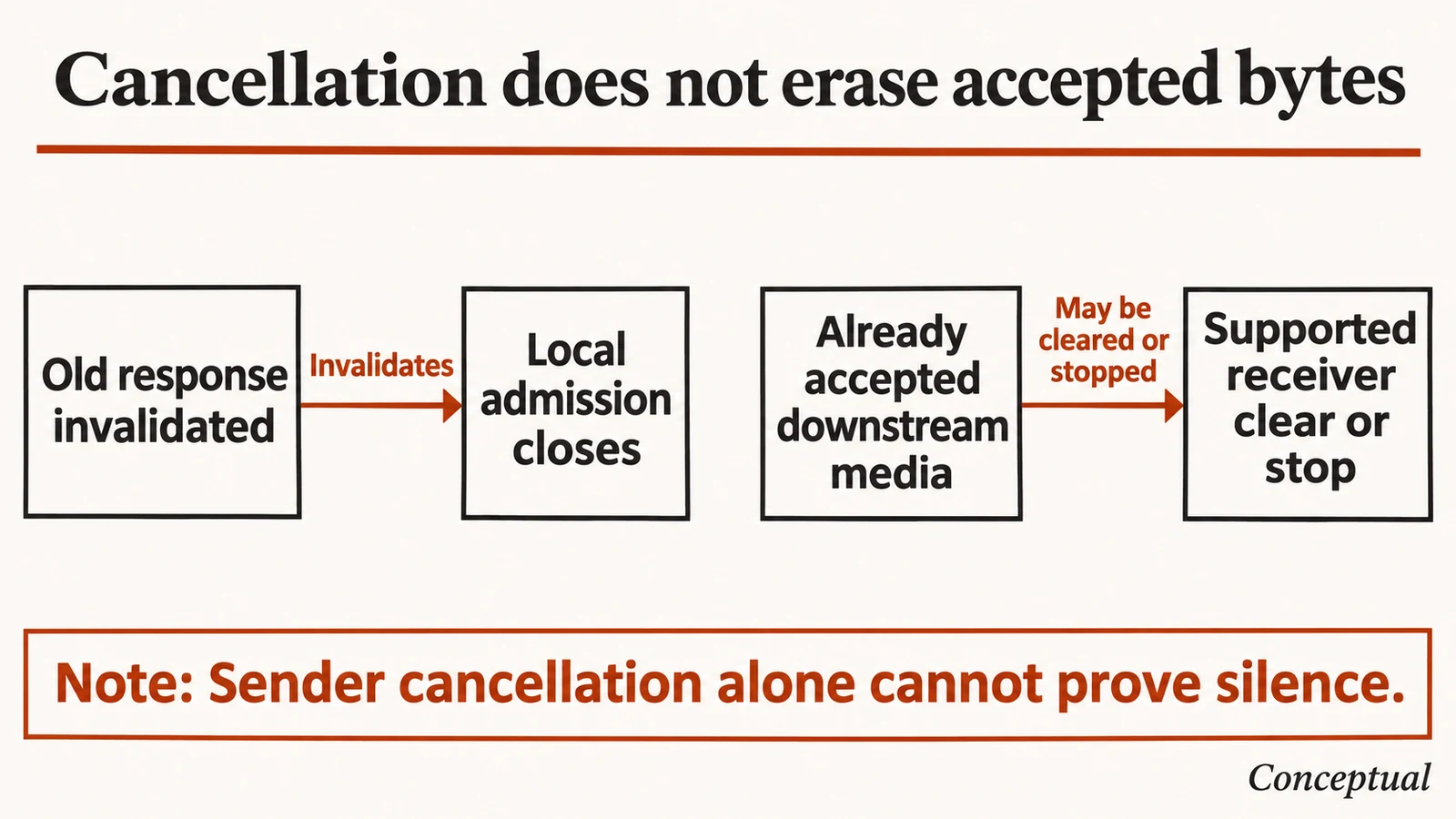
Conceptual: Invalidating a response closes future admission; already accepted media needs the receiver control available at that boundary.
Interpret the evidence
A useful result names a configuration, workload, measurement boundary, failure denominator, and uncertainty. It reports whether queue age remains bounded, whether the stream preserves content, and whether cancellation behaves as intended.
Do not combine different clocks into a single exact-looking waterfall. Show local durations beside a joined event sequence. When a gap between systems remains unmeasured, mark that gap and choose additional instrumentation only if resolving it changes the engineering decision.
A candidate can improve queue residence while increasing underruns. Another can reduce message overhead while delaying the first sample. Decide against the product's criteria rather than selecting whichever configuration wins the prettiest individual metric.
Write those criteria before reading the candidate results. For example, require correct sample reconstruction, bounded waiting under the chosen load, a documented overload action, and acceptable interruption behavior. Then compare resource consumption among candidates that meet those requirements.
Audit sample accounting before timing
Create a separate correctness ledger for the synthetic transport fixture. Give every source sample a stable position and verify that decoded output covers the intended interval exactly once. A timing report can look plausible even when a chunker repeats an overlap or truncates a buffer at a byte boundary.
At a PCM boundary, compare reconstructed samples against the original fixture. At a lossy codec boundary, exact equality is inappropriate; verify decoded duration, order, missing intervals, and a suitable listening or signal-quality check instead. Write down which comparison applies before interpreting a difference as corruption.
Include a fixture with an impulse near a chunk boundary and another with a sustained tone across it. The impulse helps locate clipping or repeated positions. The tone makes discontinuities easier to hear, though neither fixture replaces speech with consonants, pauses, and changing amplitude.
Check both the normal and invalidated paths. Normal completion should preserve all intended samples. Cancellation should remove the explicitly invalid interval without allowing a late producer callback to repopulate the queue. These are different expected outputs, so do not use one generic missing-data assertion for both.
A receiver restart should also create a visible discontinuity in the accounting ledger. If sequence numbers reset while the trace retains the old stream identity, a reporting join can attach new observations to old chunks. Include an epoch in the join key and test that an old acknowledgment cannot complete a new item.
Separate resource savings from caller benefit
Measure allocations and message rate alongside media timing. A candidate can use fewer application messages while leaving the same codec packets on the wire. Another can reduce local allocations but increase the amount of audio waiting after the user interrupts.
Report resource observations under the same workload and concurrency as the latency trial. CPU sampled during an idle single stream does not establish behavior under a busy shared worker. If your environment cannot measure per-stream CPU reliably, say so and retain process-level observations with the competing work described.
Account for serialized size as well as payload size. Encoding binary media as text changes transmitted bytes, and envelope metadata repeats for every message. Calculate the format cost from the actual serialized fixture rather than applying a generic overhead percentage to every transport.
Avoid extrapolating a small local saving into a cost claim without a complete denominator. Connection count, carrier charges, synthesis billing, and operational handling can dominate an application's economics. The cost-per-success guide supplies the broader task boundary when a queue change is being justified financially.
Check the observer does not create the queue
Instrumentation can change the behavior it measures. Logging every chunk synchronously, copying each payload for inspection, or drawing a waveform on the main thread can introduce additional waiting. Keep content-free timestamp collection small and buffer the resulting diagnostic events under a separate bounded policy.
Run a paired check with detailed diagnostics enabled and with only the minimum counters enabled. Report any observable difference rather than assuming measurement overhead is negligible. If the test device is resource constrained, the observer can become the dominant work even though the production media path would otherwise keep pace.
Separate missing telemetry from missing audio. An event collector that reaches its own cap should report a diagnostic overflow category. It must not quietly erase the worst queue samples and then leave the latency report looking healthy. Preserve attempt counts even when the detailed trace is incomplete.
Document which instrumentation was active in every comparison. A candidate tested with full payload logging cannot be compared fairly with another tested using lightweight counters. This small environment detail is often cheaper to preserve than reconstructing an inconclusive benchmark later.
Preserve an incident reproduction bundle
When a trial fails, save the smallest content-free bundle that reproduces its timing pattern: candidate settings, media durations, arrival offsets, service observations, dispositions, and reporting version. Use a synthetic waveform if the failure depends on media continuity. This gives a second engineer something executable instead of a screenshot of a percentile.
For a real-network incident, preserve the observed event gaps without claiming the simulator reproduces the network itself. Replaying the gaps can validate the queue's behavior under those arrivals, while the cause of those arrivals remains a separate investigation.
Run the bundle against the current and proposed settings. Check that the proposed setting fixes the observed failure without breaking the tail, cancellation, and overflow fixtures. A tuning change earns deployment when it addresses the actual failure boundary and preserves the contracts you already verified.
Report a decision rather than a universal number
A defensible conclusion can say that a specific duration worked within the tested load and route, while another produced unacceptable waiting or failures. It should also say which environments remain untested and what observation would trigger a reassessment.
Retain the raw content-free events and reporting version so someone can recompute the result. Keep units in field names. Preserve rejected and canceled attempts even when the final presentation summarizes them in a smaller table.
If the evidence cannot distinguish two candidates, prefer the simpler supported setting and record the unresolved difference. An inconclusive test is useful when it prevents a needless tuning mechanism. It becomes misleading only when you rename uncertainty as a measured win.
Review after deployment
Monitor the same queue-age and failure signals in production using an approved privacy-preserving schema. A laboratory setting can drift when concurrency, browser versions, provider behavior, or response length changes.
Use cohort-specific alerts rather than treating all streams as interchangeable. A mobile receiver can develop playback waiting while a server transport remains healthy. The mobile browser latency guide describes the lifecycle and device evidence needed for that branch of diagnosis.
Keep rollback simple: restore the previous supported configuration and compare the same measurements. Do not introduce adaptive chunk selection until a fixed policy has a demonstrated problem that adaptation can solve and a test set that can detect adaptation failures.
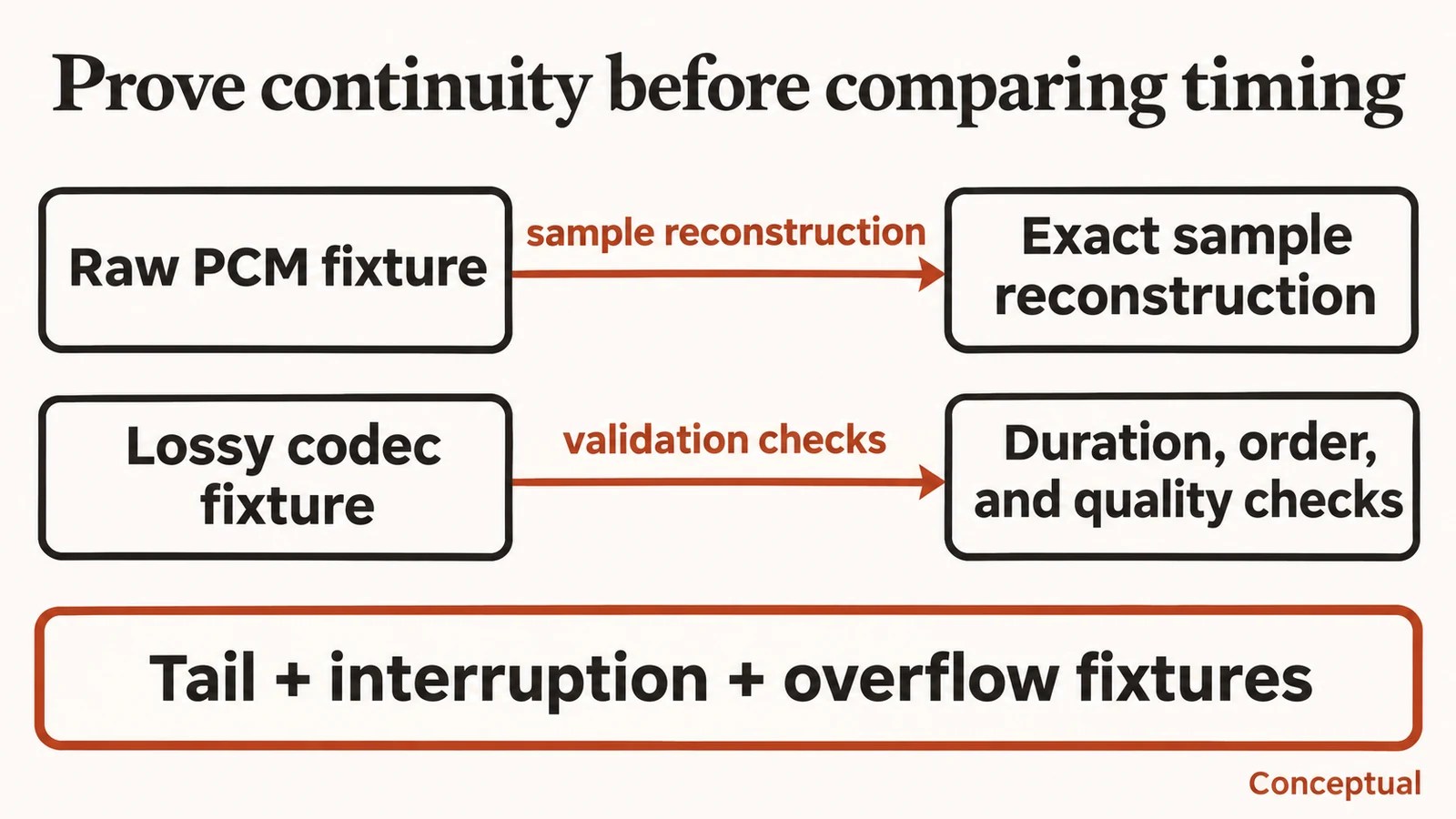
Conceptual: Use exact reconstruction for raw PCM and appropriate duration, order, and quality checks for lossy media.
Frequently asked questions
What is the best audio chunk size?
The best size is the supported setting that meets your delay, continuity, resource, and cancellation criteria on the target workload. A codec recommendation is a useful starting point, but an application chunk also interacts with capture, serialization, transport, and playback queues. Measure those boundaries before adopting a universal value.
Does a smaller chunk always lower latency?
A smaller chunk reduces assembly waiting under a continuous source, but it also increases message frequency. Repeated serialization, scheduling, or encryption overhead can create additional pressure. Compare queue age and failed attempts alongside first-sample timing so an apparent improvement does not hide overload.
How do I convert PCM bytes into duration?
Divide payload bytes by sample rate, channel count, and bytes per sample, then convert seconds to the desired unit. Verify that the payload is raw PCM with the stated format. Headers, compressed data, or a partial sample make that calculation invalid.
Are codec frames and WebSocket messages equivalent?
They are separate units. An application message can carry one frame, several frames, or bytes that require reassembly. The decoder and endpoint contract determine which framing is valid. Avoid splitting compressed frames arbitrarily merely to achieve a desired message length.
What does socket buffered amount prove?
It describes a local transmission queue under the socket's documented semantics. It does not establish remote application receipt, decoder progress, or audible playback. Retain it as one pressure signal and obtain receiver-side evidence for any claim about downstream latency.
Why measure queue age as well as queue length?
Length describes how much work is waiting. Age describes how long work has remained there. A short queue can still be stalled, and a large queue can be a recent burst draining normally. Both observations help distinguish transient bursts from persistent processing deficits.
Can I compare timestamps from different machines?
You can join events using identifiers, but direct subtraction requires a justified clock relationship. Monotonic origins differ across processes. Report local durations unless you have a synchronization method with known uncertainty, and keep that uncertainty visible in cross-machine measurements.
Should I drop old microphone audio during overload?
Only under an explicit policy that accounts for lost meaning. Dropping a negation or an identifier can change a command. If the application cannot preserve the input contract, expose a degraded state and request repair rather than silently presenting incomplete speech as trustworthy input.
Is first received audio the same as first heard audio?
Received bytes can wait for decoding, scheduling, device buffers, or an output route. A client arrival timer stops before those stages. Use a playback observation or a calibrated acoustic capture when the question concerns audible response, and label each finish boundary separately.
How should I test the final partial chunk?
Use fixtures whose lengths are not multiples of the candidate duration. Confirm that all complete samples reach the receiver in order and that end-of-stream flushing does not duplicate or omit the tail. Include silence and short final consonants in the listening set.
Can a large downstream buffer improve quality?
A buffer can absorb arrival variability and reduce gaps, but it also increases waiting and can extend stale playback after cancellation. Evaluate both effects. Treat the buffer's purpose and upper bound as part of the measurement contract rather than assuming more buffering is free.
Should generated audio be paced before sending?
Pacing can prevent a fast producer from filling downstream queues, provided the receiving interface supports the chosen behavior. Measure the queue that pacing creates locally as well. Moving waiting from a gateway into your process only helps when it improves control, cancellation, or resource use.
Why do chunk boundaries produce audible clicks?
Clicks can come from discontinuous samples, incorrect format interpretation, missing data, or scheduling gaps. A chunk-size change alone may not repair those causes. Verify sample continuity and playback scheduling with a known fixture before attributing the symptom to network duration.
How do I test cancellation fairly?
Interrupt at several media positions, invalidate the response epoch, and observe the last old-response audio at the receiver. Record bytes already accepted downstream and whether a clear or stop action exists. A sender-side cancellation event by itself does not prove playback stopped.
Can I combine warm and cold trials?
Keep them separate in the primary report. Connection setup, decoder initialization, permission prompts, and audio activation can dominate cold trials. A pooled percentile obscures which experience changed and makes repeated runs sensitive to an undocumented mixture of startup conditions.
Does the simulator predict production performance?
It predicts only the behavior of its stated synthetic queue model. Its value is validating accounting, overload reporting, and boundary definitions. Replace one modeled boundary at a time with observed events before drawing conclusions about a real browser, codec, carrier, or provider.
What if a setting has low latency but many failures?
Report both outcomes and apply the predeclared acceptance criteria. Successful-only latency can improve because the hardest attempts never complete. Count framing errors, rejection, missing playback, and canceled attempts in explicit categories so a configuration cannot win by losing work.
How should I store diagnostic events safely?
Prefer content-free fields such as durations, queue sizes, sequence numbers, and bounded test identifiers. Raw transcripts and recordings are unnecessary for many queue questions. Where listening evidence is required, use synthetic fixtures first and apply approved consent, access, and retention rules to human recordings.
When should I change the chosen duration?
Revisit it when observed workload, transport behavior, device cohorts, or cancellation requirements change. Keep the original evidence and rollback setting. A new knob should respond to a demonstrated failure mode, with a test that distinguishes a real improvement from shifted buffering.
How does this apply to 60db Agent?
Use the same external measurement contract around the documented integration you evaluate. Record caller-side observations, supported transport settings, failures, and unmeasured boundaries. This guide describes generic engineering methods and makes no claim about private implementation details or measured performance for 60db Agent.
Choose a setting you can explain
Run the small simulator to verify your reporting assumptions, then collect a paired transport trial with explicit queue and playback boundaries. Keep sample correctness, failure counts, and cancellation evidence beside the timing distribution.
The useful output is a configuration decision with a workload and a rollback condition. Add the experiment to your voice regression suite and use the latency measurement contract to keep future comparisons honest as the surrounding system changes.