
- Architecture
Caller authentication without trusting voice alone
Caller authentication needs external verification, current sessions, and exact action approval. Test expiry, revocation, and repairs.
- Author
 Udit Goenka
- Editorial date
- Reading time
- 26 min

TL;DR: Caller authentication needs independently verified credential evidence, a current session binding, and permission for the exact requested action. Voice, caller ID, remembered names, and fluent conversation cannot replace those checks; repairs, expiry, and revocation must invalidate stale authority before the next action.
A caller knows the account name and speaks confidently about an order. The agent finds a matching record and prepares a delivery change. The unresolved question is whether the current person controls an appropriate credential and has permission to change that exact resource now.
The shared-phone identity guide explains why familiar contact information does not answer that question. This guide gives you a small runnable admission contract that consumes trusted external verification assertions. It separates verified identity, live session, current intent, and action approval while keeping credential verification outside the example.
The artifact performs no voice comparison, passkey verification, one-time-password challenge, or real business action. It emits synthetic positive and negative fixture results. Those results demonstrate the local binding rules, not that an identity provider, telephone network, or production account system is secure.
Table of contents
- Separate authentication from authorization
- State the NIST rule within its scope
- Treat caller ID as admission context
- Bind the trusted assertion
- Bind the exact current intent
- Keep session expiry observable during silence
- Let revocation win over old success
- Run the action-admission reference
- Read the ownership and type fixtures
- Protect credentials from the conversation path
- Handle repairs without silently preserving approval
- Design an unauthenticated and failure route
- Compare local evidence with production obligations
- Evaluate the complete integration honestly
- Make the trust assumptions reviewable
- Reproduce mid-call changes deliberately
- Preserve the right evidence after a failure
- Frequently asked questions
- Build the smallest trustworthy admission boundary
Separate authentication from authorization
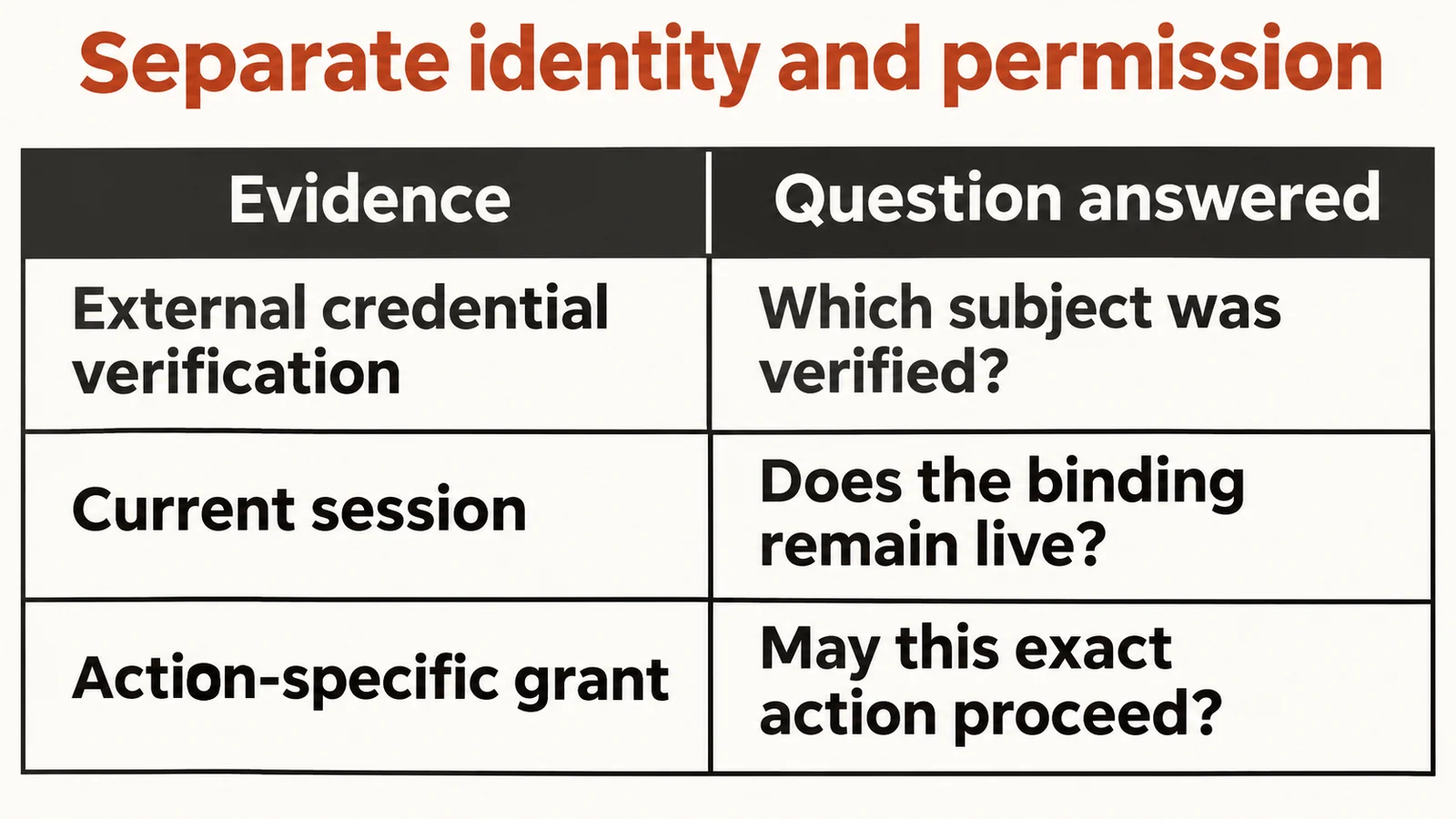
Authentication concerns evidence that a claimant controls an authenticator associated with a subject. Authorization concerns what that subject may do to a resource under current policy. Intent confirmation concerns whether the person approved the exact material operation now proposed. A successful check in one category does not automatically complete the others.
OWASP's authentication cheat sheet describes authentication controls and reauthentication around sensitive features. Its advice should be implemented through a real credential-verification route, rather than imitated by asking a language model whether a caller sounds legitimate.
OWASP's authorization cheat sheet recommends default denial and checking permissions on every request. That remains relevant after a caller successfully authenticates. Reading order status and changing a delivery preference can require different permissions, even for the same person during one call.
The workflow-enforcement guide explains how deterministic state can enforce required steps independently of conversational wording. A model can help collect a request or explain the verification route. The application must own the transition from proposed action to an authorized operation.
Keep those evidence types in separate structured fields. A verified-subject assertion should not also mean approved-current-payload unless the external contract explicitly establishes both. The reference therefore requires a verification assertion and a separate action grant, then compares both with the current session and material request.
State the NIST rule within its scope
The current NIST SP 800-63B-4 section 3.2.3 states that biometric comparison based on voice SHALL NOT be used. That is a requirement within that standard's stated scope. It must not be rewritten as a universal legal prohibition governing every voice product in every jurisdiction.
The same guidance places biometric use within its defined authentication framework and discusses authenticator requirements. Use the actual standard and your organization's applicable policy when selecting an identity design. Do not extract one sentence and claim that it certifies the rest of a call flow.
This article's teaching policy accepts only a trusted assertion labeled external-credential. That label means the verifier is outside the example; it is not a NIST assurance level or a certification. The negative voice-only fixture is rejected under this explicit local contract without attempting any biometric comparison.
The spoken prompt-injection guide explains a related authority boundary. A transcript asserting that the caller has already authenticated cannot create an external verification assertion. Nor can a model decide that persuasive speech overrides an unavailable or expired credential check.
Keep public claims precise. A voice-clone regression clip could test how one deployed system behaves under a controlled setup, but it would not prove universal security or legal compliance. This artifact does not render or classify such a clip, so it reports no acoustic attack-resistance result.
Treat caller ID as admission context
Caller ID and telephone attestation can support call-admission or anti-abuse decisions under a provider's contract. They do not by themselves establish which business account subject is currently speaking or what action that person approves. Keep network evidence separate from account-authentication evidence.
A real developer issue about inbound-call attestation discusses an optional STIR/SHAKEN requirement and caller-ID spoofing concerns. It is useful practitioner context for distinguishing call admission from business identity. The issue is not an independently reproduced security benchmark or proof that a particular current integration is vulnerable.
The phone-number capture guide also distinguishes a preserved number from validity, reachability, and ownership. Correctly capturing or receiving a phone number does not answer who controls the relevant credential or whether the account permits the current operation.
A shared family phone, an assistant calling for another person, a transferred call, or a redial can all require explicit identity handling. These are engineering scenarios, not claims about observed customer traffic. The correct treatment depends on the authorized workflow and its actual credential and delegation rules.
The safe unauthenticated route should be defined in advance. It might offer public information, explain the verification process, or arrange an authorized handoff. It should not disclose personalized account data while silently treating a familiar telephone number as a substitute credential.
Bind the trusted assertion
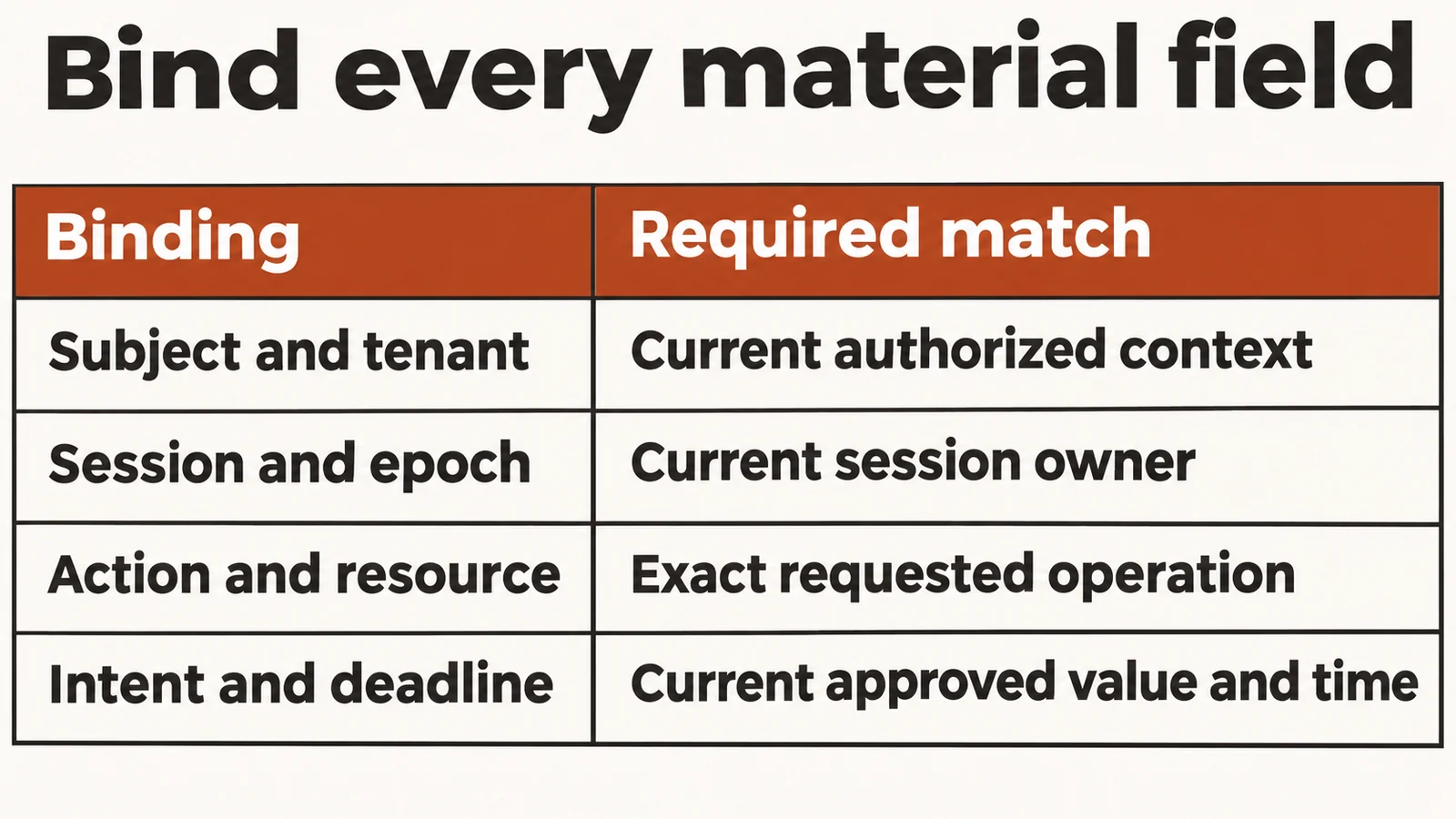
A trusted verification assertion should identify its subject, tenant, session, verification reference, method classification, verified time, expiry, and session epoch under an explicit adapter contract. The reference uses bounded synthetic labels and a declared integer clock domain. Real integrations need their own verified issuer and transport evidence.
The assertion's verification reference connects the action grant to the particular verification event. A new verification event is not automatically interchangeable with an old one. The fixture changes that reference and verifies that the original grant no longer matches, even when other visible account context stays similar.
The memory-across-calls guide explains why retained account facts need explicit identity and expiry evidence. Remembering a prior caller's name or preferred address does not renew a verification assertion for a new session or another person using the same phone.
Tenant and resource context must remain explicit too. An identifier can exist in more than one tenant, and a verified subject may have permission for one resource without permission for another. The local contract tests tenant, subject, session, and operation mismatches as separate negative cases.
The assertion must arrive through the trusted adapter path. Do not create it by copying a transcript dictionary containing verified, role, or account-owner fields. A signed provider callback can authenticate a provider event under its own contract, but its payload still needs interpretation before it becomes action-specific business permission.
Bind the exact current intent
A verified subject can make several requests during a call. Some can be public reads; others can change account state. Even if a general permission covers a feature, the application still needs the current material value that the caller intended and approved.
The reference's request is deliberately small: update one synthetic order's delivery preference to a supported value. The action grant repeats the action, resource, and value alongside the subject, tenant, session, epoch, verification reference, and deadline. The policy compares that tuple with both the requested operation and the session's current intent.
The literal identifier guide explains why exact character preservation matters before this boundary. A wrongly normalized resource identifier can bind approval to the wrong record. The authorization layer should consume the admitted literal under the destination contract, not silently repair it during submission.
The money and quantity guide gives another example of material context. Currency or unit changes are not display-only edits. An action approval must cover the actual typed value and context used by the consuming operation.
Keep new logical requests distinct from exact retries. A corrected preference requires a new approval request identity in the controller. An exact retry must preserve its original identity and frozen payload. The pure policy helper implements neither transport protocol; it provides the exact fields that such a controller must keep stable.
Keep session expiry observable during silence
Expiry should be enforced when an operation is considered, even if no callback has arrived since the last successful verification. A quiet interval does not keep a credential or approval alive. The reference checks current time against both verification expiry and action-approval deadline on every policy query.
The comparison is exact: a time equal to expiry is no longer valid. A future verification timestamp is also rejected rather than treated as unusually fresh evidence. The clock is an external trusted input in one declared test domain; it cannot be copied from an untrusted request to make old evidence appear current.
OWASP's session-management cheat sheet describes session lifecycle controls. Use the real session store and provider semantics when implementing expiration or revocation. A field in a local dataclass does not itself invalidate a remote token or terminate every active session.
The truthful tool-waiting guide is relevant while verification is pending. Tell the caller what is actually known. An authentication request being processed is not a completed verification, and a timeout should not be converted into a success merely to avoid a conversational pause.
If a controller awaits verification, a lookup, or confirmation, it must read current session evidence again after the await and immediately before ordered submission. The local synchronous function does not lock remote state. A downstream action service must repeat authorization at its authoritative mutation boundary.
Let revocation win over old success
A previously valid assertion can become unusable mid-call. The subject may sign out, permissions may change, the session may be revoked, or a resource may move outside the current grant. Keep current authoritative evidence separate from the historical verification result.
RFC 7009 defines OAuth token revocation and discusses propagation considerations. Do not claim that invoking a revocation endpoint instantly refreshes every cached authorization view everywhere. Design the consuming service around its documented invalidation and current-permission behavior.
The reference makes current revocation an explicit input and checks it before allowing an operation. A session-epoch change also invalidates the earlier assertion and grant. The fixture passes the old successful evidence alongside the new current session and expects denial, rather than letting a cached verification result restore authority.
The interruption-safety guide describes the same ownership discipline for late work. A canceled or superseded call task must not reclaim authority when an old callback eventually succeeds. Revocation and current generation are evaluated by the active owner, not the obsolete result.
The regional-failover guide treats ownership across regions. Moving a call to another worker does not justify copying a stale permission snapshot and assuming it remains current. The receiving boundary needs an authoritative session and operation contract.
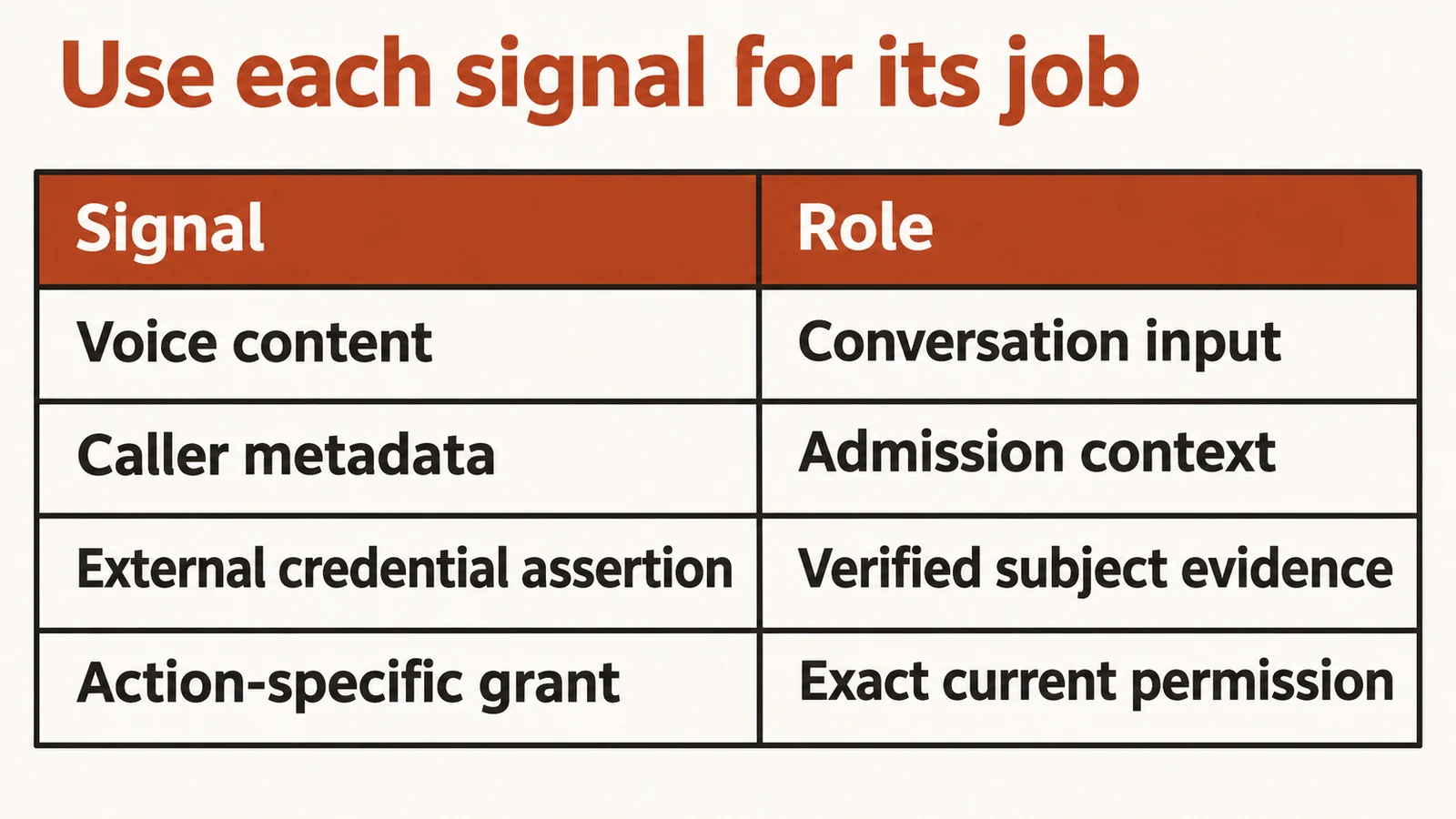
Keep those distinctions visible in the call's recovery behavior. A familiar voice can help a conversation feel continuous, but it does not renew a revoked session. A corrected account identifier can improve the candidate lookup, but it does not transfer an earlier verification to a new subject. A fresh credential assertion can establish current verifier evidence, but it does not approve a different delivery preference automatically.
The reference intentionally leaves each required comparison inspectable instead of returning one broad authenticated boolean. That shape helps an engineer see which evidence is missing and which component owns the repair. It also prevents a downstream caller from interpreting a successful identity check as permission to skip current intent, resource scope, or deadline checks. The actual service remains responsible for enforcing those requirements when it performs the operation.
Run the action-admission reference
Run the full fence with Python's standard library. It returns permit, step-up, or deny with a bounded reason. It includes actual fixture expectations and observed results, then emits them as JSON. It never returns a real credential, a raw token, a transcript, or a business-action receipt.
All assertion and action-grant objects in the fixture are synthetic trusted-adapter records. Their constructors are not credential verifiers. In a production integration, the identity provider and application authorization service must supply verified evidence through a protected path that model output cannot write.
from dataclasses import dataclass, replace, FrozenInstanceError
import json
import re

def counter(v):
    return type(v) is int and 0 <= v <= 1000000

def label(v):
    return type(v) is str and re.fullmatch(r'[A-Za-z0-9_-]{1,64}', v) is not None

@dataclass(frozen=True)
class Request:
    action: str
    resource: str
    value: str

def request(fields):
    if (type(fields) is not dict or set(fields) != {'action', 'resource', 'value'} or
            not all(type(v) is str for v in fields.values()) or
            fields['action'] != 'update_delivery' or fields['resource'] != 'synthetic-order' or
            fields['value'] not in ('pickup', 'delivery')):
        raise ValueError('unsupported request')
    return Request(fields['action'], fields['resource'], fields['value'])

@dataclass(frozen=True)
class Assertion:
    reference: str
    subject: str
    tenant: str
    session: str
    epoch: int
    method: str
    verified_at: int
    expires_at: int

@dataclass(frozen=True)
class ActionGrant:
    verification_ref: str
    subject: str
    tenant: str
    session: str
    epoch: int
    action: str
    resource: str
    value: str
    deadline: int

@dataclass(frozen=True)
class Session:
    subject: str
    tenant: str
    session: str
    epoch: int
    current_intent: Request
    revoked: bool = False

def authorize(a, g, r, s, now):
    if not counter(now) or type(s) is not Session or type(s.revoked) is not bool:
        return 'deny:invalid-current-evidence'
    if s.revoked:
        return 'deny:revoked'
    if a is None:
        return 'step-up:external-verification-required'
    if type(a) is not Assertion or type(r) is not Request or type(s.current_intent) is not Request:
        return 'deny:invalid-evidence'
    try:
        for candidate in (r, s.current_intent):
            request({'action': candidate.action, 'resource': candidate.resource, 'value': candidate.value})
    except ValueError:
        return 'deny:unsupported-intent'
    if not all(label(v) for v in (a.reference, a.subject, a.tenant, a.session,
                                   s.subject, s.tenant, s.session)):
        return 'deny:invalid-evidence'
    if not all(counter(v) for v in (a.epoch, a.verified_at, a.expires_at, s.epoch)):
        return 'deny:invalid-evidence'
    if a.method != 'external-credential':
        return 'deny:unsupported-verification-method'
    if not a.verified_at <= now < a.expires_at:
        return 'deny:verification-not-current'
    if (a.subject, a.tenant, a.session, a.epoch) != (s.subject, s.tenant, s.session, s.epoch):
        return 'deny:session-binding'
    if g is None:
        return 'step-up:current-action-approval-required'
    if type(g) is not ActionGrant or not counter(g.epoch) or not counter(g.deadline):
        return 'deny:invalid-grant'
    if not all(label(v) for v in (g.verification_ref, g.subject, g.tenant, g.session,
                                   g.action, g.resource, g.value)):
        return 'deny:invalid-grant'
    if now >= g.deadline:
        return 'deny:approval-expired'
    if (g.verification_ref, g.subject, g.tenant, g.session, g.epoch) != (
            a.reference, s.subject, s.tenant, s.session, s.epoch):
        return 'deny:grant-binding'
    if (g.action, g.resource, g.value) != (r.action, r.resource, r.value) or r != s.current_intent:
        return 'deny:current-intent-mismatch'
    return 'permit:local-admission-only'

source = {'action': 'update_delivery', 'resource': 'synthetic-order', 'value': 'pickup'}
r = request(source)
source['value'] = 'delivery'
assert r.value == 'pickup'
# Synthetic trusted-adapter records, not credentials or a verifier implementation.
a = Assertion('verification-A', 'subject-A', 'tenant-A', 'session-A', 0,
              'external-credential', 0, 20)
s = Session(a.subject, a.tenant, a.session, 0, r)
g = ActionGrant(a.reference, a.subject, a.tenant, a.session, 0,
                r.action, r.resource, r.value, 10)
cases = []
def check(name, actual, expected):
    assert actual == expected, (name, actual, expected)
    cases.append({'fixture': name, 'expected': expected, 'actual': actual})
check('verified-current', authorize(a, g, r, s, 1), 'permit:local-admission-only')
check('name-or-caller-id-only', authorize(None, None, r, s, 1), 'step-up:external-verification-required')
check('voice-match-only', authorize(replace(a, method='voice-only'), g, r, s, 1), 'deny:unsupported-verification-method')
check('exact-approval-expiry', authorize(a, g, r, s, 10), 'deny:approval-expired')
check('exact-verification-expiry', authorize(a, g, r, s, 20), 'deny:verification-not-current')
check('future-verification', authorize(replace(a, verified_at=2), g, r, s, 1), 'deny:verification-not-current')
check('tenant-changed', authorize(a, g, r, replace(s, tenant='tenant-B'), 1), 'deny:session-binding')
check('subject-changed', authorize(a, g, r, replace(s, subject='subject-B'), 1), 'deny:session-binding')
check('session-changed', authorize(a, g, r, replace(s, session='session-B'), 1), 'deny:session-binding')
check('epoch-changed', authorize(a, g, r, replace(s, epoch=1), 1), 'deny:session-binding')
check('revoked', authorize(a, g, r, replace(s, revoked=True), 1), 'deny:revoked')
check('read-grant-for-write', authorize(a, replace(g, action='read_status'), r, s, 1), 'deny:current-intent-mismatch')
check('resource-changed', authorize(a, replace(g, resource='other-order'), r, s, 1), 'deny:current-intent-mismatch')
check('repaired-value', authorize(a, g, r, replace(s, current_intent=replace(r, value='delivery')), 1), 'deny:current-intent-mismatch')
check('missing-approval', authorize(a, None, r, s, 1), 'step-up:current-action-approval-required')
check('different-verification', authorize(a, replace(g, verification_ref='verification-B'), r, s, 1), 'deny:grant-binding')
for bad in (True, None, -1, '1', float('nan')):
    assert authorize(a, g, r, s, bad) == 'deny:invalid-current-evidence'
assert authorize(replace(a, epoch=True), g, r, s, 1) == 'deny:invalid-evidence'
try:
    r.value = 'delivery'
except FrozenInstanceError:
    pass
else:
    raise AssertionError('mutable intent')
print(json.dumps({'fixture_class': 'Synthetic', 'cases': cases,
                  'credential_verification': 'external-trusted-input-not-implemented',
                  'business_action': 'not-performed'}))
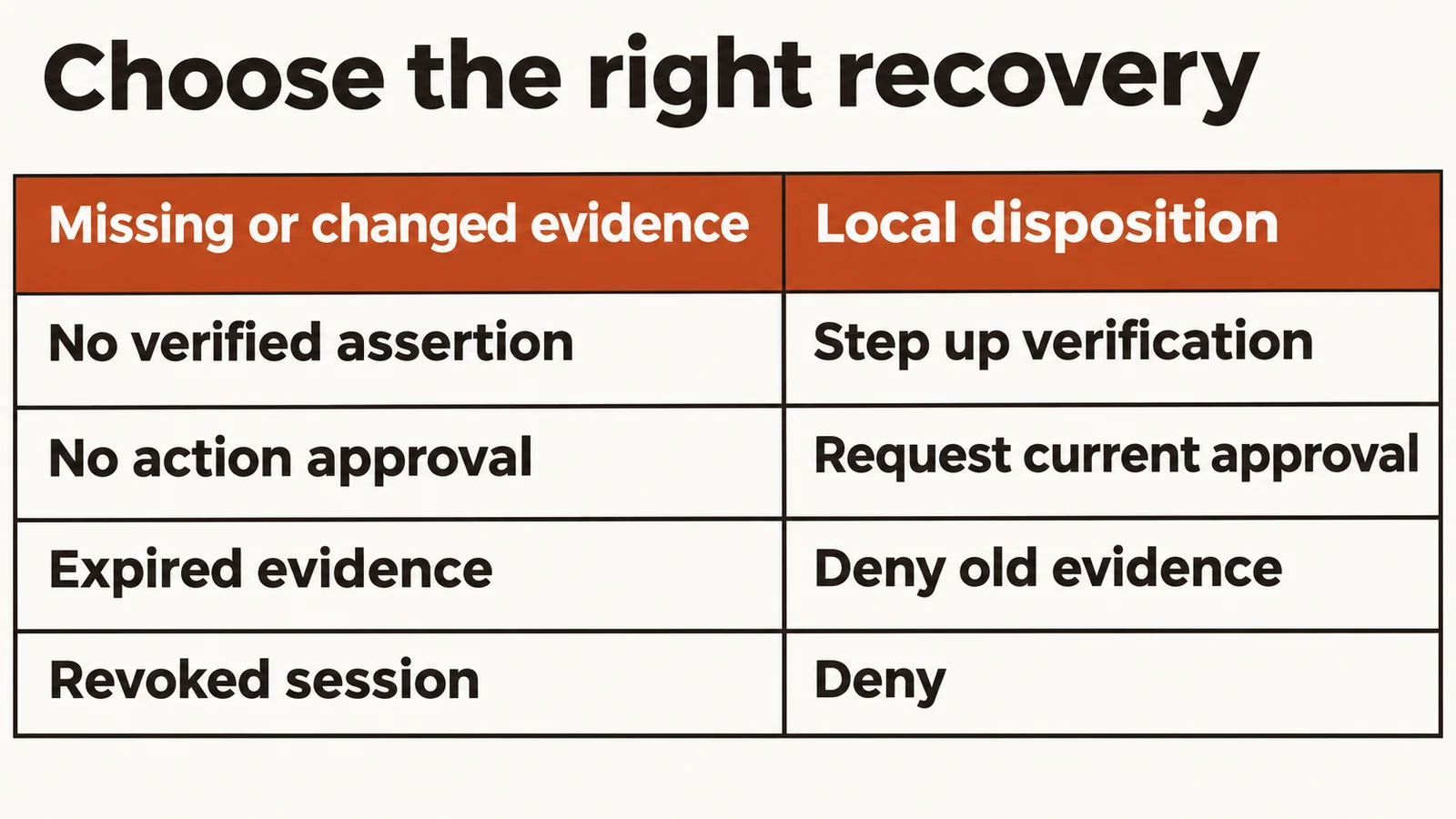
The local positive control permits only the exact current operation. The absent-assertion case requests independent verification. The absent-action-grant case requests current approval. Keeping those two step-up reasons separate prevents an application from repeatedly asking for credentials when the missing evidence is actually approval of a changed value.
The negative cases cover voice-only method, expiry, future verification, tenant, subject, session, epoch, revocation, action mismatch, resource mismatch, repaired intent, and verification-reference mismatch. They are deterministic synthetic assertions, not a measured rate of success against real attackers or callers.
Read the ownership and type fixtures
The request factory accepts only its declared field set and bounded operation values. It copies supported strings into a frozen request. A later mutation of the original source dictionary must not change the captured material intent or the grant comparison.
The function also validates manually constructed requests, because Python dataclass construction does not enforce a field's annotation. Current intent receives the same validation. An object bearing the right class name is not enough if its action or resource violates the supported teaching schema.
The integer guards use exact integer type checks. Booleans do not become epoch or clock values, and missing or nonfinite input is rejected. Zero remains a valid initial epoch and time in the synthetic clock domain, so a falsey check cannot conflate it with missing evidence.
The telemetry-redaction guide is relevant to the emitted report. The fixture uses bounded names for synthetic cases and outcomes. A real implementation must not replace those reason codes with exception text containing credentials, phone numbers, token responses, or model prompts.
The artifact does not expose an approved mutable dictionary or pretend to implement a full identity platform. Its useful boundary is inspectable: runtime validation plus immutable scalar records plus current comparisons. Provider verification, durable session state, rate limits, and atomic downstream enforcement remain explicitly external.
Protect credentials from the conversation path
Credential secrets should not become general transcript or telemetry content merely because the interaction happens by phone. Select a verification flow that keeps secret handling inside the appropriate trusted component. The conversational agent can explain the process without receiving or retaining every credential value itself.
RFC 6750 describes bearer-token usage and the need to protect tokens from disclosure. A token is not harmless diagnostic text. Keep it outside model-visible content, generic exception logs, and support exports unless the real security contract explicitly requires an appropriately protected handling path.
RFC 9700 updates OAuth security practice. A deployment using OAuth must follow the actual flow and resource-server requirements. This local comparison function is not an OAuth client, does not validate a signature or audience, and cannot replace provider-specific token and scope enforcement.
Do not assume that an SMS or voice-delivered one-time code is phishing-resistant merely because it expires. The applicable authenticator properties come from the selected standard and provider contract. This article implements no code generation, replay prevention, recovery, or challenge-rate limit and makes no assurance-level claim.
The recording-consent guide describes another independent boundary. Permission to record a call is not permission to retain credential secrets, and successful authentication does not automatically authorize recording for every purpose or participant.
Handle repairs without silently preserving approval
A caller can correct an order identifier, delivery preference, or account context while the agent is preparing the next step. That repair can invalidate the action grant even though the external credential assertion remains valid. Keep identity continuity and current-intent approval separate.
The yes-but repair guide explains why a reply containing acknowledgment and correction must be processed as a repair. Accepting an early affirmative fragment would bind an action to values the complete reply did not approve.
The partial-transcript guide addresses provisional recognition. A partial hypothesis can help responsiveness, but it must not become a final authorization request while the current input still belongs to an unfinished correction.
The reference compares the request with session.current_intent and rejects the old request after a material value change. It does not automatically issue a new grant. A controller must present the corrected operation and obtain whatever fresh action approval the actual workflow requires.
The DTMF-and-voice guide adds a modality example. A keypad can help capture characters under a supported route, but switching modalities does not authenticate a caller or preserve approval of the previous candidate automatically. Input ownership and credential evidence remain different facts.
Design an unauthenticated and failure route
A missing or failed verification should lead to a defined outcome rather than improvisation. Public information, a supported verification channel, or an authorized handoff may be appropriate. Personalized disclosure and state changes must remain behind their real permission boundary.
OWASP's authentication guidance also discusses error behavior and attack controls. Avoid exposing account existence through overly detailed caller-facing failures. Internally, bounded reasons can distinguish missing evidence, expiry, revocation, and scope mismatch without returning raw provider messages to an untrusted caller.
The warm-handoff guide explains why transferring a call requires explicit context and ownership. A handoff should carry only the authorized evidence needed by the recipient. It must not turn an unresolved verification into a trusted authenticated flag simply because another operator receives the call.
The CRM authorization-failure guide addresses provider errors during an action. Invalid credentials, insufficient scope, expired session, and a permission denial can require different recovery. Do not refresh forever or assume every error is a transient identity-provider problem.
Rate limits and lockout behavior belong to the actual credential verifier and service contract. The fixture's bounded loops are tests, not an implementation of abuse prevention. A local passing assertion does not establish that production retries are throttled or that account recovery cannot be abused.
Compare local evidence with production obligations
In this table, ✓ means the named boundary explicitly checks the property. ✗ means it does not supply that property. These marks describe contract coverage, not a measured authentication strength or compliance certification.
| Property | Voice or caller metadata | Published reference | Production boundary |
|---|---|---|---|
| Subject credential verified | ✗ No credential proof | ✗ Trusted input only | Real verifier and selected assurance policy |
| Subject and tenant match | ✗ Context is insufficient | ✓ Exact local comparison | Current authorized session data |
| Action and resource scope | ✗ Speech cannot grant it | ✓ Exact grant comparison | Authoritative action authorization |
| Material value approved | ✗ A proposal is not approval | ✓ Current-intent comparison | Trusted confirmation controller |
| Exact expiry boundary | ✗ Cannot renew evidence | ✓ Checked on every query | Trusted clock and lifecycle store |
| Revocation after old success | ✗ Familiar voice cannot restore it | ✓ Current revoked input denies | Authoritative invalidation enforcement |
| Business action completed | ✗ No execution evidence | ✗ No action performed | Provider response and reconciliation |
The local-versus-managed guide helps assign those responsibilities to actual integration owners. A managed recognizer does not own your account permissions, and a backend identity provider does not necessarily know which corrected value a caller approved in the conversation.
The stale-result guide explains why fresh authentication is also insufficient to lock business state. The authoritative write must still check the current state version and operation contract. Identity, permission, intent, and data freshness each protect a different failure mode.
Evaluate the complete integration honestly
Start with the deterministic fixture and inspect its emitted report. Then test the real identity provider, protected assertion transport, session store, confirmation controller, and action service. Those tests should use the actual configured credential methods and documented provider behavior.
The regression-testing guide explains why a model update should not weaken deterministic controls. Retain missing-assertion, wrong-tenant, expired-grant, revoked-session, and repaired-intent cases even when the current conversational model rarely proposes the corresponding unsafe operation.
An audio replay can test a separate presentation or recognition question. It cannot substitute for credential-verifier tests or prove that every replay attack fails. Report actual observed outcomes with their source and version boundaries, and keep synthetic tests distinct from real deployment evidence.
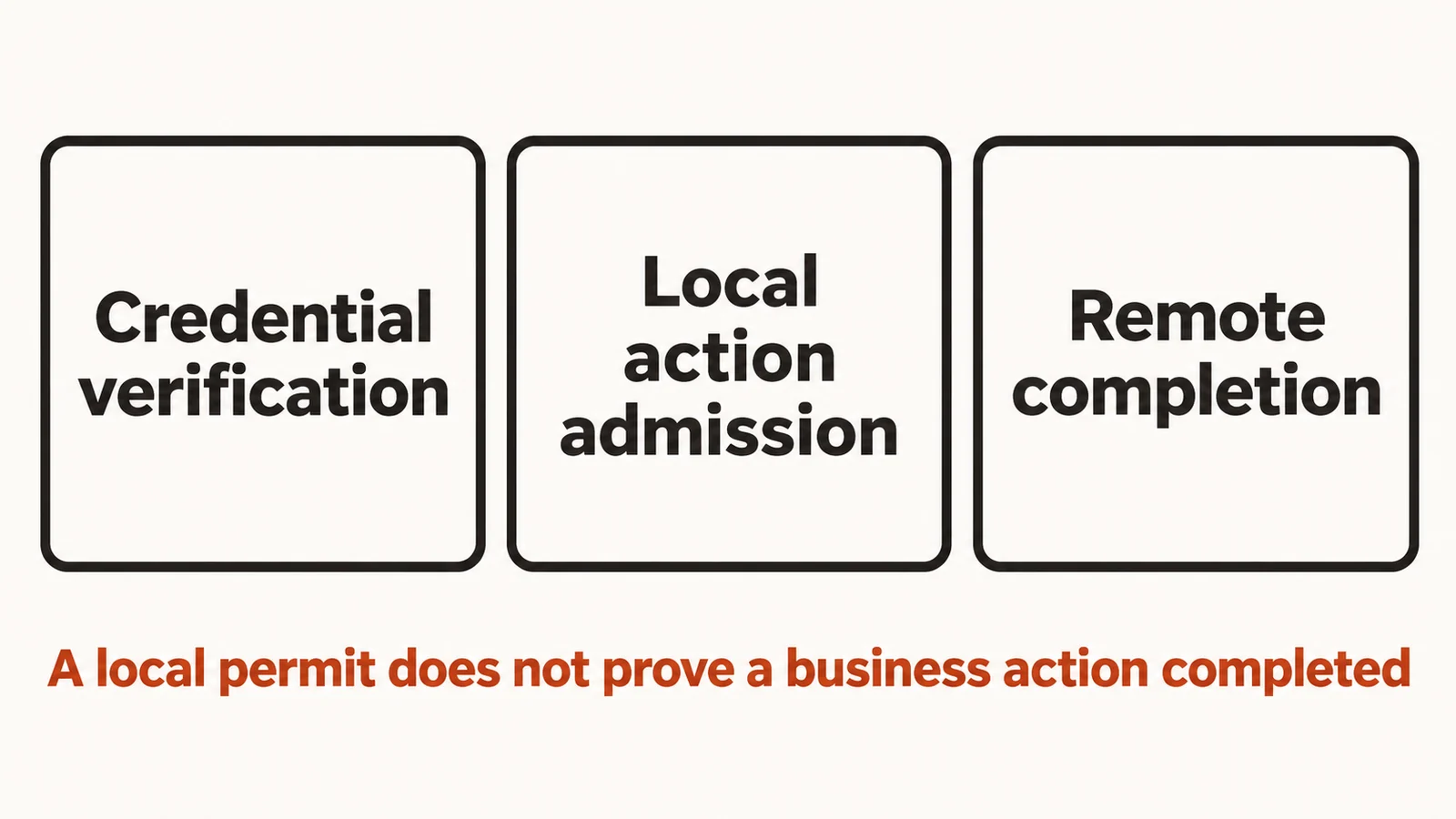
Review the points where asynchronous work can outlive its initiating session. Verification might return after revocation, or a lookup might complete after the caller corrects the resource. The final adapter must read current evidence after the wait, immediately before the authoritative side effect, rather than treating a successful historical callback as renewed permission.
Make the trust assumptions reviewable
Write down the producer of each trusted field before connecting the helper to a real call. The credential verifier produces the assertion. The current session store produces subject, tenant, session identifier, epoch, and revocation state. The confirmation controller establishes current material intent. The action authority produces the grant. Model-generated text is not an authorized producer for any of those records.
The same process can own more than one role in a small application, but the evidence boundaries still need to be explicit. A shared process is not a reason to copy untrusted request fields into the trusted session object. Review the actual construction path and test what happens when a caller supplies a field with the same name as an authoritative field.
The reference's synthetic labels avoid real account identifiers and credentials. They make equality checks inspectable without implementing a user directory. They do not establish that every string matching the label grammar is a real subject or tenant. Valid shape and trusted provenance are different requirements, and the external adapter must satisfy both.
Keep the assertion immutable once admitted. Rebinding its subject or epoch in place after verification would erase the relationship between the original credential event and later action. If the session changes, publish a new current snapshot and compare the old assertion with it. The mismatch should remain visible rather than being repaired by mutating historical evidence to look current.
For an authoritative service, the final comparison must be part of the protected operation. A client can check the session and then lose authority before its write arrives. This article does not claim to close that distributed interval. It identifies the exact evidence that the real service must validate under its transaction or conditional-action contract.
Reproduce mid-call changes deliberately
The most revealing integration fixtures change one material fact after an initial successful check. Verify a subject, then revoke the session before the next action. Verify a subject in one tenant, then attempt a resource operation under another. Approve one preference, then repair the current intent while an old callback is waiting to complete.
Those are proposed integration fixtures, separate from the synchronous cases already executed in the published fence. A test harness can pause at a real adapter boundary, change the authoritative state, resume the pending work, and inspect the submitted request and final service result. Merely checking the old snapshot again would not test whether the integration reads current evidence.
Distinguish expiry from revocation in the observed result. Expiry follows the selected clock and deadline contract. Revocation follows current authority evidence and its documented propagation. Both prevent admission, but their recovery paths can differ. An expired assertion may require a fresh verification, while a revoked grant may indicate a permission decision that repeated credential entry cannot override.
Test the exact deadline rather than only a much later value. Equality is where ambiguous comparison rules often hide. The local artifact treats now equal to expires_at or deadline as expired, and it rejects a verification timestamp later than the supplied current time. Production clock translation must preserve those semantics rather than mixing unrelated clock domains.
Also test a successful verification that returns after the initiating session has ended. The success may remain useful historical evidence, but it cannot create a new live session by itself. The receiving controller needs current ownership and a supported continuation policy. A late callback must not silently attach one person's credential event to another active call.
Preserve the right evidence after a failure
A bounded failure record should identify which contract failed without exposing its secrets. The synthetic report emits expected and actual reason codes for each named case. It does not print the assertion object, action grant, or raw provider response. In production, decide which additional correlation evidence is necessary and protect its access and retention explicitly.
An opaque verification reference can still be linkable. It may connect several actions or support records to one account or session. Do not describe hashing or replacing an identifier as proof of anonymity. Keep the identifier's diagnostic purpose separate from any claim about whether a person can be reidentified through other retained data.
Caller-facing wording can be less specific than internal diagnostic codes. An application may need to avoid revealing whether an account exists while still distinguishing wrong-tenant and expired-session failures in protected telemetry. That difference should be deliberate and tested; do not simply read internal exception strings aloud.
The emitted fixture results are useful for regression because they preserve both expectation and observation. A test failure can identify the exact boundary that changed without relying on a success message from a separate implementation. Execute the published fence itself, then compare the real adapter's behavior through its own focused harness.
Finally, keep the operation outcome separate from admission. A permit result says that the local evidence matched at the time queried. The real action can still be rejected, time out, or remain unknown after submission. Only authoritative downstream evidence can establish completion, and no authentication helper should manufacture that receipt from the existence of a valid credential.
Frequently asked questions
Why is voice alone insufficient for caller authentication?
Speech content and acoustic resemblance do not establish control of the business credential required for an operation. Use an independent verifier and bind its assertion to the current subject and session. This reference consumes such trusted evidence and performs no voice authentication.
What does NIST say about voice biometric comparison?
SP 800-63B-4 section 3.2.3 states that biometric comparison based on voice SHALL NOT be used within that standard's scope. Do not present that as universal law. Determine the applicable organizational and standards requirements from current authoritative policy.
Does a verified caller ID identify the account owner?
It does not by itself establish the business subject or current action authority. Network attestation and call-admission context answer different questions. A shared or transferred call still requires the workflow's actual credential and delegation evidence.
How does authentication differ from authorization?
Authentication concerns verified authenticator control for a subject. Authorization concerns permission for an action on a resource. Current intent approval adds another requirement: the exact material values the caller approved must match the proposed operation.
What should a trusted identity assertion contain?
Its real adapter contract should identify the verified subject, tenant, session, verification event, method classification, time, expiry, and relevant epoch. These fields are trusted only because of their protected source. A model-generated object containing the same labels is not equivalent evidence.
How should a session be bound to a tenant?
Carry the tenant explicitly in verification, action grant, and current session evidence and compare them before admission. Do not infer it from an account name or caller language. The synthetic wrong-tenant fixture rejects the mismatch without performing a business action.
When is step-up authentication needed?
Follow the selected identity and action policy when required evidence is missing, expired, or insufficient. The reference distinguishes missing external verification from missing current-action approval. Those are different recovery needs, even if both prevent the sensitive operation.
Should an OTP be read into the transcript?
Choose a supported verification flow that keeps credential secrets in the appropriate trusted component. This artifact does not implement OTP handling. Do not assume that call recording or general telemetry is an appropriate place to retain an authentication secret.
Can SMS or voice OTP be assumed phishing-resistant?
No. Its properties must come from the applicable authenticator standard and provider contract. Expiry alone does not establish phishing resistance. The example implements no OTP challenge, verifier, recovery, rate limit, or assurance-level assessment.
What happens when authentication expires mid-call?
The next policy query must reject the expired assertion even if the conversation is still active. A controller needs a supported reauthentication route. The reference checks exact expiry on every call and cannot be renewed by a transcript claiming prior success.
How should revocation affect the next action?
Current revocation must prevent admission despite older successful evidence. The reference checks the current revoked flag and session epoch. Real services must enforce their authoritative invalidation semantics, including documented propagation limits and cached-view behavior.
Can an agent reuse identity across redials?
Only under an explicit current session and identity policy with appropriate evidence. A familiar phone number or remembered account fact is insufficient. The reference binds assertions and grants to one session and rejects a different session identifier.
Why should resource and action be checked separately?
Permission to read one resource does not imply permission to write it or access another resource. The reference compares both fields and the material value. A broad subject match cannot override a narrower action grant.
How should shared phones be handled?
Treat the telephone as contact or admission context rather than an automatic person identity. Obtain the appropriate current credential and delegation evidence. Avoid disclosing another person's retained account facts while trying to guess which household member is speaking.
What is a safe unauthenticated fallback?
Use an explicitly supported route such as public information, a verification channel, or authorized handoff. Keep personalized disclosure and state changes behind their real permission checks. The artifact's step-up result describes missing evidence and performs no fallback action itself.
Which authentication events belong in telemetry?
Use bounded structured event types and reasons under a justified retention policy. Do not log raw credentials, tokens, transcripts, or provider exceptions. A local admission result can support diagnostics without becoming a new repository of authentication secrets.
How should retries be rate-limited?
Use the actual verifier and service policy, including recovery and abuse controls. This local example does not implement them. Distinguish an exact immutable retry from a new logical action or fresh confirmation after a material repair.
Can a synthetic voice-clone test prove security?
It can establish only what that controlled experiment actually observed. It cannot certify every voice, device, provider, or authorization path. This article performs no acoustic comparison and reports only deterministic synthetic admission outcomes.
Where should credential verification run?
Inside a trusted component implementing the selected provider and identity standard. The conversational model should not invent verifier assertions. The reference receives external evidence by contract and deliberately contains no passkey, OTP, or biometric cryptography.
Which boundaries need live integration tests?
Verify protected assertion transport, real credential behavior, current session and revocation handling, exact approval, and authoritative action enforcement. Test after asynchronous waits and across failure recovery. A local passing policy test does not prove a remote action completed.
Build the smallest trustworthy admission boundary
For 60db Agent integrations, identify the external verifier and authoritative action owner first. Run the complete synthetic fixture, compare its exact bindings with the real provider contract, and keep current identity, permission, intent, and expiry visible at the operation boundary.
Then test the actual integration and its failure routes. The useful outcome is a clear account of which subject was verified, which action was approved, which session remained current, and what the downstream service actually did.