
- Architecture
Redact voice telemetry without losing diagnostic value
Voice telemetry needs field and value allowlists. Test structured diagnostics, privacy canaries, exceptions, and exporter failures.
- Author
 Udit Goenka
- Editorial date
- Reading time
- 27 min
TL;DR: Minimize voice telemetry through explicit event schemas that constrain both fields and values. Keep bounded timing, state, generation, and version evidence, reject unsupported content without echoing it, and test exceptions and export failures; hashing or opaque identifiers do not prove anonymization.
An engineer removes transcript text from a span body, but the same content survives inside a reason string, nested attribute, exception, or exporter fallback. The trace looks structured while still carrying material the telemetry policy intended to exclude.
The observability guide explains why voice systems need evidence across timing and state boundaries. This guide gives you a small standard-library serializer that preserves useful diagnostic structure while refusing arbitrary content. It emits actual safe synthetic records and negative-fixture results, with explicit limits for external instrumentation and storage.
The artifact is neither a universal personal-data detector nor a complete telemetry platform. It validates two declared event variants, owns their scalar values, produces bounded JSON, and returns bounded failure outcomes. Actual sensitivity classification, correlation-token production, retention, access, and exporter behavior remain integration responsibilities.
Begin with the diagnostic question
Choose the evidence needed to answer a concrete failure question before collecting content. A slow tool stage can require a duration and stage identity. A stale playback attempt can require generation and policy evidence. A rejected action can require a bounded reason and state version rather than the entire conversation.
The latency-boundary guide distinguishes timing measurements that are easy to conflate. A useful event must identify which boundary its duration represents. Removing transcripts does not make an unlabeled elapsed number meaningful, and adding transcripts does not repair a missing clock or stage definition.
OWASP's logging cheat sheet discusses excluding secrets and unnecessary sensitive information while retaining appropriate security evidence. Apply that principle at collection time. A field that was never admitted is easier to reason about than an unrestricted payload that every downstream sink must remember to scrub.
The reference therefore has no transcript, phone-number, URL, credential, free-form message, or arbitrary attributes field. Unsupported extra keys cause rejection instead of being silently passed through. The diagnostic record retains only the supported scalar evidence selected for the two teaching variants.
The outcome-metrics guide explains why an event's meaning and denominator matter. A privacy-preserving pipeline should still distinguish failed, dropped, pending, and completed outcomes under the real workflow. Minimization is not a reason to replace useful structure with an opaque success count.
Table of contents
- Begin with the diagnostic question
- Define explicit event variants
- Constrain values as well as keys
- Preserve zero and reject unavailable numbers
- Keep diagnostic structure
- Own values before asynchronous export
- Run the complete serializer and canary suite
- Exercise privacy canaries
- Keep exception paths content-free
- Treat identifiers as linkable
- Check every sink separately
- Preserve useful failure accounting
- Compare minimization strategies honestly
- Choose fields from the failure mechanism
- Inspect the exact serialization boundary
- Test failure behavior without calling unsafe representations
- Separate correlation from authority
- Turn the local report into an integration checklist
- Frequently asked questions
- Keep the first boundary small and inspectable
Define explicit event variants
A general dictionary of attributes creates a large content surface. Every producer can add a new key, nest another object, or use a familiar key for an unexpected value. A small variant schema makes the supported shape visible and gives review a concrete object to inspect.
The reference supports stage_duration and state_transition. Both require a correlation token, generation, state version, and exact second-level UTC timestamp. The timing variant adds a stage enum and elapsed milliseconds. The transition variant adds source state, destination state, and a bounded reason.
OpenTelemetry's Logs Data Model defines structured log fields and correlation concepts. It does not establish your application's allowed content or make every possible attribute safe. The local teaching schema is a deliberate subset for one diagnostic purpose, not a replacement for that general model.
Keep schema identity explicit when adapting the example. Adding another event variant changes the contract and needs its own field and value checks. Do not retain a permissive unknown-event branch that serializes the original dictionary because it might contain something useful to an operator.
The workflow-enforcement guide illustrates why deterministic boundaries help. A model or tool can propose diagnostic content, but the final telemetry producer should admit only the declared shape. A prompt asking for safe logs cannot replace that serializer boundary.
Constrain values as well as keys
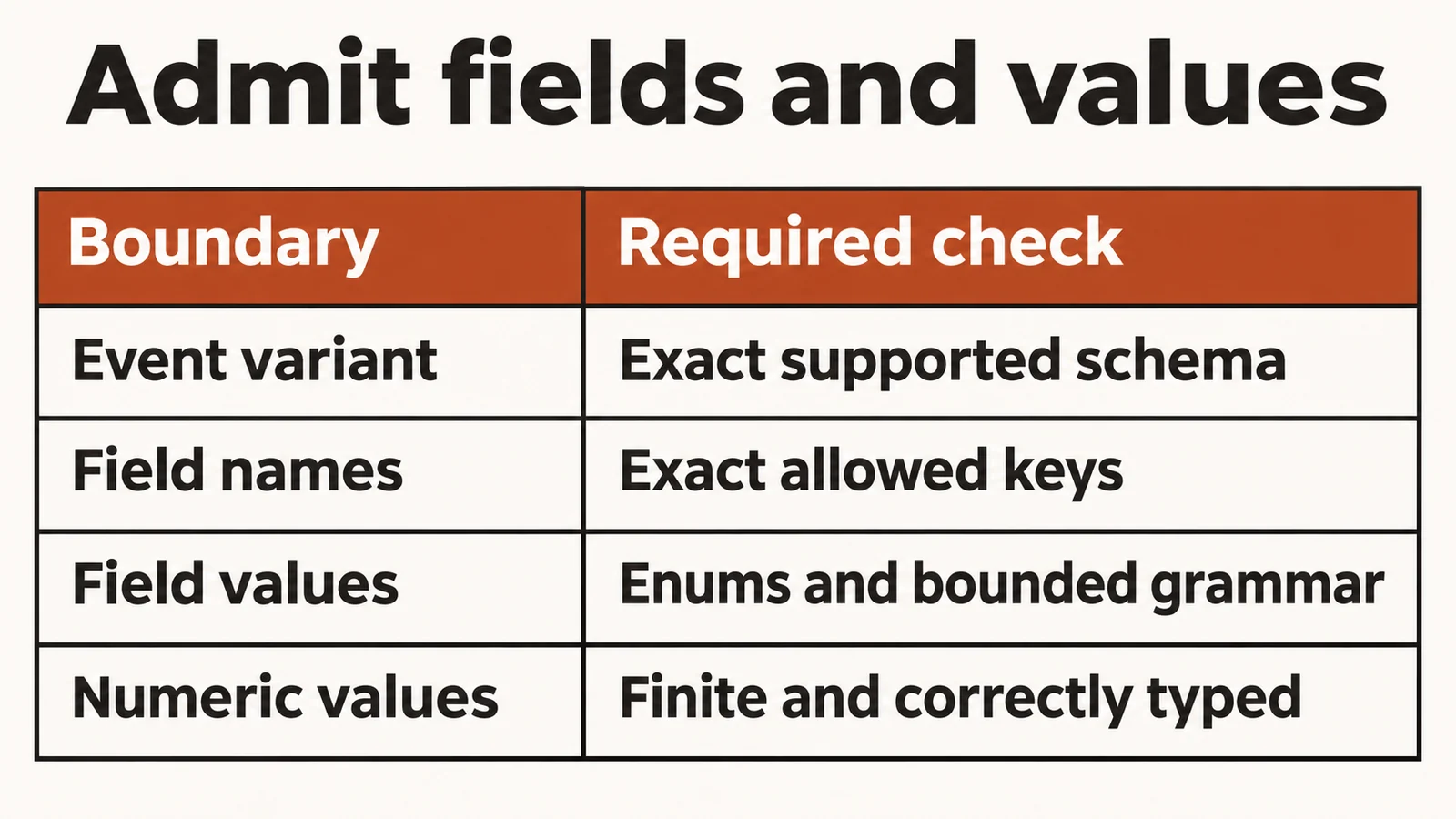
An allowlisted key can still carry a transcript. A reason field accepting arbitrary strings is a message field under another name. A resource label can contain a URL with a query token. A correlation identifier can be copied directly from an email address unless its producer and grammar are controlled.
The reference uses exact event, stage, state, and reason values. It validates a bounded token grammar and a narrow UTC timestamp format. Unknown fields, nested mappings, arbitrary strings in enum positions, malformed dates, and unsupported numeric values produce one bounded rejection record without echoing the input.
The token grammar constrains representation, not sensitivity. A value that fits it may still be linkable or derived improperly from personal data. The trusted correlation producer must create and scope appropriate tokens under a justified policy. This article does not claim that a regex proves an identifier anonymous.
The literal-ID capture guide explains why identifiers retain semantics even when they look like ordinary strings. A raw account identifier should not become a telemetry token simply because its punctuation happens to fit a convenient pattern.
An actual service might need additional safe dimensions, but they should be named and bounded. Add an enum for a real failure category rather than accepting arbitrary exception text. Add a verified schema or policy identifier where needed, while keeping per-event audit references distinct from stable policy identity.
Preserve zero and reject unavailable numbers
Zero duration is a legitimate observed value under this teaching schema. Missing duration is not. Booleans are also rejected even though Python can treat them as integers in comparisons. A truthiness check would conflate these cases and make both diagnosis and privacy policy less reliable.
The duration field accepts finite built-in integers or floats within a declared bounded range. The generation and state version require exact nonnegative integers. NaN, infinity, strings, negative values, and missing metadata are rejected before the event reaches the JSON encoder.
The stale-result guide shows why version zero must remain distinct from unavailable evidence. Telemetry should preserve that same distinction. A missing state version cannot be replaced with zero merely to satisfy a formatter or keep an aggregation pipeline running.
Python's JSON documentation describes encoder behavior for nonfinite values and allow_nan. The reference sets allow_nan to false as an additional serialization boundary after explicit numeric validation. A successfully encoded numeric-looking token is not enough to establish supported event semantics.
If a metric is derived from cumulative counters, retain the original counter and receiver identity required to recompute it under the actual metric contract. This artifact emits individual stage durations and versions rather than deriving a weighted aggregate. It makes no claim to reconstruct a receiver-rate metric from insufficient fields.
Keep diagnostic structure
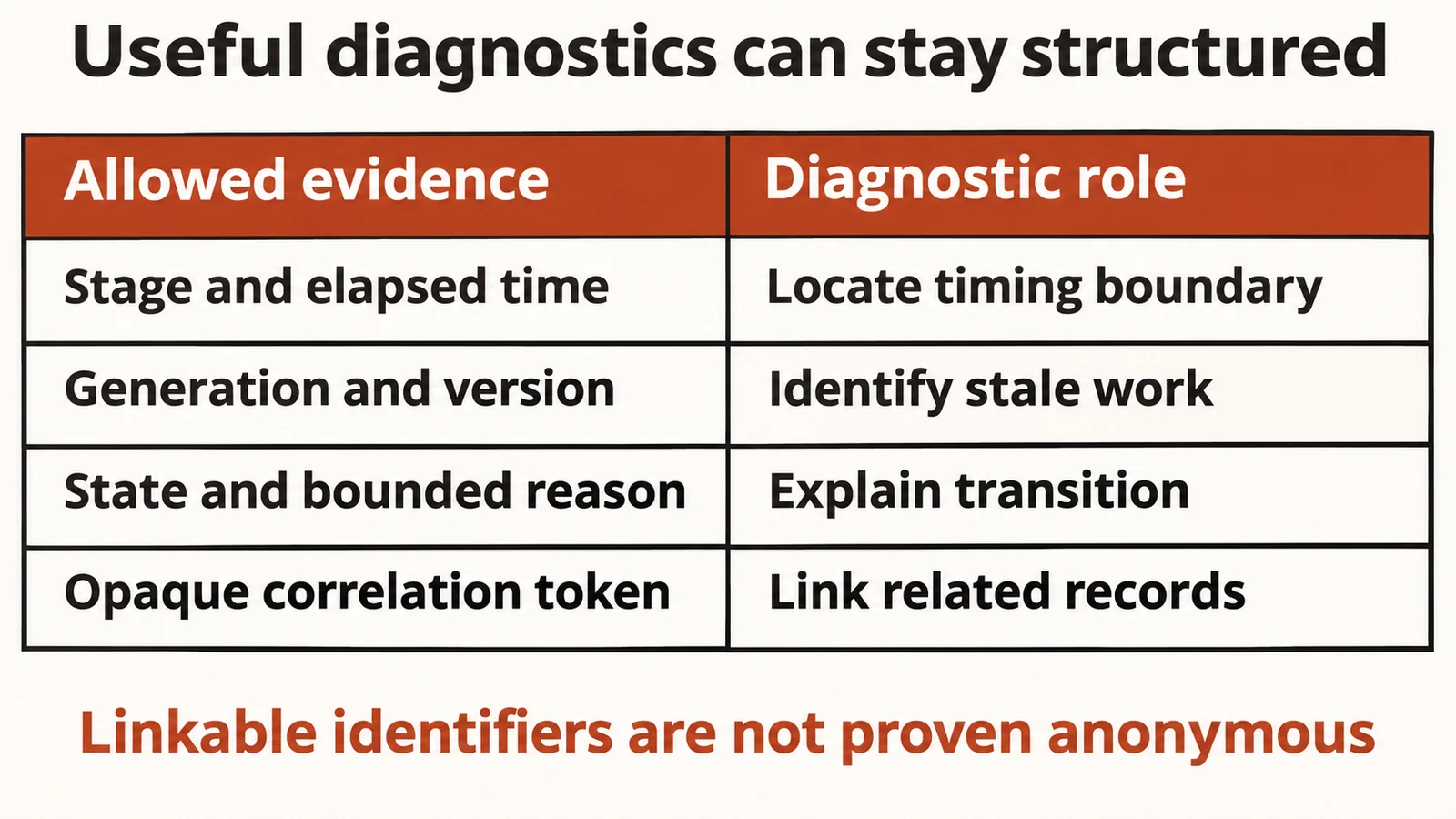
Useful structure can explain many failures without conversation content. A timing event identifies its stage and elapsed milliseconds. A transition event identifies its supported state pair and reason. Generation and version fields help connect that observation with current or obsolete work under the application's actual correlation policy.
The audio-backpressure guide demonstrates why generation and age are material diagnostic dimensions. A record describing a stale item should preserve the relevant structured evidence rather than copying the text that item would have spoken.
The playback-acknowledgment guide adds an evidence limit. A local event can describe writer acceptance or an observed acknowledgment, but it cannot prove acoustic audibility or caller comprehension. Safe telemetry still needs honest event semantics.
The transition serializer checks a bounded pair vocabulary, including terminal-to-active pairs being unsupported. It does not maintain authoritative runtime state or validate an entire event history. A record passing this serializer is a supported diagnostic statement, not permission to revive closed work.
Own values before asynchronous export
A mutable attribute object can change after admission but before a batch exporter serializes it. Pooling and reuse add another risk: the object may no longer contain the value the producer intended. Copy the supported scalar representation before handing it to another component.
A historical OpenTelemetry .NET issue about pooled attributes and redaction describes this kind of timing concern. It is practitioner evidence about a reported implementation question, not a claim that the latest .NET exporter still has the same behavior or that this Python test reproduces that SDK.
The local freeze_event function first copies an exact built-in dictionary, then validates and constructs the event exclusively from that private snapshot. Every accepted value is a supported immutable scalar, so a shallow snapshot owns the admitted representation once validation finishes. The fixtures change the original source dictionary both after admission and at a deterministic validation boundary, verifying that the owned event still serializes only the snapshot values.
Python's dataclass documentation explains why frozen assignment is only part of that guarantee. A frozen object containing an arbitrary nested dictionary would still expose mutable content. This artifact deliberately accepts neither nested mappings nor unrelated dataclass objects as serializable event payloads.
The encoder revalidates manually constructed Event objects. It rejects duplicate field names and invalid pair shapes before converting them into a supported record. A class label or a tuple wrapper cannot be used to bypass the field-and-value policy.
Run the complete serializer and canary suite
Run the full fence with Python's standard library. It implements the two event variants, owned scalar snapshots, bounded rejection, and a small export wrapper. Its canaries are invented markers used only to detect whether the tested output paths echo unsupported content.
The report includes actual safe synthetic records, the observed number of rejected fixtures, an export-failure disposition, and explicit untested external boundaries. It does not log real caller material or claim that every form of personal information has been detected or removed.
from dataclasses import dataclass, FrozenInstanceError
from datetime import datetime
import json
import math
import re

@dataclass(frozen=True)
class Event:
    fields: tuple

COMMON = {'event', 'token', 'generation', 'state_version', 'timestamp'}
SHAPES = {'stage_duration': COMMON | {'stage', 'elapsed_ms'},
          'state_transition': COMMON | {'from_state', 'to_state', 'reason'}}
STATES = ('listening', 'waiting', 'speaking', 'closed')
PAIRS = {('listening', 'waiting'), ('waiting', 'speaking'), ('speaking', 'listening'),
         ('listening', 'closed'), ('waiting', 'closed'), ('speaking', 'closed')}

def freeze_event(raw):
    if type(raw) is not dict:
        raise ValueError('invalid shape')
    snapshot = dict.copy(raw)
    if any(type(k) is not str for k in snapshot):
        raise ValueError('invalid shape')
    name = snapshot.get('event')
    if type(name) is not str or name not in SHAPES or set(snapshot) != SHAPES[name]:
        raise ValueError('invalid shape')
    if type(snapshot['token']) is not str or not re.fullmatch(r'run-[0-9a-f]{16}', snapshot['token']):
        raise ValueError('invalid correlation token')
    for key in ('generation', 'state_version'):
        if type(snapshot[key]) is not int or not 0 <= snapshot[key] <= 1000000:
            raise ValueError('invalid counter')
    stamp = snapshot['timestamp']
    if type(stamp) is not str or not re.fullmatch(r'[0-9]{4}-[0-9]{2}-[0-9]{2}T[0-9]{2}:[0-9]{2}:[0-9]{2}Z', stamp):
        raise ValueError('invalid timestamp')
    datetime.strptime(stamp, '%Y-%m-%dT%H:%M:%SZ')
    if name == 'stage_duration':
        if type(snapshot['stage']) is not str or snapshot['stage'] not in ('asr', 'model', 'tool', 'tts'):
            raise ValueError('invalid stage')
        elapsed = snapshot['elapsed_ms']
        if type(elapsed) not in (int, float) or not 0 <= elapsed <= 3600000 or not math.isfinite(elapsed):
            raise ValueError('invalid duration')
    else:
        if any(type(snapshot[k]) is not str or snapshot[k] not in STATES for k in ('from_state', 'to_state')):
            raise ValueError('invalid state')
        if (snapshot['from_state'], snapshot['to_state']) not in PAIRS:
            raise ValueError('unsupported transition pair')
        if type(snapshot['reason']) is not str or snapshot['reason'] not in ('normal', 'timeout', 'canceled', 'policy-denied'):
            raise ValueError('invalid reason')
    return Event(tuple((key, snapshot[key]) for key in sorted(snapshot)))

def encode(raw):
    try:
        if type(raw) is Event:
            if type(raw.fields) is not tuple or any(type(p) is not tuple or len(p) != 2 or type(p[0]) is not str for p in raw.fields):
                raise ValueError('invalid owned event')
            fields = dict(raw.fields)
            if len(fields) != len(raw.fields):
                raise ValueError('duplicate field')
            owned = freeze_event(fields)
        else:
            owned = freeze_event(raw)
        rendered = json.dumps(dict(owned.fields), sort_keys=True, separators=(',', ':'), allow_nan=False)
        if len(rendered.encode('utf-8')) > 1024:
            raise ValueError('record too large')
        return rendered
    except Exception:
        # Deliberately never inspect exception/input repr or str.
        return '{"event":"telemetry_rejected","reason":"schema-invalid"}'

def export(raw, sink):
    safe = encode(raw)
    try:
        sink(safe)
    except Exception:
        return {'status': 'export-failed', 'reason': 'sink-unavailable'}
    return {'status': 'submitted-to-sink', 'record': safe}

CANARY = 'SYNTHETIC_PRIVATE_MARKER'
base = {'event': 'stage_duration', 'token': 'run-0123456789abcdef', 'generation': 0,
        'state_version': 0, 'timestamp': '2026-11-10T00:00:00Z', 'stage': 'asr', 'elapsed_ms': 0}
owned = freeze_event(base)
base['stage'] = 'tts'
assert json.loads(encode(owned))['stage'] == 'asr'
assert json.loads(encode(owned))['elapsed_ms'] == 0
race_source = {**base, 'token': 'run-fedcba9876543210'}
original_fullmatch = re.fullmatch
def mutate_source_after_real_validation(pattern, value, *args, **kwargs):
    result = original_fullmatch(pattern, value, *args, **kwargs)
    if pattern == r'run-[0-9a-f]{16}' and result is not None:
        race_source['token'] = CANARY
    return result
re.fullmatch = mutate_source_after_real_validation
try:
    race_output = encode(race_source)
finally:
    re.fullmatch = original_fullmatch
assert race_source['token'] == CANARY
assert json.loads(race_output)['token'] == 'run-fedcba9876543210'
assert CANARY not in race_output
try:
    owned.fields = ()
except FrozenInstanceError:
    pass
else:
    raise AssertionError('mutable event')
transition = {k: v for k, v in base.items() if k not in ('stage', 'elapsed_ms')}
transition.update(event='state_transition', from_state='waiting', to_state='closed', reason='canceled')
assert json.loads(encode(transition))['reason'] == 'canceled'
bad = [{**base, 'transcript': CANARY}, {**base, 'nested': {'secret': CANARY}},
       {**base, 'event': CANARY}, {**base, 'stage': CANARY}, {**base, 'token': CANARY},
       {**base, 'timestamp': CANARY}, {**base, 'timestamp': '2026-02-30T00:00:00Z'},
       {**base, 'generation': True}, {**base, 'state_version': None},
       {**transition, 'reason': CANARY}, {**transition, 'from_state': 'closed', 'to_state': 'speaking'},
       Event((('event', 'stage_duration'), ('event', CANARY))),
       Event((('event', {'secret': CANARY}),))]
bad.extend({**base, 'elapsed_ms': v} for v in (True, None, -1, float('nan'), float('inf'), 3600001))
for raw in bad:
    output = encode(raw)
    assert CANARY not in output and json.loads(output)['event'] == 'telemetry_rejected'
representation_calls = []
class NoRepresentation:
    def __repr__(self):
        representation_calls.append('input-repr')
        return CANARY
assert json.loads(encode(NoRepresentation()))['event'] == 'telemetry_rejected'
assert representation_calls == []
class SecretError(Exception):
    def __str__(self):
        representation_calls.append('exception-str')
        return CANARY
def failing_sink(record):
    raise SecretError(CANARY)
failure = export({**base, 'transcript': CANARY}, failing_sink)
assert failure == {'status': 'export-failed', 'reason': 'sink-unavailable'}
assert representation_calls == []
received = []
submitted = export(owned, received.append)
assert received == [encode(owned)]
assert CANARY not in json.dumps([submitted, failure])
print(json.dumps({'fixture_class': 'Synthetic', 'safe_duration_event': json.loads(encode(owned)),
                  'safe_transition_event': json.loads(encode(transition)),
                  'rejected_fixture_count': len(bad), 'export_failure': failure,
                  'canary_excluded_from_tested_outputs': True,
                  'concurrent_source_mutation_excluded': True,
                  'external_exporter_privacy': 'not-tested', 'anonymization': 'not-established'}))
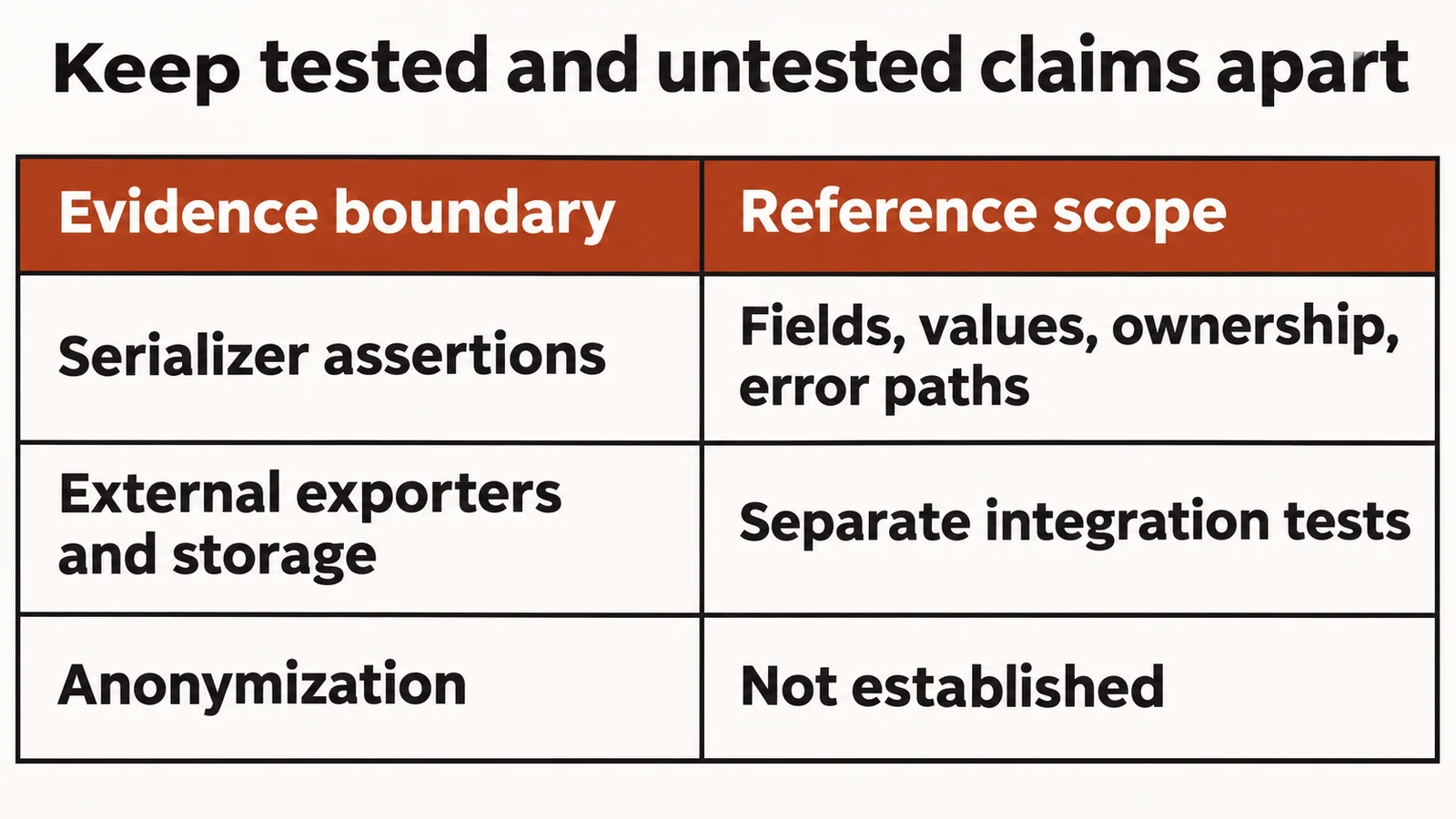
The output labels the fixture Synthetic. Its canary-excluded flag refers only to the specific tested outputs. External exporter privacy and anonymization remain explicitly unestablished, so a reader examining the JSON alone cannot reasonably mistake the local pass for a complete privacy certification.
Exercise privacy canaries
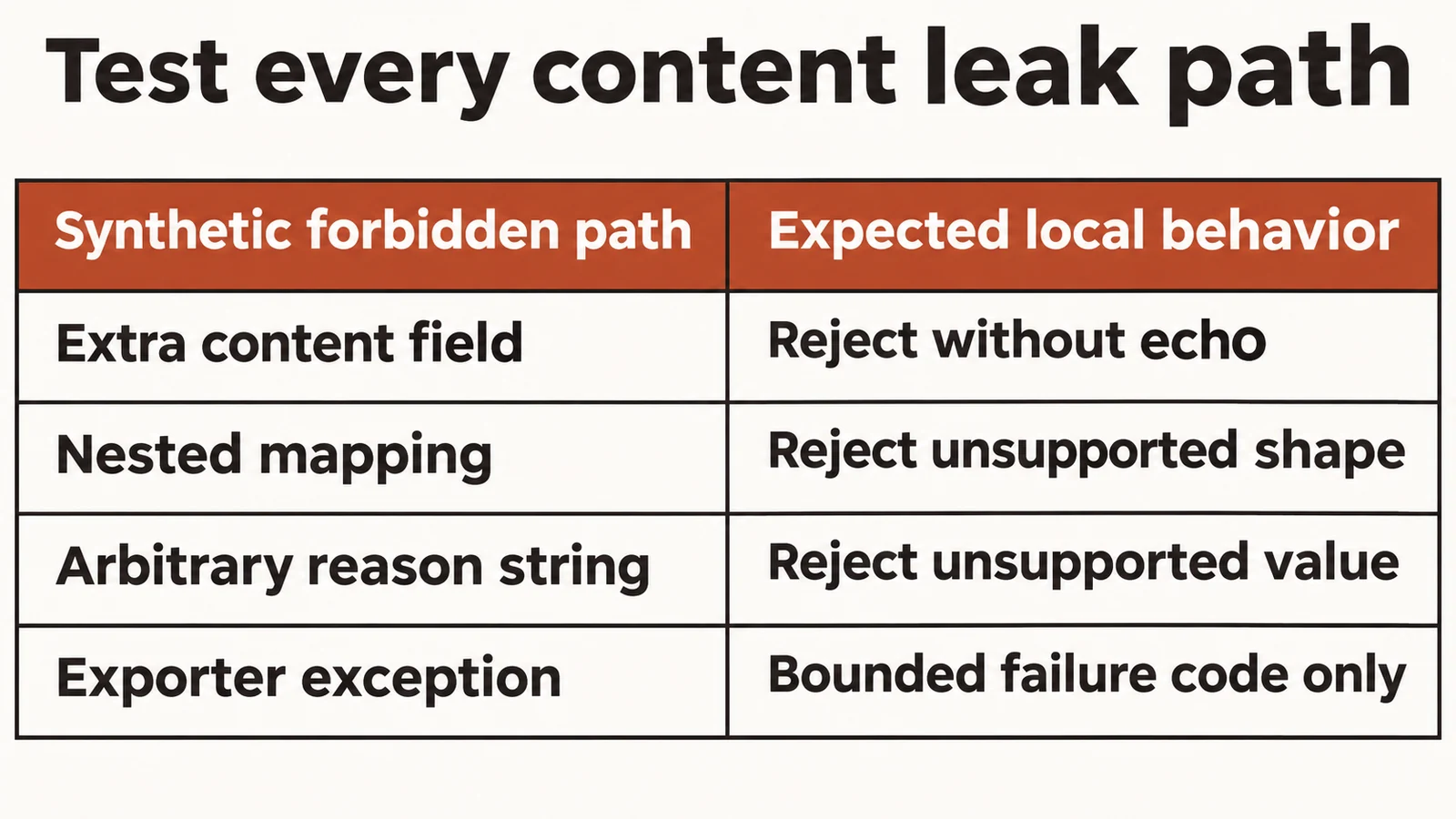
The extra-field case inserts the invented marker under transcript, while another case places it in a nested object. Both must produce only the bounded rejection envelope. The serializer does not attempt a recursive best-effort cleanup that might preserve an unsupported branch accidentally.
The value cases insert the same marker under event, stage, token, timestamp, and reason. These fields have permitted names, so they test the separate value boundary. A field-name-only allowlist would fail to establish the advertised behavior even if it removed every unknown key correctly.
The numeric cases distinguish valid zero from missing or nonfinite data. The immutable-source cases verify that an admitted event does not change when the producer reuses its dictionary, including a deterministic mutation immediately after the real token validator returns. The manual Event cases test duplicate keys and nested values behind a type that superficially looks trusted.
The regression-testing guide explains why negative cases belong in the executed artifact. A test that merely checks that one ordinary record serializes successfully says little about content leakage through error or extension paths. Run the complete published fence instead of a separate simplified copy.
The canary test is deliberately scoped. It detects the selected invented marker in tested outputs. It does not establish that every indirect identifier, rare phrase, or combination of retained dimensions is nonidentifying. Sensitivity review remains a separate responsibility tied to the real application and data population.
Keep exception paths content-free
Validation failures often receive less review than normal outputs. A helpful-looking error message can echo the rejected value, stringify an arbitrary object, or include a provider response containing credentials. A failure path must remain inside the same content boundary.
The encoder catches ordinary exceptions and returns one fixed rejection JSON record. It deliberately does not call repr or str on the input or exception. The fixture instruments those representation methods and verifies they were not invoked, rather than merely checking that their returned text was absent afterward.
The export wrapper passes only the encoded safe record to its sink. If that sink raises, the wrapper returns a bounded sink-unavailable reason and no original event. It has no fallback that dumps raw input to another log, standard output, or a support payload.
The CRM authorization-failure guide illustrates why raw provider errors can be sensitive. The application may need a safe reason code to distinguish recovery, but copying the full exception into every span can expose authentication context or private resource details.
This example does not claim control over an external SDK's internal logs. A sink can emit its own diagnostics independently, and instrumentation may collect fields before this wrapper is called. Those are separate integration boundaries requiring observation of the actual emitted data.
Treat identifiers as linkable
Replacing a name with a stable opaque token can preserve useful correlation, but it can also preserve linkability. A token may connect many events or be joined with another table that identifies the person. Hashing or pseudonymizing an identifier does not by itself prove anonymization.
The reference uses a bounded synthetic run token and makes no statement about a real token generator's privacy properties. A deployment should define token scope, lifetime, access, and permitted joins. Avoid deriving the token directly from a phone number or account identifier without an explicitly justified design and review.
The caller-authentication guide separates subject authority from contact metadata. Telemetry correlation is another distinct role. A diagnostic token should not become a reusable credential or an account-lookup shortcut merely because it is stable across several records.
The memory-across-calls guide explains why retention and identity scope matter over time. A field that seems harmless in one event can become revealing when linked across calls or combined with long-lived memory. Review the actual collection and use context.
Keep exact token grammar and sensitivity claims separate in documentation. The grammar can be tested mechanically. Whether the token is appropriate to retain depends on its producer, population, access, and policy. The emitted report therefore states that anonymization was not established.
Check every sink separately
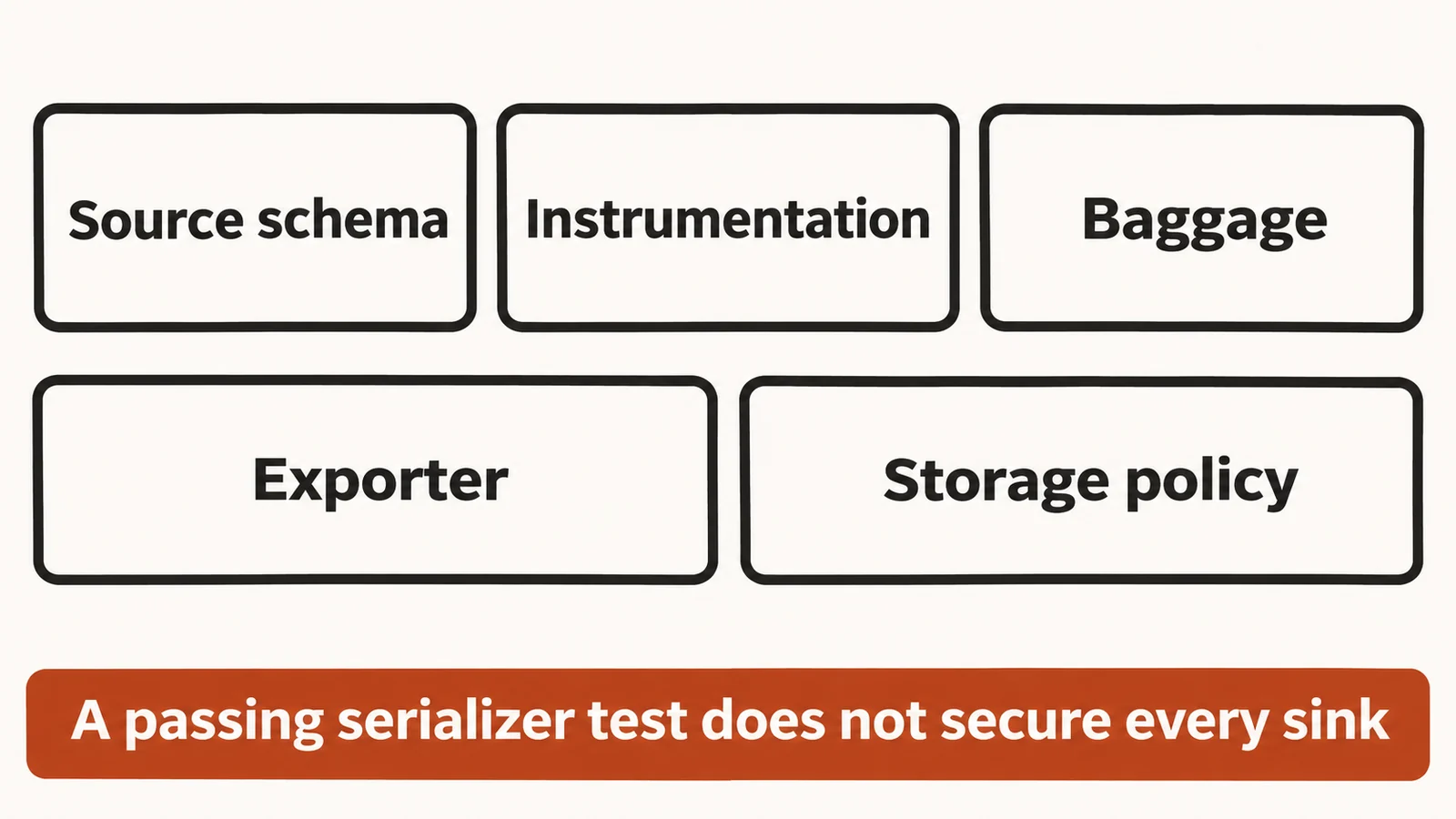
A local serializer controls one path. Automatic instrumentation, resource attributes, baggage, span events, exporter retries, collector processors, storage indexes, and support exports can carry additional data. A passing unit test must not become a blanket claim that every telemetry sink is safe.
OpenTelemetry's sensitive-data guidance explains the application's responsibility to identify and handle sensitive data. Inspect what the actual configured instrumentation collects and how processors and exporters transform it. Default collection behavior is not a substitute for an application-specific policy.
The recording-policy guide describes how permission and retention can change during a call. Telemetry must follow its own authorized content and lifecycle contract. Removing a transcript from one stream does not establish that the same material is absent from a recording, derivative store, or another observability destination.
OWASP's authorization guidance also applies to access to retained diagnostics. Minimizing content does not eliminate access-control responsibilities. Operators, dashboards, and exports should receive only the evidence their actual roles and purposes require.
Preserve useful failure accounting
A rejected event is still an event-handling outcome. Keep a bounded drop or rejection count so schema drift does not become silent loss of diagnostic coverage. Do not include the rejected raw payload in that count's labels or message, which would recreate the leak under a different telemetry field.
The load-testing guide explains why every scheduled identity and outcome matters in an execution ledger. The same accounting discipline applies to telemetry: missing or rejected records should not disappear from an evaluation denominator merely because they failed serialization.
The model-regression guide helps distinguish cause when diagnostics change after an update. Record stable schema and producer versions through an explicitly supported field or surrounding deployment evidence. A new arbitrary payload branch is not an acceptable way to capture whatever changed.
For aggregate measurements, preserve the counters and identities needed by the declared formula in a separately reviewed event variant. This reference does not derive a receiver metric or percentile distribution. A stage duration can help locate an individual timing boundary, while a population statistic needs its own denominator and workload evidence.
Compare minimization strategies honestly
Here ✓ means the named mechanism explicitly enforces the stated local boundary. ✗ means it does not establish that property. These marks describe scope rather than a measured privacy rate, security score, or universal comparison between products.
| Property | Regex-only cleanup | Published structured serializer | Integration obligation |
|---|---|---|---|
| Unknown fields excluded | ✗ No schema guarantee | ✓ Exact field sets | Review all producers |
| Arbitrary reason content excluded | ✗ Pattern coverage is finite | ✓ Exact reason enum | Maintain bounded taxonomy |
| Nested content excluded | ✗ Depends on traversal | ✓ Unsupported shape rejected | Inspect SDK-added attributes |
| Zero distinct from missing | ✗ Unrelated to value semantics | ✓ Explicit type and range checks | Preserve real measurement meaning |
| Exception and fallback echo blocked | ✗ Not automatic | ✓ Tested wrapper paths | Inspect external library failures |
| Opaque token anonymous | ✗ Not established | ✗ Not established | Context-specific privacy review |
| Every telemetry sink safe | ✗ Not established | ✗ Not established | Observe actual export and storage |
A regex processor can still be a useful additional layer for a declared pattern under a real pipeline. The important limitation is that its finite pattern coverage cannot establish the absence of every sensitive value. Use minimization and explicit shapes first, then validate the actual processor and sink behavior separately.
Choose fields from the failure mechanism
Ask which missing fact prevents diagnosis. A queue-delay question needs arrival and readiness evidence, while a tool-duration question needs the tool boundary and elapsed time. Do not collect a transcript simply because the existing event schema lacks the correct timing fields. Define the new reviewed variant that answers the actual question.
The cold-start and warm-capacity guide distinguishes arrival wait from worker startup and idle time. Those observations require their own explicit clock and identity fields. The two variants in this article do not implement that complete accounting model, so their successful serialization cannot establish a queue-delay measurement that the schema never emitted.
The WebSocket head-of-line guide shows another example. An increasing delay can arise at a transport or buffering boundary rather than inside model computation. A reviewed diagnostic schema should retain the corresponding counters and observation identity without adding raw audio or arbitrary network payloads to every record.
The admission-control guide explains why accepted, rejected, and overloaded work are different outcomes. A bounded reason enum can preserve those distinctions when a real event variant supports them. Avoid a single free-form status field that mixes state, exception text, transcript snippets, and business completion claims.
This approach keeps schema expansion purposeful. Each new dimension should have a defined producer, units or vocabulary, and an actual diagnostic consumer. If nobody can explain what question the field answers, retaining it indefinitely creates content and access obligations without a clear engineering benefit.
Inspect the exact serialization boundary
The serializer validates before calling json.dumps. It does not rely on the encoder to decide which input fields are appropriate. That order matters because ordinary object serialization is designed to represent data faithfully, including data that a telemetry policy should never admit.
For an owned Event, the encoder first checks the pair structure and duplicate keys, then reconstructs the supported dictionary and applies the same validation path. This prevents an apparently trusted wrapper from bypassing field checks. A tuple containing an arbitrary nested object remains unsupported, and an Event constructed with repeated keys does not silently choose a winning secret-bearing value.
The accepted representation contains only built-in immutable scalars under reviewed keys. Freezing the outer dataclass is useful, but the supported shape supplies the deeper ownership property. The exact built-in input dictionary is shallow-copied before any validation, and every later read uses that private snapshot. The source-mutation assertions confirm both that the emitted stage remains the original value after ordinary reuse and that a mutation timed immediately after successful token validation cannot change the serialized token.
The JSON output has an explicit byte limit after encoding. That is a local record-size boundary, not a full ingestion-rate or memory-exhaustion defense. A production ingress may also need request-size, batch-size, queue, and rate limits before constructing input objects. This small serializer does not claim to implement those broader resource controls.
Keep those limitations visible in the adapter. A safe serialized string can still be attached to an unsafe larger envelope by later instrumentation. Inspect the actual final export payload rather than reviewing only the helper's return value and assuming every surrounding attribute follows the same contract.
Test failure behavior without calling unsafe representations
A canary test that checks only the final string can miss unnecessary handling of rejected content. A code path might call repr on an unsupported object, then discard the result or catch an exception. The fixture therefore records whether the input representation method was called and asserts that its call ledger remains empty.
The exporter exception has a similarly instrumented string conversion. The wrapper catches the exception without inspecting its message, and the fixture verifies that no string conversion occurred. This is stronger evidence for the stated local behavior than an exception whose string method merely raises and is swallowed by the same broad catch.
The sink receives only the safe encoded record. For invalid input, that record is the fixed rejection envelope rather than the raw event. If the sink fails, export returns a fixed failure outcome. There is no alternate logger or secondary sink in this function that receives the original input as a helpful troubleshooting fallback.
This does not make arbitrary sink code trustworthy. A real SDK can produce its own logs or attach configuration data independently of the supplied record. Instrument the actual configured sink and its failure behavior in a controlled test environment. The local fixture states external exporter privacy is untested precisely because it never exercises those independent paths.
Keep canaries synthetic and scoped. Their job is to reveal a known forbidden path without creating another sensitive dataset. Do not insert real credentials into a test just to prove that a redactor would have removed them, and do not copy a customer transcript into a fixture repository as a convenient regression sample.
Separate correlation from authority
A diagnostic token links observations under a declared policy; it does not authenticate the caller or authorize a business operation. A generation counter distinguishes work ownership under an application's contract; it does not prove that a resource server approved a mutation. A state-version field is evidence supplied by its producer, not a command to overwrite authoritative state.
The spoken prompt-injection guide explains why untrusted content cannot create tool authority. Telemetry should preserve that separation. An event claiming a principal was verified remains a diagnostic observation until the actual trusted verifier and session contract establish the corresponding authority.
The out-of-order webhook guide also distinguishes delivery from current state. A structured log arriving later is not automatically the newest business fact. If a downstream projector consumes telemetry, it needs its own ordering and identity contract instead of treating the log stream as an unrestricted control channel.
Likewise, a pseudonymous correlation token should not become an account-recovery or lookup credential. Its storage and visibility may be broader than the identity system's protected assertions. Keep diagnostic joins explicit and review whether the retained combinations can reveal a person, even when each individual field looks harmless in isolation.
Turn the local report into an integration checklist
The emitted safe timing and transition records show the exact supported shape. The rejected-fixture count is an observed synthetic test count, not a rate of privacy failures in production. The bounded export-failure record shows only this wrapper's behavior, and the untested fields identify what the run did not establish.
Use those artifacts as inputs to a focused integration test. Send synthetic reviewed events through the actual instrumentation and exporter configuration, exercise a declared failure, and inspect every resulting destination. Preserve expected values and observed outputs separately so an unexpected extra field cannot be dismissed by rewriting the expectation after the fact.
Check resource attributes and baggage in the same test, along with exporter self-diagnostics and support exports that the real deployment actually enables. A pipeline can have several paths to storage, and an allowlisted application event does not automatically sanitize all of them. Avoid inventing unobserved paths, but inventory the real ones before making a complete coverage claim.
Retain enough structured accounting to detect rejected records and schema drift without echoing the rejected values. A sudden increase in fixed schema-invalid outcomes is useful evidence for the producer owner. It is not permission to enable a raw-payload fallback in production before the content policy has been reviewed.
Interpret the report's unknowns as active work boundaries. If a local event is safe but the collector adds an unrestricted resource label, the serializer's assertion remains true and the integration still has a content problem. The next useful test inspects that actual label producer. Expanding a phrase list inside this helper would not address an independent channel that bypasses it.
The same reasoning applies to retention and access. An event can contain only supported fields and still be retained longer than its purpose requires or exposed to an operator who does not need its correlation history. Those are real policy and storage questions, but the local code has no authority to answer them. Keep their evidence separate instead of converting a JSON validation result into a broad privacy approval.
When changing the schema, retain the original negative controls and add the new value boundaries explicitly. An additional reason category should remain an enum, a new numeric field should distinguish zero from missing and reject nonfinite input, and a new identifier should have a declared producer and scope. Reusing the generic dictionary path would undo the small contract that makes the example inspectable.
This gives an engineer a concrete first-value result: actual bounded records and explicit failed-input behavior that can be verified before connecting a production sink. The later integration review can then focus on the real paths and policies outside that boundary, with no claim that a finite canary set established universal anonymization.
Frequently asked questions
What diagnostic evidence can be retained without transcripts?
Use the fields needed for a concrete question, such as stage duration, state transition, generation, version, and bounded reason. Correlation and retention still need policy. The reference emits only two supported variants and claims no universal sensitivity classification.
Why are regex redactors insufficient alone?
A finite pattern set cannot establish that every sensitive representation has been removed. Content can also appear in nested fields, enum-like strings, exceptions, or fallbacks. The reference prevents unsupported shapes and values from entering its local output instead of relying on phrase detection.
How should an allowlisted telemetry schema work?
Define exact event variants, required keys, permitted values, and numeric or timestamp boundaries. Reject unsupported input without echoing it. A key allowlist alone is insufficient when an allowed field can contain arbitrary conversation content.
Which event fields should be enums?
Use bounded vocabularies for categories such as event, stage, state, and failure reason when their diagnostic meaning is known. Do not hide a free-form message inside a reason field. Add supported categories through an explicit schema change and regression fixtures.
Why reject booleans where numbers are expected?
Python can compare booleans as integers, which can confuse missing or flag-like metadata with real counters. The reference uses exact type guards. Zero remains a valid observed duration and initial generation, while a boolean is rejected.
How should NaN and infinity be handled?
They are outside this finite duration contract and are rejected before encoding. The JSON encoder also disables nonfinite output. Do not substitute zero or omit the field silently, because that would turn unavailable evidence into a misleading observation.
Can opaque identifiers still identify a person?
They can remain linkable or joinable with other records. Hashing and pseudonymization do not by themselves prove anonymity. Define token scope, lifetime, access, and permitted joins under the application's actual privacy policy.
Should tool payloads appear in spans?
Only under an explicitly authorized content contract appropriate to the real workflow. This reference admits no raw tool payload field. Preserve bounded operation outcomes and reviewed diagnostic dimensions rather than dumping arbitrary arguments or provider responses.
How can exceptions leak sensitive content?
Their messages can include rejected values, URLs, credentials, or raw provider bodies. Stringifying the input for a helpful error can create the same leak. The tested wrapper emits fixed reasons and verifies that input and exception representation methods are not called.
What is a privacy canary test?
It inserts an invented marker into forbidden paths and checks whether tested outputs expose it. The marker is synthetic, not real personal data. Passing establishes that specific regression boundary, not universal removal of every possible sensitive value.
How should nested attributes be treated?
Define a bounded reviewed shape if they are truly required. This small reference rejects all nested mappings and unrelated objects. A recursive serializer that accepts anything can preserve unsupported content even when its outer object has a trusted-looking type.
Can OpenTelemetry automatically make logs safe?
It does not know your full application-specific sensitivity policy. Inspect collection, attributes, processing, exporters, and storage under the actual configuration. The local serializer controls only its own supported output path.
How should baggage and resource attributes be checked?
Review their actual producers, values, propagation, and destinations separately from event bodies. A safe body does not establish that those channels lack sensitive data. Include them in integration canary tests and access or retention review.
What should an exporter do on failure?
Follow a defined bounded failure policy without falling back to raw payload dumps. The reference returns sink-unavailable and never returns the original event. External SDK retries and self-diagnostics remain separate paths requiring actual observation.
How do timing counters preserve diagnostic value?
They can identify a measured boundary without retaining speech content, provided their units and meaning are explicit. Derived metrics also need original counters, identity, and reset semantics under their formula. This example emits individual stage durations and performs no aggregate measurement.
Should unknown event fields be dropped or rejected?
Choose and document the contract. This reference rejects the entire unsupported shape with a fixed envelope, making producer drift visible. It does not silently retain unknown fields or log them elsewhere for later inspection.
How should retention and access be configured?
Use the organization's actual purpose and sensitivity policy, with appropriate storage and export controls. Reduced content does not eliminate linkability. The artifact implements neither access management nor deletion and makes no legal-compliance claim.
Which boundaries need integration tests?
Observe actual instrumentation, resource attributes, baggage, exporter failures, collectors, storage, and support exports. Use synthetic canaries and declared expectations. A local serializer pass cannot certify libraries or destinations that were never exercised.
Can structured logging still contain personal data?
Yes. Structure describes representation, not sensitivity. An allowed string field can carry a transcript or identifier unless its values and producer are constrained. The reference uses bounded grammars and enums while explicitly leaving contextual privacy assessment external.
What does a passing serializer test fail to prove?
It does not prove universal personal-data detection, anonymity, lawful retention, or safety of every telemetry sink. It proves only the declared local shape, value, ownership, and output behavior exercised by its fixtures. The report states those limits explicitly.
Keep the first boundary small and inspectable
For 60db Agent integrations, begin with the diagnostic questions and the minimum event shapes that answer them. Run the complete synthetic serializer suite, inspect its actual JSON, and verify that unsupported content cannot escape through ordinary or failure outputs.
Then test the real instrumentation and export pipeline under the organization's access and retention policy. Useful diagnostics come from well-defined evidence, and a local privacy boundary should be described precisely enough for another engineer to verify its scope.