
- Architecture
Recording consent changes during a live call
Recording consent changes need scoped policy epochs, final admission checks, and separate stop, retention, and deletion evidence.
- Author
 Udit Goenka
- Editorial date
- Reading time
- 27 min
TL;DR: Treat recording permission as a current scoped policy decision that can change during a call. Withdrawal must block new capture and processing admission immediately in the application model, while actual recorder stopping, retained-copy handling, and deletion remain separate evidence-bearing operations.
A caller changes their recording preference while a transcription job is waiting to export its result. The application updates a consent flag, but the queued job still carries an older approval. A recorder callback arrives later and is mistaken for proof that every stored copy was deleted.
The workflow-enforcement guide explains why a conversational instruction needs an explicit application transition. This guide provides a small recording-policy machine with call-leg and purpose scope, monotonic policy epochs, final job admission, separate stop acknowledgment, and an erasure ledger.
It is an engineering policy demonstration. Qualified organization policy supplies the applicable purpose, participants, lawful basis, and retention decisions. The code neither determines legal consent nor contacts a recorder or storage provider, and a local fixture pass establishes no universal compliance claim.
Table of contents
- Separate the policy decision from its effects
- Scope recording policy explicitly
- Withdraw before admitting more work
- Keep stop request and stop acknowledgment distinct
- Keep deletion independent from stopping
- Preserve qualified retention decisions
- Reject replay without losing audit history
- Run the scoped policy reference
- Interpret the local fixture evidence
- Recheck after suspended work
- Account for transfers and deployment boundaries
- Minimize the policy audit
- Compare the evidence boundaries
- Define the supported transition model
- Match callbacks to operations and lineage
- Inventory downstream work before declaring closure
- Verify the orchestration without fabricating provider results
- Frequently asked questions
- Start with scoped admission and honest evidence
Separate the policy decision from its effects
A recording policy describes what the application may currently admit for a named scope and purpose. A recorder's observed state describes what an external recorder reports doing. Retention and deletion evidence describe what happened to already created material. Those facts can change at different times.
The GDPR text on EUR-Lex separates withdrawal of consent in Article 7 from erasure and its conditions in Article 17. Those provisions apply within that regulation's actual scope. They are not a universal call-recording rule or a substitute for qualified organization decisions about a particular workflow.
Use a trusted policy adapter to translate the organization's authorized decision into explicit machine inputs. Detecting a phrase in a transcript is not itself proof that valid consent was given, withdrawn, or changed for every participant and purpose. The recognition path can propose a change; the policy owner establishes the applicable decision.
The caller-authentication guide addresses a related distinction. Knowing a person's identity does not automatically establish recording permission, and a recording preference does not authenticate the person for account actions. Keep those evidence channels separate even when the same conversation collects both.
The reference's Decision record is explicitly trusted input. It carries an epoch, leg, purpose, allowed flag, and retention disposition. The example supplies invented decisions in tests and labels them synthetic rather than claiming to implement a legal-policy service.
Scope recording policy explicitly
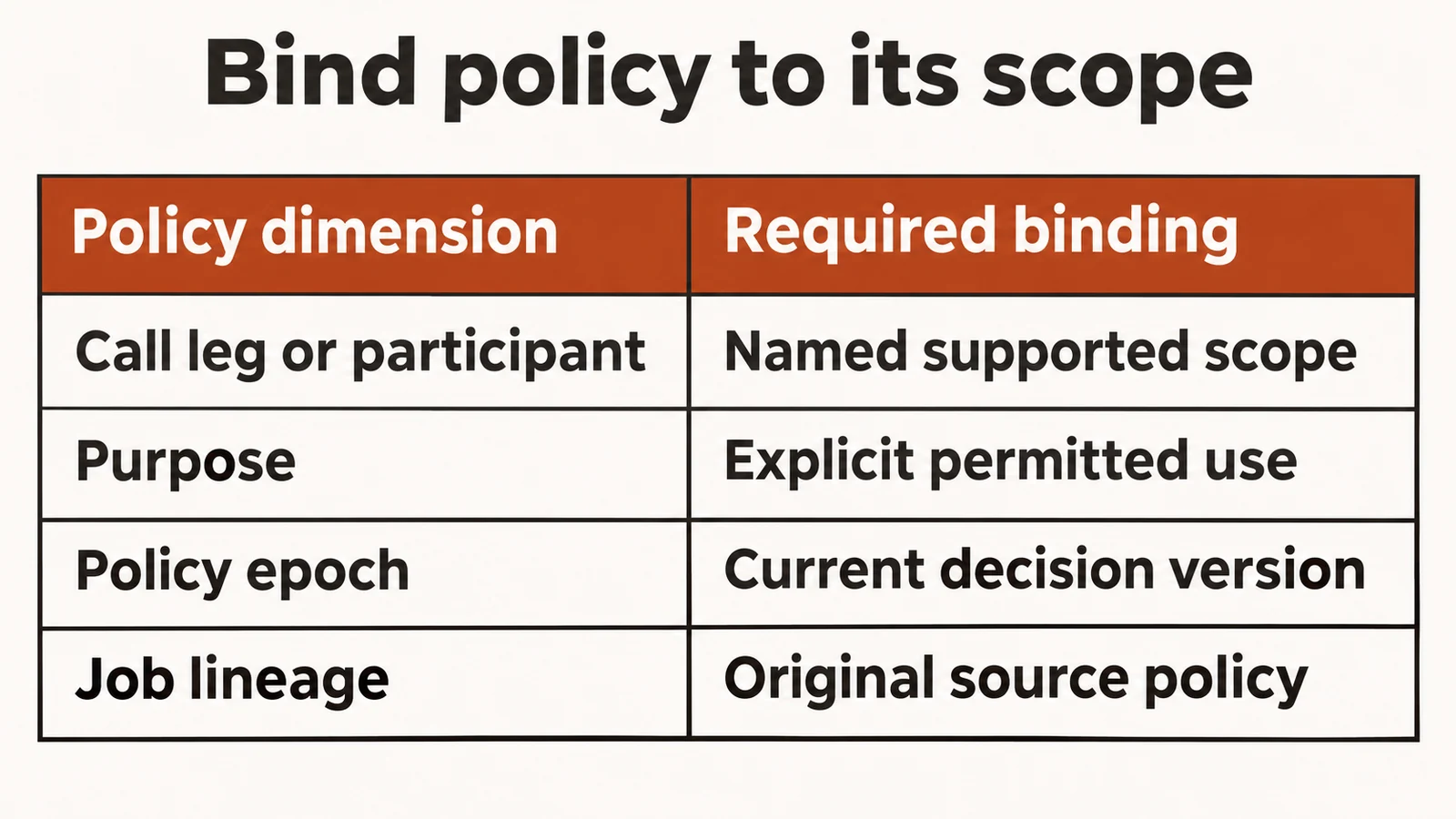
A policy decision should say whose or which call leg's material it covers and why it may be processed. A grant for one leg cannot silently authorize another participant's audio. A grant for support cannot automatically authorize training or an unrelated export purpose.
The local model is configured for one bounded leg and one purpose. Tickets carry that same scope and the policy epoch under which work was prepared. Admission compares the current decision with every ticket, rejecting both leg mismatches and purpose mismatches.
The shared-phone identity guide explains why one telephone endpoint can represent more than one person. A real participant model can be more detailed than this teaching leg identifier, but it still needs an explicit scope contract. Do not claim that a phone number alone defines every affected person's permission.
Transfers complicate the mapping between application policy and recorder behavior. A real developer discussion about recording during external transfer reports a recording pause despite configuration expectations. It is an adjacent operational symptom, not a legal interpretation or proof that every current provider behaves that way.
The warm-handoff guide describes why transfer needs explicit context and ownership. Recording policy should follow the actual intended participant and leg scope through that handoff. A configuration flag in one system does not establish the observed state of another recorder or derivative job.
Withdraw before admitting more work
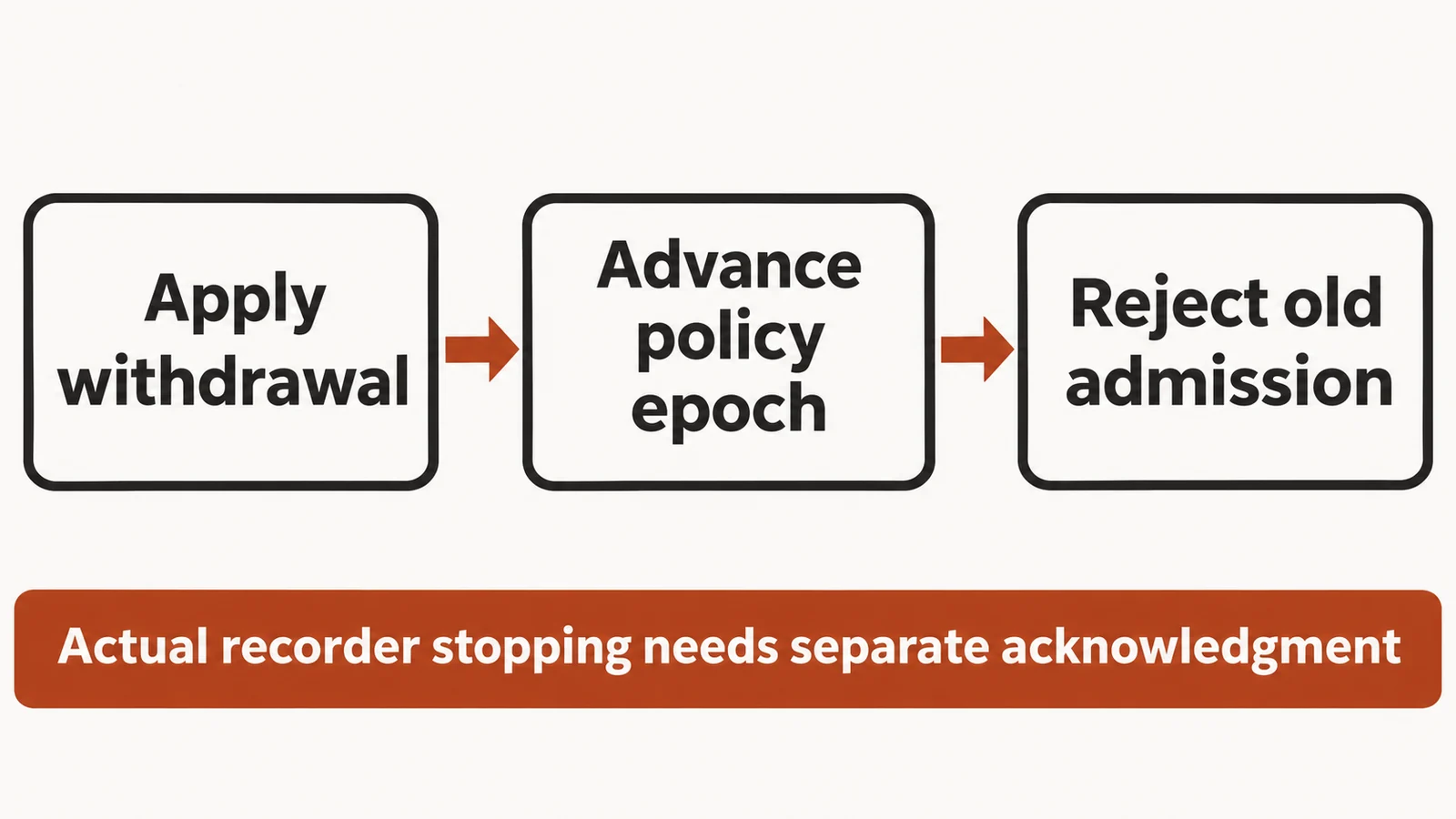
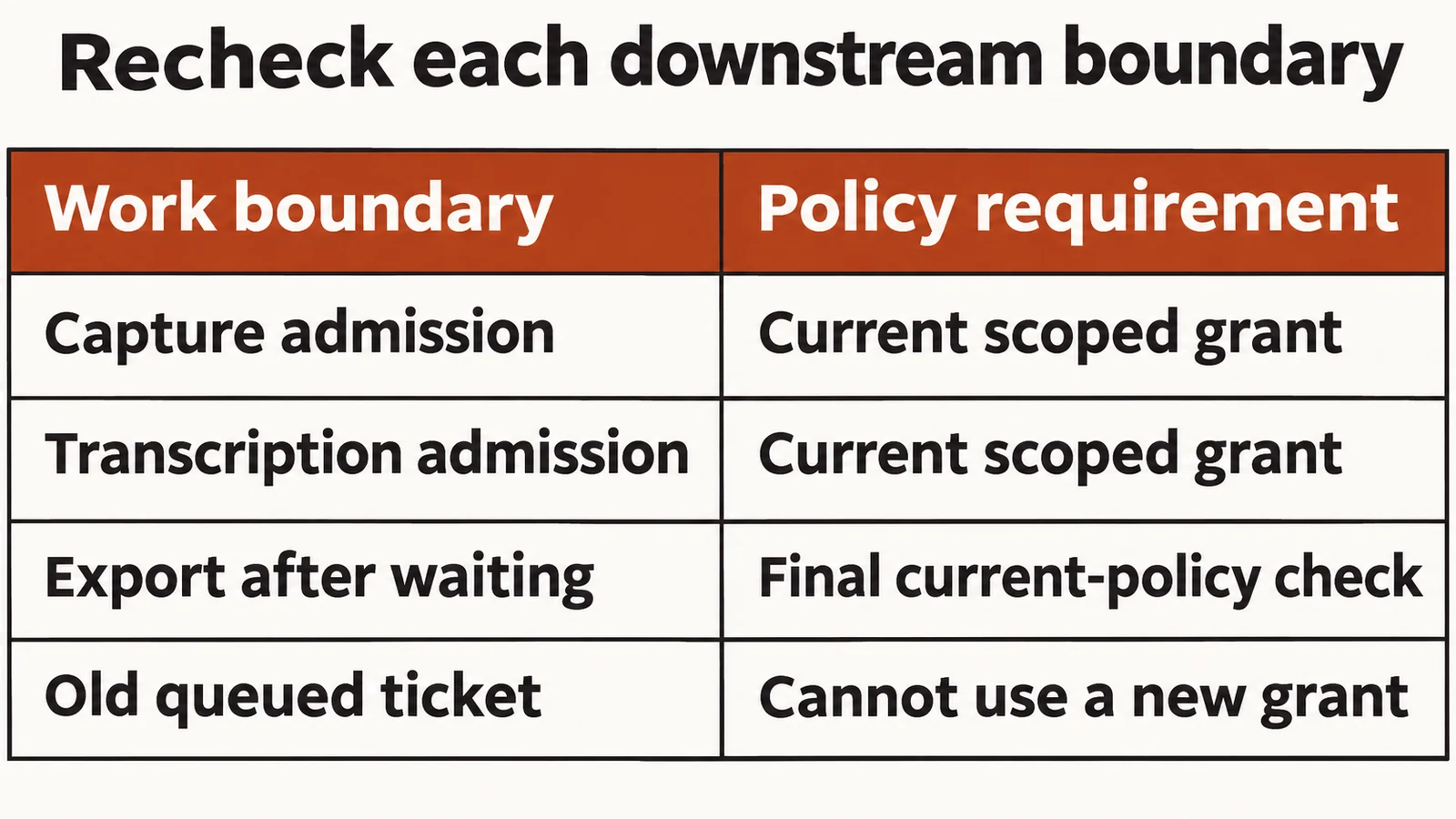
Apply the current withdrawal decision before considering another capture, transcription, or export admission. Old queued work must not keep using the earlier allowed flag simply because it was prepared when recording was permitted. The new epoch makes that boundary inspectable.
The reference replaces its frozen current decision with a strictly newer epoch. Its admission function reads the current decision each time. While the policy is withdrawn, all supported stage admissions are denied regardless of an old ticket's earlier permission.
The audio-backpressure guide explains why held work needs a final admission check. A queue can drain while one item remains outside it, waiting for another operation. The same principle applies to a transcription or export job holding material prepared under an older recording policy.
Call admission and policy update are local ordering boundaries here. A production service must provide equivalent atomicity at its actual capture and processing adapters. If several workers act on a shared scope, their final admission must use authoritative current policy rather than independently cached booleans.
The stale-tool-result guide addresses how to coordinate current policy and state at a protected operation. Checking before a wait is insufficient. A job that resumes after withdrawal must check again before the next ordered side effect.
Keep stop request and stop acknowledgment distinct
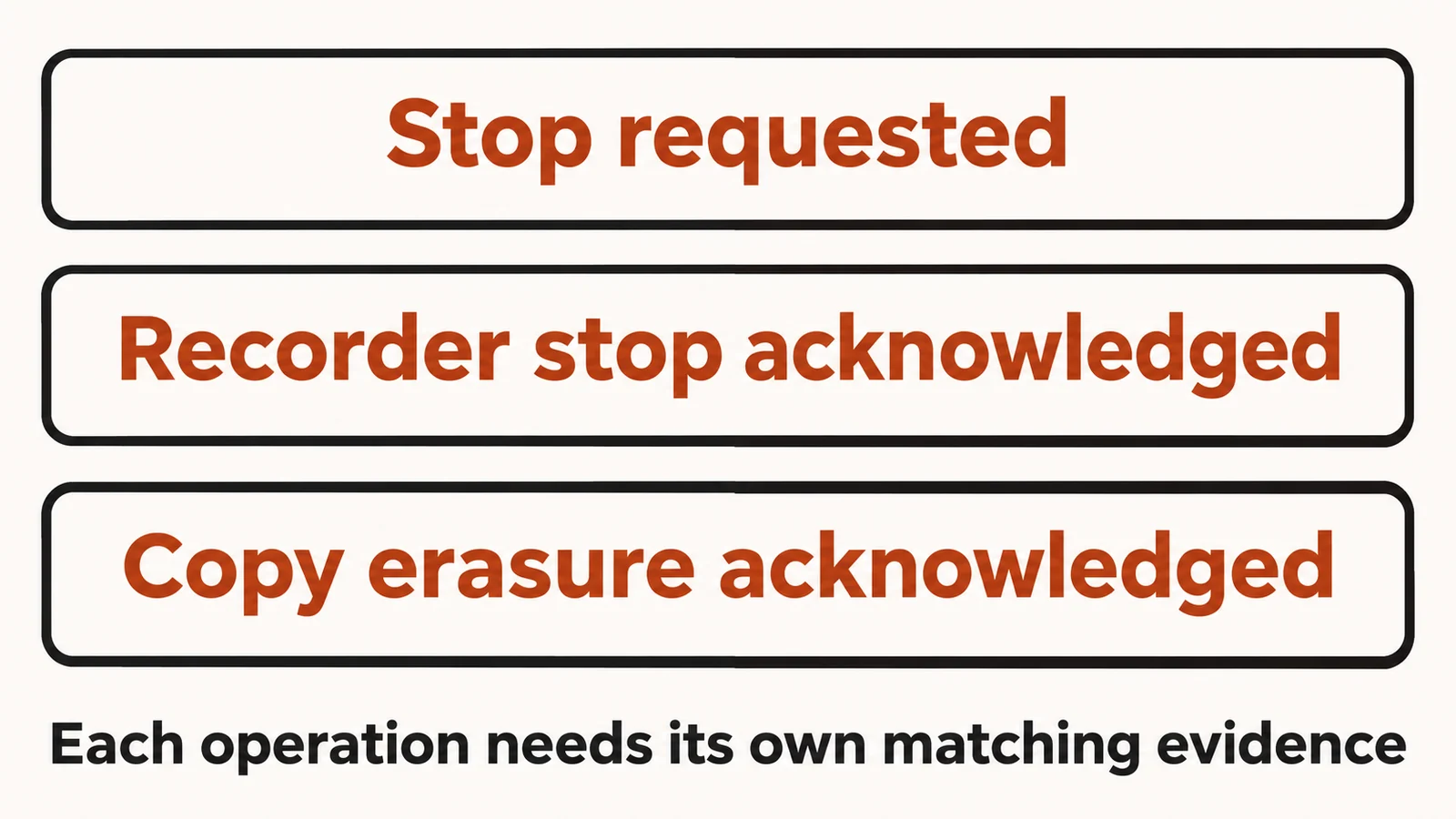
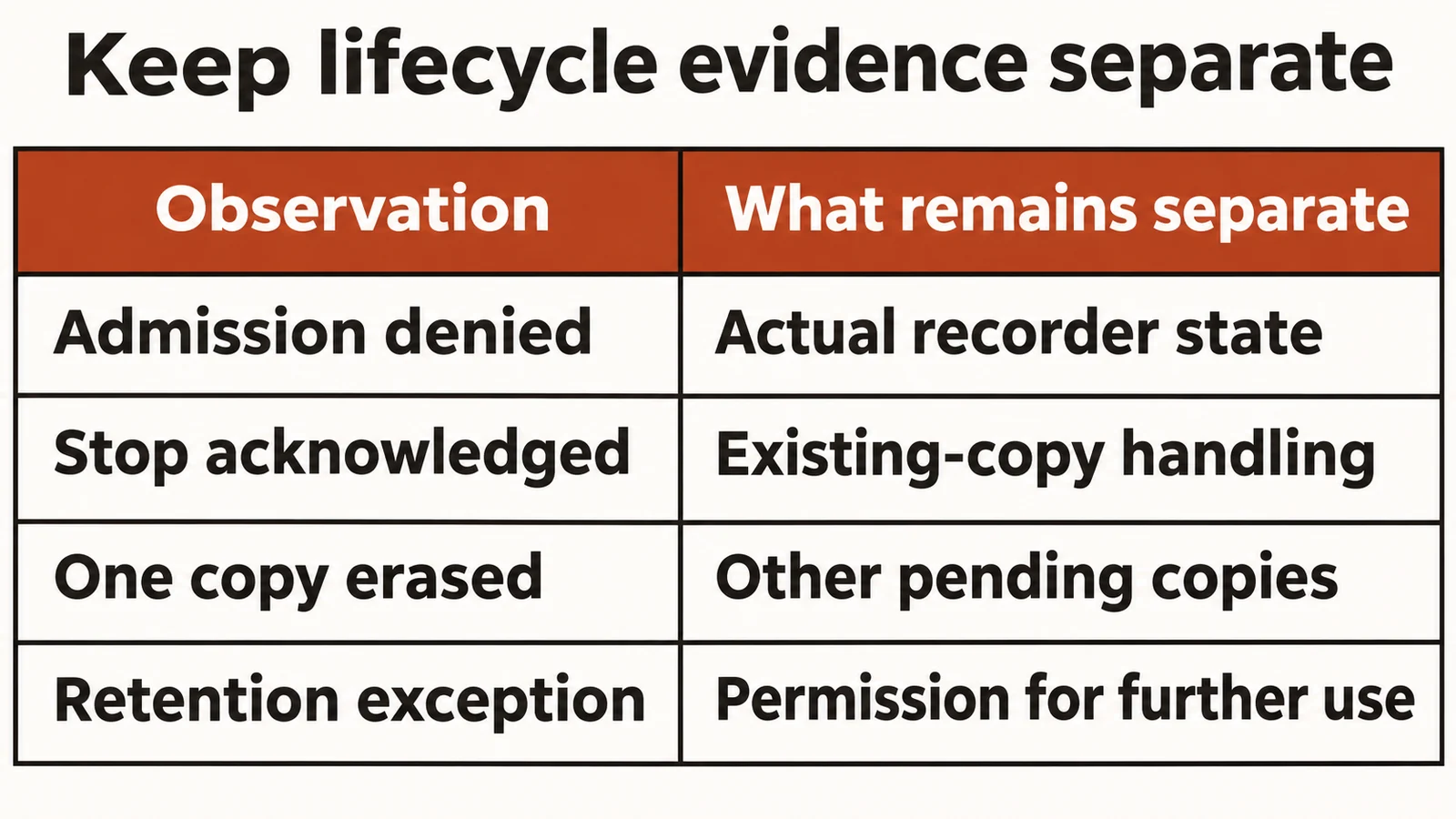
Blocking application admission does not prove the external recorder stopped. A stop request may be queued, rejected, delayed, or time out. Preserve stop-requested until the correct trusted acknowledgment or other authoritative evidence resolves the recorder's actual state.
Twilio's Recording resource documentation describes provider-specific recording lifecycle operations. Its current documentation distinguishes call and conference capabilities, including the limits of stopped status. Do not copy one call-recording operation into a universal pause, stop, and resume abstraction for every recorder type.
The reference does not call Twilio or any other recorder. It models the local observation state and consumes a synthetic trusted stop acknowledgment tied to the current stop token. The printed report explicitly labels those acknowledgments as fixture inputs rather than actual provider receipts.
The truthful tool-waiting guide explains how to communicate pending operations. A caller should not hear that recording definitely stopped merely because the application sent a request. Wording must match observed evidence and the organization's authorized communication policy.
A late acknowledgment can belong to a previous recording generation. After a fresh grant, the model clears the old stop token and reports start-unconfirmed. The old stop acknowledgment cannot mark the new recording attempt stopped. It remains a stale acknowledgment for current-state purposes.
Keep deletion independent from stopping
Stopping capture does not erase earlier recordings, transcripts, exports, or backups. Each relevant copy needs its own lifecycle evidence under the actual retention and deletion contract. A recorder stop callback is not a deletion receipt for unrelated storage systems.
The local erasure ledger has three declared copy classes: recording, transcript, and export. They are illustrative inventory entries, not a complete map of every production data store. The organization must supply the real lineage and copy inventory, including derived data and external destinations where applicable.
The retrieval-for-speech guide illustrates why derivative material can outlive its original input. A transcript might have generated a retrieval record or another result under a separate pipeline. Deleting one audio object does not demonstrate what happened to those other representations.
The model retains the source policy epoch with each erasure record. That identifies the old source generation being handled, even after a new grant advances the current policy. An acknowledgment for old material updates that historical erasure entry without claiming to delete newly admitted material.
The memory-across-calls guide addresses another derivative boundary. Retained memory needs its own purpose, consent, identity, and expiry evidence. Do not assume a recording-policy update automatically implements every lifecycle rule of a separate memory system.
Preserve qualified retention decisions
Withdrawal and erasure are different policy questions. Applicable rules may require deletion, restriction, or retention under a qualified exception for some material. The engineering model should consume that authorized decision without inventing its legal basis or claiming every withdrawal means the same thing everywhere.
The reference accepts erase or retain-exception as an externally supplied disposition. Withdrawal still denies new admissions in both cases. A retained copy remains explicitly labeled retention-exception, and a synthetic erasure acknowledgment cannot silently rewrite that status to erased.
This separation prevents a dangerous shortcut: retaining material under an exception must not become permission to keep using it for the withdrawn purpose. The admission policy remains denied. Storage lifecycle and allowed processing are different dimensions, so a retained object needs the actual restrictions selected by the organization.
The telemetry-redaction guide explains why the policy audit itself should minimize content. A small event recording the transition and bounded reason can support diagnosis without copying the caller's full withdrawal utterance or account details into general logs.
The local example does not decide whether an exception is legally valid, whether a deletion deadline applies, or whether an audit record must be retained. Those decisions are trusted external policy inputs. The emitted report explicitly states that legal compliance was not established.
Reject replay without losing audit history
An older allowed event must not restore recording after a newer withdrawal. The reference checks epoch ordering before changing current state. Strictly older decisions are stale; exact duplicates retain their existing disposition and append a bounded duplicate observation; changed payloads reusing the current epoch are revision conflicts.
The out-of-order webhook guide describes why delivery order and business order are different. A signed callback can still arrive late or be delivered more than once. Provider authenticity does not make its event the newest current policy decision.
Keep original transition evidence available for audit where authorized. The model records old epoch, new epoch, and grant-or-withdraw action. It does not rewrite a historical grant into a withdrawal or erase the fact that a duplicate was observed merely to make the current state look simpler.
The network-resume guide provides another replay example. A reconnected transport should not resend an old consent-granted event as if it were a new affirmative decision. Resume requires the current policy contract, not the accidental arrival of familiar bytes.
Fresh regrant uses a strictly newer epoch under the trusted policy adapter. Old tickets remain obsolete after that regrant, and old stop acknowledgments cannot overwrite the new recorder observation. A new policy state does not revive old queued work or erase unresolved historical deletion obligations.
Run the scoped policy reference
Run the full fence with Python's standard library. It implements a single-owner local policy model, frozen decision and ticket records, copy-specific erasure evidence, a copied report, and a deterministic suspended-export fixture. It does not run a recorder, store audio, delete a file, or determine legal consent.
The leg and purpose vocabulary is intentionally small. A real adapter must define actual participant scope and trusted policy provenance. The synthetic decisions and acknowledgments in this fence are fixture setup, not provider event verification or legal-policy evaluation.
import asyncio
from dataclasses import dataclass, replace, FrozenInstanceError
import json

def revision(v):
    return type(v) is int and 0 <= v <= 1000000

@dataclass(frozen=True)
class Decision:
    epoch: int
    leg: str
    purpose: str
    allowed: bool
    retention: str

@dataclass(frozen=True)
class Ticket:
    epoch: int
    leg: str
    purpose: str

def valid_ticket(t):
    return (type(t) is Ticket and revision(t.epoch) and
            type(t.leg) is str and t.leg in ('leg-A', 'leg-B') and
            type(t.purpose) is str and t.purpose in ('support', 'training'))

class RecordingPolicy:
    def __init__(self, leg='leg-A', purpose='support'):
        if (type(leg) is not str or type(purpose) is not str or
                leg not in ('leg-A', 'leg-B') or purpose not in ('support', 'training')):
            raise ValueError('unsupported scope')
        self._leg, self._purpose = leg, purpose
        self._decision = None
        self._stop = None
        self._recorder = 'unobserved'
        self._erasures = {}
        self._erasure_sources = {}
        self._capture_epoch = None
        self._audit = []

    @property
    def policy(self):
        return self._decision

    @property
    def recorder_evidence(self):
        return self._recorder

    def apply(self, d):
        # d is supplied only by a trusted organization-policy adapter.
        if (type(d) is not Decision or not revision(d.epoch) or
                type(d.allowed) is not bool or type(d.retention) is not str or
                d.retention not in ('erase', 'retain-exception') or
                type(d.leg) is not str or type(d.purpose) is not str):
            raise ValueError('invalid policy decision')
        if (d.leg, d.purpose) != (self._leg, self._purpose):
            return 'scope-mismatch'
        old = self._decision
        if old is not None and d.epoch < old.epoch:
            return 'stale'
        if old is not None and d.epoch == old.epoch:
            if d != old:
                return 'revision-conflict'
            self._audit.append((old.epoch, d.epoch, 'duplicate'))
            return 'duplicate'
        if old is not None and d.allowed == old.allowed:
            return 'unsupported-transition'
        self._decision = Decision(d.epoch, d.leg, d.purpose, d.allowed, d.retention)
        self._audit.append((None if old is None else old.epoch, d.epoch,
                            'grant' if d.allowed else 'withdraw'))
        if d.allowed:
            self._capture_epoch = d.epoch
            self._stop = None
            self._recorder = 'start-unconfirmed'
        else:
            self._stop = Ticket(d.epoch, d.leg, d.purpose)
            self._recorder = 'stop-requested'
            self._erasure_sources[self._stop] = self._capture_epoch
            self._erasures[self._stop] = {copy: ('pending' if d.retention == 'erase' else 'retention-exception')
                                         for copy in ('recording', 'transcript', 'export')}
        return 'policy-updated'

    def admit(self, ticket, stage):
        if type(stage) is not str or stage not in ('capture', 'transcribe', 'export'):
            return 'unsupported-stage'
        if not valid_ticket(ticket):
            return 'invalid-ticket'
        d = self._decision
        if d is None or not d.allowed:
            return 'policy-denied'
        if (ticket.epoch, ticket.leg, ticket.purpose) != (d.epoch, d.leg, d.purpose):
            return 'stale-or-scope-mismatch'
        return 'admitted-local-only'

    def acknowledge_stop(self, token):
        if not valid_ticket(token) or self._stop != token:
            return 'stale-stop-ack'
        self._recorder = 'stopped-acknowledged'
        return self._recorder

    def acknowledge_erasure(self, token, copy):
        if (not valid_ticket(token) or type(copy) is not str or
                copy not in ('recording', 'transcript', 'export') or token not in self._erasures):
            return 'unknown-erasure-target'
        row = self._erasures[token]
        if row[copy] == 'retention-exception':
            return 'retention-exception'
        row[copy] = 'erased-acknowledged'
        return row[copy]

    def report(self):
        return {'policy_epoch': None if self.policy is None else self.policy.epoch,
                'recorder': self.recorder_evidence,
                'audit': [list(row) for row in self._audit],
                'erasure_ledger': [{'epoch': t.epoch, 'leg': t.leg, 'purpose': t.purpose,
                                    'source_policy_epoch': self._erasure_sources[t],
                                    'copies': dict(copies)} for t, copies in self._erasures.items()]}

async def final_admission(model, ticket, wait):
    await wait()
    return model.admit(ticket, 'export')

m = RecordingPolicy()
grant = Decision(0, 'leg-A', 'support', True, 'erase')
ticket = Ticket(0, 'leg-A', 'support')
assert m.admit(ticket, 'capture') == 'policy-denied'
assert m.apply(grant) == 'policy-updated'
before_duplicate = m.report()
assert m.apply(grant) == 'duplicate'
after_duplicate = m.report()
assert after_duplicate['policy_epoch'] == before_duplicate['policy_epoch'] == 0
assert after_duplicate['recorder'] == before_duplicate['recorder'] == 'start-unconfirmed'
assert after_duplicate['erasure_ledger'] == before_duplicate['erasure_ledger'] == []
assert after_duplicate['audit'][:-1] == before_duplicate['audit']
assert after_duplicate['audit'][-1] == [0, 0, 'duplicate']
after_duplicate['audit'][-1][2] = 'forged'
assert m.report()['audit'][-1] == [0, 0, 'duplicate']
assert m.apply(replace(grant, epoch=1)) == 'unsupported-transition'
assert m.policy.epoch == 0
assert m.admit(ticket, 'capture') == 'admitted-local-only'
assert m.admit(replace(ticket, leg='leg-B'), 'capture') == 'stale-or-scope-mismatch'
assert m.admit(replace(ticket, purpose='training'), 'export') == 'stale-or-scope-mismatch'
assert m.admit(replace(ticket, epoch=True), 'capture') == 'invalid-ticket'
assert m.apply(replace(grant, leg='leg-B', epoch=1)) == 'scope-mismatch'
withdraw = Decision(1, 'leg-A', 'support', False, 'erase')
assert m.apply(withdraw) == 'policy-updated'
assert m.apply(replace(withdraw, epoch=2)) == 'unsupported-transition'
stop = Ticket(1, 'leg-A', 'support')
assert m.admit(ticket, 'transcribe') == 'policy-denied'
assert m.recorder_evidence == 'stop-requested'  # No recorder acknowledgment yet.
assert m.apply(grant) == 'stale'
assert m.apply(replace(withdraw, allowed=True)) == 'revision-conflict'
assert m.acknowledge_stop(stop) == 'stopped-acknowledged'
assert m.report()['erasure_ledger'][0]['copies']['recording'] == 'pending'
assert m.report()['erasure_ledger'][0]['source_policy_epoch'] == 0
assert m.acknowledge_erasure(stop, 'recording') == 'erased-acknowledged'
assert m.report()['erasure_ledger'][0]['copies']['transcript'] == 'pending'
before_withdraw_duplicate = m.report()
assert m.apply(withdraw) == 'duplicate'
after_withdraw_duplicate = m.report()
assert after_withdraw_duplicate['policy_epoch'] == before_withdraw_duplicate['policy_epoch'] == 1
assert after_withdraw_duplicate['recorder'] == before_withdraw_duplicate['recorder'] == 'stopped-acknowledged'
assert after_withdraw_duplicate['erasure_ledger'] == before_withdraw_duplicate['erasure_ledger']
assert after_withdraw_duplicate['audit'][:-1] == before_withdraw_duplicate['audit']
assert after_withdraw_duplicate['audit'][-1] == [1, 1, 'duplicate']
assert m.apply(replace(grant, epoch=2)) == 'policy-updated'
assert m.admit(ticket, 'export') == 'stale-or-scope-mismatch'
assert m.acknowledge_stop(stop) == 'stale-stop-ack'
assert m.recorder_evidence == 'start-unconfirmed'
assert m.acknowledge_erasure(stop, 'transcript') == 'erased-acknowledged'
assert m.acknowledge_erasure(stop, 'export') == 'erased-acknowledged'
snapshot = m.report()
snapshot['erasure_ledger'][0]['copies']['recording'] = 'forged'
assert m.report()['erasure_ledger'][0]['copies']['recording'] == 'erased-acknowledged'
try:
    grant.allowed = False
except FrozenInstanceError:
    pass
else:
    raise AssertionError('mutable decision')
for bad in (replace(grant, epoch=True), replace(grant, allowed=1),
            replace(grant, retention='unknown'), None):
    try:
        m.apply(bad)
    except ValueError:
        pass
    else:
        raise AssertionError('invalid policy admitted')
assert m.admit(ticket, 'unlisted-stage') == 'unsupported-stage'
assert m.acknowledge_stop(replace(stop, epoch=True)) == 'stale-stop-ack'
retained = RecordingPolicy()
retained.apply(grant)
retained.apply(replace(withdraw, retention='retain-exception'))
assert retained.acknowledge_erasure(stop, 'recording') == 'retention-exception'
assert retained.admit(ticket, 'export') == 'policy-denied'

async def suspended_test():
    current = RecordingPolicy()
    current.apply(grant)
    entered, release = asyncio.Event(), asyncio.Event()
    async def wait():
        entered.set()
        await release.wait()
    pending = asyncio.create_task(final_admission(current, ticket, wait))
    await entered.wait()
    current.apply(withdraw)
    release.set()
    result = await pending
    assert result == 'policy-denied'
    return result
after_wait = asyncio.run(suspended_test())
print(json.dumps({'fixture_class': 'Synthetic', 'policy_report': m.report(),
                  'retention_report': retained.report(), 'export_after_withdrawal': after_wait,
                  'acknowledgments': 'synthetic trusted adapter inputs',
                  'actual_recorder_or_storage_call': 'not-performed',
                  'legal_compliance': 'not-established'}))
The printed report contains actual local policy epochs, bounded audit transitions, recorder observation labels, source policy lineage, copy-specific statuses, and the result of export admission after withdrawal. It also states that no actual recorder or storage call occurred and that compliance was not established.
Interpret the local fixture evidence
The initial no-policy case denies capture. A matching grant admits local work, while a different leg or purpose is rejected. The exact integer guard prevents a boolean epoch from matching a legitimate numeric revision through Python's equality behavior.
The withdrawal case denies old transcription admission before any stop acknowledgment arrives. Recorder evidence remains stop-requested. Only a matching trusted stop token advances the observation to stopped-acknowledged, and the erasure ledger remains pending after that transition.
The partial-erasure case acknowledges one copy while keeping another pending. That protects against a broad erased flag that accidentally hides unresolved derivatives. The later regrant preserves the old erasure lineage, allowing late acknowledgments for those old copy classes without authorizing new capture from old tickets.
The observability guide helps keep those dimensions separate in an integration. Policy admission, recorder state, and each copy's lifecycle deserve distinct evidence. A single success counter or a green recording icon cannot establish all of them.
The report-ownership fixture changes a returned nested dictionary and verifies that internal state remains unchanged. The report is a copied diagnostic view, not a mutable backdoor into the policy machine. Frozen decision assignment is also tested, and malformed trusted-decision shapes receive bounded errors rather than partial state changes.
Recheck after suspended work
A job can pass admission, wait for another operation, and become obsolete before export. The final_admission helper deliberately awaits a controlled boundary and then queries current policy again. The fixture withdraws permission while that coroutine is suspended and asserts that export is denied after it resumes.
Python's asyncio task documentation describes coroutine scheduling and cancellation behavior. Canceling a local task is cooperative behavior under that runtime; it is not an acknowledgment that a remote recorder stopped or that storage deleted a copy.
The interruption-safety guide explains why late work must not reclaim ownership. A transcription job started under an old epoch can retain historical lineage while losing permission to enter the next stage. Do not let its successful completion create a new grant.
An additional await requires another current-policy check before the next side effect. The pure model returns local admission only. A production storage writer, processor, or export adapter must provide equivalent final enforcement at its authoritative boundary, including when work crosses processes or regions.
Account for transfers and deployment boundaries
A live call can span several media legs, recorders, application workers, and downstream processors. The local policy model intentionally covers one named leg and purpose. A deployment must map that scope to the real components that capture, derive, store, and export its material.
The rolling-deployment guide explains why moving workers and draining sessions require explicit ownership. A new worker must not start with a default recording grant while an old worker holds a withdrawal. Policy continuity needs authoritative current state, not process-local assumptions carried through a restart.
The shutdown-semantics guide adds the termination boundary. A process exiting before a stop request receives its acknowledgment leaves an unresolved external operation. Durable evidence and recovery must follow the actual recorder contract; local teardown is not proof of remote cessation.
For a transfer, test which participant and leg the provider's recording identifier actually covers. A provider may record a call, conference, or selected track under different lifecycle rules. Match those documented semantics to organization policy before using a callback to update broader application state.
The model's fixed copy classes remain illustrative. Real exports and backups can have separate storage owners, retention constraints, and deletion acknowledgment shapes. Inventory them through actual data lineage rather than claiming the local three-entry ledger covers every external copy automatically.
Minimize the policy audit
A useful audit records the decision reference, scope, purpose, old and new epochs, and operation states under a justified access policy. It does not need a raw transcript attached to every transition. Identifiers can still be linkable and need appropriate retention even when they appear opaque.
OWASP's logging guidance discusses avoiding secrets and unnecessary sensitive content while retaining useful security evidence. Apply the same discipline to policy failures and provider exceptions. A stop timeout should not cause the whole recording payload or authentication context to be dumped into a log.
OpenTelemetry's sensitive-data guidance describes application responsibilities across collection and processing. Instrumentation does not automatically know which recording metadata is sensitive for your workflow. Check attributes, exporter behavior, storage access, and failure paths separately.
The regional speech-dataset guide addresses another purpose boundary. Material collected for support should not silently become training or evaluation data. The trusted policy input must identify the actual purpose and participant scope rather than relying on a generic consent label.
Compare the evidence boundaries
Here ✓ means a named boundary explicitly provides the stated local check or evidence. ✗ means it supplies no such guarantee. The marks are scope descriptions, not a legal-compliance score or a measured provider-reliability result.
| Property | Policy update | Synthetic reference | Real integration evidence |
|---|---|---|---|
| New admission denied after withdrawal | ✓ Current decision required | ✓ Checked per stage | Authoritative adapter enforcement |
| Other leg or purpose rejected | ✓ Explicit scope needed | ✓ Ticket mismatch tested | Actual participant and leg mapping |
| Recorder has stopped | ✗ Request is insufficient | ✗ Synthetic acknowledgment only | Correct recorder receipt or observation |
| Existing copies erased | ✗ Policy change is insufficient | ✗ Ledger tracks synthetic evidence | Copy-specific storage acknowledgments |
| Retention exception valid | ✗ Machine cannot decide law | ✗ Trusted external disposition | Qualified organization policy |
| Old grant replay rejected | ✓ Monotonic decision order | ✓ Stale and conflict fixtures | Durable shared-state ordering |
| Compliance established | ✗ Not from a flag | ✗ Not claimed | Applicable policy and independent evidence |
The local-versus-managed guide helps assign those responsibilities to actual operators and providers. A hosted recorder, application controller, and storage service can each own different lifecycle steps. The integration needs evidence from each boundary it claims to control.
Define the supported transition model
The reference deliberately implements alternating grant and withdrawal transitions for one configured scope. An exact duplicate preserves the current state and appends only a duplicate audit observation, while a new same-state decision receives unsupported-transition. This keeps a small model from pretending to handle every kind of notice refresh, purpose migration, or recording-generation replacement.
That limit matters for lineage. A fresh grant after withdrawal begins a new admitted generation, while the old withdrawal retains its source-policy epoch and copy ledger. A new grant while a grant is already active would require an additional rule for existing recording segments and their inventory. The teaching API rejects that transition instead of overwriting the last source epoch and losing evidence about earlier material.
Likewise, a new withdrawal while already withdrawn is outside this model's transition contract. An exact retry of the existing withdrawal appends a duplicate observation but does not reset stop or erasure progress. A real policy system can support additional decisions, but it must define how their operation identities, source generations, and existing acknowledgments are retained.
The negative fixtures exercise both unsupported same-state transitions and verify that current state remains unchanged. This is different from silently accepting the event or advancing an epoch with no defined recording lifecycle. An explicit unsupported outcome gives the controller a concrete integration issue to handle without inventing permission.
Match callbacks to operations and lineage
A stop acknowledgment and an erasure acknowledgment have different matching rules. Stop acknowledgment updates the current recorder observation only when its token matches the current stop request. After regrant, that old token is no longer current and cannot label the new attempt stopped.
An erasure acknowledgment can still be relevant after regrant because it belongs to old material. The historical ledger retains the withdrawal token, scope, purpose, and source-policy epoch. A late acknowledgment updates that original entry rather than using the active policy epoch to guess which objects were deleted.
The reference's copy labels identify classes of material in an illustrative inventory. A real adapter must bind acknowledgments to actual stored object and derivative identities under the authorized lineage policy. It must also verify the callback's provider authenticity and exact operation reference before passing trusted evidence into this local model.
The playback-acknowledgment guide illustrates a parallel evidence limit. An acknowledgment proves only the event defined by its contract. A stop receipt, a delete receipt, a local write, and a caller hearing a statement are different observations. Do not merge them into one generic success event merely because their payloads arrive through the same webhook transport.
Test missing, wrong-scope, repeated, and delayed acknowledgments at the actual integration boundary. Preserve unknown outcomes when evidence is unavailable. A matching local token is necessary for correct routing, but it cannot establish that an unverified callback tells the truth about a real recorder or storage system.
Inventory downstream work before declaring closure
Trace how material moves from capture into storage, transcription, summarization, retrieval, analytics, support exports, and backups where those components actually exist. Each transition can create another copy or derivative with its own lifecycle owner. The purpose of an inventory is to identify real obligations, not to populate a hypothetical platform diagram with every possible technology.
The local three-copy ledger demonstrates the shape of that accounting. A recording acknowledgment does not close the transcript entry, and a transcript acknowledgment does not close an export entry. The fixture inspects the actual remaining pending status after one copy is acknowledged so an overly broad completion flag would fail visibly.
An organization may decide that some material must be retained under a qualified exception while further use is restricted. The model preserves that status explicitly and refuses to relabel it erased merely because a callback arrives. A later change to the retention decision would require a separately declared policy transition and evidence contract, which this small artifact does not implement.
The outcome-metrics guide explains why pending and unknown outcomes belong in the ledger. A workflow should not report every withdrawal as fully completed while excluding recorder timeouts or unresolved copies. A local policy update is a real event, but it is not the same completed outcome as acknowledged cessation and resolved lifecycle handling.
Keep scope when reporting progress. A copy's deletion under an old support-purpose generation does not establish deletion of another participant's material or a newly admitted recording generation. The source-policy epoch and actual object lineage prevent those claims from crossing unrelated data boundaries.
Verify the orchestration without fabricating provider results
The suspended-export fixture uses events to control ordering. It waits until a coroutine has reached its boundary, applies withdrawal, and then lets that coroutine resume. The assertion inspects the final admission result. This establishes the local timing relationship without relying on an arbitrary sleep or claiming to exercise a real recorder.
The policy report and retention report expose actual model state after the executed transitions. Their acknowledgment values are labeled synthetic trusted inputs. Those labels are part of the reusable output because a reader might inspect the JSON separately from the article. No real stop, deletion, or legal-compliance receipt is generated.
For an integration test, replace the synthetic adapter input with a verified observation from an authorized test environment and preserve the original expectation. Record which call leg, recorder type, operation identity, policy epoch, and copy lineage were exercised. Report what remained pending or unknown instead of rewriting the expected result to match an incomplete provider response.
Review failure paths too. A provider exception must not cause a raw transcript dump, an automatic regrant, or a fallback export of the material whose admission was just denied. The policy machine supplies bounded local dispositions; the actual adapter must respect them on success, timeout, cancellation, and retry paths.
The regression-testing guide can help preserve those cases across releases. Execute the complete current published fence and compare its emitted evidence with the stated contract. Then run focused recorder and storage tests separately, because a copied policy implementation cannot establish the behavior of components it never contacts.
The machine admits only an explicit valid allowed decision. Missing policy begins denied, and malformed allowed values such as numeric truthy values are rejected before any transition. This prevents a producer error from becoming permission simply because Python considers the supplied object truthy. The same discipline applies to epoch fields, where boolean values must not compare equal to legitimate integer revisions.
Scope rejection also leaves current state unchanged. A decision for another leg or purpose does not partially update the epoch, stop token, or erasure ledger. The controller can route that decision to the correct scope owner or report an integration mismatch. It must not broaden the configured scope to make an unrelated event fit the current object.
The copied report is deliberately distinct from authoritative state. Its nested dictionaries can be serialized or inspected by a test runner, and the alias fixture confirms that changing a returned copy cannot alter the internal erasure status. Do not mistake that diagnostic snapshot for a current permission token at a later adapter boundary; admission still queries the current machine.
The original source epoch is likewise historical evidence. It explains which admitted generation the illustrative erasure entry concerns. A fresh grant creates a different current epoch but leaves old lifecycle work visible. That is why a late deletion acknowledgment can remain useful while a late stop acknowledgment is rejected for the new recorder observation: they refer to different operations and protect different facts.
For a deployment, make those operation references concrete before connecting actual callbacks. Verify the provider event, locate its exact recorder or object lineage, and then apply only the corresponding observation. An unrelated callback must not flip a broad consent or erased boolean for the entire call. Bounded local policy and explicit external receipts together make the operational claims reviewable without pretending the example implements the whole recording platform.
Use the pending entries to drive a concrete next investigation. If admission is denied but recorder evidence remains stop-requested, inspect the recorder operation and its actual response. If stopping is acknowledged but a transcript copy remains pending, inspect the derivative store's lifecycle request. If a copy has retention-exception, consult the authorized policy owner rather than pretending a transport retry can decide the exception away.
Those are different owners and evidence sources. Keeping their outcomes separate lets an operator explain the current state without claiming that a local flag proves every downstream effect. The reference's emitted report preserves that separation even after regrant, so historical deletion work remains visible while current capture admission follows a newer explicit decision.
Frequently asked questions
What changes when recording permission is withdrawn?
The application should apply the current authorized policy and block unsupported new admissions for its scope. Actual recorder stopping and handling of existing copies remain separate operations. This example models those distinctions and does not determine legal consent.
How does stopping differ from pausing?
Their exact meanings depend on the recorder and recording type. Read the current provider contract rather than assuming a universal lifecycle. The local model tracks a stop request and acknowledgment only; it does not implement provider pause or resume APIs.
Does stopping delete the existing recording?
No deletion evidence follows merely from stopping. Existing recordings and derivatives need their own retention or erasure workflow. The fixture explicitly keeps copy statuses pending after a synthetic stop acknowledgment.
What should a recording policy epoch contain?
It should identify a current ordered decision with explicit participant or leg and purpose scope. The reference also carries an external retention disposition. A numeric revision without its scope and trusted producer cannot establish which work the policy permits.
How should queued transcription jobs react?
Recheck current policy before the next protected processing or export boundary. A job's old ticket does not retain permission after withdrawal or regrant. Preserve its original lineage for audit without allowing that history to authorize new work.
What happens to a late recording callback?
Match it to the correct operation and source scope. An old stop acknowledgment must not overwrite a new recorder generation. The reference rejects that callback for current-state purposes while keeping old erasure records available for their own historical acknowledgments.
Can an old consent event re-enable recording?
It must not override a newer decision. The local machine classifies older epochs as stale and changed payloads at the current epoch as conflicts. A genuine resume requires a fresh authorized transition with a newer epoch.
When should policy be rechecked?
Before each ordered capture, processing, storage, or export admission and after intervening asynchronous work. The reference demonstrates a final export check after waiting. Real adapters must enforce their actual authoritative policy boundaries.
How should a failed stop request be represented?
Keep pending or unknown recorder evidence until an authoritative outcome resolves it. Do not claim capture ceased merely because the client timed out. The synthetic model remains stop-requested when no matching acknowledgment arrives.
Which downstream copies require erasure tracking?
Use the actual data-lineage inventory and qualified retention policy. Recordings, transcripts, exports, backups, or derived stores may have different owners and operations. The three copy classes in the example are illustrative and do not certify complete production coverage.
Does consent withdrawal always require immediate deletion?
Do not infer a universal rule from this engineering example. Applicable law, purpose, lawful basis, and qualified retention decisions are external inputs. The model keeps admission denial separate from erase or retain-exception dispositions.
How do lawful basis and retention exceptions differ?
Their legal meaning and applicability require qualified organization policy. The machine consumes a bounded retention decision without deciding its validity. Retaining material under an exception does not restore processing admission for the withdrawn purpose.
Can a recording resume after a new grant?
A supported workflow can admit new work after a fresh authorized policy transition. The reference uses a newer epoch and leaves actual recorder start unconfirmed. Old tickets and old stop acknowledgments cannot revive or overwrite the new attempt.
Should a withdrawal erase the policy audit itself?
That depends on the applicable authorized retention and audit policy. Keep content minimization and evidence requirements explicit. The example records bounded synthetic transitions but makes no universal legal claim about audit retention.
How can telemetry minimize consent-related data?
Use structured scope and operation evidence with bounded reasons instead of copying full utterances into every log. Protect linkable identifiers and inspect failure paths. The separate telemetry serializer guide covers field-and-value allowlists.
What should the caller be told during pending operations?
Use wording consistent with what is observed and the organization's communication policy. A stop request being sent is different from recording stopped or all copies erased. The reference establishes only local state labels and synthetic acknowledgment behavior.
How should backups and exports be accounted for?
Identify them through real lineage and assign explicit lifecycle owners and evidence. Do not treat a recording-object deletion as proof about every derivative. This bounded ledger must be adapted to the actual inventory before making broader erasure claims.
Which consent rules depend on jurisdiction?
The applicable participant, purpose, notice, lawful-basis, and retention requirements must come from qualified current policy. This article does not select those rules. Its code demonstrates how a trusted decision can invalidate stale local admission safely.
Can local tests prove a recorder has stopped?
No. They can verify the model's handling of a correctly matched acknowledgment. The fence performs no recorder call and labels all acknowledgments synthetic. Actual cessation requires provider or endpoint evidence under the real integration contract.
What end-to-end evidence closes an erasure workflow?
Use copy-specific authoritative outcomes for the declared scope, plus any qualified retained exceptions and unresolved states. Preserve source lineage so old acknowledgments do not apply to new material. A single local erased flag cannot establish that every external copy is gone.
Start with scoped admission and honest evidence
For 60db Agent integrations, identify the trusted policy owner and actual recorder and storage boundaries first. Run the complete local fixture and inspect the emitted scope, epoch, stop, and erasure evidence before mapping it to real provider operations.
Then test withdrawal during queued work, delayed acknowledgments, fresh regrant, transfers, and copy-specific lifecycle handling through the actual adapters. Keep legal decisions external and describe only the operational evidence the integration has established.