
- Engineering
Diagnose head-of-line blocking in WebSocket audio
Separate TCP reassembly, complete-message delivery, application stalls, and playback queues with a bounded diagnostic replay.
- Author
 Udit Goenka
- Editorial date
- Reading time
- 25 min
TL;DR: WebSocket audio can stall at TCP reassembly, complete-message delivery, an application read loop, or playback, and those causes need different evidence. Trace each boundary, preserve message and transport identities, and use controlled replays before attributing a long silence to head-of-line blocking or changing transports.
The agent generated the answer on time, but the receiver hears silence followed by a burst of old audio. The model trace looks healthy and the socket remains connected.
A missing earlier part of an ordered transport can delay later data. A blocked application consumer can produce a similar visible pause without any network gap, and a receiver queue can delay audio after complete messages have already arrived.
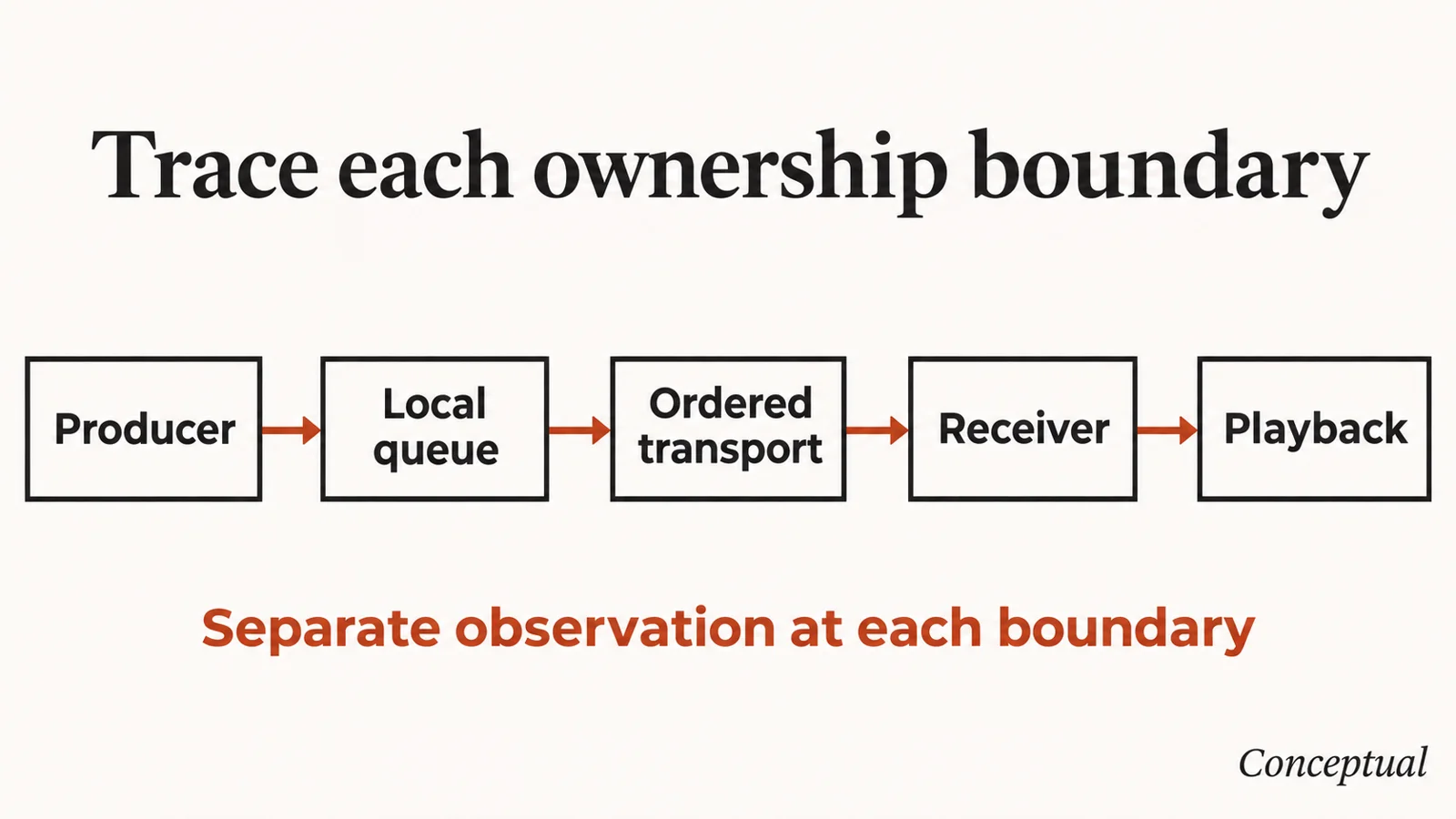
Begin by finding the first stalled boundary. Separate producer readiness, local send acceptance, transport observations, complete WebSocket message events, application consumption and supported playback evidence.
The transport comparison explains the broader delivery choices. This article supplies a synthetic transport-reassembly model, a separate complete-message gate, and an application-stall fixture that prevents those layers from being confused.
All fixtures are synthetic. The program does not implement TCP or RFC 6455 framing, capture actual packets, measure a physical speaker, or describe private 60db Agent architecture.
Table of contents
- Define which layer is blocked
- Read the ordered delivery contract
- Separate application stalls from transport gaps
- Run a layered stall replay
- Interpret local buffer evidence
- Trace complete messages and playback
- Protect cancellation behind queued media
- Choose cause-aligned mitigations
- Run a controlled transport trial
- Report a bounded diagnosis
- Build a boundary ledger before changing transports
- Exercise the controls that can resemble network loss
- Bound message size without inventing a priority guarantee
- Preserve evidence when the observation process stalls
- Write the diagnosis around the first supported cause
- Check the replay contract before reusing it
- Frequently asked questions
- Start with two different pauses
Define which layer is blocked
Head-of-line blocking describes later work waiting behind earlier work under an ordering contract. The phrase is useful only when the report identifies the queue, message sequence or transport layer whose ordering caused the wait.
A browser WebSocket application receives complete message events. It does not normally receive TCP byte ranges or a callback that directly reports which transport segment is missing.
A packet capture or suitable transport instrumentation can provide lower-layer evidence. Application timestamps alone can establish a delay between observed boundaries without proving that a TCP retransmission caused it.
Keep those distinctions in the event names. A message-ready timestamp, socket send call, receiver message event and player submission each describes a different point in the path.
The latency benchmark guide gives the measurement framework. Join identities across boundaries and subtract timestamps only when their clock relationship supports that calculation.
A connected socket can be idle, blocked behind missing bytes, waiting for the application, or serving media already too old for the conversation. Connection state by itself does not establish progress.
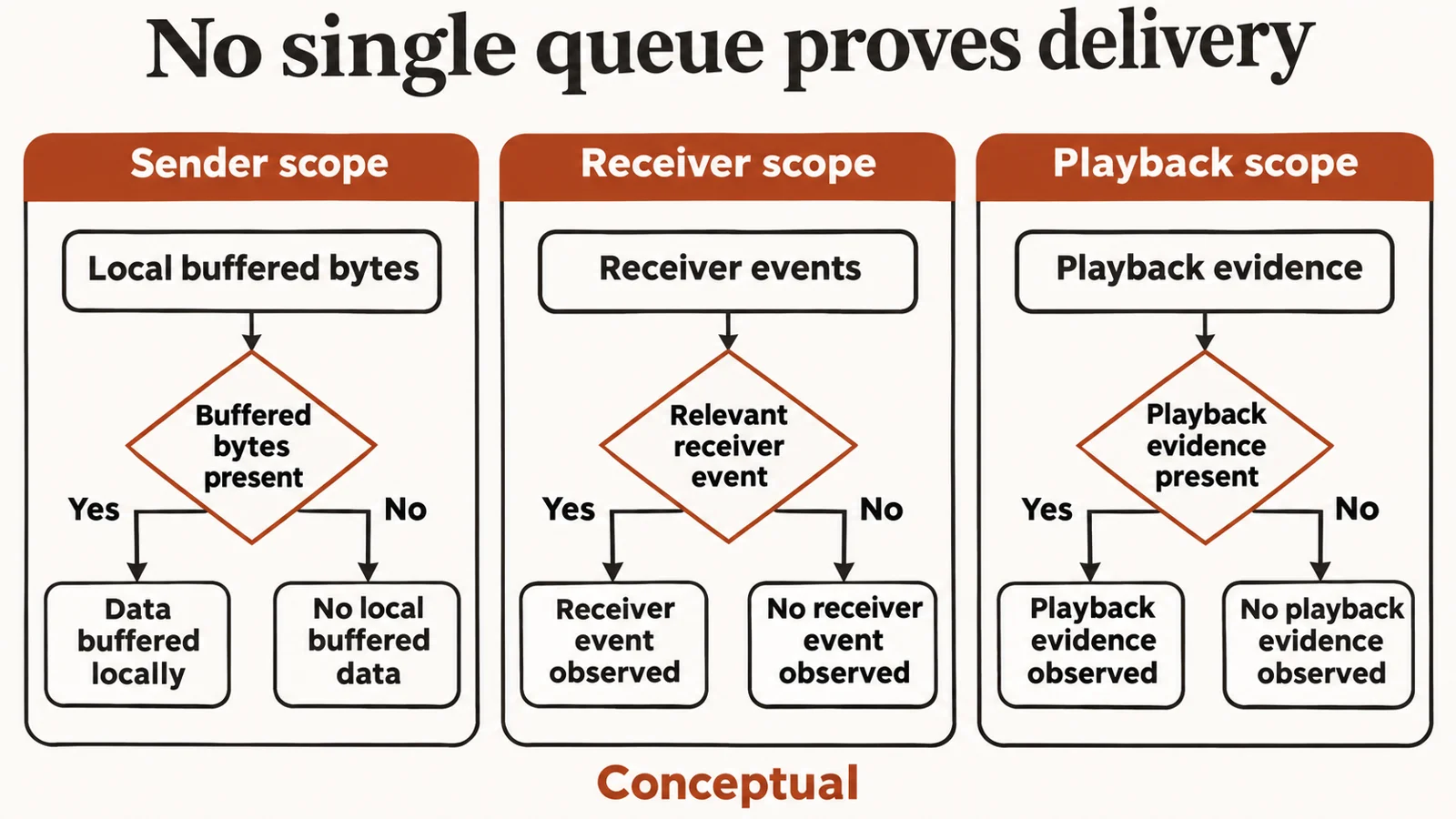
An empty local queue is equally limited. Another consumer can hold a chunk, a socket can retain bytes, and a receiver can have buffered media beyond the queue you inspected.
The backpressure guide develops that complete-path view. Queue depth and media age should remain separate observations.
Read the ordered delivery contract
RFC 6455 defines WebSocket framing layered over TCP. Message fragmentation and protocol control frames have their own rules, which should not be confused with the application's audio and cancel messages.
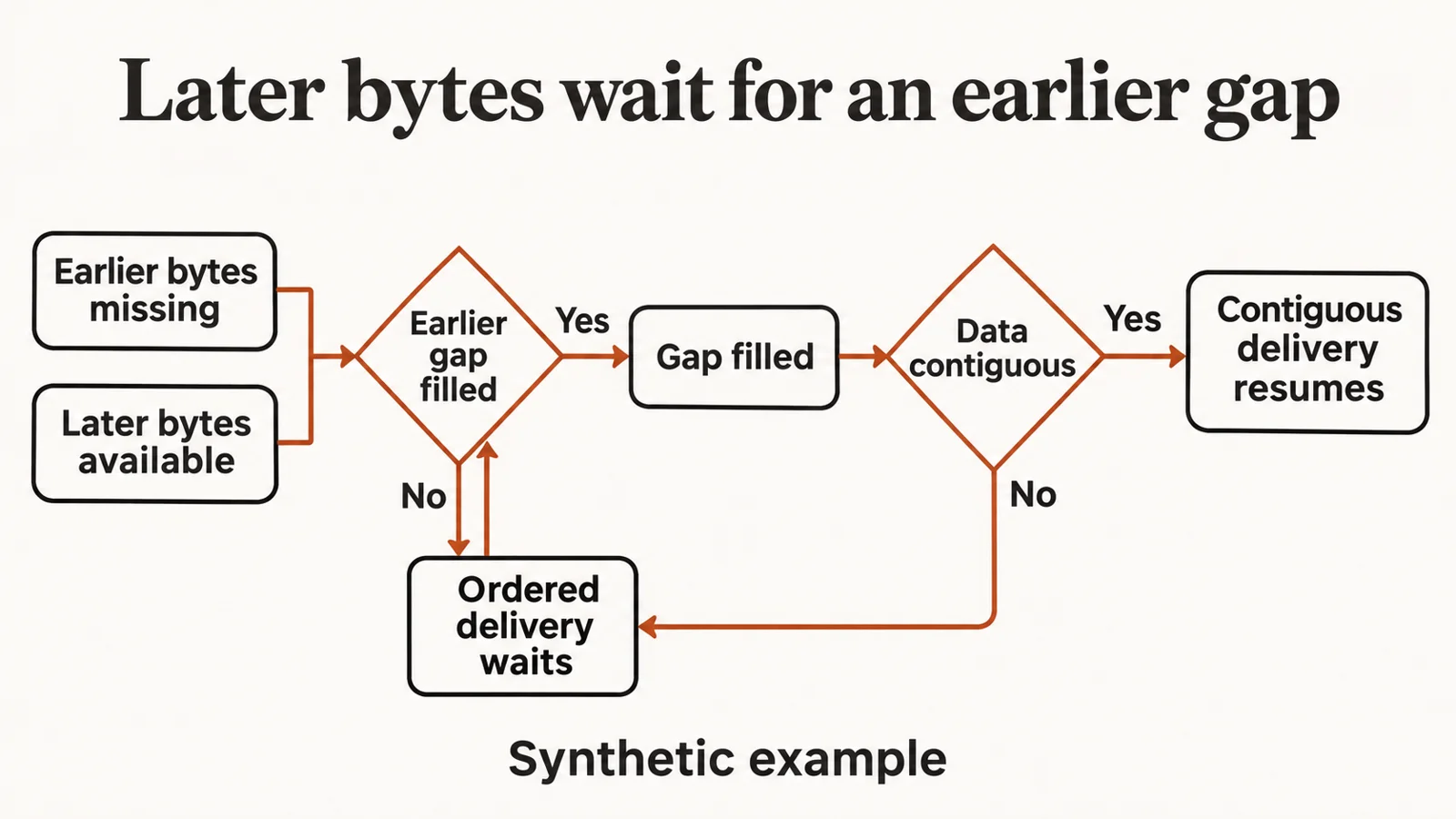
RFC 9293 defines TCP's reliable ordered byte stream. Later bytes can be received internally while delivery to the next layer waits for an earlier gap to be filled.
The application usually observes the consequence through message timing. It should not label a message event as a TCP segment or assume that an absent event identifies a particular lost network packet.
Complete-message delivery adds another boundary. A large application message may remain unavailable to an API that exposes it only after the message is complete, even when some lower-layer bytes have already reached the receiver.
An application-level cancel command sent after audio on the same ordered path must obey that path's delivery rules. It is not automatically equivalent to a WebSocket protocol ping, close or other control frame.
Protocol control-frame handling does not let data overtake missing TCP bytes. Keep any statement about frame interleaving separate from a claim about transport reassembly.
The reference code models these layers explicitly with a simple synthetic reassembly buffer and predefined message lengths. It does not parse WebSocket wire frames or claim that browsers expose partial application messages.
The chunk-size guide helps choose meaningful application units. Smaller messages can bound one kind of application waiting while leaving TCP's ordering obligation intact.
Separate application stalls from transport gaps
A consumer can stop processing complete messages because it awaits unrelated work, performs blocking computation, or shares a serialized callback with another task. That can delay audio without any evidence of a missing network byte range.
A developer question asks about sending and receiving WebSocket frames without blocking. Its scheduling problem is useful context, while current library documentation and actual loop evidence own the implementation decision.
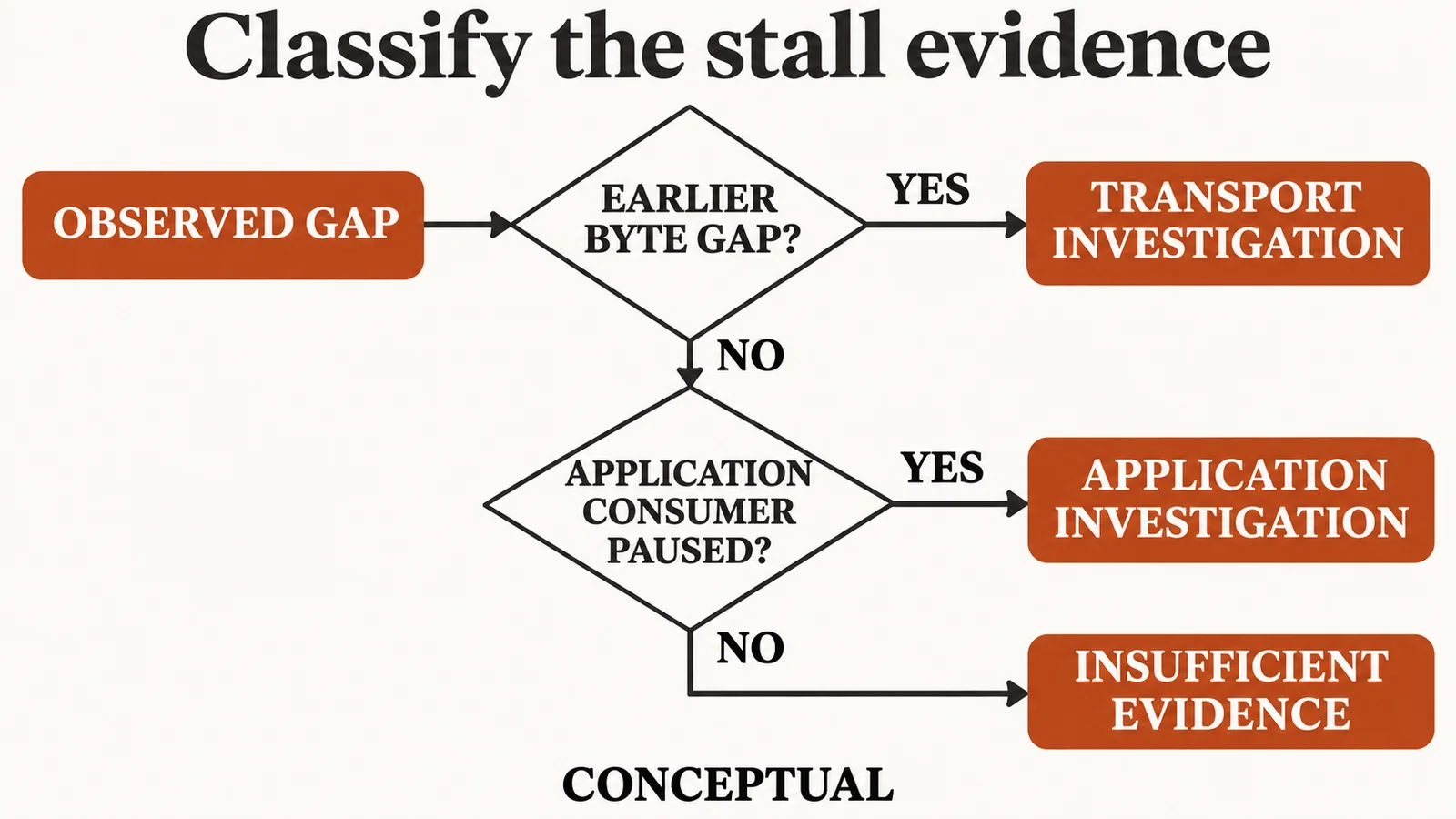
Do not diagnose every pause as TCP head-of-line blocking. Check whether complete messages reached the application on time and then waited before the media consumer admitted them.
A sender-side stall is another case. If the producer stopped creating audio, the receiver's silence cannot be attributed to transport ordering merely because WebSocket is in the path.
The cold-start guide separates readiness from queue residence. Time before work becomes ready should not be relabeled as media already waiting in a transport queue.
Use different fixtures for these causes. One should withhold earlier transport bytes while later bytes are available; another should deliver complete messages normally and pause only the application consumer.
A real trace can contain both. Treat the diagnostic classifier as a guide to the next investigation, not a proof that one observed cause excludes every other contributing delay.
The following criteria compare evidence boundaries. A check means the observation can support the named local claim under its documented contract. A cross means that observation alone cannot establish the claim; it is not a verdict on the transport's overall quality.
| Criterion | Local send return | Complete-message event | Supported transport trace | Application consumer trace |
|---|---|---|---|---|
| Establishes local send acceptance | ✓ At that API boundary | ✗ Different boundary | ✗ Different boundary | ✗ Different boundary |
| Establishes complete message delivery to the API | ✗ | ✓ | ✗ Without a supported join | ✗ Without the delivery event |
| Can identify an earlier transport gap | ✗ | ✗ | ✓ At its observation point | ✗ |
| Can identify a paused local consumer | ✗ | ✗ | ✗ | ✓ With explicit progress evidence |
| Proves acoustic playout by itself | ✗ | ✗ | ✗ | ✗ |
Use the table to choose the next observation, not to combine unrelated timestamps. A complete-message event and a consumer-start event on the same application clock can establish local residence between those points. Neither event alone explains time spent before complete delivery. The synthetic replay keeps these boundary claims separate so the test can distinguish the two causes without inventing a packet capture.
Run a layered stall replay
Save this complete fence as websocket_stalls.py and run Python 3.11 or later. The byte-range model is deliberately synthetic transport reassembly, followed by a separate predefined complete-message gate and local consumer queue.
The trusted fixture supplies nonoverlapping ranges and known message boundaries. Real packet sequence extension, TCP retransmissions, WebSocket framing, encryption, decoder behavior and playback remain adapter responsibilities.
The first fixture holds an incomplete earlier audio message while later application cancel bytes are available. The second fixture delivers complete messages but pauses consumption without any network-gap evidence.
class Reassembly:
    def __init__(self):
        self.next_byte = 0
        self.pending = {}

    def feed(self, start, data):
        if type(start) is not int or start < 0 or type(data) is not bytes or not data:
            raise ValueError("nonempty immutable byte range required")
        if start < self.next_byte:
            raise ValueError("already delivered range")
        end = start + len(data)
        for other_start, other in self.pending.items():
            if start < other_start + len(other) and other_start < end:
                raise ValueError("overlapping range")
        self.pending[start] = data
        output = []
        while self.next_byte in self.pending:
            part = self.pending.pop(self.next_byte)
            self.next_byte += len(part)
            output.append(part)
        return b"".join(output)


class CompleteMessages:
    def __init__(self, layout):
        layout = tuple(layout)
        if any(type(size) is not int or size < 1 or type(kind) is not str
               for kind, size in layout):
            raise ValueError("positive predefined message lengths required")
        self.layout = layout
        self.buffer = b""
        self.index = 0

    def feed_contiguous(self, data):
        if type(data) is not bytes:
            raise ValueError("bytes required")
        self.buffer += data
        output = []
        while self.index < len(self.layout):
            kind, size = self.layout[self.index]
            if len(self.buffer) < size:
                break
            output.append((kind, self.buffer[:size]))
            self.buffer = self.buffer[size:]
            self.index += 1
        return tuple(output)


class Inbox:
    def __init__(self):
        self.messages = []
        self.paused = False

    def receive_complete(self, messages):
        self.messages.extend(tuple(messages))

    def consume(self):
        if self.paused:
            return "application_paused", None
        if not self.messages:
            return "empty", None
        return "message", self.messages.pop(0)


def investigate(earlier_gap, consumer_paused):
    if earlier_gap is True:
        return "transport_investigation"
    if earlier_gap is False and consumer_paused is True:
        return "application_investigation"
    return "insufficient_evidence"


def tests():
    wire = Reassembly()
    messages = CompleteMessages((("audio", 6), ("app_cancel", 3)))
    assert messages.feed_contiguous(wire.feed(0, b"AB")) == ()
    # Later cancel bytes are present, but an earlier audio byte gap remains.
    assert messages.feed_contiguous(wire.feed(6, b"XYZ")) == ()
    assert wire.next_byte == 2 and 6 in wire.pending
    completed = messages.feed_contiguous(wire.feed(2, b"CDEF"))
    assert completed == (("audio", b"ABCDEF"), ("app_cancel", b"XYZ"))
    assert investigate(True, False) == "transport_investigation"
    inbox = Inbox()
    inbox.receive_complete(completed)
    inbox.paused = True
    assert inbox.consume() == ("application_paused", None)
    assert investigate(False, True) == "application_investigation"
    inbox.paused = False
    assert inbox.consume() == ("message", completed[0])
    assert inbox.consume() == ("message", completed[1])
    assert inbox.consume() == ("empty", None)
    assert investigate(None, False) == "insufficient_evidence"
    assert investigate(False, False) == "insufficient_evidence"
    partial = Reassembly()
    assert partial.feed(4, b"EF") == b""
    assert partial.feed(0, b"AB") == b"AB"
    assert partial.feed(2, b"CD") == b"CDEF"
    for bad in (lambda: Reassembly().feed(-1, b"x"),
                lambda: Reassembly().feed(0, b""),
                lambda: CompleteMessages((("audio", 0),))):
        try:
            bad()
            raise AssertionError("invalid fixture accepted")
        except ValueError:
            pass
    overlap = Reassembly()
    overlap.feed(4, b"EF")
    try:
        overlap.feed(5, b"FG")
        raise AssertionError("overlap accepted")
    except ValueError:
        pass
    print("synthetic transport, message and consumer stall fixtures passed")


if __name__ == "__main__":
    tests()
The predefined message layout is a fixture aid. A real WebSocket implementation supplies complete messages through its supported API; the code never suggests that an application should reconstruct TCP ranges from ordinary browser message events.
The classifier returns investigation directions. Establishing a real transport cause still requires packet or equivalent lower-layer evidence, and establishing a read-loop defect needs application scheduling evidence.
Interpret local buffer evidence
MDN's bufferedAmount documentation describes a local WebSocket byte count. It does not describe receiver playback depth or prove that the caller heard the corresponding audio.
A zero local count can coexist with media already accepted elsewhere. Keep that limit explicit when using the value to diagnose stalls or deciding whether old output has been cleared.
A growing local count can indicate that production exceeds local transmission progress. It does not by itself identify which later boundary is slow or whether the cause is congestion, scheduling or a blocked peer.
The admission-control guide separates capacity decisions from later work residence. Rejecting new work can protect resources, while stale media still needs an age and identity policy.
Keep bytes and represented audio duration separate. Compression and message content can make a small byte count represent a long period of obsolete speech.
The backpressure guide provides a bounded queue model. An application can discard its own stale queued work, but it cannot assume that the same operation purges bytes already accepted downstream.
Trace complete messages and playback
Record when the sender's application unit becomes ready, when it is submitted locally, when the receiver gets a complete message, when the consumer admits it and what playback evidence follows.
Use stable synthetic identities in the fixture. Join the same media unit across observations rather than matching a vague timestamp range or assuming every message contains equal audio duration.
The observability guide explains how to keep event boundaries separate. Preserve original message sizes and sequence identities so a reviewer can reconstruct which earlier work blocked later work.
Do not subtract a sender wall-clock timestamp from an unrelated receiver timer without a justified relationship. Local intervals and correlated event sequences can still establish useful evidence when exact cross-host timing is unavailable.
Keep playback interpretation tied to the actual transport adapter. The playback evidence guide distinguishes local submission, provider events and acoustic observations.
A receiver message event proves delivery to that API boundary. It does not establish that the media was decoded, scheduled, played, heard or understood.
If output arrives in a burst, inspect its creation age. A healthy receiver can faithfully play stale speech that the application should have invalidated before submission.
The network-change recovery guide supplies epoch and generation fencing for that case. Reconnect must not become permission to flush obsolete work.
Protect cancellation behind queued media
An application cancel message can wait behind earlier data on the same ordered path. If the controller relies only on that message, old audio may continue through the controllable period before the receiver receives the command.
The interruption-safe output guide separates stopping generation, invalidating owned queues and using supported receiver controls. Apply the controls available at each boundary instead of pretending one cancellation flag owns them all.
A local writer accepting a cancel request is not endpoint purge evidence. A successful provider acknowledgment is also limited by the provider's documented semantics and cannot retract sound already heard.
The Twilio Media Streams contract is an example of a concrete mark and clear interface. Use the actual adapter's contract rather than assuming identical behavior for every WebSocket audio service.
Keep old-generation results terminal. A later successful send or cached acknowledgment cannot restore a response that the caller has canceled or corrected.
The shutdown guide explains that terminal state. If the task is closed, a recovering socket should not create another response from its backlog.
A real interruption trial should record the last supported old-output observation. State whether that observation is local, provider-side or acoustic instead of labeling all of them caller stop latency.
Choose cause-aligned mitigations
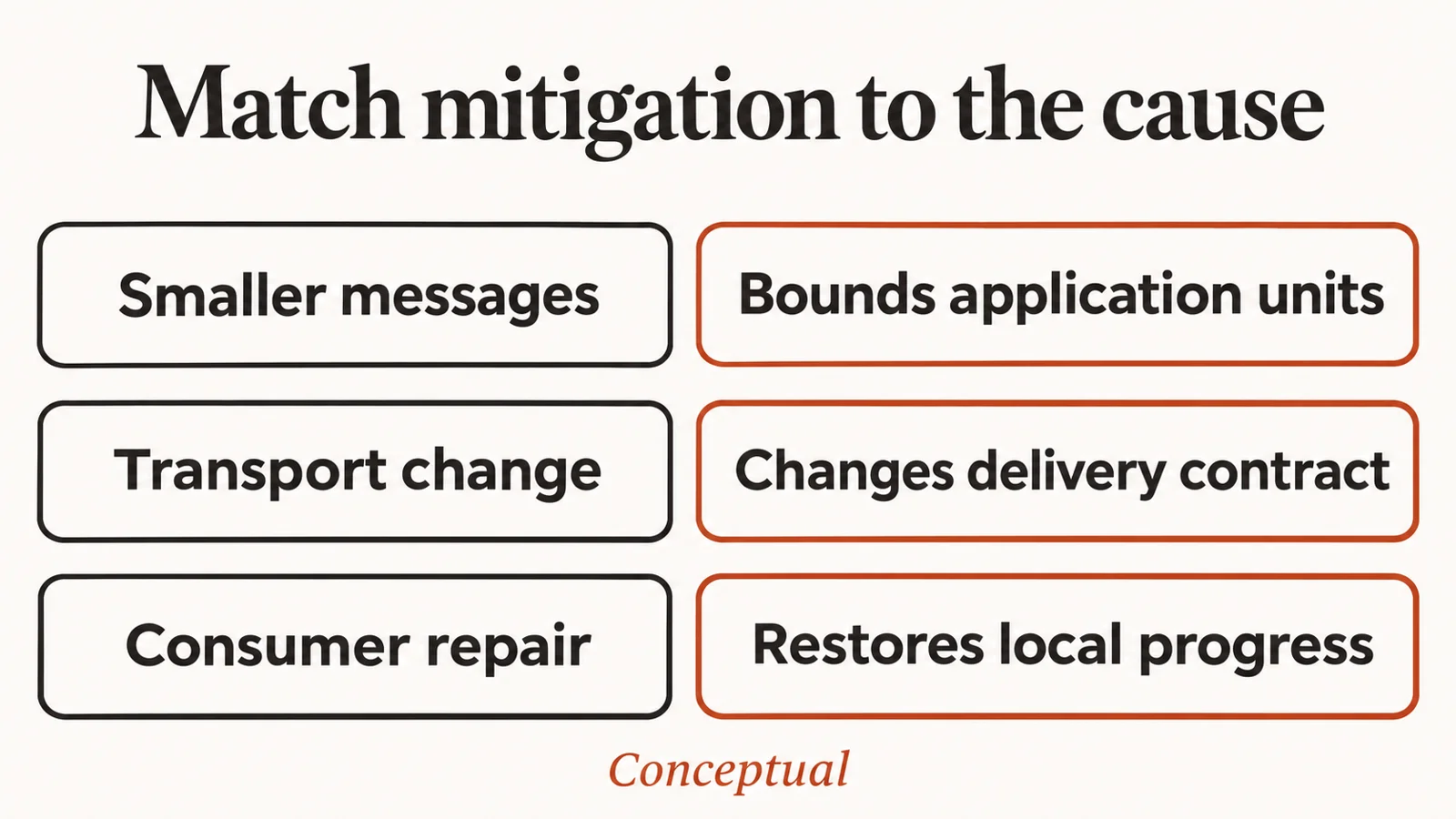
Smaller application messages can reduce time spent waiting for a complete large message under the application contract. They do not remove TCP's requirement to deliver earlier missing bytes first.
Separating unrelated large traffic from latency-sensitive media can change queue ownership and resource contention. Evaluate the actual route and workload rather than assuming another connection fixes every stall.
A blocked consumer needs a scheduling or ownership repair. Changing transports while leaving a serialized read loop blocked on unrelated work can preserve the visible problem under a new protocol name.
The model-work cancellation guide provides a related resource boundary. Cancel only the owned work and avoid blocking independent consumers through a shared lifecycle mistake.
A transport change is a larger contract change. RFC 9000 describes QUIC stream behavior, while ordering within a chosen stream and application scheduling still need their own analysis.
The public Socket.IO FAQ discusses supported transport choices. A library's recovery feature is not proof that old media remains appropriate to replay under a corrected task.
Run a controlled transport trial
Use an undamaged baseline and an isolated impairment environment before attributing a live symptom to a protocol. Record exact application message sizes, source media, send cadence, receiver behavior and route conditions.
The netem manual documents impairment options and limitations. A requested loss or delay setting is configuration, while the observed packet and application events establish the realized experiment.
Keep a separate application-consumer pause with no induced network gap. That counterexample prevents an investigator from recognizing one visual pattern and diagnosing every similar pause as TCP reassembly.
No real network state is changed by the published fence. A later interface trial should use a controlled test route, save its original configuration and restore it when the owned experiment ends.
The voice regression guide explains how to retain a discovered failure. Preserve both the lower-layer evidence and application event ordering rather than only a recording of the final silence.
Report a bounded diagnosis
A useful diagnosis names the first stalled boundary and the evidence that supports it. It can also state that transport evidence is unavailable and the current trace only establishes an application-level delay.
Keep hypotheses separate from observations. Missing message events, local buffered bytes and a connected socket can motivate a transport investigation without proving a particular packet was lost.
Report failed and incomplete trials alongside completed latency samples. A candidate that disconnects difficult calls should not appear faster because those calls were excluded from the timing population.
The outcome metrics guide provides the caller-level denominator. A transport change is useful only when the current task remains correct and the listener receives an appropriate response.
This article reports no measured transport winner or production latency saving. The code verifies its synthetic reassembly, complete-message and consumer distinctions; actual network behavior and physical playback require separate adapter and device evidence.
Build a boundary ledger before changing transports
A transport diagnosis begins with an event ledger that can distinguish absence of observation from observation of absence. If the application did not record a message callback, that fact alone cannot tell whether the message was still in the network, waiting for complete-message delivery, or already delivered to a stalled process.
Give each event a boundary name rather than a generic received timestamp. Useful boundaries include producer-ready, local-send-called, local-send-returned, receiver-message-event, consumer-started, consumer-finished, player-submitted and the selected playback observation. A packet-capture observation belongs in a separate transport stream joined through the experiment's supported correlation.
Record stable message identity, response generation and connection identity with those events. An apparently late message can be a duplicate observation, a completion from a previous connection or a current message delayed in a local queue. Joining by timestamp proximity alone can make those different cases look like one continuous delivery path.
Keep payload length as a measurement with a declared layer. Application audio bytes, complete WebSocket message bytes, frame overhead and captured transport bytes are different quantities. The artifact uses abstract ordered byte ranges and a declared synthetic message layout; it does not pretend that those ranges include real frame headers or operating-system segmentation.
Preserve raw counters alongside derived labels. A message count can establish how many complete messages the callback observed. A local buffered-byte count describes the API's named local buffer. Neither is a direct count of unheard samples at the speaker. Keep the counter's definition in the report so a future reader does not promote it to a stronger boundary.
Attach a clock domain to every timestamp. Producer and receiver processes can have independently offset clocks. Without a supported synchronization or round-trip method, a direct subtraction can produce a plausible number that has no valid one-way-delay interpretation. Within a single process, monotonic intervals are easier to interpret, but a restart still needs a new observation epoch.
The latency measurement method provides the wider framework for those joins. The immediate goal here is to find the earliest boundary whose progress stopped while the preceding boundary could still be observed to progress.
Retain unavailable states. A trace with no packet capture cannot assert that no transport gap occurred. It can assert that the complete-message callback paused while the producer continued, and then identify the additional experiment needed to separate the remaining causes. A bounded conclusion is useful when it directs the next measurement.
Exercise the controls that can resemble network loss
The second fixture matters as much as the reassembly fixture. Deliver a complete message into the application-owned inbox, then deliberately pause its consumer. The message remains available while application progress stops. This creates a stall with no synthetic transport gap and shows why silence alone cannot identify a network cause.
Make the pause deterministic. Use a named gate, event or explicit fixture state, not an arbitrary sleep that may or may not overlap the critical work. Record that the message reached the inbox before the pause. When the consumer resumes, observe the already-available identity rather than treating the later consumption time as the network arrival time.
A real application has several possible local gates. A callback may wait on unrelated work, a handler may hold a lock, a decoder may be busy, or a player may accept data more slowly than producers supply it. These are hypotheses to test at the owning boundary. The generic artifact models only an explicit paused consumer and does not diagnose which real subsystem caused a pause.
Use an independent progress signal carefully. A timer or heartbeat on the same blocked event loop can pause for the same reason as message handling. Its absence does not independently prove a network outage. If the experiment uses a separate process or thread as an observer, document that separation and the synchronization used to join its evidence.
Now test a producer pause. If the application stops generating messages, an empty receive interval may be expected. Keep that control distinct from a network impairment trial. The receiver cannot deliver work that was never offered, and a transport change cannot repair a producer that has no current media ready.
Test the player boundary as another separate control. Deliver and consume complete messages while deliberately withholding player submission in the fixture adapter. That schedule can produce silence despite healthy message delivery. Conversely, player submission can succeed locally while supported remote playout remains unknown.
The playback boundary guide helps name the last observable event. Avoid using a local write callback as the end of an acoustic latency measurement unless the report explicitly limits the metric to local submission.
Keep these controls small enough to reason about. A single trace with producer delay, transport loss, callback blocking and player backlog cannot attribute the final pause. Establish each effect independently, then combine them only when the application needs an interaction test and the report preserves every injected condition.
Bound message size without inventing a priority guarantee
Smaller application messages can reduce the amount of work attached to one message boundary. They can also make queue accounting and cancellation checks more frequent. Those are useful design properties, but they do not create a guarantee that later application control can overtake earlier data on the same ordered stream.
An application cancel message is still application data. Sending it after an audio message places it later in the relevant ordering contract. The synthetic incomplete-earlier-message fixture demonstrates the consequence at its simplified boundary: later application control cannot be delivered through that same complete-message sequence until earlier required data becomes available.
RFC 6455 also defines protocol control frames. Those protocol frames are distinct from an application's cancel JSON or command message. Do not cite a protocol frame's special handling as proof that an application command can jump ahead of already-ordered audio bytes.
A separate application queue can help only before the shared transport boundary that it controls. Once media has been accepted into an ordered transport, removing it from an upstream queue does not establish that it was removed from every downstream buffer. Preserve that distinction when evaluating a priority queue or a cancellation worker.
The reconnect fencing guide provides a final local validity check for media that has not crossed that acceptance boundary. It also explains why an accepted clear request is weaker than proof that old audio cannot play remotely.
Choosing a message duration needs more than a throughput target. Record the audio representation, amount of media per message, producer cadence, consumer cost and supported cancellation boundary. Evaluate whether the chosen unit permits current work to progress while bounding the locally owned backlog.
Do not derive an acoustic queue duration from compressed byte count without a representation-specific mapping. Variable encoding and mixed control messages can make that conversion invalid. A message can carry a known media duration if the application contract supplies one; otherwise retain bytes and media time as separate observations.
Changing transports introduces another delivery contract rather than a universal cure. A candidate may expose independent streams or unreliable delivery, but the application still needs to handle missing, reordered, duplicated or obsolete work according to that candidate's actual API. Keep the comparison tied to the specific blocking boundary established by the experiment.
The loss-pattern analysis is useful when the candidate changes how impairment reaches the decoder. Preserve the offered media and declared impairment model so a transport trial does not quietly become a comparison of different source material or different network damage.
Preserve evidence when the observation process stalls
Instrumentation can participate in the failure. A logging callback on the same event loop may be delayed along with audio handling. The resulting cluster of timestamps can describe when logs were flushed rather than when the source events occurred.
Record event time at the earliest supported boundary and keep log-write time separate when that distinction matters. If the API gives only callback execution time, name it accordingly. Do not backfill earlier arrival times from a later burst or distribute them evenly to make a graph look smooth.
Use bounded logging so the observer does not create an unbounded queue of its own. Preserve the fields needed to reproduce the diagnosis: identities, raw local counters, clock domain, event order and injected control state. Avoid copying actual speech or customer content when a synthetic payload and stable identity answer the question.
Record process and connection restarts explicitly. An unchanged socket label or reused stream identifier does not establish continuity of the same observer. Counter baselines and relative timestamps need a new epoch when their owner restarts. A derived trend across that boundary can otherwise invent a drain or a delay that never occurred.
Keep transport captures and application events as separate evidence streams until the join is justified. A capture can show retransmission or out-of-order arrival at its observation point, while the application ledger shows when complete messages became visible. The report should explain the relationship rather than merging them into one invented timestamp sequence.
When capture is unavailable, use controlled changes to narrow hypotheses. A reproducible consumer pause establishes how a local stall appears. A reproducible network impairment establishes a different pattern under the stated environment. Similarity to a production symptom can guide further work, but it does not prove that the production cause is identical.
The network fault harness guide describes the broader experiment discipline. Retain the command configuration and the observed impairment, because a requested fault and a fault delivered to the intended traffic are separate facts.
Write the diagnosis around the first supported cause
A useful incident note states the observed boundaries first. For example, a synthetic report can say that the producer offered both messages, the simplified reassembler held later bytes behind a gap, and the complete-message gate emitted neither message until the gap closed. That statement is precise without claiming a browser exposed partial TCP bytes.
The separate application fixture supports a different report: the complete message was available in the inbox while consumption was paused, with no injected reassembly gap. That establishes the synthetic consumer cause. It does not establish that an actual network path was lossless unless that path was measured separately.
Then state the user-visible consequence at the boundary you observed. A delayed player submission can be described as delayed local submission. A listening trial can add an acoustic observation. Human comprehension requires a task review. These layers can be joined, but each claim should retain the evidence that supports it.
Choose a mitigation that acts on the established cause. A blocked consumer calls for local scheduling or workload repair. A known ordered-transport dependency may justify a delivery-contract trial. Obsolete media calls for age and generation checks before acceptance. One change can address more than one problem, but the report should not attribute every improvement to transport ordering.
Preserve unsuccessful trials. If smaller messages do not remove a gap-induced wait, that result is consistent with the ordered delivery contract and helps prevent repeated rediscovery. If a transport change leaves an application pause untouched, the remaining evidence points back to the local boundary rather than proving the alternative transport failed at its own contract.
End with the next falsifiable question. Identify the observation that would disprove the current hypothesis, the adapter change needed to collect it and the scope still unknown. This keeps a diagnosis actionable without promoting a synthetic replay or a single trace into a universal performance claim.
Check the replay contract before reusing it
The reassembly model accepts disjoint synthetic byte ranges and releases a contiguous prefix. It rejects overlap with already delivered data and conflicting pending ranges. Those are deliberately small fixture rules; real TCP retransmission, sequence-number wrap, acknowledgments, congestion control and socket buffering are outside the model.
The complete-message gate consumes only that contiguous output and a supplied layout of message kinds and lengths. The layout represents a synthetic application envelope. It is not an RFC 6455 frame parser and does not expose browser partial-message callbacks. Keep those statements with any copied fixture so a later test does not quietly promote the model into a protocol implementation.
The paused inbox begins after complete-message delivery. Its independent state is what makes the second negative fixture useful. When consumption pauses with a message already available, the model has application-stall evidence without any injected transport gap. Calling that case network head-of-line blocking would contradict the fixture's own event order.
A real adapter can preserve the same distinctions while using different observability. Keep packet or transport evidence in the layer that can observe it, record complete WebSocket message events at the API, and record application consumption separately. Where a boundary is opaque, retain that unknown rather than fabricating an intermediate timestamp.
Use the published tests as contract examples, then add adapter-specific tests at real acceptance boundaries. A passing abstract replay establishes the expected labels for the supplied schedule. A passing adapter test establishes that the adapter maps real observations to those labels honestly. The two forms of evidence complement each other without claiming an unmeasured transport benchmark.
Frequently asked questions
What is TCP head-of-line blocking?
Later byte delivery waits for earlier missing bytes under TCP's ordered-stream contract. A real diagnosis needs transport evidence rather than an inference from a long application pause alone.
Is every WebSocket pause transport blocking?
A pause can originate in production, application scheduling, complete-message delivery or playback. Locate the first stalled boundary before naming the transport as the cause.
Can smaller messages remove TCP ordering?
Smaller messages can bound an application unit or complete-message wait. They do not let later bytes bypass an earlier missing TCP range.
Does bufferedAmount prove delivery?
It describes local buffered bytes under the WebSocket API contract. It does not establish receiver consumption, playback, hearing or comprehension.
What if bufferedAmount is zero?
Zero local buffered bytes can coexist with downstream queued media or unavailable endpoint evidence. Keep those observations separate rather than treating zero as proof that the path is empty.
How do application event-loop stalls differ?
Complete messages can already be available while the application consumer is paused. That case needs application scheduling evidence and can occur without any network byte-gap observation.
Can ping overtake missing TCP bytes?
WebSocket control-frame rules do not remove the transport's ordered byte delivery. Keep frame-level interleaving claims separate from a claim that data bypasses TCP reassembly.
Can a cancel message retract sent audio?
A cancel command has the receiver's documented scope and delivery constraints. It cannot retract sound already heard, and local acceptance alone does not prove downstream purge.
Why preserve byte and message identities?
They describe different ordering boundaries. Transport ranges explain synthetic reassembly, while complete-message identities let an application trace correlate the media it can observe through its API.
How should retransmissions be diagnosed?
Use packet capture or equivalent lower-layer instrumentation on the controlled route. Application message timing can reveal a stall without proving retransmission caused it.
Can I compare sender and receiver clocks directly?
Cross-host subtraction needs a justified synchronization or mapping. Without it, use local durations and correlated identities rather than manufacturing an exact end-to-end interval.
Does another connection solve every stall?
Another connection can change queue sharing and resource use. It does not repair a blocked producer, consumer or device path, so evaluate the cause and the changed contract.
Does QUIC eliminate all blocking?
QUIC has distinct stream behavior, while ordering within a stream and application scheduling still matter. A transport name is not a universal guarantee of timely media.
Can WebRTC use a TCP relay?
The selected route and transport need observation under the actual configuration. Do not infer every path's behavior from the fact that the application uses WebRTC.
How should an empty receive queue be interpreted?
It means no item is queued at that local boundary. A consumer can hold an item and another layer can buffer media, so emptiness does not establish an empty end-to-end path.
What does the synthetic gate prove?
It proves the stated reassembly, predefined complete-message and paused-consumer outcomes. It does not implement TCP, parse RFC 6455 wire frames or measure a real network.
Which real impairment tests are appropriate?
Use controlled route-specific loss, delay or scheduling trials that answer a defined hypothesis. Preserve actual observations and restore the isolated environment rather than applying examples to shared production interfaces.
How do stalled consumers affect output age?
Prepared media can become obsolete while waiting after delivery. Recheck generation and age before local submission so a recovered consumer does not replay an old answer.
Should a reconnect replay buffered speech?
Only current eligible media should proceed under the new epoch and response ownership. Reconcile the caller's current intent and keep closed or canceled generations terminal.
Where should a diagnostic trace begin?
Begin when the application unit becomes ready and carry its identity through send, complete-message receipt, consumption and playback evidence. Add lower-layer instrumentation when the trace calls for a transport-specific claim.
Start with two different pauses
Run the reference fence's earlier-byte-gap fixture and its separate paused-consumer fixture. Confirm that the evidence leads to different investigation directions before attaching a protocol label to a live incident.
Then capture one controlled real trace with the same observation boundaries. Use the first demonstrated stall to choose the smallest cause-aligned repair, preserving the fixture so the defect cannot return behind a different transport or helper.