
- Engineering
Prosody for confirmations: make values easy to distinguish
Build a paired listening protocol that separates critical-value recall, prosody, playback evidence, and business authorization.
- Author
 Udit Goenka
- Editorial date
- Reading time
- 25 min
TL;DR: Give the field label, value, and confirmation question separate spoken roles, and test whether listeners can reproduce the value before asking which voice they prefer. Bind the approved value to an immutable representation; pleasant prosody and completed playback do not establish authorization.
The caller says yes after hearing a confirmation, but the value they understood differs from the value the application will submit. The utterance sounded natural. The failure was hidden inside a phrase that mixed explanation, a critical field, and a request for approval.
Begin with a small test: play two versions of the same synthetic confirmation, ask listeners to identify the exact field value, then collect preference separately. Keep an uncertain option. A confident preference score cannot substitute for a correct value response.
Prosody supplies timing, stress, and grouping cues. It can help listeners distinguish a value from surrounding words, but it cannot repair an ambiguous data model or make a stale value current. The workflow enforcement guide defines the separate business-action boundary.
This article provides a reproducible paired-trial artifact and a critical-field rubric. It contains no completed listening study, acoustic benchmark, or claimed improvement for 60db Agent. Every example field is synthetic and carries no permission to perform a real action.
Table of contents
- Define what the caller must distinguish
- Build a spoken confirmation contract
- Generate a balanced paired trial
- Choose prosody controls with explicit limits
- Score critical fields before preference
- Handle interruption and revised values
- Review evidence and rollout boundaries
- Frequently asked questions
- Test the value the caller heard
Define what the caller must distinguish
A confirmation is useful when the caller can identify the proposed value and the action attached to it. A fluent sentence can still fail that test. Define the field, its canonical value, its spoken representation, and the expected response before tuning the voice.
A digit string and a quantity can use the same written characters while requiring different speech. A synthetic code such as 0042 preserves leading zeros and order. A quantity with the same characters can have a different meaning and a different acceptable pronunciation.
Dates require a locale and an interpretation. A numeric date with slash separators can be ambiguous before synthesis begins. Resolve the business value first, then choose a spoken form that names the relevant month, day, year, or timezone explicitly enough for the task.
Amounts need a unit or currency and a precision policy. The listener should not have to infer whether a number describes a total, a count, a time, or a reference. The spoken label supplies that context while the value remains the object being confirmed.
Microsoft's pronunciation documentation documents say-as content types and locale-specific support. Treat those controls as guidance with a declared support boundary. Verify the actual voice output rather than assuming a tag guarantees the intended reading.
A public number-pronunciation question asks about reading a written number as a sequence rather than a cardinal. It illustrates a genuine developer requirement: representation depends on the field's meaning. The historical answer does not establish current behavior across providers.
Names introduce another distinction. Spelling a name can help identify characters while making the phrase less natural. A pronunciation aid can improve the sound while obscuring the exact spelling. Decide which of those properties the confirmation needs to establish.
The multilingual evaluation method helps keep language competence explicit. A listener unfamiliar with a language cannot reliably certify its grouping or pronunciation, and a familiar-sounding English rendering is not evidence that a local-language field was understood.
For each field family, define acceptable responses. A digit identifier can require exact character order, including zeros. A calendar date can allow equivalent spoken forms that resolve to the same date under the stated locale. Do not apply one normalization rule to every field.
The confirmation should also identify what will happen next. "The code is zero zero four two" is a readback. "Should I use code zero zero four two for this request?" attaches the value to an action, but the application still needs its own authorization and repair policy.
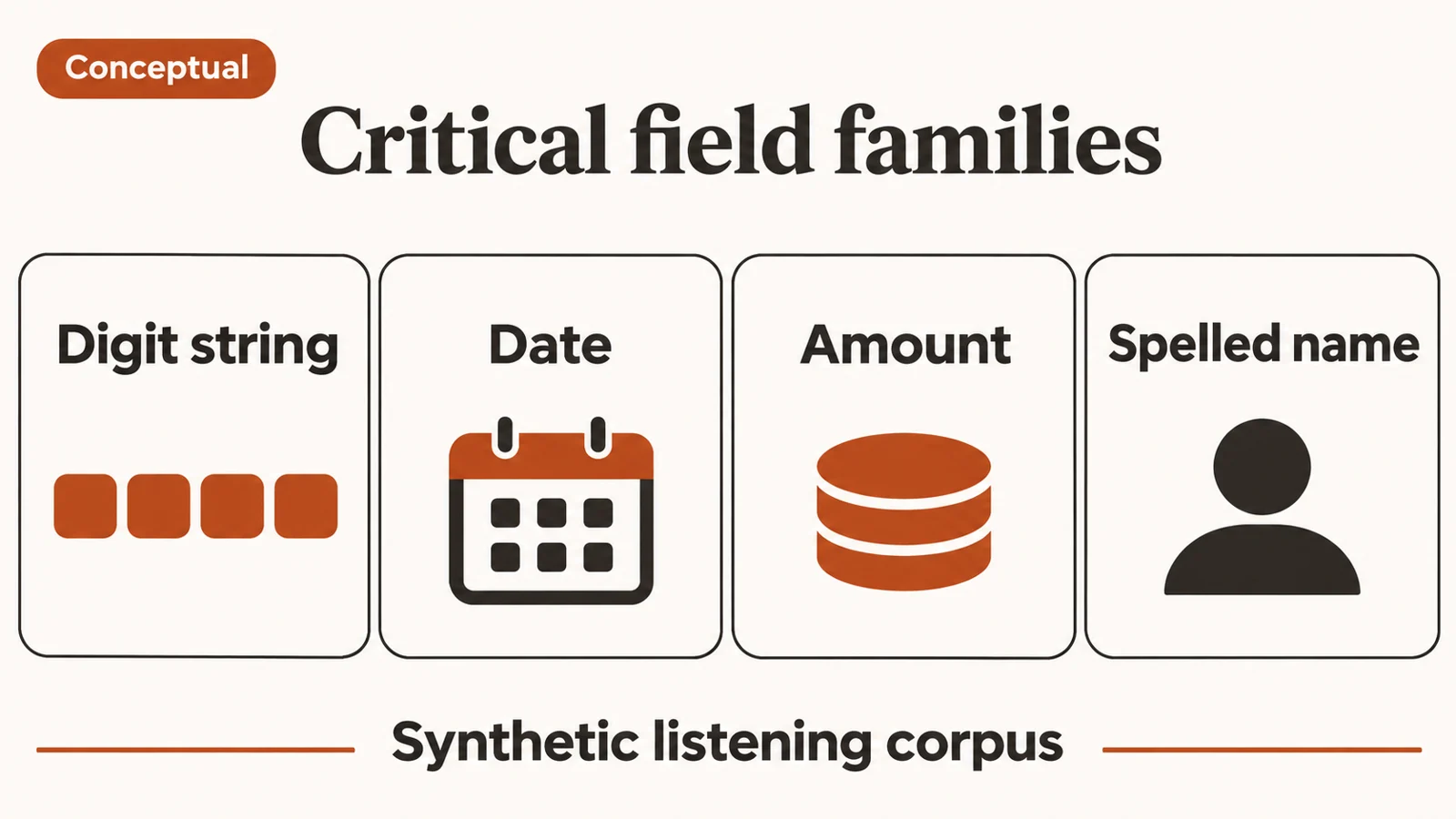
Keep the first useful artifact small. A table of field families, canonical values, spoken forms, and expected responses can expose ambiguity before any audio is generated. It also supplies the item bank for the listening protocol.
The retrieval-to-speech contract addresses related explanatory content. A confirmation has a narrower burden: the caller needs to distinguish the exact proposed field and the consequence of agreeing.
Build a spoken confirmation contract
Represent the canonical value separately from the spoken text. The canonical value is what the application proposes to use. The spoken text is a rendering that can be revised, localized, or synthesized differently without silently changing the underlying proposal.
An approved rendering should point to an owned value snapshot and a revision. If the business value changes, the prior confirmation becomes stale. Reusing the same audio because it sounds close enough is unsafe when the meaningful field changed.
The SSML 1.1 recommendation defines speech markup for pronunciation and prosody. It does not own the business meaning of a confirmation or the application's action policy. Keep that boundary visible in the data contract and the diagram.
A practical confirmation record contains the field kind, canonical value, spoken representation, locale, rendering-policy version, synthesis configuration identity, and proposal revision. Delivery evidence and caller response are later observations attached to that record, not values hidden inside one success flag.
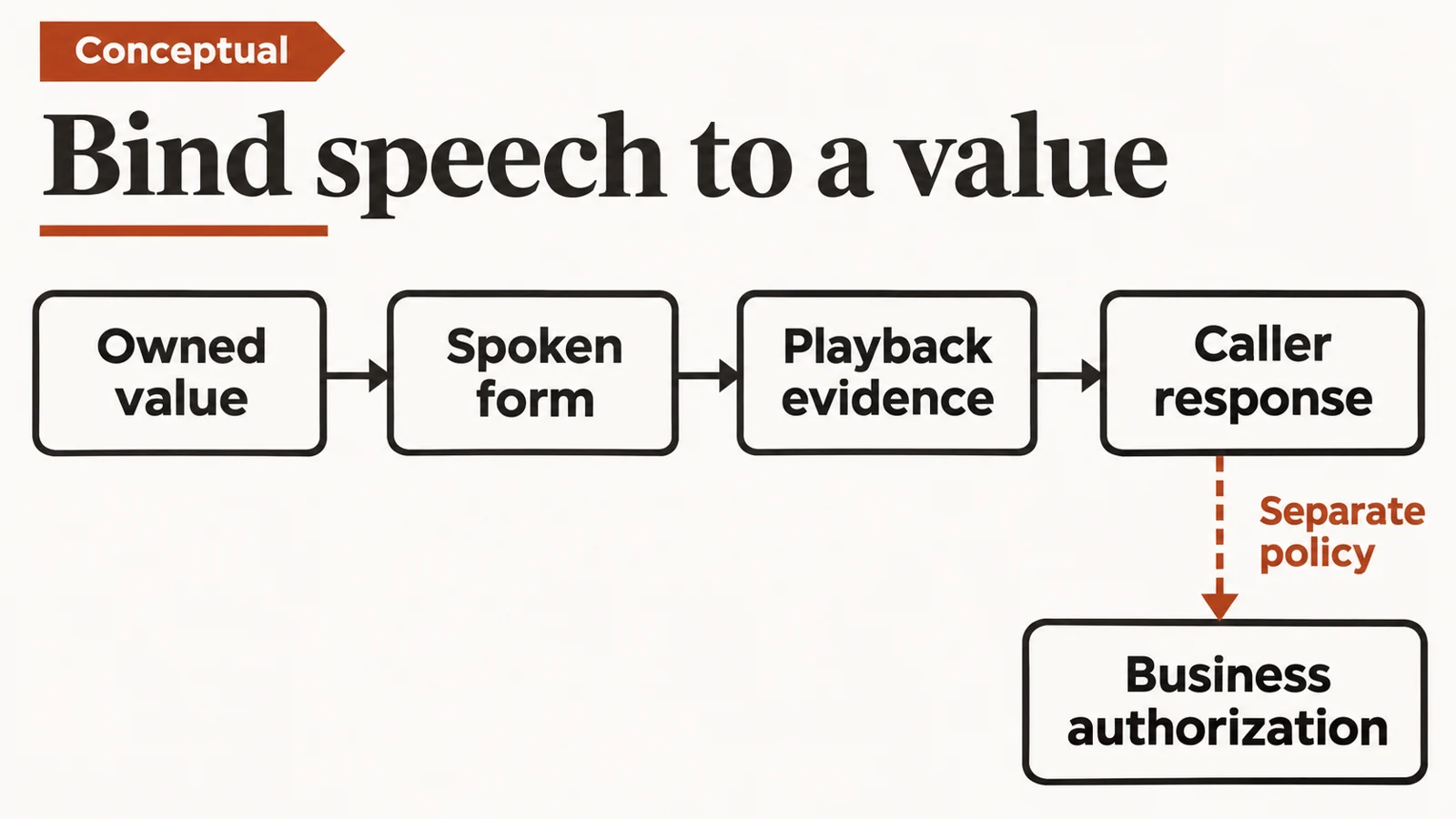
Split the utterance into semantic roles before applying audio effects. The label identifies the field. The value carries the information being checked. The question asks for a response. An optional explanation should not sit inside the value or make the listener wait through unrelated detail to discover what they are confirming.
Use a short enough unit that interruption has a clear repair. If the caller interrupts before the value finishes, the controller should know which proposal remains unconfirmed. The interruption-safe guide supplies the lifecycle boundary around that media event.
A complete synthesis response is only producer evidence. Local output acceptance is another boundary. Endpoint playback acknowledgment, where available, is stronger about delivery but still does not establish comprehension. Preserve these distinctions rather than calling all of them confirmed.
The playback acknowledgment article describes those limits in more detail. Prosody design should not weaken them by treating a well-formed audio file as proof that the caller heard the entire value.
For SSML, keep markup generation deterministic and escape untrusted text. XML 1.0 defines the document syntax underlying the markup. User content must remain content rather than becoming a tag that changes the voice, inserts audio, or alters what the application intended to say.
Validate length and allowed field shape before rendering. A field typed as an ASCII digit identifier should reject whitespace, signs, non-ASCII lookalike digits, and unexpected punctuation unless the accepted contract explicitly allows them. Silent cleanup can merge values that the business system considers different.
Keep the original supported value as well as its derived spoken form. If the listener reports an error, an engineer should be able to reconstruct the exact intended characters without guessing from an audio transcript. A transcript is another observation and can make its own mistakes.
The partial transcript revision model applies to the caller's response too. A partial yes can become a correction. Do not let an early affirmative token authorize the old value before the response stabilizes under the application's policy.
Generate a balanced paired trial
The following reference creates two presentation orders for every synthetic item. It owns immutable values, rejects unsupported inputs, renders ASCII digit identifiers into an explicit English digit sequence, and scores exact recall separately from preference.
Its scope is intentionally small. It is not a general number normalizer, SSML builder, authorization engine, or statistical analysis package. It provides a deterministic item and response contract that an actual listening study can use.
Save the complete fence as confirmation-trials.py and run Python 3.11 or later. The trials are a protocol artifact. Passing its assertions does not mean any participant listened or that any prosody condition improved comprehension.
from dataclasses import dataclass, FrozenInstanceError
from random import Random

DIGITS = ("zero", "one", "two", "three", "four", "five",
          "six", "seven", "eight", "nine")

@dataclass(frozen=True)
class Item:
    key: str
    revision: int
    value: str
    spoken: str

    def __post_init__(self):
        if type(self.key) is not str or not self.key:
            raise ValueError("item key required")
        if type(self.revision) is not int or self.revision < 1:
            raise ValueError("positive revision required")
        if type(self.value) is not str or not 1 <= len(self.value) <= 12:
            raise ValueError("one to twelve ASCII digits required")
        if any(c not in "0123456789" for c in self.value):
            raise ValueError("ASCII digit identifier required")
        expected = " ".join(DIGITS[int(c)] for c in self.value)
        if self.spoken != expected:
            raise ValueError("spoken form does not match value")

def item(key, revision, value):
    if type(value) is not str or any(c not in "0123456789" for c in value):
        raise ValueError("ASCII string required")
    spoken = " ".join(DIGITS[int(c)] for c in value)
    return Item(key, revision, value, spoken)

def schedule(items, seed):
    owned = tuple(Item(x.key, x.revision, x.value, x.spoken) for x in items)
    keys = [(x.key, x.revision) for x in owned]
    if len(keys) != len(set(keys)):
        raise ValueError("duplicate item revision")
    trials = [(x, order) for x in owned for order in (("A", "B"), ("B", "A"))]
    Random(seed).shuffle(trials)
    return tuple(trials)

def recall(expected, response):
    if response is None:
        return "uncertain"
    if type(response) is not str:
        raise ValueError("response must be an exact digit string or None")
    if not response or any(c not in "0123456789" for c in response):
        raise ValueError("unscorable response")
    return "correct" if response == expected.value else "incorrect"

def rejects(error, fn):
    try:
        fn()
    except error:
        return
    raise AssertionError("expected " + error.__name__)

raw = [item("synthetic-code", 1, "0042"), item("synthetic-code", 2, "0043")]
trials = schedule(raw, 17)
assert trials == schedule(raw, 17)
assert len(trials) == 4
for x in raw:
    assert sum(t[0] == x and t[1] == ("A", "B") for t in trials) == 1
    assert sum(t[0] == x and t[1] == ("B", "A") for t in trials) == 1
raw.clear()
assert len(trials) == 4
x = item("synthetic-code", 1, "0042")
assert x.spoken == "zero zero four two"
assert recall(x, "0042") == "correct"
assert recall(x, "42") == "incorrect"
assert recall(x, "0043") == "incorrect"
assert recall(x, None) == "uncertain"
rejects(ValueError, lambda: recall(x, " 0042"))
rejects(ValueError, lambda: item("x", 1, "0042"))
rejects(ValueError, lambda: item("x", 1, ""))
rejects(ValueError, lambda: item("x", 1, "1" * 13))
rejects(ValueError, lambda: item("x", True, "1"))
rejects(ValueError, lambda: Item("x", 1, "0042", "forty two"))
rejects(ValueError, lambda: schedule([x, x], 17))
rejects(FrozenInstanceError, lambda: setattr(x, "value", "0043"))
rejects(FrozenInstanceError, lambda: setattr(x, "spoken", "four three"))
print("Synthetic trial-contract fixtures passed; no study conducted")
The schedule supplies both orders per item. A real study still needs a participant assignment plan so an individual does not simply memorize a value by hearing every condition repeatedly. Store the schedule as the versioned source and derive appropriate participant subsets from it.
The random seed makes the trial list reproducible. It does not make the listening study unbiased by itself. Record how participants were assigned, what they heard, which responses were excluded, and why.
The reference treats leading zeros as meaningful. It rejects full-width digits rather than silently converting them, because this artifact's accepted value shape is ASCII identifiers. A multilingual application can support another shape through a separate explicit contract and fixtures.
The immutable item protects ordinary application use from accidental mutation. It does not defend against arbitrary code with reflective access. The trust boundary remains the validated constructor and the application's ownership discipline.
A changed revision can carry the same field key with a new value. The trial identity includes both. An old response must never be scored against the new value merely because the key matches.
Preference is deliberately absent from the recall function. Store it as a separate response with its own rubric. A listener can choose variant A as more pleasant while failing its field recall, and that disagreement is evidence the product decision must consider.
The schedule also needs a presentation contract. Record whether the listener hears one variant at a time or a paired sequence, whether replay is allowed, and whether the task requires immediate recall. Those choices change the cognitive burden and must stay fixed while comparing variants.
A practical item assignment can distribute each family across listeners so nobody hears its exact value repeatedly. Keep a separate mapping from neutral trial labels to item revisions and conditions. The listener-facing interface should contain enough information to complete the task without revealing which condition the team expects to win.
If replay is allowed, record replay requests independently. A variant can produce correct final recall only after repetition, which differs from first-presentation comprehension in a live confirmation. Do not erase that distinction by retaining only the last answer.
For a small diagnostic, a participant can state the value aloud while an authorized reviewer records the response category. For a broader study, choose an accessible response interface and evaluate its own error sources. A keyboard layout that cannot enter the expected characters makes a speech result impossible to interpret fairly.
The trial manifest should include the generated artifact identity for every condition. A/B labels alone are insufficient because a later synthesis run can produce another performance under the same requested settings. Keep both original audio files and the exact text or markup that produced them.
A missing artifact should block the affected trial. Replacing it with an unrecorded fresh generation introduces an uncontrolled difference, and silently dropping the item can unbalance the difficult field families. Record the failure and regenerate a new versioned assignment when the protocol requires it.
Choose prosody controls with explicit limits
Prosody can create an audible boundary around a field. A pause before the value can draw attention; a pause after it can give the listener time to retain it before the question begins. The useful duration depends on the voice, language, field length, and output channel.
Do not publish a universal pause value without a study. Start with a small set of supported variants and compare them under controlled conditions. Keep the exact requested markup or provider parameters with the generated artifact.
Microsoft's SSML structure documentation describes sentence, paragraph, break, and other markup elements, while noting that support differs among voices. Validate the selected voice's supported elements rather than treating accepted XML as proof of applied prosody.
The voice and sound documentation supplies provider-specific voice and prosody controls. These are examples of a public interface, not a claim that every speech service uses the same syntax or behavior.
Keep the value contiguous unless there is a tested reason to group it. An arbitrary chunk boundary can interrupt a digit sequence in a way that sounds like a new field. The sentence-boundary guide explains why transport deltas should not decide linguistic commitment.
A level increase can make a field stand out, but it can also bias preference and introduce output clipping. Record the level policy and evaluate the actual target path. If volume is not the treatment, keep it controlled across variants.
Changing rate can improve separation while changing voice character. The rate and clock experiment helps prevent a sample-rate or playback mistake from being mislabeled as a prosody improvement.
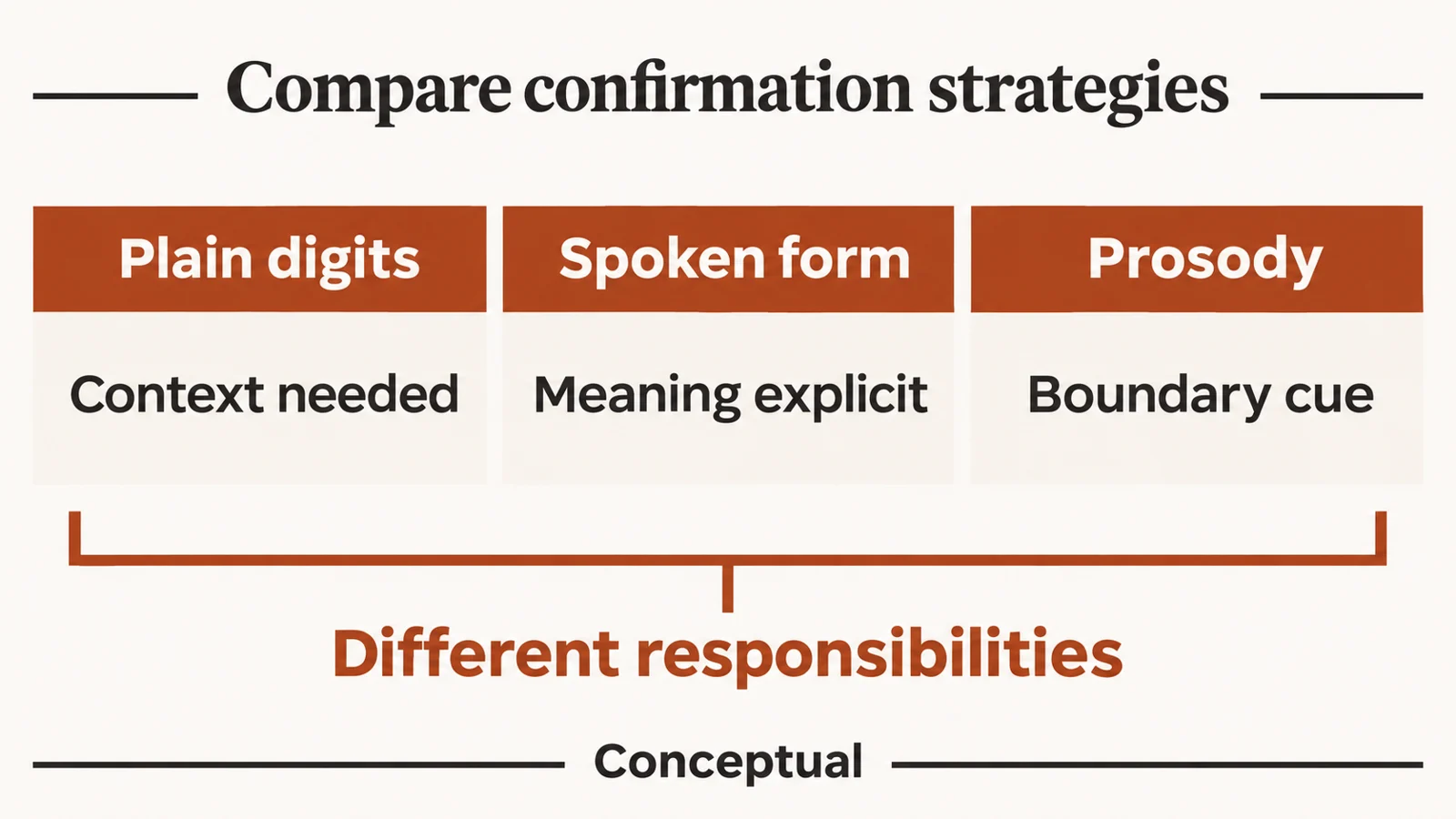
Here ✓ means a strategy directly addresses the stated requirement under its scope. ✗ means another mechanism is needed. The table compares logical responsibilities, not measured effectiveness.
| Requirement | Explicit spoken form | Prosody cue | Authorization state |
|---|---|---|---|
| Preserve intended digit order in text | ✓ With a validated renderer | ✗ Sound cue only | ✗ Stores approval state |
| Distinguish value from explanation | ✓ Labels help | ✓ Requires listening validation | ✗ Does not shape audio |
| Detect a stale proposed value | ✗ Needs revision binding | ✗ Cannot inspect business state | ✓ With versioned proposal |
| Prove caller comprehension | ✗ Needs response evidence | ✗ Needs response evidence | ✗ Policy depends on evidence |
| Prevent action after cancellation | ✗ Rendering alone | ✗ Audio style alone | ✓ With terminal-state checks |
A plain-language spoken form can be more portable than elaborate markup, but it still needs locale-aware review. Explicit digit words can preserve an identifier while sounding unnatural for an amount. Preserve the field type rather than applying one renderer everywhere.
A pronunciation lexicon can help stable names or domain terms. It can also create a maintenance burden when the supported language or voice changes. Use the existing provider capability when it solves a demonstrated problem, and keep its version in the corpus.
The voice consistency corpus is useful when prosody changes make short confirmations sound like another speaker. Evaluate identity separately from field recall so a clearer value is not accepted at the cost of an unexplained voice transition.
Score critical fields before preference
The primary task should match the field's purpose. For an identifier, exact recall can be appropriate. For a date, a listener can select the resolved calendar value. For a name, the task might require spelling, pronunciation recognition, or distinguishing two candidates.
Choose the acceptable answer set before listening. Post-hoc normalization can turn errors into successes when the team likes a variant. Preserve the raw response and the rule version used to score it, so an independent reviewer can recompute the classification.
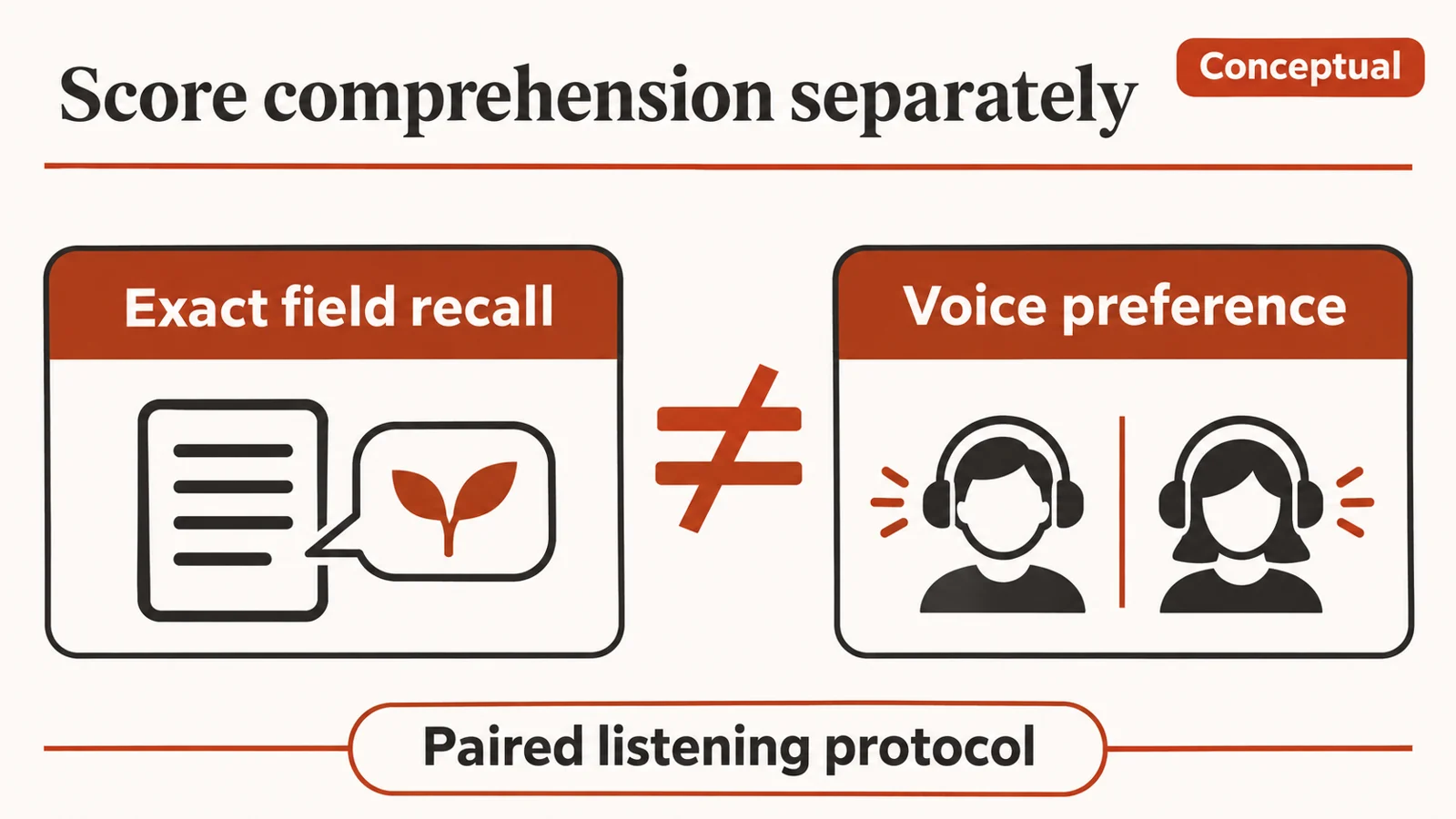
Use ITU-T P.800 as a public methodological reference for subjective transmission-quality work. This article's proposed paired protocol is an engineering study design, not a claim of compliance or a completed standardized score.
Keep uncertain responses separate from wrong responses. Uncertainty may prompt a safe repetition in a real call, while a confidently wrong response can carry a different product risk. Combining them can hide the behavior the confirmation is supposed to prevent.
Ask a preference question after recall. Explain its scale and keep its result distinct from the content score. Do not invent a composite "clarity" number that mixes correctness, comfort, naturalness, and speed without an explicit analysis plan.
The outcome metrics guide makes the same distinction at the conversation level. A successful speech request and an agreeable listener are insufficient evidence for a correctly completed business task.
Balance the item bank. If every difficult value appears in one condition, the comparison confounds prosody with content. Include confusable values, leading zeros where relevant, longer strings, and short fields that can be lost inside an explanation.
A date study needs the intended locale in participant instructions. An amount study needs units and precision rules. A spelling study needs a response method that can represent every supported character without forcing a lossy transliteration.
Record the output device and listening environment. A desktop headphone trial cannot establish performance through a telephone codec or a noisy speakerphone. Keep channel-specific results separate and expand the study only where the deployment requires it.
Do not normalize away the artifact you are studying. If a variant inserts a long pause, trimming silence before the trial removes part of the treatment. If level normalization is required, apply it under the same documented rule and retain the original audio.
A participant should not see variant names such as "improved" or "clear." Neutral labels and randomized order reduce obvious expectation cues. The experiment should allow the candidate to fail.
For analysis, preserve item and participant linkage in restricted records. Repeated responses from one listener are not independent strangers. A public report can describe the method and aggregate errors without publishing identifiable responses or raw recordings.
Handle interruption and revised values
A confirmation can become stale while it is being synthesized. The caller may correct a value, the application may receive updated evidence, or the user may cancel the action. The old audio must not regain authority simply because its generation later completes.
Bind each spoken proposal to a generation and revision. Before ordered local submission, recheck that the proposal remains current and the stream remains active. If the adapter awaits capacity or another asynchronous operation, repeat the check afterward.
The retrieval correction contract demonstrates the broader stale-evidence problem. A well-spoken answer based on the wrong revision remains wrong, and prosody cannot repair that state relationship.
A caller's "yes, but" is a repair, not a completed approval. The yes-but handling guide explains why an early affirmative token must not trigger the action before the corrective continuation is handled.
Keep proposal state terminal after cancellation. Historical audio or an exact retry can return historical evidence, but it cannot reopen the canceled action. The prose, API result, and UI should agree about whether a retry reports history or current disposition.
If the caller interrupts during the value, do not assume they heard the missing suffix. Use a concise repair that restates the current value and asks the appropriate question. The continue-or-restart guide helps choose a bounded recovery.
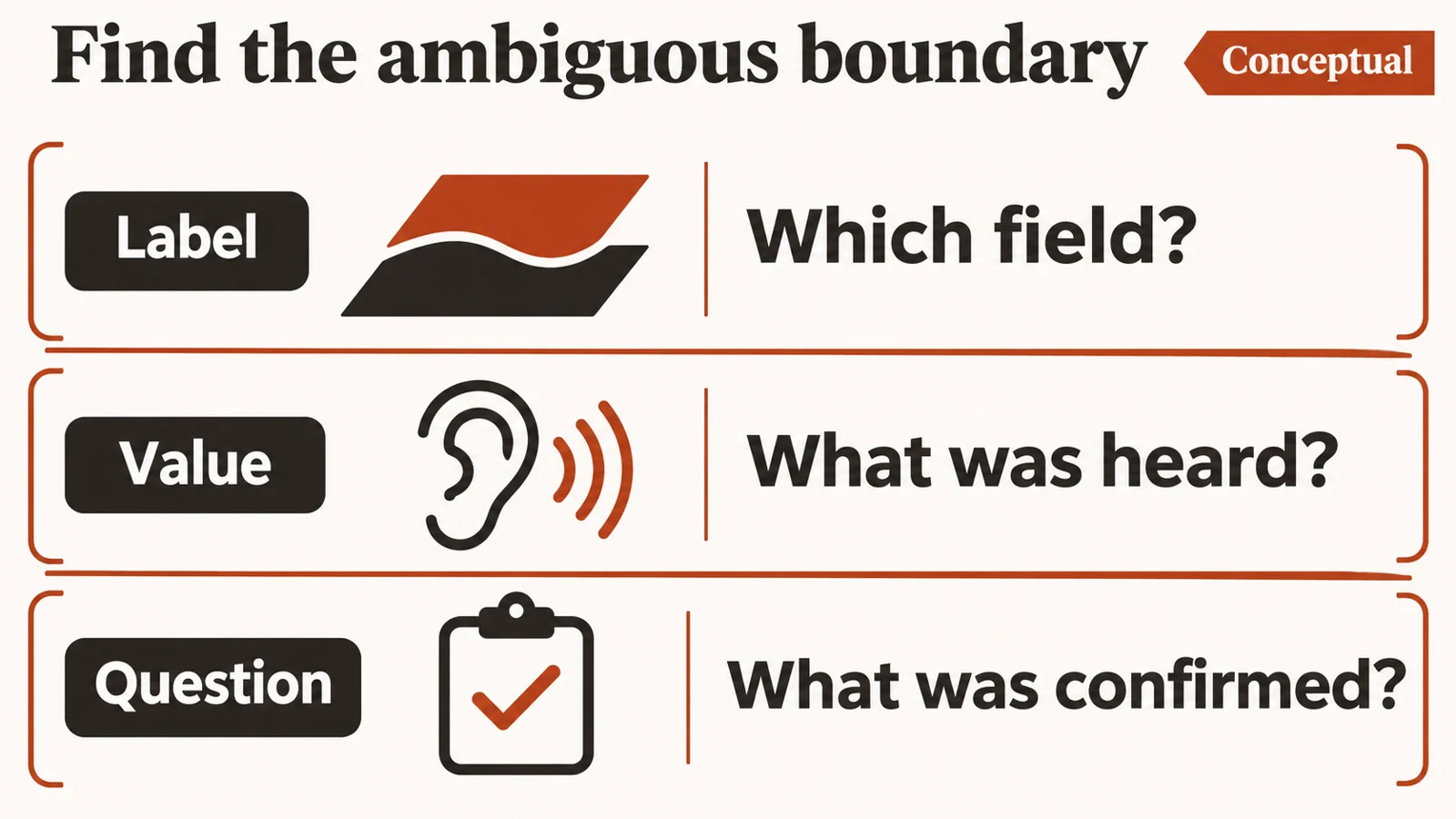
A repeated confirmation should explain meaningful changes. If the value changed after the first readback, identify the new proposal rather than silently replaying audio with a different field. The listener needs a clear conversational reference for their next response.
The action gate should consume the approved snapshot, not a mutable dictionary that another task can edit. Copy the supported value shape, expose a read-only representation, and invalidate approval when a material field changes. Test alias mutation and property rebinding in the actual application.
Delivery failures need explicit outcomes. Pending synthesis, canceled playback, expired output, and an empty producer are not interchangeable. The controller may repeat, wait, abandon, or escalate depending on which event occurred.
Do not infer approval from silence after a polished readback. The no-input policy belongs to the conversation design. The progressive no-input article describes recovery without claiming the caller agreed.
A fallback voice also changes the listening condition. If the primary synthesis path fails, the replacement should preserve the same canonical value and proposal revision. Record the actual selected voice and avoid treating a successful fallback request as proof that its critical fields remain intelligible.
A revision policy should distinguish older delivery from conflicting current evidence. If a response belongs to a strictly older proposal revision, classify it stale before comparing its value with the current proposal. That prevents an old but internally consistent readback from being mislabeled as corruption of the new field.
An exact duplicate of a current completed confirmation can preserve historical evidence under a declared retry contract. A changed payload that reuses the same proposal identity is different: reject it as a conflict. Never let a retry cache reopen a canceled proposal or replace the immutable value that the caller was asked to approve.
Queue age matters when a confirmation waits behind other speech. The admission-control guide addresses bounded waiting, and the backpressure method addresses obsolete media. If a value expires while held, report expiry explicitly rather than returning an empty result that hides the need to abandon or repeat the proposal.
Keep an evidence ledger for the repair. It should state which value was current, which rendering was generated, what media observation exists, what caller response was captured, and which policy decided the outcome. No single yes token or completed audio callback should bypass those relationships.
Review evidence and rollout boundaries
A useful release packet begins with the field contract and the reason a change is needed. Include the canonical synthetic values, spoken forms, exact markup or settings, artifact identities, trial schedule, rubric, and results only for tests that were actually run.
Keep deterministic checks and listening evidence in separate sections. The published script can prove that leading zeros survive the renderer and that the paired schedule is reproducible. It cannot prove that the generated voice said those zeros or that a listener heard them.
Before any listening trial, inspect the audio for missing or duplicated words, clipping, and unintended pauses. The audio boundary inspection procedure helps distinguish an assembly problem from a prosody treatment.
The review should also inspect markup injection boundaries. A field containing angle brackets must not become an instruction to the speech service. Prefer an existing XML serializer when producing real SSML, and test hostile text under the application's documented accepted shape.
For a digit-only field, rejecting unsupported characters is often the smallest complete behavior. For free text, escaping and length limits are still necessary, while pronunciation needs its own supported-language policy. Do not extend the reference renderer into a general text sanitizer by accident.
A rollout can begin with one field family and one supported channel. Use the existing release mechanism and retain a rollback path. Expanding to more languages or voices requires evidence for those conditions rather than assuming a shared markup string makes them equivalent.
Keep a negative corpus beside the successful examples. Include a changed digit, lost leading zero, reordered sequence, stale revision, interrupted value, uncertain response, and a response attached to the wrong trial. The integrated gate should reject each according to the contract.
Monitor repetition requests and correction behavior as diagnostic signals. They can show where a confirmation needs review, but they do not prove that prosody caused the problem. Preserve the relevant policy and configuration versions so the investigation can compare like conditions.
For 60db Agent, use the public workflow and speech interfaces you can observe. Ask for a reproducible confirmation and a clear evidence boundary. Do not infer a private architecture from a pleasant voice or a successful demo.
The practical next step is a small authorized listening run with a frozen item bank. Report content recall, uncertainty, and preference independently, then decide which field and channel the evidence supports. Leave untested conditions visibly untested.
Before publishing a result, inspect the denominator behind every percentage. State the number of scored trials, distinct items, and participants, along with exclusions and unavailable captures. Repeated observations of one easy identifier should not make a difficult field family disappear inside an overall average.
Keep the analysis plan modest when the collection is small. A diagnostic run can establish that a specific ambiguity occurred and justify a targeted repair. It cannot establish a population-wide improvement or a universal best pause duration without a suitable design and enough evidence for that claim.
For accessible delivery, offer an appropriate alternative when the caller cannot confidently resolve the spoken value. That can be a repetition, spelling, or the application's existing supported handoff path. The warm-handoff guide explains a separate recovery boundary; the confirmation itself should not invent a new channel or assume permission to send private details elsewhere.
Finally, inspect the wording around the question. The caller needs to know whether they are confirming a proposed field, acknowledging an explanation, or authorizing an action. A prosody test that leaves that semantic distinction ambiguous is testing an unclear prompt, even if every generated sound is technically intact.
Make the protocol usable by someone who did not design the prompt. Give the reviewer the field definition, canonical value, allowed response set, audio identity, and the intended business consequence. They should be able to determine whether the trial scored the correct value without relying on the author's preferred wording.
Keep an explicit not-yet-run line in the study record until listening occurs. The reference harness can pass while all acoustic and participant observations remain absent. That separation prevents an attractive comparison graphic or a completed trial schedule from acquiring the appearance of a measured result.
When the study does run, attach its limits to the conclusion: selected field families, voices, languages, output routes, and response method. A narrow successful confirmation can ship under that boundary while unrelated cases remain pending under the ordinary application policy.
Frequently asked questions
What is confirmation prosody?
It is the timing, stress, grouping, and related delivery used when reading a proposed value and asking for a response. Its job is to help the listener distinguish the field from surrounding explanation. It does not replace a canonical value, revision binding, or business authorization policy.
Should a digit code be read as a number?
Use the field's meaning. An identifier can require each digit in order, including leading zeros. A quantity can require a cardinal reading with units. Test the spoken representation for that field family rather than applying one number-normalization rule everywhere.
Can a pause guarantee the caller understood a value?
No. A pause supplies an audible cue. Understanding needs response evidence under a defined task. Ask listeners to identify the value in a controlled test, and keep uncertain responses separate from exact recall and general voice preference.
How long should the pause before a value be?
This article establishes no universal duration. Compare a bounded set of supported variants for the selected voice, language, field length, and output channel. Retain the exact requested settings and generated artifacts so another engineer can reproduce the comparison.
Why score recall before preference?
A pleasant voice can still obscure a digit or date. Collecting recall first makes the content task explicit and avoids treating preference as comprehension. Preserve both outcomes, including cases where a listener prefers the variant on which they made an error.
Does SSML work identically across providers?
No universal behavior should be assumed. Providers and voices support different elements and can interpret controls differently. Validate against current official documentation and inspect the generated audio under the selected configuration, especially when changing voices or synthesis modes.
Why keep the canonical value separate from speech text?
The canonical value defines the proposal the application will use. Speech text is a rendering of it. Keeping them separate makes localization and prosody changes inspectable and lets the action gate reject a stale rendering when the meaningful value changes.
Can I remove leading zeros during scoring?
Only if the field contract says they are irrelevant. The reference treats them as meaningful for synthetic digit identifiers, so 42 is incorrect when the expected value is 0042. Scoring normalization must reflect the business meaning rather than a preferred study outcome.
What if the caller says yes and then corrects a digit?
Treat the response as a repair until the application's completion policy resolves it. An early affirmative token must not authorize the old proposal while the caller is still speaking. Bind the final response to the current value revision and re-confirm when required.
Does completed synthesis mean the confirmation was delivered?
It establishes producer completion at that interface. Local writer acceptance and endpoint playback are different boundaries. None alone proves that the caller understood or approved the field. Keep those observations separate in the proposal record and action gate.
Should the trial use real account values?
Prefer synthetic values with the same difficulty and shape. They reproduce grouping and recall problems without exposing account data or asking participants to approve a real action. Keep any necessary restricted operational evidence outside the public corpus and publication artifacts.
Why does the reference reject full-width digits?
Its declared scope is ASCII digit identifiers. Silent conversion could merge distinct input shapes or conceal an upstream contract error. An application can support additional character systems through an explicit locale-aware renderer and corresponding positive and negative fixtures.
Is the trial script an authorization engine?
No. It validates immutable synthetic items, schedules both presentation orders, and classifies exact recall. The application still owns identity, permissions, proposal state, confirmation completion, cancellation, and the final business action. Keep that boundary explicit when adapting the artifact.
Can automatic transcription score the listening response?
It can assist, but it introduces another error source. Preserve the raw authorized response and review ambiguous cases under the study protocol. Do not treat a recognition transcript as unquestionable evidence that the listener spoke or understood the intended value.
How do I test date confirmations?
Resolve the canonical date and locale first. Choose a spoken form that removes the relevant ambiguity, then score responses against the resolved date under a predeclared rubric. Include confusable dates and preserve units such as timezone when the task depends on them.
Can louder values improve the study result unfairly?
Level changes can influence both intelligibility and preference. If level is the intended treatment, record and evaluate it explicitly. Otherwise control it across variants, retain any normalization parameters, and inspect the target output path for clipping or processing differences.
What if a fallback voice has different prosody?
Treat it as another condition. Preserve the same canonical value and revision, record the actual selected configuration, and test critical-field comprehension for the supported fallback path. A successful API response does not establish equivalent pronunciation or grouping.
Do short confirmations need a separate corpus?
Yes, when they are a meaningful product surface. A short field can lose context that helps listeners recover errors in a long explanation. Include isolated and contextual versions so the study can distinguish a field problem from a broader reply-length effect.
What makes the paired schedule reproducible?
A frozen item bank, stable item revisions, recorded seed, and retained assignment map. The seed alone does not establish unbiased participant assignment or complete data collection. Keep the actual presented trials and response linkage with the study record.
What should ship before a broad prosody rollout?
A validated field renderer, negative fixtures, revision and cancellation checks, and a bounded listening result for the selected channel. Use the existing release mechanism and report untested languages or devices. Expand only when the evidence supports the additional condition.
Test the value the caller heard
Start with the field's meaning, then make its spoken boundary easy to follow. Preserve the canonical proposal, render it through an explicit policy, and keep content recall separate from preference and authorization.
Run the synthetic trial-contract harness and inspect the generated audio before recruiting listeners. Freeze the item bank, balance presentation order, and retain uncertain responses. A study that permits a candidate to fail gives the product team a useful decision boundary.
Choose one critical field in one supported channel and compare a plain rendering with the proposed prosody treatment. Ask what the listener heard, then ask what they preferred. Ship only the behavior those observations and the application's confirmation policy can justify.