
- Engineering
Avoid clipped consonants and clicks at streaming audio boundaries
Trace streaming audio clicks to PCM assembly, scheduling, or synthesis with lossless fixtures and an onset inspection procedure.
- Author
 Udit Goenka
- Editorial date
- Reading time
- 25 min
TL;DR: Preserve every complete audio frame and retain partial bytes across transport chunks before changing synthesis or adding fades. Compare source, assembled, and output recordings at the same media boundary, then use listening tests to establish whether consonants remain intelligible.
A caller hears the first word without its opening consonant. A later sentence begins with a click, yet the provider's saved audio sounds acceptable. Start by proving that the playback path preserves the audio it receives.
A transport chunk is a delivery unit. It does not promise to end at a sample, an interleaved channel frame, a codec packet, or a word boundary. An adapter that silently drops a trailing byte can damage every later sample while reporting a successful request.
The useful first test is lossless reconstruction: assemble the same synthetic PCM byte stream under every possible two-part split and compare the result byte for byte. This separates a deterministic assembly defect from a speech-quality question that needs listening evidence.
The audio chunk sizing guide explains the latency side of this boundary. Here the narrower goal is to preserve content, locate discontinuities, and avoid repairing the wrong layer.
This article provides a Python reference assembler and a reproducible inspection procedure. The fixtures are synthetic. No acoustic measurements, customer recordings, or quality results for 60db Agent are claimed.
Table of contents
- Define what a boundary contains
- Find where the sound changed
- Preserve frames with a small assembler
- Build continuity and onset fixtures
- Repair scheduling before smoothing audio
- Review consonants with listening evidence
- Turn a reproduction into a release gate
- Frequently asked questions
- Ship the smallest verified repair
Define what a boundary contains
An audio frame contains one sample for each channel at one media instant. For the reference example, the input is signed 16-bit little-endian linear PCM with either one or two interleaved channels, at a declared positive integer sample rate. No container header, compression, resampling, or channel conversion is performed.
Those assumptions matter before any code runs. A stereo frame has four bytes under this contract; a two-byte fragment contains one channel sample, not a complete stereo instant. Playing it as a full frame changes channel alignment rather than merely reducing quality.
The Python wave documentation exposes channels, sample width, frame rate, and frame count as separate properties. Preserve that separation in your own diagnostics. A filename ending in .wav is insufficient evidence for a decoder contract, and the example below intentionally consumes raw bytes rather than parsing a WAV container.
A chunk can end between the low and high byte of one sample. It can also end after the left channel but before the right channel. Both cases are ordinary transport fragmentation when the transport offers an ordered byte stream rather than an audio-aware framing guarantee.
Do not infer endianness from the word PCM. RFC 3551 defines particular RTP audio payload representations, including L16, whose representation must be read in its own protocol context. The little-endian assumption in this example is local and does not describe every network audio format.
Compressed audio needs another boundary model. An arbitrary byte range from an encoded stream can depend on decoder state, container metadata, or previous packets. Use the documented streaming decoder interface; do not reinterpret compressed bytes as integers and expect sample-level operations to remain meaningful.
A second distinction is temporal. Source frame position is a media coordinate. Network receive time is an observation on a local clock. A sample discontinuity can exist even when packets arrive regularly, while a perfectly continuous source signal can produce silence if the device queue drains.
Keep speech-generation timing and waveform continuity in separate test columns. A shorter time to first bytes says nothing about whether the initial consonant survived, and a clean saved file says nothing about whether the actual device scheduled it correctly.
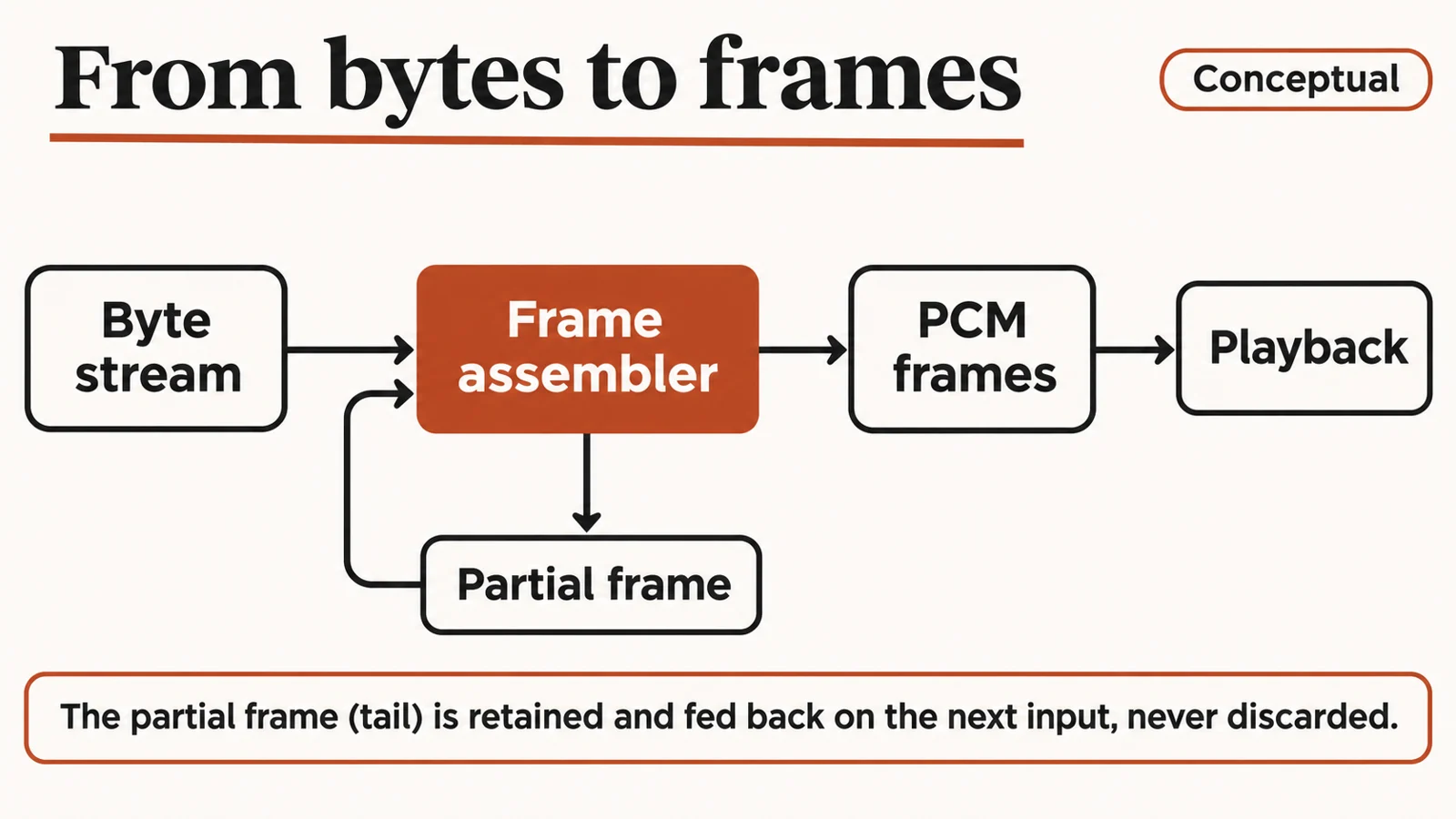
The figure's feedback path represents retained bytes. It does not create new audio. At the next push, the assembler prepends the retained tail to the new bytes and releases only complete frames.
The session owns this state. Reusing a partial tail across separate replies is a data corruption bug even when both replies use the same voice and sample rate. Reusing it across concurrent calls is also an isolation failure, which the session settings contract addresses at a broader boundary.
Write the format contract beside the capture. Include encoding, bit depth, byte order, channel layout, sample rate, and whether the stream has an explicit terminal event. If any field is unknown, mark it unknown and resolve it before interpreting bytes.
For a bounded reproduction, choose one supported format rather than building an automatic detector. Format guessing can turn a useful failing fixture into a misleading passing one by silently converting the evidence.
Find where the sound changed
Capture the same approved synthetic utterance at three places: the provider or source output, the decoded and assembled PCM before submission, and an authorized output capture. Give each capture an independent identity and record the transformation between it and its predecessor.
The source capture answers whether the missing sound already existed before your adapter. The assembled capture answers whether your code preserved the source samples. The output capture includes scheduling, device, and possibly acoustic effects, depending on where it was recorded.
An output loopback is not a microphone recording. A microphone recording is not a transcript. Name the boundary so another engineer can repeat the test without assuming it establishes audibility or comprehension.
The Web Audio specification defines an audio rendering model and scheduled source behavior. Its current published document is a working draft when checked on November 10, 2026; use the browser implementation and its documented support as additional test context rather than treating every draft feature as deployed everywhere.
A historical Web Audio chunk-click discussion asks about artifacts at chunk starts and discusses a sample-rate mismatch. That is a useful symptom report, not evidence that the same workaround applies to current browsers or to your stream.
The lesson for diagnosis is to retain the actual format and the actual split. If you only keep a screenshot of the waveform, you cannot distinguish a malformed header, a dropped sample, and an output scheduler gap with confidence.
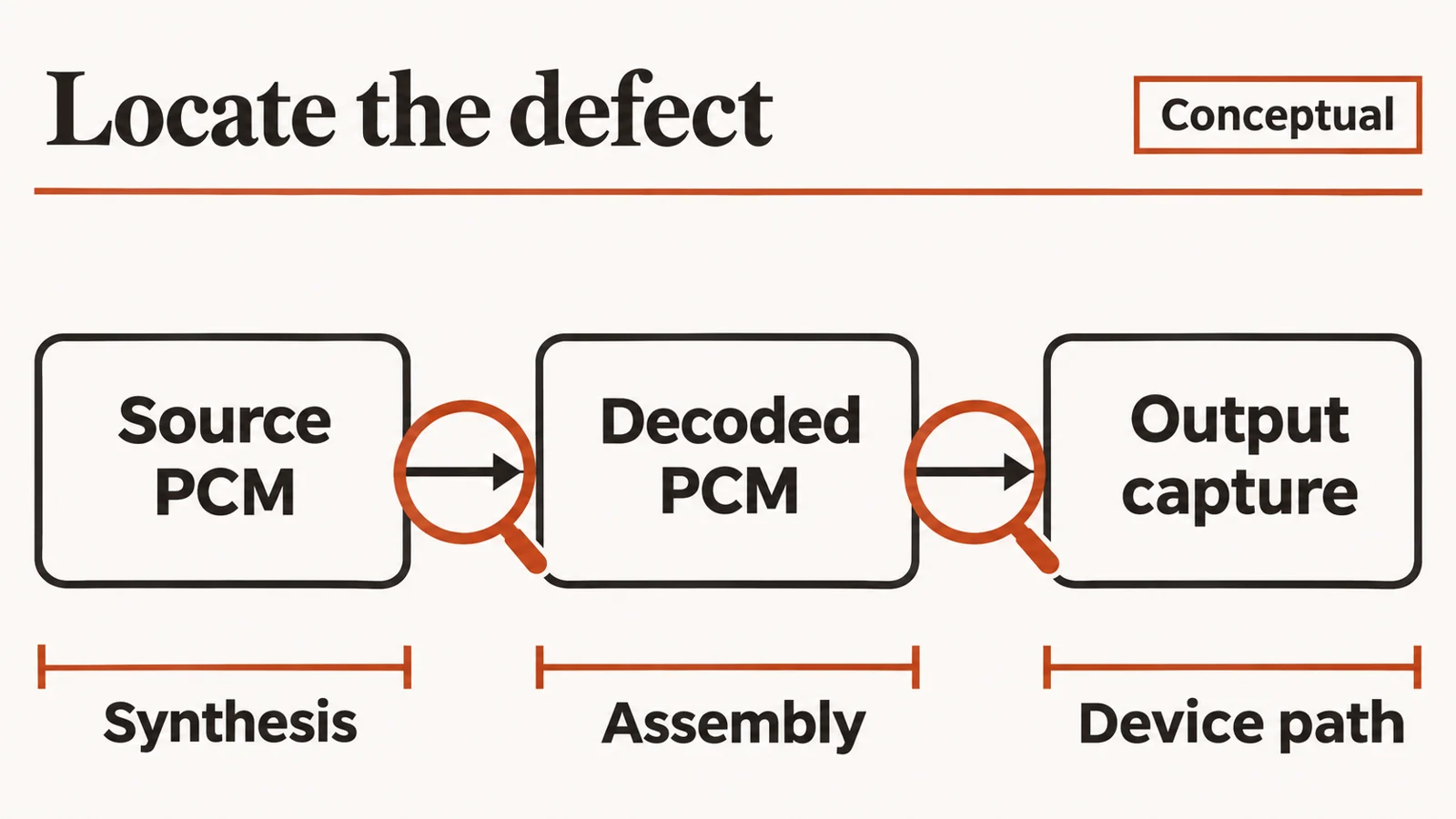
First compare bytes before introducing alignment heuristics. If the format is identical and the path promises preservation, an exact comparison is stronger than a similarity score. Report the first differing byte and the surrounding frame index.
When a legitimate transform changes the sample grid, compare the correct invariant instead. A resampler changes sample values and often frame count; compare duration, documented delay, channel mapping, and a reference signal under declared tolerances. The speaking-rate guide separates this case from playback-rate manipulation.
A missing onset can also come from an intentional gate. A voice-activity detector, silence trimmer, gain envelope, or interruption controller may classify a quiet initial sound as removable. Inspect the samples before and after each gate rather than placing every defect under the synthesis model.
For example, a fricative onset can carry low-energy noise rather than a large periodic peak. A threshold selected against vowel energy can remove it. The right acceptance test is content preservation and intelligibility under the target channel, not whether the first surviving sample exceeds a chosen amplitude.
Cancellation creates another plausible symptom. An old response can finish decoding after a new response begins, and an adapter can apply the wrong stop or clear operation. Correlate the media generation with interruption state before calling the symptom clipping.
A queue that becomes empty between chunks needs a pending-producer state when more content can still arrive. It must also have a true terminal state, so canceled or closed playback cannot restart on a late callback. The shutdown semantics article explains why those states require distinct outcomes.
Write your initial diagnosis as a falsifiable sentence. "The assembler drops an incomplete stereo frame when a transport chunk ends after one channel" is testable. "Streaming sounds worse" is too broad to choose a repair.
Retain unsuccessful hypotheses in the investigation note, with the evidence that rejected them. This stops a future engineer from repeatedly adding fades to a format mismatch that a byte comparison already identified.
Preserve frames with a small assembler
The reference function has one responsibility: preserve a known ordered raw PCM stream while exposing only complete interleaved frames. It copies incoming mutable buffers into owned immutable bytes, retains a partial tail, and treats finish or failure as terminal.
A nonempty tail at finish is a truncation error. The assembler does not pad it with zeros, discard it, or pretend the stream ended successfully. The caller decides whether to abandon playback, request a fresh response, or report a synthesis error.
Save the complete fence as pcm-boundaries.py and run it with Python 3.11 or later. The harness uses only the standard library. Its success proves the declared assembly properties for synthetic fixtures; it performs no sound playback and establishes no acoustic quality.
import struct
from dataclasses import dataclass, FrozenInstanceError

@dataclass(frozen=True)
class PCM:
    rate: int
    channels: int
    encoding: str = "s16le"

    def __post_init__(self):
        if type(self.rate) is not int or self.rate <= 0:
            raise ValueError("positive integer rate required")
        if type(self.channels) is not int or self.channels not in (1, 2):
            raise ValueError("mono or interleaved stereo required")
        if self.encoding != "s16le":
            raise ValueError("only raw signed 16-bit little-endian PCM")

    @property
    def frame_bytes(self):
        return 2 * self.channels

class Assembler:
    def __init__(self, fmt):
        if not isinstance(fmt, PCM):
            raise TypeError("PCM contract required")
        self._fmt = PCM(fmt.rate, fmt.channels, fmt.encoding)
        self._tail = b""
        self._terminal = False

    def push(self, chunk):
        if self._terminal:
            raise RuntimeError("terminal stream")
        if not isinstance(chunk, (bytes, bytearray, memoryview)):
            raise TypeError("byte buffer required")
        data = self._tail + bytes(chunk)
        size = self._fmt.frame_bytes
        end = len(data) - len(data) % size
        self._tail = data[end:]
        return data[:end]

    def finish(self):
        if self._terminal:
            raise RuntimeError("terminal stream")
        self._terminal = True
        if self._tail:
            raise ValueError("truncated interleaved frame")

    def cancel(self):
        self._terminal = True
        self._tail = b""

def rejects(error, fn):
    try:
        fn()
    except error:
        return
    raise AssertionError("expected " + error.__name__)

for channels in (1, 2):
    fmt = PCM(24000, channels)
    samples = [0, 100, -100, 32767, -32768, 0] * channels
    raw = struct.pack("<" + "h" * len(samples), *samples)
    for split in range(len(raw) + 1):
        a = Assembler(fmt)
        result = a.push(raw[:split]) + a.push(raw[split:])
        a.finish()
        assert result == raw, (channels, split)
        rejects(RuntimeError, lambda: a.push(b""))
        rejects(RuntimeError, a.finish)
    a = Assembler(fmt)
    result = b"".join(a.push(bytes([x])) for x in raw)
    a.finish()
    assert result == raw

# Caller mutation cannot change the retained tail.
a = Assembler(PCM(24000, 1))
caller = bytearray(b"\x01")
assert a.push(caller) == b""
caller[0] = 255
assert a.push(b"\x02") == b"\x01\x02"
a.finish()

# Finish failure is terminal; late bytes cannot repair or resurrect it.
a = Assembler(PCM(24000, 2))
assert a.push(b"\x01\x02") == b""
rejects(ValueError, a.finish)
rejects(RuntimeError, lambda: a.push(b"\x03\x04"))
a = Assembler(PCM(24000, 1))
a.cancel()
rejects(RuntimeError, lambda: a.push(b"\x00\x00"))

# Empty completed streams are distinct from truncated streams.
a = Assembler(PCM(24000, 1))
assert a.push(b"") == b""
a.finish()
for args in ((0, 1), (24000, 3), (True, 1), (24000, True)):
    rejects(ValueError, lambda args=args: PCM(*args))
rejects(ValueError, lambda: PCM(24000, 1, "opus"))
rejects(TypeError, lambda: Assembler(PCM(24000, 1)).push("audio"))
fmt = PCM(24000, 1)
rejects(FrozenInstanceError, lambda: setattr(fmt, "rate", 48000))
# Deliberate deletion, duplication, and reordering fail preservation.
raw = struct.pack("<hhhh", 10, 20, 30, 40)
for damaged in (raw[2:], raw[:2] + raw, raw[4:] + raw[:4]):
    a = Assembler(PCM(24000, 1))
    rebuilt = a.push(damaged)
    a.finish()
    assert rebuilt != raw
print("PCM boundary fixtures passed; no listening test performed")
The constructor owns a separate format value rather than borrowing an application's mutable configuration. The frozen dataclass describes the supported contract; it is not a security boundary against arbitrary reflective Python code.
The tests exercise all two-part splits and a stream delivered one byte at a time. Both matter. A two-part test proves one retained boundary, while the one-byte test forces repeated retention and release across many calls.
The extreme signed sample values check representation preservation. They are not a recommendation to synthesize at full scale, and the harness makes no claim about clipping in an analog device. Exact bytes remain the expected result.
Cancellation clears only this assembler's tail. It does not clear a global playback device or another call's buffers. An adapter must propagate the terminal disposition to its own consumer and reject late generation results before submitting audio.
This reference intentionally has no network retry logic, decoder, scheduler, timeout, or automatic format negotiation. Adding those responsibilities would hide the assembly proof. Integrate it behind a documented adapter boundary and test that boundary separately.
If the upstream protocol permits a midstream format change, it needs an explicit transition that ends one assembler and creates another. Never change channels while retaining a partial frame. The old tail belongs to the old format and cannot be interpreted safely under the new one.
For a network stream, preserve original transport sequence information alongside the PCM capture. An ordered transport can still carry application-level duplicates if a producer retries payloads, while unordered transports need their documented sequencing and loss policy before this assembler sees bytes.
A local successful push means the reference accepted bytes. It does not mean the device accepted them, that the caller heard them, or that the caller understood the word. Playback acknowledgments require a separate evidence chain.
Build continuity and onset fixtures
Start with signals whose expected reconstruction is exact. A zero stream reveals inserted nonzero values. A constant stream reveals unexpected resets. A ramp exposes dropped or duplicated samples because the discontinuity appears at a known position.
A periodic tone is useful for scheduling inspection, but it is insufficient alone. Depending on phase, a splice can accidentally meet at similar amplitudes and look clean. Use several split positions rather than selecting the visually nicest cut.
For stereo, make the channels intentionally different. A left-channel ramp and a right-channel constant make channel swaps and half-frame alignment defects easier to locate. A mono tone duplicated to both channels cannot expose every channel-mapping error.
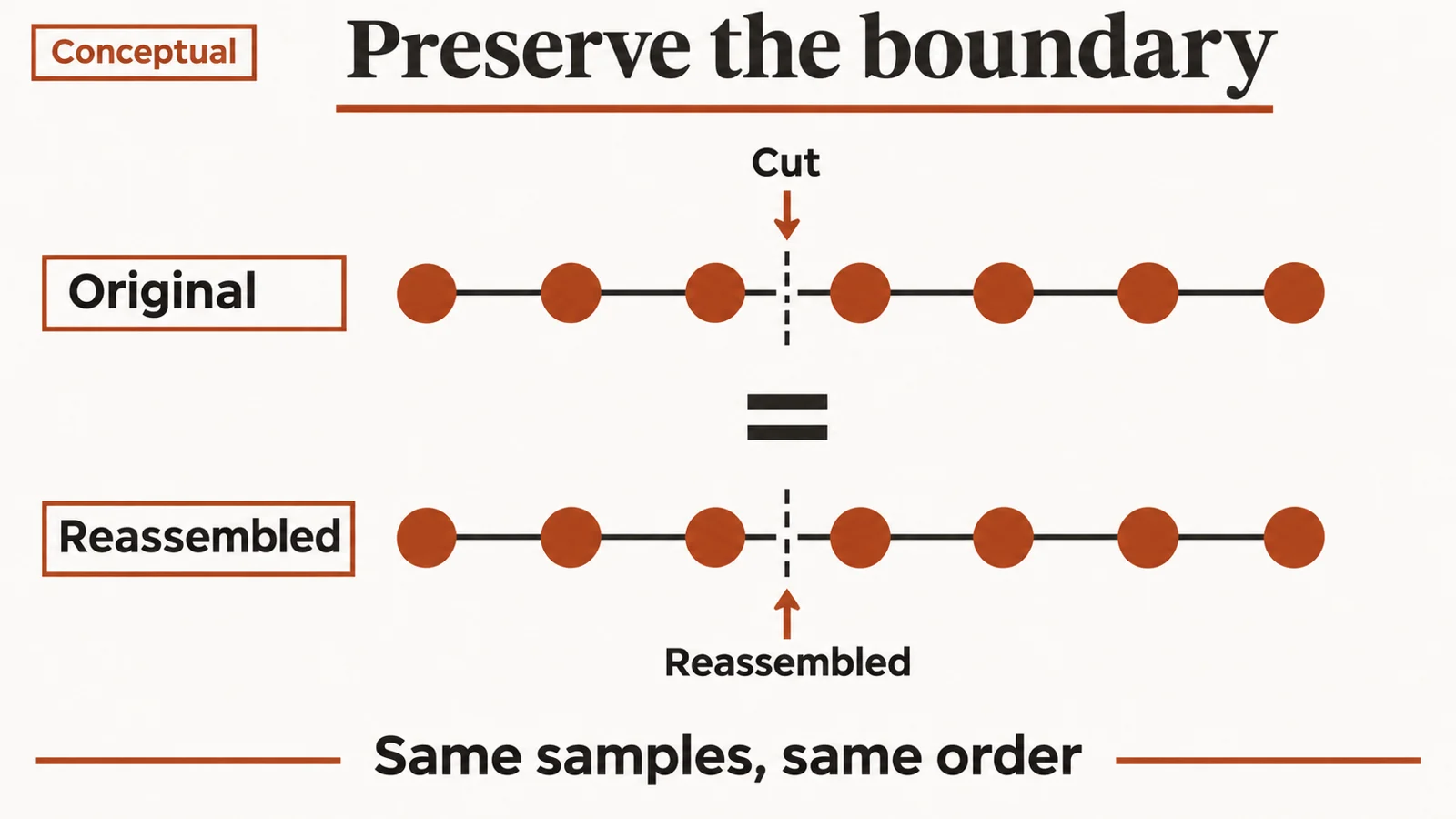
Use a single master fixture and derive transport fragments from it. Generating each chunk independently produces a different experiment because the signal itself can reset at every chunk. You would then be measuring both synthesis boundaries and transport assembly together.
Record the fixture's generator, format, frame count, content digest, and split positions. The digest establishes file identity; it does not prove perceptual equivalence. Store the original bytes so someone can recompute the comparison without trusting your summary.
For natural speech, select authorized recordings or explicitly generated test phrases. Include initial stops, fricatives, quiet onsets, final consonants, short acknowledgments, and critical values. The test collection should reflect the channel and languages your application supports.
Do not trim the fixtures before you establish a reference. Silence trimming can move the onset or remove breath and noise that help identify a sound. If trimming is part of the product, version its settings and compare pre-trim and post-trim captures.
The multilingual benchmark method helps define language-specific review rather than assuming an English consonant set covers every supported locale. Have qualified listeners review the target language and preserve uncertainty when the listening team lacks that competence.
A useful negative fixture deliberately removes one frame at a chosen seam. Another duplicates a frame. A third reorders two transport fragments before assembly. Each should fail the exact reconstruction check, proving the check can detect the defect it claims to prevent.
A malformed terminal tail is a separate fixture. The expected result is explicit failure, even if the missing byte happens to lie near silence. Content importance should not decide whether a structural input error is reported.
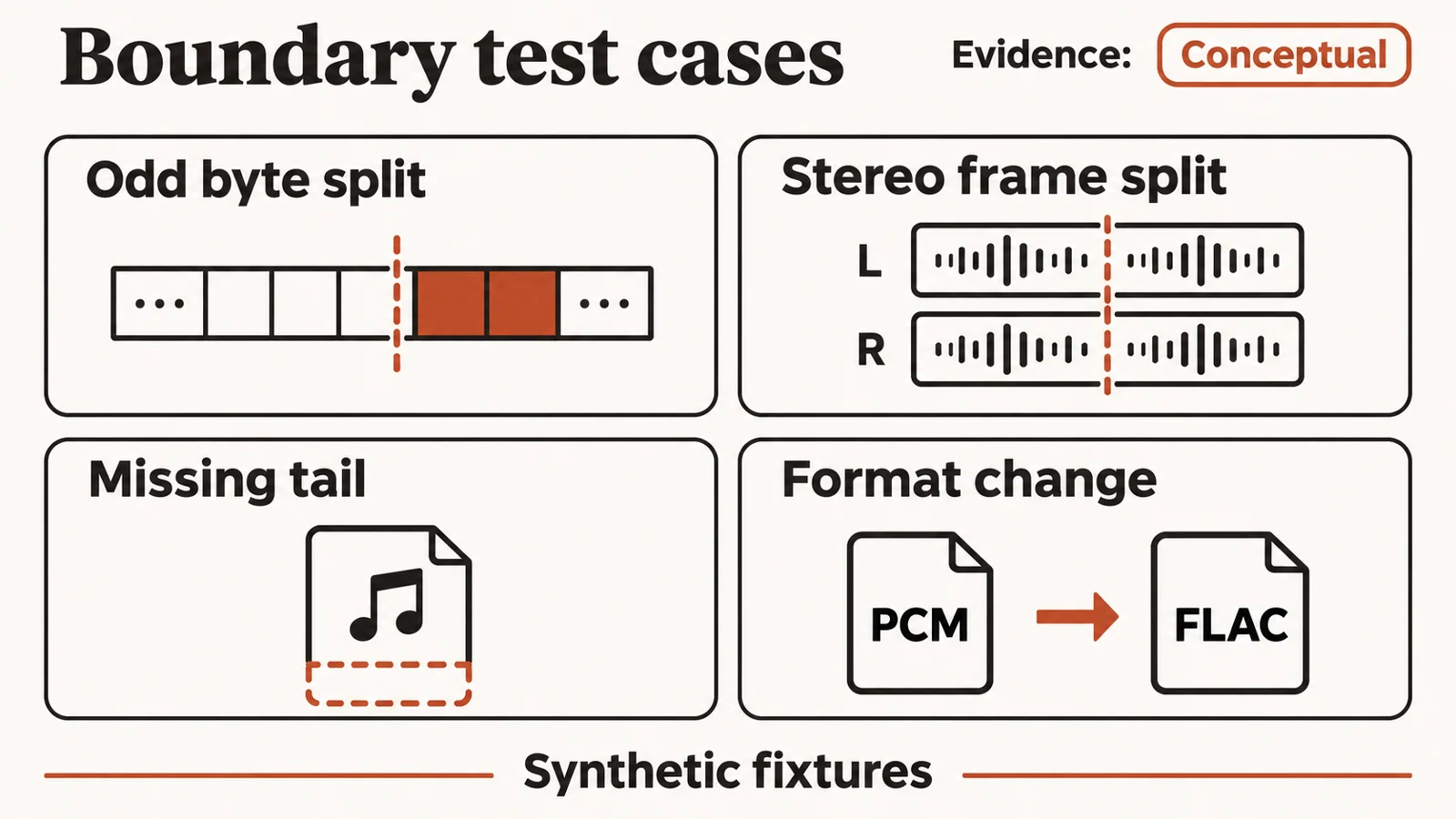
Keep fixtures for empty streams and empty pushes. Empty transport delivery can mean no new bytes yet; an explicit successful end means the producer is done. Your application should not convert both into a single "nothing to play" outcome when recovery differs.
Test reuse after terminal events. Finishing an assembler twice should not silently create a new stream, and cancellation must prevent a later callback from restoring the old response. A fresh response receives fresh state and an independent generation identity.
The regression testing guide describes how to retain these failures across releases. Prefer a compact set that catches real boundary mistakes over a large collection of nearly identical successful waveforms.
Repair scheduling before smoothing audio
If samples are preserved before submission but the output contains gaps, inspect the scheduler. Starting each chunk at callback arrival time can translate network jitter into audible pauses. Media scheduling needs a consistent output timeline and an explicit policy for late data.
Avoid creating an independent clock from each chunk's arrival timestamp. The frame count supplies media duration under a fixed sample rate. Arrival time supplies a different observation: when data became available to the scheduler.
A browser audio context can have its own sample rate and scheduling clock. Device changes, suspension, and resumption must be part of the reproduction. Reinitializing a player per sentence can create gaps even when the content bytes are correct.
MDN's decodeAudioData documentation describes decoding complete file data and resampling into the audio context's rate. Do not assume it is a generic decoder for arbitrary fragments of a streaming file. Choose an interface suited to the source's encoding and framing.
Fades can be legitimate after you know the cause. A deliberate stop may need a bounded gain ramp to avoid an abrupt waveform edge. Independently synthesized speech units may need a reviewed join treatment if the product accepts the resulting content change.
A fade is not a repair for missing bytes. It alters the waveform around the seam and can attenuate the exact onset you are trying to preserve. A crossfade can overlap phonemes that were meant to be sequential.
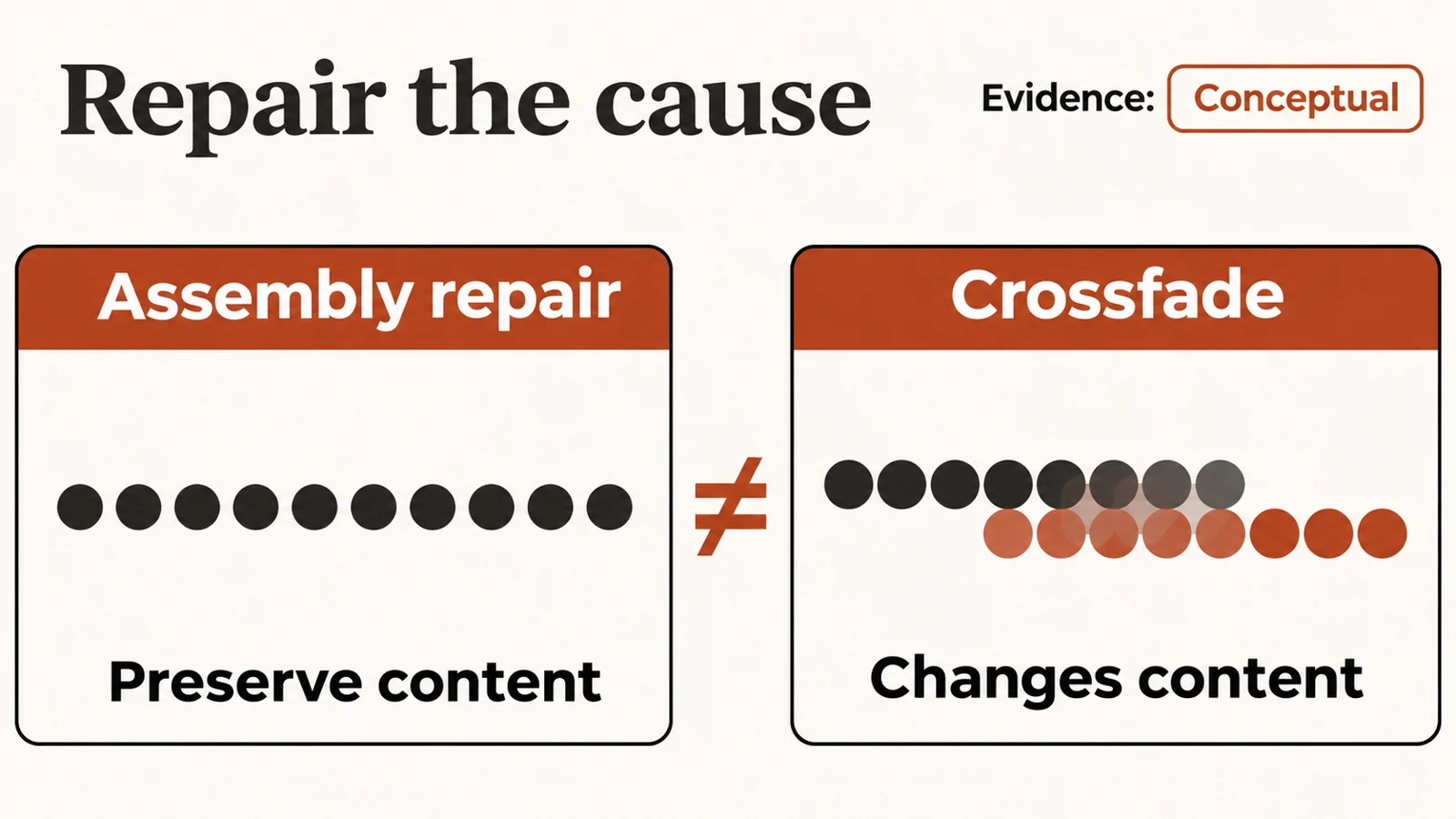
In this criteria table, ✓ means the method directly supplies the stated property under its declared scope. ✗ means it does not. The table is a logical comparison, not a measured ranking of audio products.
| Criterion | Frame-preserving assembly | Output timeline repair | Crossfade alone |
|---|---|---|---|
| Preserves every original source byte | ✓ Under fixed raw PCM contract | ✓ If scheduling only | ✗ Alters samples |
| Detects incomplete terminal frames | ✓ Explicit finish error | ✗ Needs input validation | ✗ Can conceal symptoms |
| Addresses callback-arrival gaps | ✗ No scheduler included | ✓ With a tested late-data policy | ✗ Cannot create missing content |
| Guarantees consonant intelligibility | ✗ Requires listening | ✗ Requires listening | ✗ Requires listening |
| Safe across arbitrary compressed fragments | ✗ PCM only | ✗ Decoder contract still needed | ✗ Decoding still needed |
A scheduling fix also needs age limits. Keeping every chunk forever avoids underruns by creating an unbounded backlog, which fails during interruption. The backpressure policy handles the different question of which audio remains timely enough to submit.
After any asynchronous wait, check whether the held chunk still belongs to the active generation and whether a clear barrier or expiry invalidated it. A correct waveform can still be the wrong waveform for the current conversation.
When you cannot submit a late chunk safely, record the disposition and apply a documented recovery. Quietly compressing the timeline or skipping a phoneme changes speech content and needs its own listening evaluation.
Keep one repair per experiment. Fix the byte-tail bug, repeat the capture, and then evaluate the scheduler. Changing the model, chunk size, player, trim threshold, and fade together can improve a demo while leaving the original cause unresolved.
Review consonants with listening evidence
The assembler harness proves preservation. Listening establishes whether a person can distinguish the intended sound under the tested channel. Those are complementary checks with different evidence and different failure definitions.
Use the ITU-T P.800 recommendation as a public reference for subjective transmission-quality evaluation methods. A small internal diagnostic listening session should be labeled as such rather than described as a standards-compliant study without meeting the method's requirements.
For a practical diagnostic, prepare randomized A/B pairs from the same source. One member uses the reference assembly path; the other uses the candidate path. Keep the text, source voice, format, and output level constant unless that variable is the subject of the experiment.
Ask a content question before a preference question. "Which initial word did you hear?" can reveal a missing consonant that a broad naturalness score hides. Include an explicit uncertain response and preserve it separately from an incorrect response.
Short words deserve dedicated trials. A missing onset in a long explanation may be recoverable from context, while the same defect in an isolated confirmation can change the perceived value. The confirmation prosody rubric focuses on critical fields rather than general pleasantness.
Use headphones or devices that match the intended diagnostic question. A desktop loopback test cannot establish behavior through a mobile speaker, a Bluetooth route, or a telephone codec. Add those conditions only with an authorized test plan and report them separately.
Record listener eligibility, language familiarity, listening equipment, playback conditions, randomization method, and exclusions. Avoid publishing listener identifiers or raw recordings without the appropriate permission. A report can retain aggregate errors while keeping participant data separate.
Do not ask the listener to infer a waveform defect from a chart. Present the audio, collect the response, and then inspect the signal around disagreement cases. This avoids teaching participants to report the symptom the engineer expects.
A spectrogram can help locate a transient, but its display settings affect appearance. Retain window, overlap, scaling, and channel selection when you use one. A striking image without the underlying audio and parameters is weak reproduction evidence.
When listeners disagree, preserve the disagreement rather than replacing it with a confident average. Different devices or language backgrounds can expose a genuine boundary. The next experiment should test that difference explicitly.
A clean assembly result and poor onset intelligibility can point upstream to synthesis or downstream to processing. It does not justify claiming that the assembler failed. Keep the diagnosis attached to the earliest boundary where the defect appears.
Turn a reproduction into a release gate
A release gate should state what it rejects. For the reference assembler, any byte mismatch, silent terminal truncation, unsupported format acceptance, or post-terminal push is a failure. The test output remains useful even without a live speech provider.
For an integrated adapter, add captures around the real decoder and writer. Record the adapter version, fixture identity, requested format, observed format, chunk sequence, terminal event, and result disposition. Keep secrets and account identifiers out of the artifact.
Include a run where the producer pauses between chunks without finishing. Empty queue state must remain distinguishable from a completed producer. Include another where cancellation occurs while decode is pending, and verify the late result cannot reach the output writer.
The observability guide helps separate those events in traces. A generic successful request span cannot explain why the final phoneme was missing if the media lifecycle remains unrecorded.
Gate the deterministic properties automatically. Keep the listening gate proportional to changes that affect content, timing, level, trimming, or output processing. A documentation-only correction should not require a new acoustic study, while a new fade policy does.
Preserve the failing-before artifact when correcting a defect. The old implementation should fail a specific fixture, and the repaired version should pass the same fixture without weakening its expected result. This is more informative than a fresh happy-path recording.
A production rollout needs an observable fallback. If the new assembly path rejects an unsupported format, the caller should receive the configured recovery rather than silence with a successful completion status. Monitor rejection classes separately from quality complaints.
Keep source artifacts restricted when they contain licensed voices or sensitive content. Prefer synthetic, authorized fixtures for public regression examples. Publishing a reproducible method does not require publishing private media.
For 60db Agent or any other voice application, request evidence at the interface you can test. Confirm the documented format, playback lifecycle, and cancellation behavior. Avoid assuming that a public feature description exposes the private implementation responsible for it.
After the repair, run the original utterance, the synthetic boundary corpus, and the affected device path. Report exactly which checks passed. A statement that the audio "sounds fixed" leaves future regressions without a clear acceptance boundary.
A useful incident packet also distinguishes a restart from a resumed stream. A device reconnect can create a new output clock while the source frame positions continue. Record that transition explicitly so an analyst does not interpret a legitimate clock reset as a negative duration or a duplicated audio region.
Retain raw counters with the receiver identity that produced them. A cumulative frame count without a stream or device identity is ambiguous after a reconnect. Derived milliseconds should remain recomputable from the original count and declared rate, including a genuine zero at startup.
Choose a bounded evidence window around the defect. Preserve enough pre-onset and post-boundary content to interpret the missing sound, while avoiding an unnecessary full-call recording. The public regression artifact can use the synthetic replacement even when the private incident required a restricted capture.
If the fix changes buffering, report its effect on latency separately. A larger buffer can hide callback jitter while increasing the time before speech starts or stops. Use the same workload and clock boundary when comparing the candidate with the previous release, and retain unknown output observations rather than counting them as successful playback.
For rollback, keep the previous adapter selectable through the application's existing release mechanism. Do not introduce a new control plane solely for this repair. The rollback should preserve the format validation added by the fix whenever that validation prevents malformed audio from reaching the caller.
A practical handoff includes the narrow hypothesis, the exact fixture command, the original failure output, the repaired result, and the unmeasured boundaries. That lets another engineer verify the claim without recreating a production conversation or trusting a subjective description of a click.
Finally, inspect the figures against the implemented contract. The retained tail loops into the next assembly operation; it never goes directly to playback. The comparison graphic shows sample preservation as a property of reconstruction, not as proof of naturalness or a claim that a flat synthetic signal resembles speech.
Choose the reproduction channel deliberately. An authorized local loopback can isolate the writer and device scheduling path without introducing room acoustics. A later microphone capture can answer another question about the physical output, provided the recording setup, distance, route, and environmental conditions are documented rather than inferred from the file alone.
For telephony, preserve the negotiated codec and any transcoding stages in the experiment record. The SIP troubleshooting procedure separates connection establishment from working media, while the transport comparison helps identify which interface owns framing and playback evidence. A successful call setup cannot certify consonant preservation.
Keep a second engineer's reproduction independent of your listening description. Give them the fixture, split positions, expected byte result, and capture boundary first. Ask them to report the earliest mismatch they can prove. Only then compare the subjective symptom, so a familiar label such as click does not steer every investigation toward the same gain-envelope workaround.
The short-and-long reply corpus can retain the same boundary failure in a linguistic context after the deterministic repair passes. Keep that corpus separate from a benchmark ranking: its purpose here is to verify that the originally affected sound remains distinguishable under the selected output condition.
If a missing consonant changes a critical value, repeat the confirmation task with the repaired path. Ask what the listener heard before collecting preference. A smooth seam is valuable only within the content and timing contract the application needs to preserve.
Frequently asked questions
Why do I hear a click between otherwise valid audio chunks?
A waveform edge, a dropped sample, a duplicated frame, or a scheduling gap can create a transient. Compare the assembled PCM with the source before selecting a fade. If the bytes match, inspect the output timeline and device path rather than changing synthesis settings immediately.
Can a network chunk split a PCM sample?
Yes, when the transport contract is an ordered byte stream without audio-aware framing. Retain the partial bytes and prepend them to the next delivery. The reference harness tests every two-part split, including splits inside samples and interleaved stereo frames.
Is a PCM sample the same as an audio frame?
For mono they contain the same number of sample instants. For interleaved stereo, one frame contains one sample from each channel. Under the example's signed 16-bit contract, a stereo frame requires four bytes, so preserving only two-byte alignment is insufficient.
Should I pad an incomplete final frame with zeros?
Only if an explicit input contract permits that repair and downstream users accept it. The reference rejects truncation because it cannot know which original bytes were missing. Padding can conceal a producer defect and changes the waveform, so it needs separate evidence.
Will crossfading restore a clipped consonant?
A crossfade cannot recreate missing speech content. It can soften a join while attenuating or overlapping phonemes. Repair assembly or trimming first, then evaluate any join treatment with the same critical-word listening task used to detect the original problem.
Can silence trimming remove quiet consonants?
It can remove speech onsets that fall inside its rejected region. Test the exact trim settings against authorized phrases with quiet and noisy onsets. Preserve the pre-trim audio so the inspection can establish whether synthesis or the trim stage introduced the missing sound.
Does matching byte count prove correct assembly?
No. A duplicate can replace a missing fragment while preserving length, and channel order can change without changing the number of bytes. Compare complete byte content and order under a fixed format contract, then retain format and timing evidence for the integrated path.
Why use different signals in the stereo channels?
Different channel content exposes swaps and half-frame misalignment. Identical left and right signals can hide those defects. Keep the channel layout explicit and compare each channel independently after decoding rather than treating a stereo file as an unlabeled sample list.
Can I feed MP3 fragments into this assembler?
No. The assembler accepts raw signed 16-bit little-endian PCM only. Compressed streams need their documented decoder and packet or container handling. Decode at the correct boundary first, then apply a PCM preservation check to the decoded representation if that matches your adapter contract.
Does a saved clean WAV prove caller audio was clean?
It proves only the saved capture's content at its recorded boundary. Scheduling, output processing, and the device can still introduce defects. Capture the actual output path when authorized, and distinguish digital loopback from acoustic recording in both the test plan and report.
Should I recreate the player for every sentence?
Use the platform's documented lifecycle and test the resulting timing. Repeated creation can introduce initialization or queue gaps, but a persistent player still needs correct cancellation and cleanup. Select the smallest lifecycle that preserves ordering, terminal state, and the intended device route.
Can a successful playback acknowledgment prove intelligibility?
No. It can establish a bounded playback or transport observation, depending on the protocol. It does not show that a listener distinguished the initial consonant or understood the value. Collect a content response in a listening test when intelligibility is the claim.
What should happen after the assembler is canceled?
It must reject future pushes for that stream. A late decoder callback must not restore canceled playback. Create a fresh assembler for a new response and keep the generation check in the adapter immediately before submitting audio to its ordered local writer.
Why does the reference reject boolean sample rates?
Python treats booleans as integer-like values in some operations. A format contract should accept explicit positive integer rates rather than accidental truth values. The strict type check makes malformed configuration visible before any media bytes are interpreted.
Do empty chunks mean the producer finished?
Only when the protocol explicitly says so. The reference treats an empty push as no additional bytes and requires a separate finish call. That distinction prevents a temporary gap from being mistaken for successful completion or from discarding later valid audio.
How do I compare audio after resampling?
Exact byte equality usually no longer applies because the sample grid changed. Preserve the original format, transform settings, output format, and documented delay. Compare reference signals and duration under declared tolerances, then perform listening checks for content and artifacts.
Should the regression corpus contain real customer speech?
Prefer authorized synthetic or licensed fixtures that reproduce the failure without private content. If customer media is necessary, follow the applicable consent, access, retention, and publication boundaries. A public debugging article does not need identifiable recordings to explain the method.
What proves the test can detect a missing frame?
A negative fixture that removes a known frame should fail the exact comparison. Keep that failure alongside the successful reassembly tests. Without deliberate damaged inputs, a passing check can be too weak or incorrectly wired while appearing to validate the repair.
Can these fixtures rank two speech models?
They validate assembly behavior under a narrow raw PCM contract. They do not compare naturalness, pronunciation, voice identity, or language quality. A model comparison needs a controlled corpus and listening procedure with the synthesis conditions and output channel held explicit.
What is the first useful production change?
Add a bounded capture and exact reconstruction test at the adapter boundary implicated by the symptom. Repair the earliest proven defect, retain its negative fixture, and rerun the affected output path. Expand the change only when the evidence identifies another failure.
Ship the smallest verified repair
A clean streaming boundary begins with a declared format and complete frames. Retain partial bytes, fail explicitly on terminal truncation, and prevent old state from crossing replies or calls. These properties are cheap to verify and expensive to guess from listening alone.
Keep synthesis quality, assembly correctness, scheduling, and endpoint perception as separate evidence columns. A successful repair can close one column while leaving another unmeasured. Say so in the release note rather than turning a narrow fixture into a broad quality claim.
Take one affected utterance through the source, assembled, and output checkpoints. Save the original bytes and split positions, run the full reference harness, and add the failing boundary to your application's regression set. Then use qualified listeners to determine whether the repaired path preserves the consonant the caller needs to hear.