
- Engineering
Change speaking rate without corrupting audio timing
Separate synthesis rate, resampling, and playback speed with a reproducible duration experiment and explicit clock contracts.
- Author
 Udit Goenka
- Editorial date
- Reading time
- 25 min
TL;DR: Choose whether you want new speech at a different pace, a new sample grid at the same duration, or faster playback with changed pitch. Keep source frames, network arrival, and output clocks separate, and verify timing with known signals before evaluating speech quality.
The request sounds simple: make the agent speak faster. A developer changes the sample-rate label, the caller hears a higher voice, and the transcript highlight gradually moves away from the audio. Several different controls have been treated as if they were one setting.
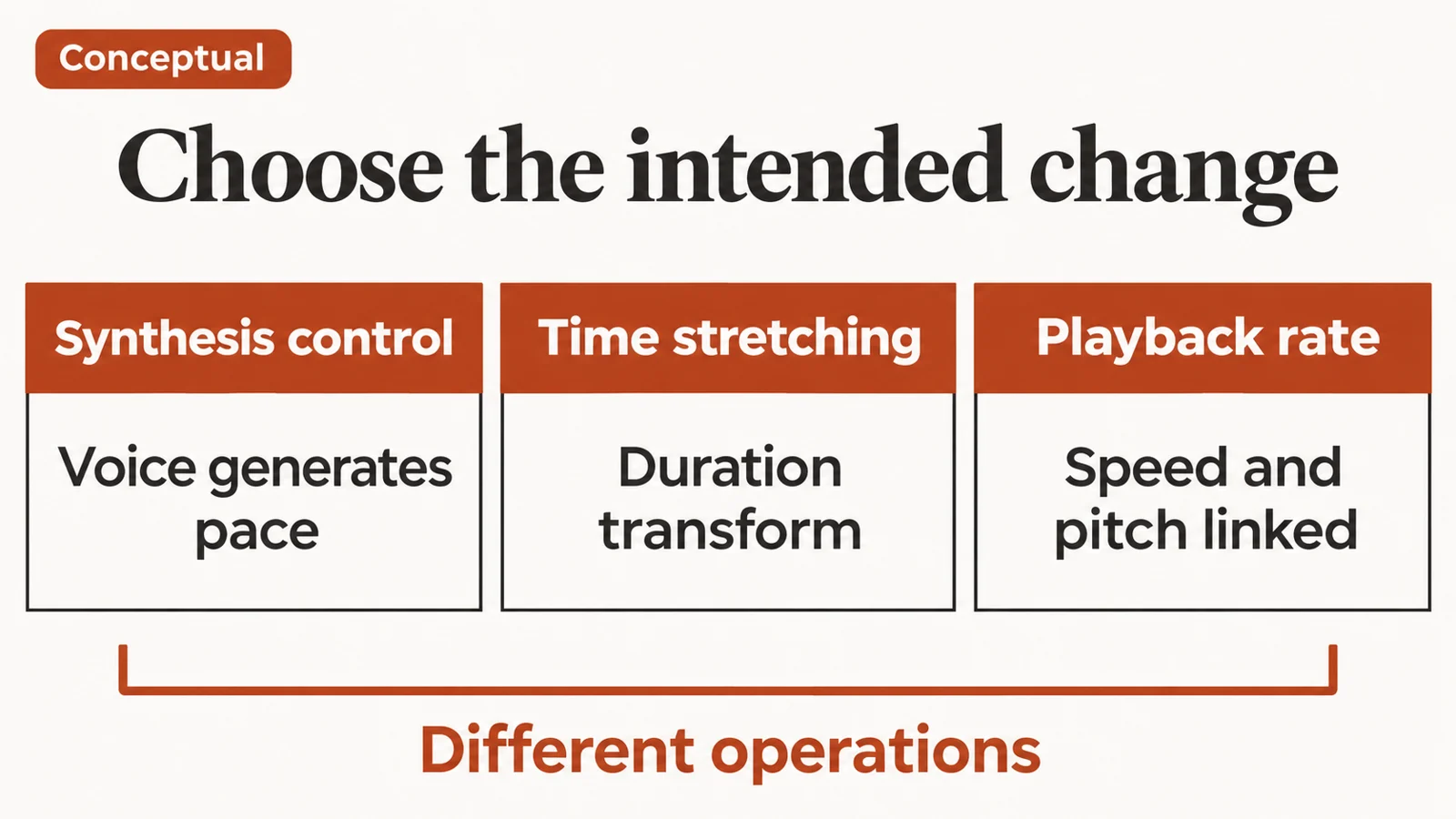
Start by writing the desired invariant. If the caller should hear the same voice identity at a faster conversational pace, request an appropriate synthesis control or evaluate a pitch-preserving time transform. If the device requires another sample rate, resample the audio while preserving its intended duration.
Sending chunks sooner does not make their samples play sooner once they are queued against a media clock. It can fill a backlog. The audio backpressure guide explains why transport speed and spoken pace need separate policies.
This guide supplies a small synthetic resampling and pacing experiment. It tests arithmetic, frame layout, and schedule construction. It does not implement a production-quality speech resampler, establish perceptual transparency, or report acoustic results for 60db Agent.
Table of contents
- Choose the rate you intend to change
- Keep audio clock domains explicit
- Run a reference signal experiment
- Interpret duration and pitch evidence
- Retest streaming boundaries and cancellation
- Evaluate pace on critical speech
- Record a reproducible rollout decision
- Frequently asked questions
- Change one control with a clear invariant
Choose the rate you intend to change
Speaking rate describes speech delivery; sample rate describes a sample grid. They can affect one another through processing, but they answer different questions. The first concerns how quickly linguistic content is spoken. The second specifies how many audio frames represent a second under a declared format.
A synthesis-rate control asks the speech system to generate a different performance. It can change phoneme durations, pauses, stress, and other delivery choices. Its behavior must be evaluated with the particular voice, model, locale, and synthesis mode you use.
The SSML 1.1 recommendation defines prosody controls, including rate. An accepted rate request does not establish an exact output duration or a universal mapping to words per minute. Treat provider support and measured output as separate evidence.
Resampling constructs a signal on a different sample grid. If you convert a fixed-duration recording to a new nominal sample rate correctly, its intended media duration remains approximately the same, subject to the output frame rounding policy and the transform's documented delay.
Playback-rate manipulation consumes an existing signal at another speed. MDN's AudioBufferSourceNode playbackRate reference describes this speed parameter and its resampling behavior. Do not assume it supplies the same pitch-preserving behavior as a different playback interface.
A pitch-preserving time-stretch algorithm changes duration while attempting to preserve pitch. It has quality and buffering trade-offs that depend on the algorithm, ratio, content, and implementation. Selecting such a processor is an evaluation task rather than a reason to rename a sample-rate field.
Pacing is another control. An application can delay submission of chunks or send them at a target media schedule. This changes when content becomes available to the output path; it does not automatically compress the waveform or change how long a phoneme lasts.
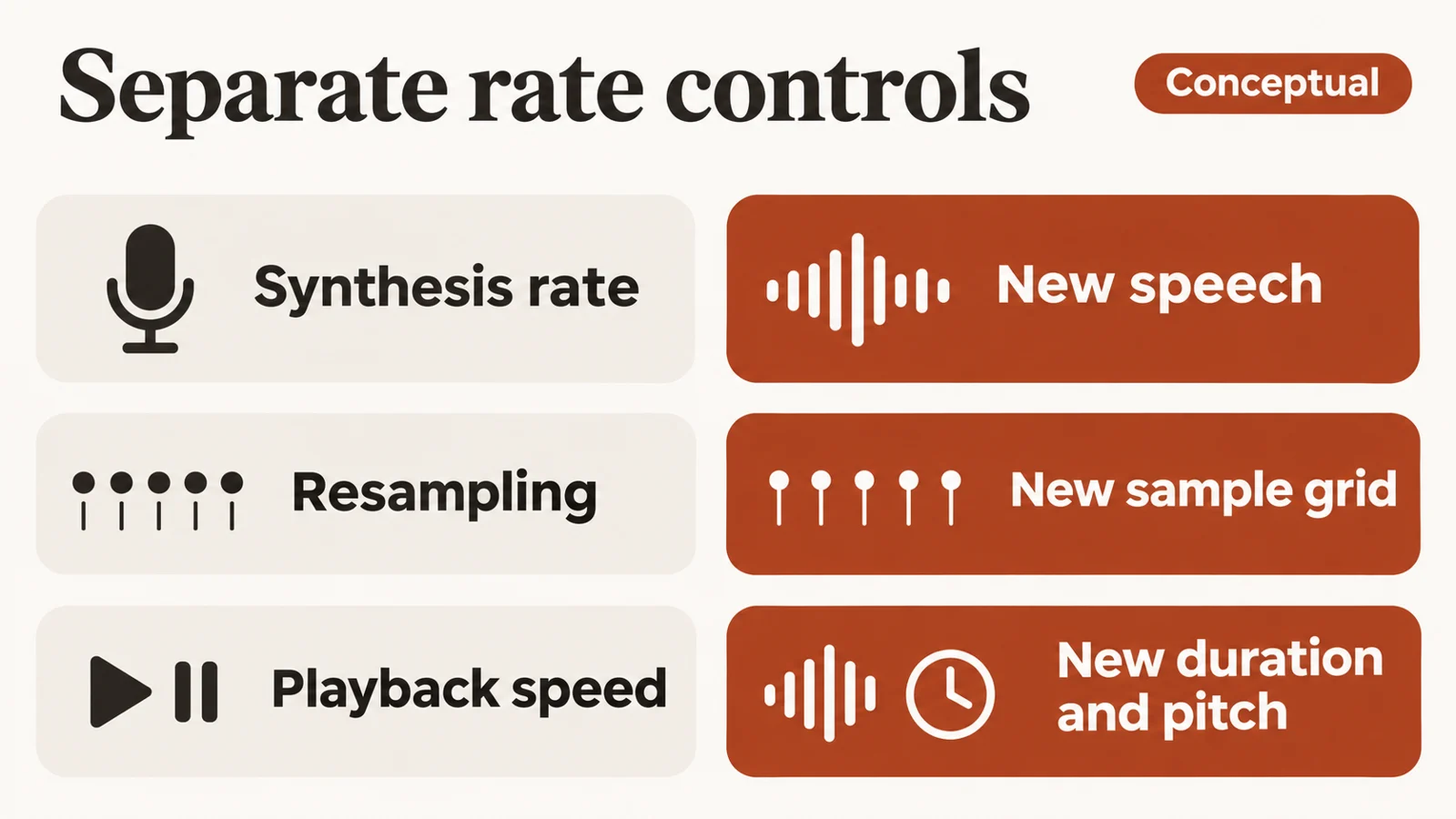
A useful request contract names the operation and invariant. "Resample from the declared source rate to the required output rate while preserving duration" is testable. "Set speed to fast" leaves too much interpretation to the adapter.
The voice configuration isolation guide adds another boundary: one call's rate request must not mutate another call's configuration. Capture the selected operation in an owned request snapshot rather than reading a mutable global setting midway through a stream.
Avoid stacking independent controls without an explicit experiment. Increasing synthesis pace and playback speed together can produce a much larger change than intended. A decoder may also resample into the device's native rate, introducing another transform that belongs in the record.
For critical values, the desired pace can differ from surrounding explanation. The confirmation prosody method tests whether a listener can distinguish the value, rather than assuming that a globally faster voice improves the interaction.
Keep audio clock domains explicit
A media timestamp identifies a position in audio. A monotonic wall-clock timestamp records when an event happened on one machine. An output device has its own rendering clock. Store the domain with every timestamp so a subtraction does not silently mix incompatible coordinates.
For fixed-rate PCM, duration is frame count divided by frames per second. Count frames per channel instant, not the total number of interleaved scalar samples. Stereo doubles the number of samples stored for the same duration; it does not double the recording's length.
RFC 3551 provides a public reference for RTP audio payload conventions. Packet clock interpretation follows the negotiated codec and payload contract, so a field named timestamp does not by itself identify the source PCM sampling rate or a local wall-clock instant.
For a synthetic mono example, 24,000 frames at 24,000 frames per second represent one second. Relabeling those same frames as 48,000 frames per second represents half a second. These are arithmetic examples, not measured performance claims.
A proper conversion to 48,000 frames per second instead creates about 48,000 output frames for the same one-second source interval. It needs interpolation and, depending on the conversion, filtering. Changing a header without changing the signal is a different operation.
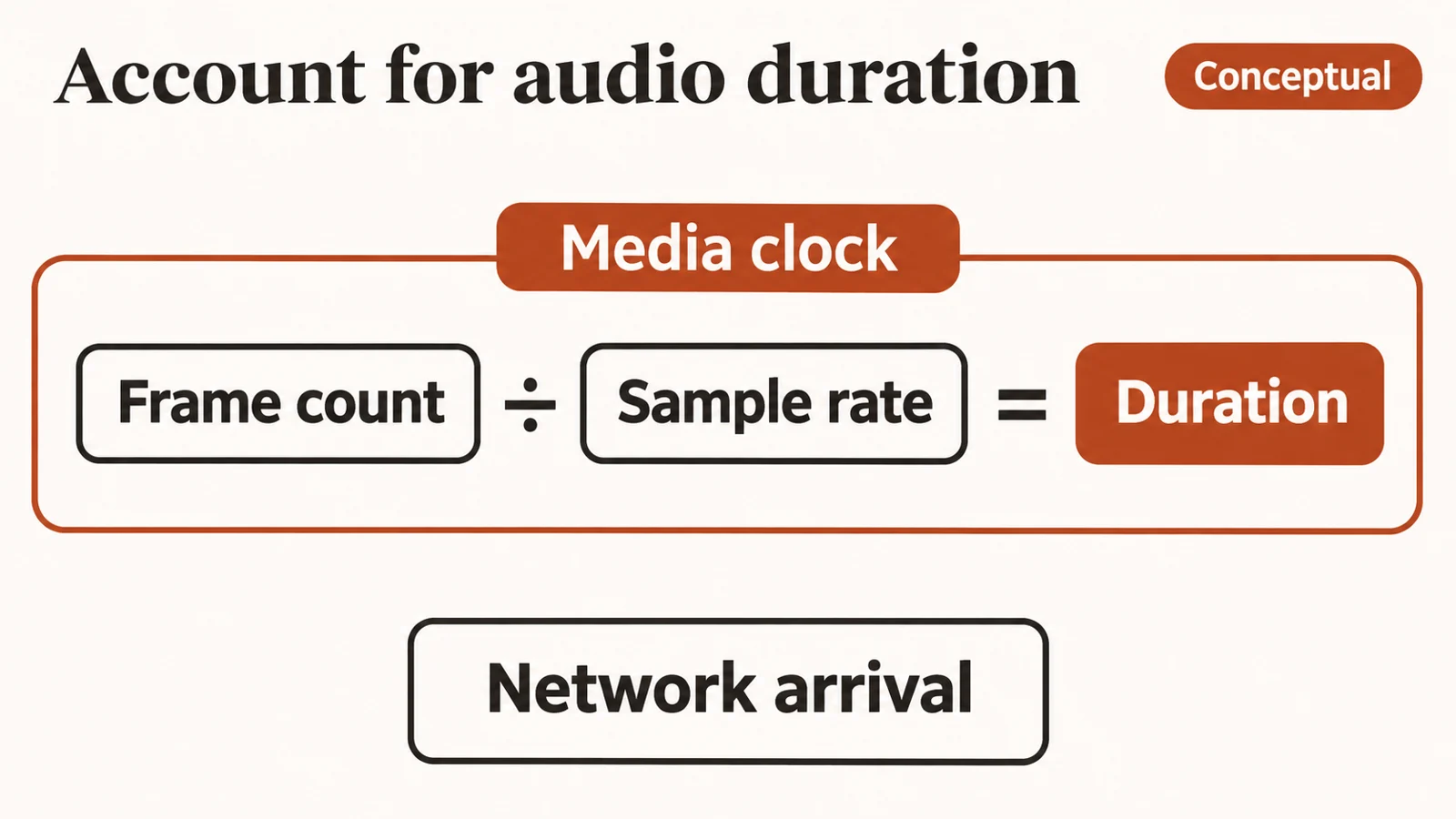
Store the original values used in that calculation. A report containing only "duration = 1.0" cannot reveal whether the author counted scalar samples, frames, milliseconds, or codec ticks. Preserve frame count, channel count, rate, and any rounding convention alongside derived seconds.
For chunk pacing, derive each chunk's intended start from a cumulative frame offset. Adding rounded durations repeatedly can accumulate error. Retain the integer frame position and convert to seconds at the scheduling boundary.
A network receiver can observe two chunks in the same event-loop turn even when their media starts are far apart. That arrival pattern is a transport observation. The output scheduler should not replace the media interval with the difference between callback times.
The latency benchmark guide helps separate request-to-first-byte measurements from caller-visible timing. Faster delivery into a queue can coexist with unchanged or increased time to audible speech if output buffering grows.
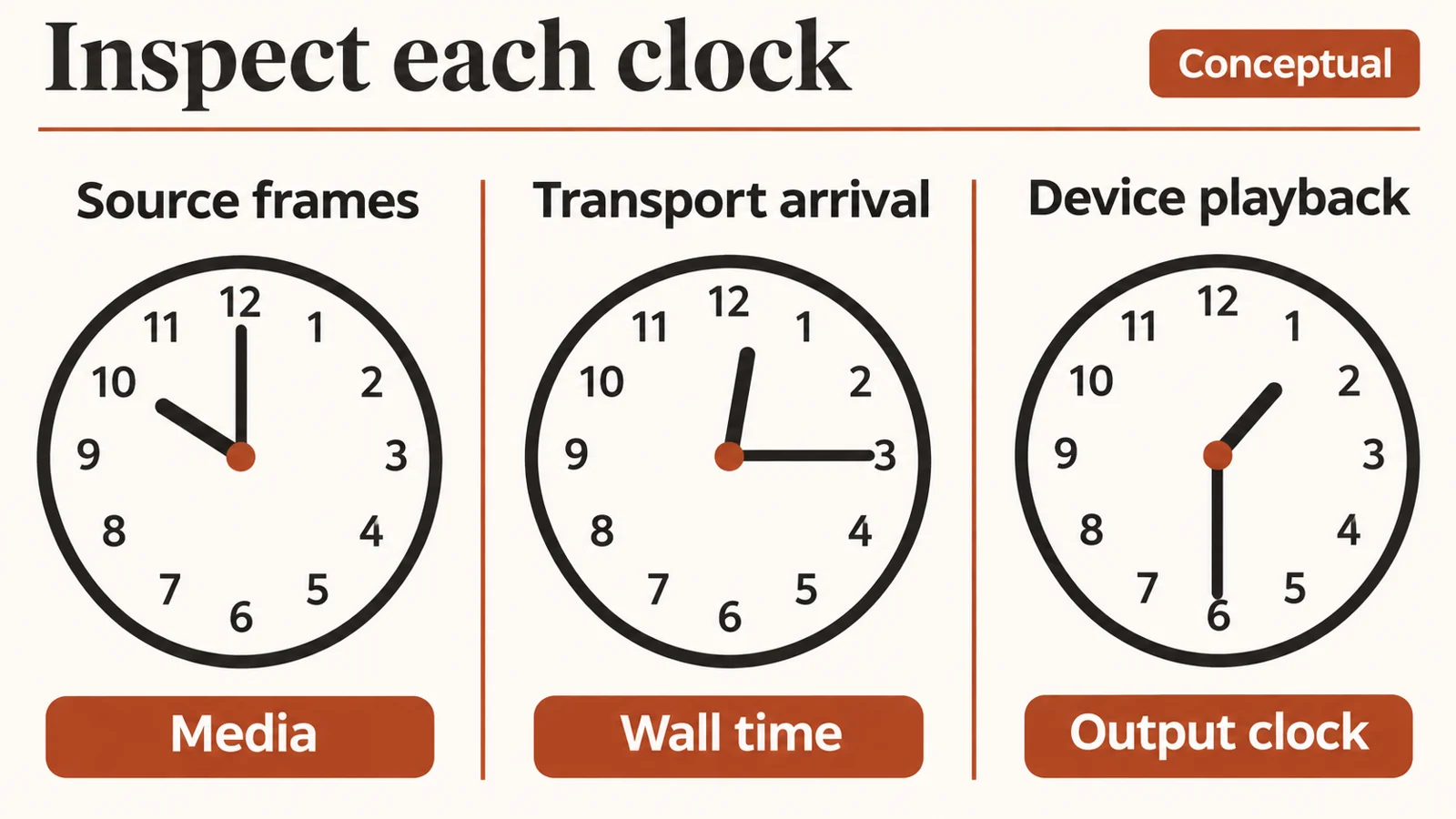
A device reconnect can reset its clock. A source generation can also restart frame numbering. Keep receiver identity, source identity, and generation with cumulative counters before calculating deltas; reject or split comparisons when identity changes or counters move backward.
Zero is a valid counter value. Missing is an absence of evidence. Replacing both with a false-like default can turn an unknown start point into a fabricated zero-latency result, particularly when the first capture arrives after output has already begun.
When a transform adds algorithmic delay, keep that delay distinct from media duration. A file can contain the expected number of useful frames while still requiring a documented lead-in or alignment offset. The evaluation should state how that offset is treated.
Run a reference signal experiment
The following complete script builds synthetic stereo frame markers, linearly resamples an upsample-only signal, and constructs media start times from integer offsets. It rejects unsupported downsampling because this small interpolator has no anti-alias filter.
The supported input is normalized floating-point PCM represented as a finite sequence of tuples, one or two channels, with a positive integer rate. It is neither a WAV parser nor a codec decoder. The output count rounds the ideal count to the nearest integer using an explicit half-up rule.
Save the fence as rate-contract.py and run Python 3.11 or later. The linear interpolator is a teaching reference for clocks and channel layout. Use an evaluated production processor for speech, especially for downsampling or pitch-preserving time stretching.
import math
from fractions import Fraction

def positive_int(value):
    if type(value) is not int or value <= 0:
        raise ValueError("positive integer required")
    return value

def own_frames(frames):
    rows = tuple(tuple(row) for row in frames)
    if not rows:
        raise ValueError("nonempty frames required")
    channels = len(rows[0])
    if channels not in (1, 2):
        raise ValueError("mono or stereo required")
    for row in rows:
        if len(row) != channels:
            raise ValueError("channel layout changed")
        for value in row:
            if type(value) not in (int, float):
                raise ValueError("numeric samples required")
            if not math.isfinite(value) or abs(value) > 1:
                raise ValueError("finite normalized samples required")
    return rows

def upsample_linear(frames, source_rate, target_rate):
    source_rate = positive_int(source_rate)
    target_rate = positive_int(target_rate)
    rows = own_frames(frames)
    if target_rate < source_rate:
        raise ValueError("downsampling needs an anti-alias filter")
    n = len(rows)
    count = (2 * n * target_rate + source_rate) // (2 * source_rate)
    result = []
    for j in range(count):
        position = Fraction(j * source_rate, target_rate)
        left = min(position.numerator // position.denominator, n - 1)
        right = min(left + 1, n - 1)
        weight = float(position - left)
        if left == n - 1:
            weight = 0.0
        result.append(tuple(
            a + (b - a) * weight
            for a, b in zip(rows[left], rows[right])
        ))
    return tuple(result)

def media_starts(chunk_frames, rate):
    rate = positive_int(rate)
    offset = 0
    starts = []
    for count in chunk_frames:
        positive_int(count)
        starts.append(Fraction(offset, rate))
        offset += count
    return tuple(starts), Fraction(offset, rate)

def rejects(fn):
    try:
        fn()
    except ValueError:
        return
    raise AssertionError("expected ValueError")

# Synthetic constant and stereo-marker fixtures.
source = [[0.25, -0.5] for _ in range(24)]
out = upsample_linear(source, 24000, 48000)
assert len(out) == 48 and all(x == (0.25, -0.5) for x in out)
source[0][0] = 1
assert out[0] == (0.25, -0.5)
assert Fraction(len(out), 48000) == Fraction(24, 24000)
assert upsample_linear([(0.0,), (1.0,)], 1, 2) == (
    (0.0,), (0.5,), (1.0,), (1.0,)
)
assert upsample_linear([(0.2,)], 7, 7) == ((0.2,),)
# Noninteger ratios use the declared output rounding policy.
out = upsample_linear([(0.0,)] * 7, 7, 10)
assert len(out) == 10
fractional = upsample_linear([(0.0,)] * 3, 7, 10)
assert len(fractional) == 4
assert abs(Fraction(len(fractional), 10) - Fraction(3, 7)) <= Fraction(1, 20)
impulse = upsample_linear([(1.0,), (0.0,), (0.0,)], 2, 4)
assert impulse[:3] == ((1.0,), (0.5,), (0.0,))
assert upsample_linear([(0.0,)] * 4, 2, 4) == ((0.0,),) * 8
assert abs(Fraction(len(out), 10) - Fraction(7, 7)) <= Fraction(1, 20)
starts, duration = media_starts([3, 5, 7], 24000)
assert starts == (Fraction(0), Fraction(3, 24000), Fraction(8, 24000))
assert duration == Fraction(15, 24000)
assert media_starts([], 24000) == ((), Fraction(0))
for args in (([], 1, 2), ([(0.0,)], 2, 1),
             ([(float("nan"),)], 1, 2), ([(1.1,)], 1, 2),
             ([(0.0,), (0.0, 0.0)], 1, 2), ([(0.0,)], True, 2)):
    rejects(lambda args=args: upsample_linear(*args))
rejects(lambda: media_starts([0], 24000))
rejects(lambda: media_starts([-1], 24000))
print("Synthetic timing fixtures passed; audio quality unmeasured")
The constant signal checks duration and channel preservation without requiring a listening judgment. The two-frame ramp checks interpolation placement. The final held sample is an explicit edge policy, not a claim about ideal reconstruction.
A real band-limited resampler needs appropriate filtering and state across chunks. Calling this function separately on each transport delivery would repeat the edge policy at every chunk and produce a different signal. The experiment is offline over one owned signal on purpose.
Keep the single-sample case. Boundary bugs often hide when a signal is long enough that ordinary interpolation indices remain valid. Empty input is rejected here because the reference's output contract requires at least one input frame; an application can handle successful empty synthesis before invoking it.
The schedule function accepts empty chunk lists as an empty schedule and rejects zero-length scheduled chunks. Those are different boundaries. A transport can deliver an empty message without creating an output-media interval.
The negative downsampling case is essential. An example that silently decimates samples can produce the requested frame count while creating aliasing. This script refuses to imply that correct duration proves correct signal processing.
The streaming boundary fixtures cover raw-byte alignment before the floating-point representation used here. Keep decoding and validation ahead of this experiment; a corrupted channel layout cannot be repaired by a correct duration formula.
Interpret duration and pitch evidence
A measured duration should state its endpoints. File duration, scheduled output duration, digital loopback duration, and microphone-recorded speech duration differ. Removing leading silence changes one boundary without necessarily changing the caller's time to understand a value.
For arithmetic checks, compare expected frames with observed frames under the declared rate. For signal checks, retain the original and output waveforms. For pitch checks, use a known periodic reference before interpreting a natural utterance whose pitch varies over time.
The Web Audio specification describes buffer source playback and audio parameter behavior. Consult the implementation support you deploy, because a specification document alone does not establish identical quality or timing across browser and device combinations.
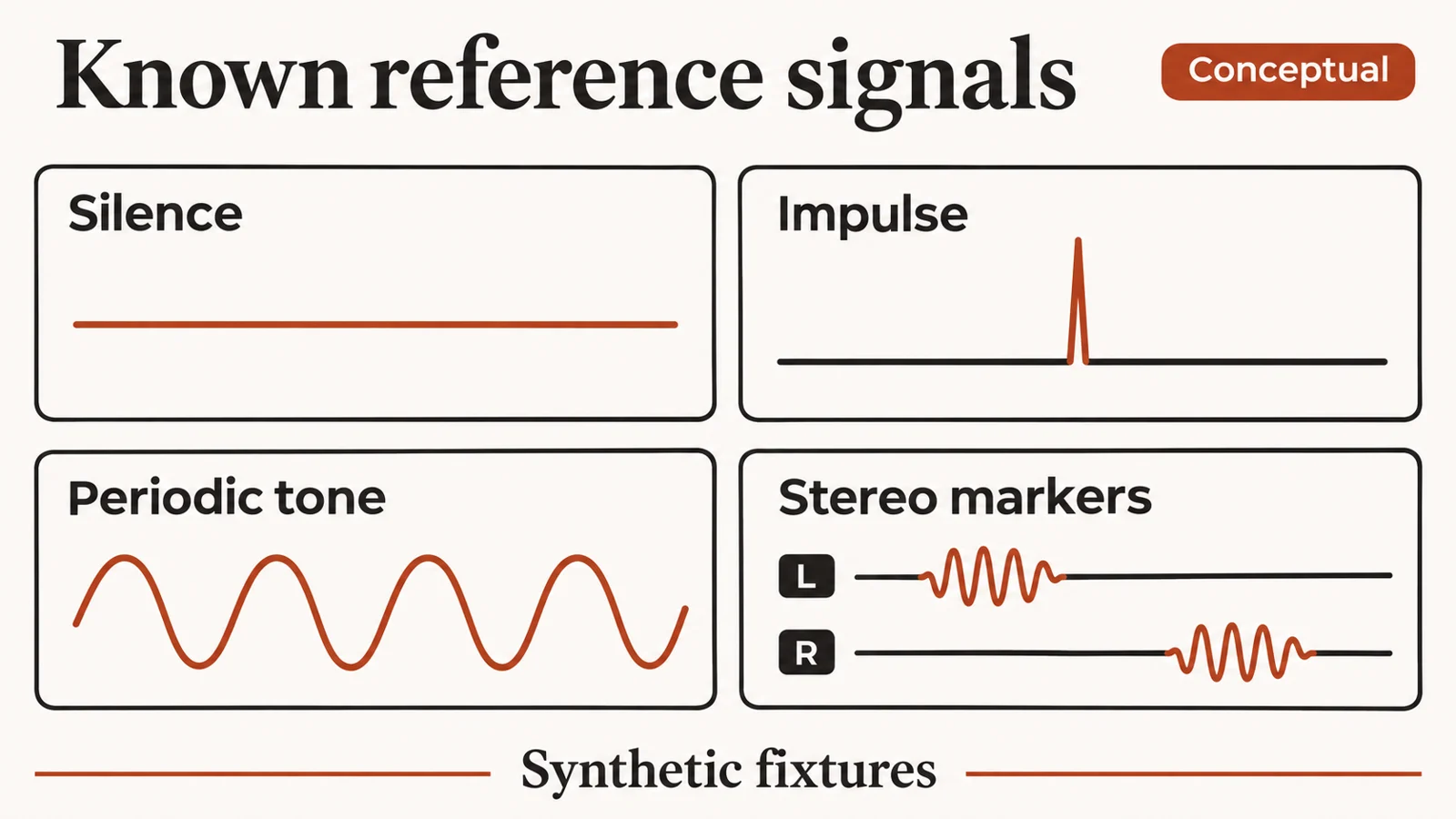
A periodic tone can reveal that a header relabeling changed its apparent frequency. A short impulse can reveal alignment and filter delay. Neither establishes that a transformed voice remains natural or recognizable to listeners.
A silence fixture reveals unintended nonzero output or unexpected timing material. A stereo marker fixture reveals channel swaps. Together these references help separate format errors from the subjective effects of speaking faster.
Compare transforms under an explicit level policy. A louder output can be preferred for reasons unrelated to pace or identity. If level normalization is applied, retain its parameters and both raw and normalized artifacts so another engineer can inspect its effect.
Do not summarize every effect as a single quality score. Keep duration accuracy, pitch behavior, intelligibility, naturalness, and task success in separate columns. A change can improve one and worsen another without being inconsistent.
In the following criteria table, ✓ means the operation directly targets the stated property under a suitable implementation. ✗ means it does not provide that property. These are design distinctions rather than empirical product rankings.
| Intended property | Synthesis rate control | Proper resampling | Playback speed change | Pitch-preserving time stretch |
|---|---|---|---|---|
| Generate a different linguistic delivery | ✓ Voice-dependent | ✗ Existing signal | ✗ Existing signal | ✗ Existing signal |
| Convert sample grid at similar duration | ✗ Not its contract | ✓ With rounding and delay stated | ✗ Changes consumption speed | ✗ Different goal |
| Shorten existing audio duration | ✗ Requires new generation | ✗ Preserves duration | ✓ Pitch behavior depends on path | ✓ With quality trade-offs |
| Guarantee critical-value comprehension | ✗ Listening required | ✗ Listening required | ✗ Listening required | ✗ Listening required |
| Avoid all added buffering | ✗ Provider-dependent | ✗ Processor-dependent | ✗ Player-dependent | ✗ Processor-dependent |
The HTML media playbackRate reference describes a different playback surface, including pitch correction behavior and supported-range considerations. Test the actual interface rather than transferring assumptions from a similarly named property.
A browser test should record browser version, operating system, output route, context rate, source format, and chosen control. An API-level stub can verify that a parameter was passed; it cannot establish the resulting acoustic behavior.
For comparison reports, preserve failed and unavailable observations. If a platform rejects a requested rate, record unsupported. If output capture fails, record unmeasured. Counting either as a successful zero-error trial biases the conclusion.
Retest streaming boundaries and cancellation
A duration transform changes the relationship between text, source media positions, and output positions. Word highlighting, interruption repair, and playback acknowledgments must use the correct coordinate after that transform.
If alignment arrives in source time, define how it maps to output time. A constant playback ratio offers simple arithmetic only while the ratio remains constant and no extra pauses or dropped regions are inserted. Variable-rate processing requires a richer mapping or a narrower UI promise.
The playback evidence guide explains why local acceptance does not establish what reached the endpoint. A timestamp transform cannot promote weak evidence into stronger evidence merely by giving it more decimal places.
Rate changes during a response need an explicit application policy. Apply a new setting to a future synthesis unit, regenerate unsent content, or use a tested continuous processor. Mutating a shared rate field while old chunks are still queued creates mixed assumptions inside one apparent utterance.
A practical adapter binds each chunk to a generation, format, and transform revision. Late output from an old revision should be rejected before local submission. Changing the rate should not resurrect a canceled generation or restore a superseded confirmation.
The interruption repair guide shows why the amount already heard matters. A faster transformed output can invalidate a repair estimate derived from source timestamps if the application never mapped the positions.
For a streaming resampler, preserve processor state across transport chunks belonging to one continuous signal. Resetting filter state at every chunk can add repeated edges. Reset only at a declared stream boundary and test the onset and tail behavior that reset creates.
A final flush must be documented. Some processors hold delayed output that needs draining; others require explicit end-of-input. Treating an empty queue as completed processing can clip a tail even when every input frame was accepted.
Cancellation may intentionally discard held output. That is different from successful drain. The terminal result should preserve why audio stopped so the conversation controller can decide whether a spoken repair or retry is appropriate.
The shutdown contract provides a useful vocabulary for terminal states. Apply it to the processor and the writer separately rather than treating a successful transform return as a completed utterance.
After awaiting output capacity, recheck active generation, transform revision, age, and the output clear barrier. Check generation first so an obsolete chunk cannot expire or clear the newer response. Any later asynchronous boundary requires another admission check.
The script above does not implement those lifecycle rules. They belong in the integrated adapter harness. Keeping that limitation explicit makes its arithmetic proof useful instead of inviting a false claim that the offline example is a production streaming engine.
Evaluate pace on critical speech
A faster voice can shorten a reply while increasing the number of requested repetitions. Measure the user task as well as the sound. For a critical field, ask the listener to identify or restate the value before collecting a general preference.
Use paired trials drawn from the same text and source configuration. Randomize presentation order, blind variant names where practical, and include an uncertain response. Preserve participant and item identities in restricted study records so the analysis can account for repeated observations without publishing personal data.
ITU-T P.800 is a public methodological reference for subjective transmission-quality evaluation. A small engineering listening test can borrow the discipline of controlled conditions without claiming compliance with a standard it has not fully implemented.
Include brief confirmations, longer explanations, spelled strings, numbers with similar-sounding forms, and opportunities for interruption. Choose synthetic content that cannot be mistaken for a real account or instruction. Test the languages and devices the application actually supports.
The short-versus-long voice corpus helps separate an apparent identity change from a change in content length. Use the same rate operation in each matched condition so the comparison has a clear cause.
Do not set a universal words-per-minute target from one speaker or one language. Written tokens, spoken words, syllables, and semantic difficulty are different quantities. A rate setting that feels comfortable for an explanatory sentence can be too fast for a code or unfamiliar name.
A historical playback-speed discussion asks about sample-rate changes and pitch. Its engineering concern remains useful; its platform suggestions need current verification before use. Treat community questions as requirements evidence, not a current API contract.
Inspect failures by field type. If dates become harder to distinguish but simple acknowledgments remain acceptable, adjust the policy around dates rather than slowing every utterance. A local, tested speech-unit rule is easier to reason about than a global compensating change.
Separate listening preference from action safety. A confident, fast confirmation can sound polished while leaving the caller unsure about one digit. Business authorization still needs the explicit confirmation policy described in the workflow enforcement guide.
Record the limits of the study before reviewing results. Device coverage, listener language familiarity, and the selected phrases constrain the conclusion. An untested telephone path remains untested even if a browser headphone test passes.
A paired comparison should preserve the same source text and intended business meaning. If a faster variant also rewrites the sentence, an improvement in comprehension could come from simpler wording rather than pace. Run a separate text experiment when that is the desired change, and keep the rate comparison tied to one representation.
Use counterbalancing when a participant hears several related items. Hearing the slow version first can teach the value and make the fast version seem easier. Different synthetic values with comparable difficulty can reduce memorization, while a recorded assignment map keeps the variants balanced and reproducible.
Choose the response method with care. Typing a heard field introduces keyboard and literacy demands, while spoken restatement introduces recognition and transcription demands. Record which response boundary you score and inspect uncertain cases manually rather than treating an automatic transcript as unquestionable ground truth.
A preference question can follow the content task, but it should remain a separate outcome. A participant may prefer a faster delivery even when it causes more field errors. The product decision then needs an explicit trade-off rather than an average that merges the two outcomes into an attractive number.
For multilingual studies, define acceptable restatements before testing. Equivalent spoken forms can differ in grouping, number naming, and grammatical agreement. The scoring rubric should preserve semantic equivalence where the task permits it and demand exact character order where the field is an identifier.
The absence of a reported error is weak evidence when participants can guess from context. Include deliberately confusable values and a genuine uncertain option. Keep the fixture synthetic so the test never asks a participant to authorize a real operation or expose a personal field.
Record a reproducible rollout decision
The decision record should name the requested operation, expected invariant, source format, target format, processor version, rate setting, and output route. Include the reference fixture identities and the commands that created them.
Retain raw observations before calculating summary statistics. Store source and output frame counts, receiver identities, elapsed timestamps with clock domains, and explicit missing values. A summary duration without those inputs cannot be independently recomputed.
For listening, retain the randomization seed, item set, response rubric, exclusions, and aggregate result boundaries. Do not invent preference percentages while the study remains a plan. A completed deterministic harness and an unrun listening study are two separate statuses.
Choose a rollback trigger tied to observable failure. Format rejection, alignment drift, late chunk rejection, and critical-field confusion require different responses. A generic complaint rate can help prioritize investigation, but it is too broad to identify which transform to undo.
Use an existing release mechanism rather than adding a new configuration system for one rate change. Version the selected policy and keep the previous value available through the same mechanism. The regression test method helps preserve the exact negative cases across versions.
A rollout should also test mixed workloads. One long transformed reply must not exhaust the output queue while short confirmations wait. The admission-control policy handles capacity, while the rate experiment supplies the actual media-duration assumptions needed for planning.
Verify cancellation under the slower and faster settings. A transform with more buffered state can make stop behavior worse even if its steady-state audio sounds good. Measure the appropriate local stop boundary separately from endpoint playback evidence.
For 60db Agent, evaluate public behavior at the documented interface. Ask which rate operation is supported and what evidence identifies output format and completion. No public claim about a control requires guessing the private processor or synthesis architecture behind it.
A final report can be concise: timing fixtures passed under the specified formats; one adapter path passed cancellation tests; listening on specified devices remains pending or passed under the recorded protocol. Precision about scope is more useful than an unqualified claim of faster, better speech.
Repeatability needs an environment record as well as a script. Record the processor build, operating system, source decoder, source format, output context, and any automatic platform pitch correction. If a dependency changes between trials, treat that as a new condition instead of assuming the rate parameter alone explains the difference.
For a streaming run, keep the transport fragmentation pattern. A processor that passes an offline whole-buffer test can fail when state is reset across tiny fragments. Replay identical source frames with several legal delivery patterns and compare the final output against the processor's stated streaming contract, including delayed tail handling.
Separate resource measurements from signal measurements. CPU time, allocation volume, queue age, and underruns describe operating cost. They do not establish that speech remained intelligible, and a good listening result does not show that the processor can meet the target concurrency under bursty arrivals.
A bounded operational test can use one synthetic signal per active stream and a deterministic interleaving schedule. Check that each output remains attached to its source identity and configuration revision. This catches accidental shared transform state without requiring real calls or publishing a vendor-specific internal design.
If output timestamps become fractional, retain the supported precision. Do not round each timestamp to whole milliseconds before computing alignment. Preserve a rational frame coordinate or the original timestamp representation until the boundary where the consuming interface imposes its documented precision.
For failure analysis, distinguish unsupported operation, invalid input, interrupted processing, and missing capture. Each requires a different remedy. An unsupported downsample request should not silently fall back to relabeling, and a failed microphone recording should not become a successful no-artifact observation in the report.
Finally, verify the rollback against the same fixture. Returning to an earlier rate value may leave queued transformed audio in flight. The application needs its normal generation invalidation and clear-barrier procedure so the previous policy applies to new work without replaying stale output from the abandoned experiment.
A real-time rate change also needs a response to insufficient capacity. A pitch-preserving processor can require a working window before it emits output, while a direct playback control can act at another boundary. Record startup and steady-state behavior separately rather than assuming one duration measurement describes the whole lifecycle.
Use the audio chunk sizing method to inspect how much media accumulates before the next stage can act. The mobile browser latency guide adds route and lifecycle conditions that an offline reference cannot cover. Neither source supplies a universal buffer size for every rate transform.
When the caller changes a preference, decide which future speech unit receives it. Announce or apply the change under the existing interaction policy, then invalidate only the work the policy supersedes. A global player-rate assignment can affect audio already queued for a different utterance, so its ownership needs the same scrutiny as the synthesis request.
Do not repair an alignment mismatch by stretching the transcript display until it looks plausible. Preserve the source alignment and the transform map, then calculate the displayed coordinate from those values. If a reliable map is unavailable, a coarser progress indicator is more honest than highlighting a specific word that the evidence cannot locate.
For operating-cost planning, use the measured transformed duration rather than the unmodified text length as the media workload. The warm-capacity worksheet helps identify the startup boundary, while the bursty arrival test supplies a separate concurrency experiment. Neither should turn an arithmetic signal fixture into an unrun throughput claim.
A final handoff should state which processor state persists across chunks and which event flushes or discards it. Include the last input frame and the last expected output frame in the synthetic reproduction. This makes a tail-loss regression observable without requiring the reviewer to infer it from a vague report that the new pace sounded abrupt.
Frequently asked questions
Is speaking rate the same as sample rate?
No. Speaking rate concerns how quickly speech content is delivered. Sample rate defines the number of audio frames representing a second under a format contract. Changing the sample-rate label without resampling changes the interpretation of the existing waveform, including its duration and pitch.
Why did the voice become higher when I increased speed?
The playback path may be consuming the waveform faster without pitch preservation. Test the exact interface and setting with a periodic reference, then listen to speech. A synthesis-rate control or evaluated time-stretch processor is a different operation with different quality trade-offs.
Does sending audio chunks faster make the agent speak faster?
It makes data available sooner to the receiver. The output media clock still determines how quickly samples play. If the scheduler queues every arrival, faster delivery can increase buffered audio rather than shorten spoken duration, making cancellation less responsive.
What is the correct PCM duration formula?
Divide frame count by the declared frames-per-second sample rate. For interleaved stereo, count each left-right pair as one frame. Preserve the original count and rate in the report so another engineer can reproduce the derived duration and inspect the channel assumption.
Can I resample by changing a WAV header?
That relabels the existing samples and changes their interpreted duration. Proper resampling creates a new sample grid. Use a processor suited to the format and conversion ratio, record its delay and rounding policy, and verify both timing and signal behavior.
Why does the reference reject downsampling?
It has no anti-alias filter. Returning the desired frame count would not prove a correct downsampled signal. The refusal keeps the example's timing and interpolation scope honest; a production conversion should use an evaluated resampler with appropriate filtering and stream state.
Is linear interpolation good enough for production speech?
This article does not establish that. The reference makes frame arithmetic and boundary policy inspectable. Evaluate a production processor using known signals, listening tasks, target devices, and the supported ratio range before claiming speech quality or perceptual transparency.
Why keep rational frame offsets in the schedule?
They avoid cumulative error from repeatedly adding rounded chunk durations. Retain integer frame positions and convert at the scheduling boundary. This preserves the media relationship even when transport callbacks arrive irregularly or several chunks are received together.
What happens when the output device uses another rate?
The platform may perform another conversion. Record the source, processing, and output context rates instead of assuming they match. Test the actual route because a correct offline file does not establish browser, driver, or device behavior.
Does faster synthesis preserve word alignment timestamps?
Only according to the provider's documented alignment contract and the actual generated output. If alignment refers to source audio that is later transformed, map it to output coordinates or narrow the UI promise. Do not reuse source timestamps unchanged after altering duration.
Can I change rate halfway through a response?
Define whether the new setting applies to future synthesis units, unsent content, or a continuous transform. Bind chunks to a revision and reject obsolete output. Test the boundary for discontinuities, mixed timing assumptions, and cancellation before allowing dynamic changes.
Why test silence and impulses when the product speaks words?
Known signals isolate timing, channel, and processing behavior without linguistic ambiguity. They cannot establish intelligibility, so add speech trials afterward. A silence fixture or impulse alignment failure can identify an adapter defect before an expensive listening study begins.
Does a shorter file mean lower conversational latency?
It means a shorter media interval under the declared rate. Startup delay, buffering, transport, and output scheduling still affect when the caller hears the reply. Measure the conversational boundary separately and preserve the conditions used in the comparison.
Should all fields use the same pace?
Use evidence from the intended task. Acknowledgments and critical values impose different comprehension demands. If one field type fails at a selected pace, a tested local policy can address it without changing every utterance or claiming a universal speaking-speed target.
Can SSML guarantee an exact words-per-minute rate?
Do not assume that from a relative rate request. Voice, language, content, and provider support affect the generated performance. Measure output duration and task comprehension under the specific settings, and document the control as a request rather than an exact timing guarantee.
How should a transform report cancellation?
As a terminal disposition distinct from successful drain. Held output may be discarded intentionally, and late callbacks must remain rejected. Keep processor completion and local writer completion separate so a successful transform cannot falsely mark the whole utterance as delivered.
What should I retain for timing reproduction?
Keep source and output frame counts, sample rates, channels, transform settings, rounding policy, receiver identity, and timestamps with clock domains. Preserve raw zero values and mark unavailable values explicitly. Derived seconds alone are insufficient to diagnose resets or incorrect denominators.
Can an offline harness prove mobile speaker quality?
No. It verifies the logic and fixtures executed offline. Mobile output adds platform processing, route changes, and device behavior. Test that path separately with authorized captures and listening conditions before making a claim about its quality.
How do I compare short and long replies fairly?
Use matched text families, the same voice configuration, the same rate operation, and controlled output conditions. Keep identity, intelligibility, level, cadence, and task comprehension separate. A single preference score can conceal a long-response failure that never appears in a short acknowledgment.
What should I change first?
Name the operation and invariant, then test the smallest path that supplies it. Use synthesis control for a new delivery, proper resampling for a new sample grid, and evaluated playback or time processing for existing audio. Preserve a negative fixture for the mistake you are preventing.
Change one control with a clear invariant
Write the intended change before touching a rate parameter. Preserve duration when converting the sample grid, preserve the correct clock mapping when changing playback, and evaluate speech delivery when requesting a new synthesis pace.
Run the synthetic reference experiment, then repeat the adapter and cancellation tests at the selected setting. Keep acoustic quality and listening results separate from the arithmetic proof. A well-scoped passing harness is useful precisely because it does not pretend to establish every property of speech.
Take one critical confirmation through the selected operation and ask a qualified listener to identify its value. Keep the original frames and settings with the result. That evidence turns a vague request for faster speech into a change another engineer can reproduce and a caller can use.