
- Benchmarks
Tamil-English names across scripts and transliterations
Separate Tamil text normalization, transliteration, and entity identity with a scoped alias registry and collision tests.
- Author
 Udit Goenka
- Editorial date
- Reading time
- 25 min
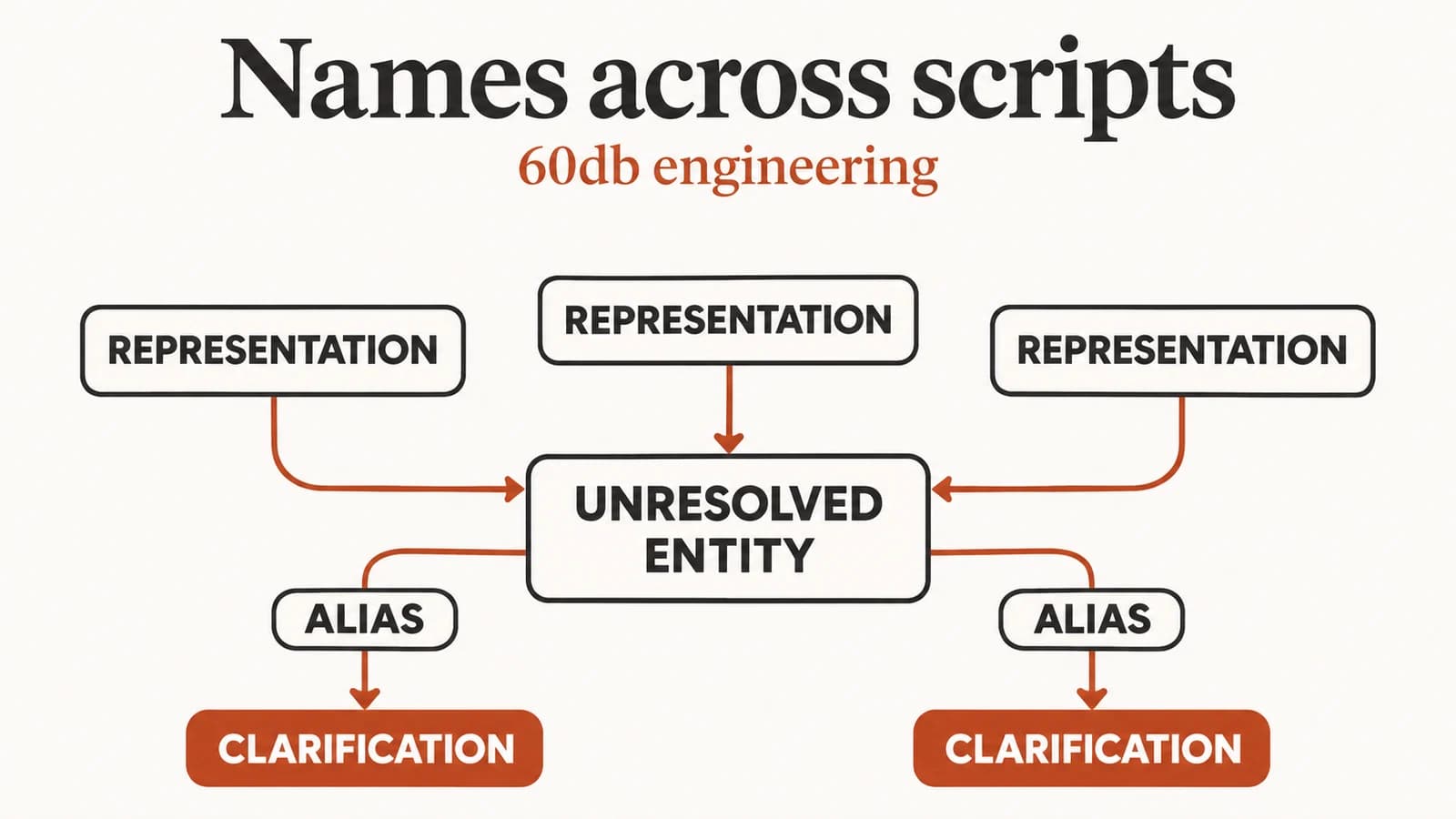
TL;DR: Preserve raw text, apply an explicit Unicode policy, and resolve reviewed aliases inside a versioned scope. Canonical text equivalence does not establish name identity, and a transliteration collision must trigger clarification rather than merge people or authorize an action.
A caller gives a name, the transcript uses a different script from the contact list, and a search returns an apparently close match. The dangerous step is treating visual or phonetic similarity as sufficient evidence that the selected record is the intended person.
Begin with a resolver that returns a candidate set and preserves uncertainty. A unique candidate can support a confirmation question; an ambiguous alias requires another discriminating fact. The multilingual benchmark framework separates transcript representation from verified task outcomes, which is the boundary needed here.
The Unicode Tamil FAQ documents encoding and normalization details, including canonically equivalent representations. Those are text properties. The document does not certify that differently spelled personal names refer to one entity or that a particular romanization preserves a caller's intended identity.
This guide provides a standard-library synthetic alias registry and negative fixtures. It performs no speech recognition, phonetic inference, or Tamil name-accuracy measurement for 60db Agent. Its useful guarantee is narrower: an admitted alias collision remains visible, scoped, and reproducible.
Table of contents
- Separate representation from entity identity
- Normalize text under an explicit policy
- Review transliterations and pronunciation variants
- Build an immutable scoped alias registry
- Confirm a candidate without granting authority
- Evaluate name tasks with honest boundaries
- Debug and revise the registry safely
- Frequently asked questions
- Make ambiguity an explicit result
Separate representation from entity identity
A text representation is a sequence encoded according to a character standard. An entity identity is an application decision about a particular record under a particular scope. A written name can be associated with several records, and one record can have several reviewed written forms.
A spoken realization is another layer. A recording contains acoustic information that a recognizer or reviewer interprets. A Latin-script transcription, a Tamil-script transcription, and an audio segment are different artifacts; none should silently overwrite the others in an evaluation packet.
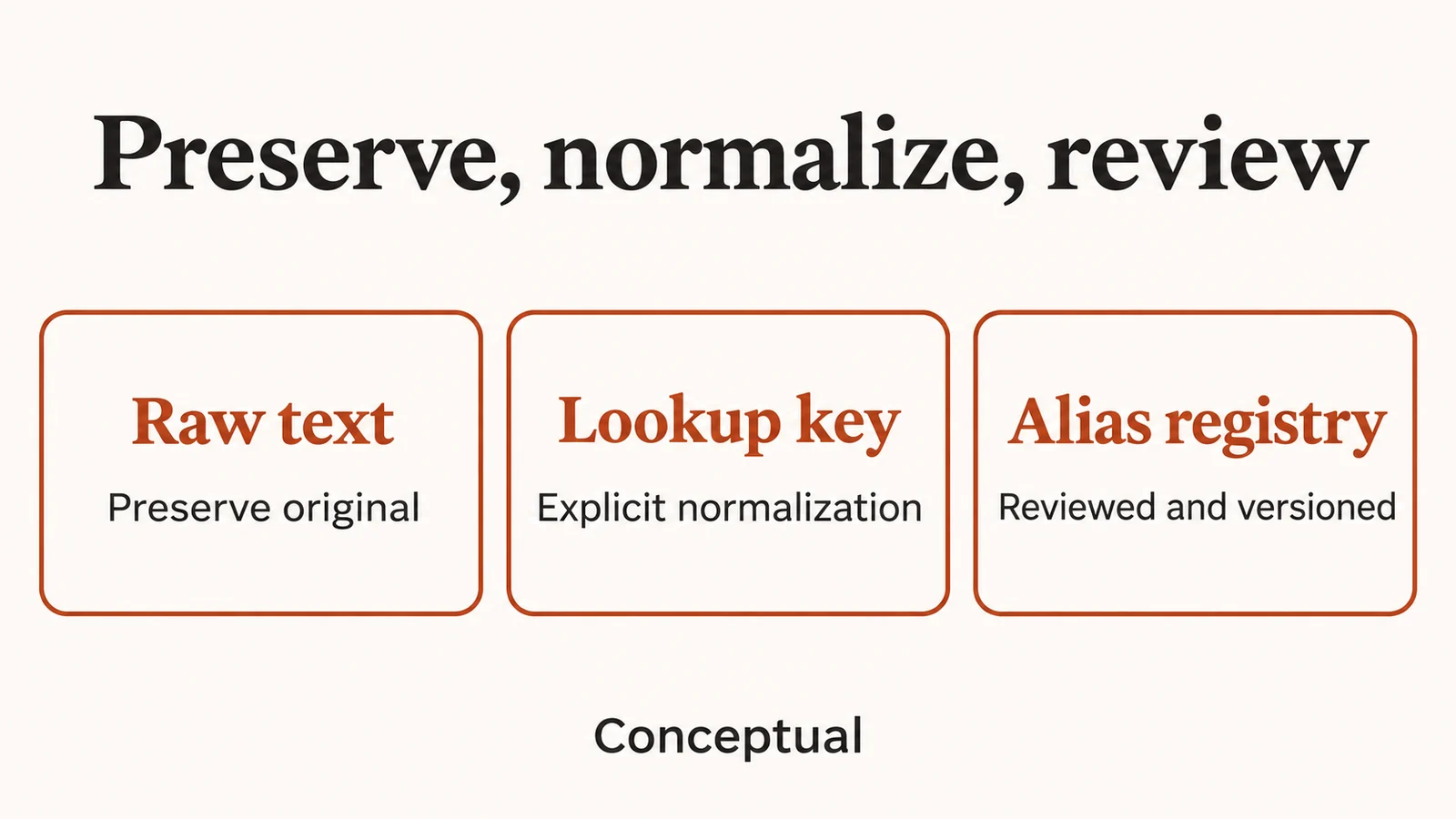
Start your schema with stable synthetic entity IDs and separate alias records. Store the alias text, its source, review status, intended scope, and registry revision. The original display form remains useful even when a derived lookup key makes equivalent encodings easier to find.
The scope matters as much as the spelling. A contact name inside one organization's authorized directory should not search another directory merely because the alias is globally unique in a development database. Call isolation applies to settings and context; directory resolution needs an equally explicit ownership boundary.
Do not combine identity confirmation with authorization. Knowing which record a caller means does not establish that the caller may read or modify it. The shared-phone identity boundary is especially relevant when several people can use the same device or number.
In a synthetic task, define an intended entity ID and the set of permitted clarification facts. If an alias maps to several IDs, the expected behavior can be a clarification question. Calling that result incorrect because the resolver did not guess would reward an unsafe shortcut.
A useful first diagnostic is a collision report. For every admitted lookup key, list how many distinct entity IDs it can resolve to within its scope. Review keys with multiple candidates before adding fuzzy matching, because exact alias ambiguity already reveals a problem the search layer must preserve.
Keep phonetic annotations out of that exact-match claim. A reviewed pronunciation variant may support an alias relation for one synthetic task or consented record, but it cannot become a universal assertion that two name strings are interchangeable. The evidence must stay attached to the source and scope that justified it.
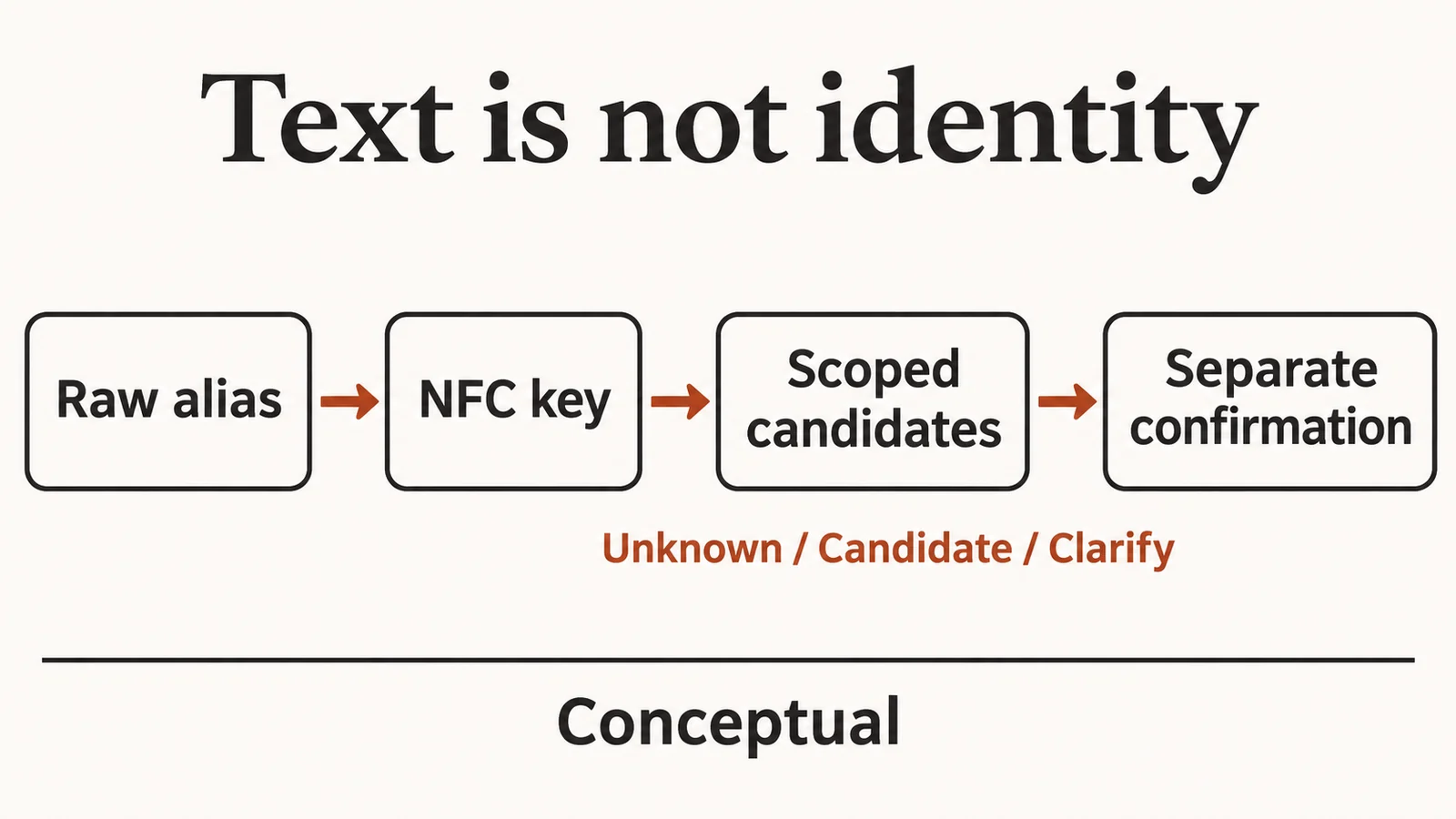
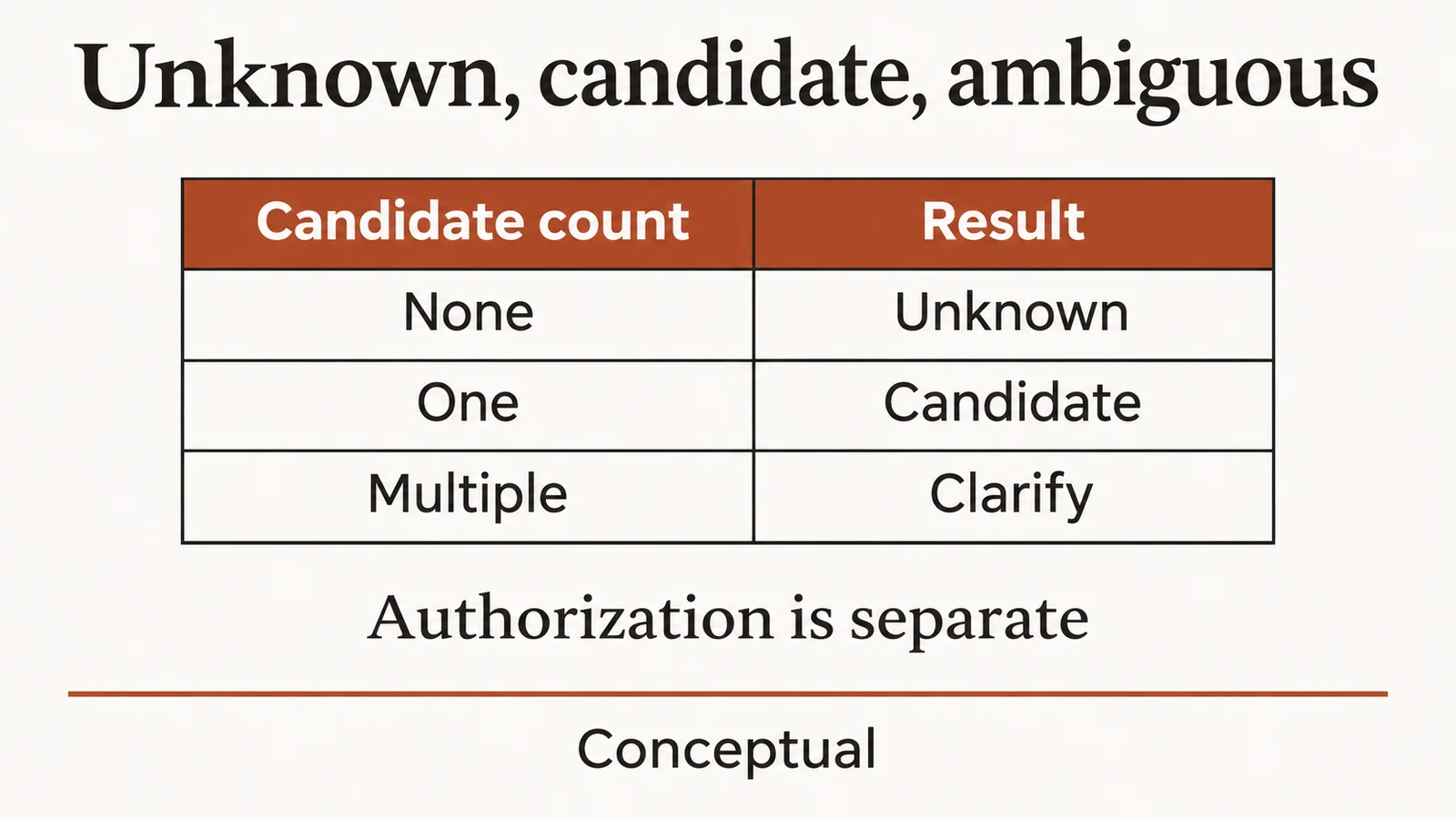
Write a task contract that names the observable behavior you want. A synthetic directory might contain a unique approved alias, an alias shared by two records, and an unknown input. The reference answers are then a unique candidate, clarification, and unknown respectively; there is no requirement that every input produce a selected record.
That task contract also determines what evidence a clarification may request. A public service location might be permissible while a private account attribute is not. The resolver should not invent a question from arbitrary fields returned by search, because candidate generation and disclosure permission have different owners.
Keep name preference separate from record identity. A person can choose a preferred spoken or written form without changing the underlying record key. Update display preferences through the appropriate authorized process and retain the relationship to the stable key, rather than creating another apparent person whenever the presentation changes.
For evaluation, distinguish an entity collision from an annotation disagreement. A collision is an admitted alias mapping to multiple IDs. An annotation disagreement means reviewers have not settled which mapping should be admitted. Both require explicit handling, but they should not enter the same denominator as resolved and reviewed tasks.
The first useful implementation step is therefore a small registry export with provenance, not a larger fuzzy-search threshold. Inspect a few admitted entries end to end, confirm their scopes, and verify that the reviewer can explain why each alias belongs to its entity. That gives later speech experiments a reference boundary they can actually test.
Normalize text under an explicit policy
Normalization changes a text representation under defined rules; it does not identify a person. Unicode Standard Annex 15 distinguishes canonical and compatibility normalization. Choose a form deliberately and record it with the runtime version used to generate lookup keys.
NFC is a useful example policy for canonical-equivalent lookup. Preserve the raw alias and compute an NFC key. Do not apply compatibility folding, punctuation deletion, whitespace collapse, case folding, or diacritic removal as undocumented additions to the same operation.
Those extra transformations can be useful in a particular application, but they change equivalence rules. A removed character can merge aliases that a directory needs to distinguish. Give each transformation a versioned definition and inspect its collision set before allowing it to affect candidate selection.
A real Stack Overflow question about Tamil string length asks why programmatic string length and cursor positions differ. That is a practical reason to distinguish code units, code points, and user-perceived characters. It is not a reason to truncate names until lengths happen to match.
Unicode text segmentation describes grapheme boundaries. A UI can use an appropriate segmentation implementation for selection and truncation, while an identity resolver keeps the full original text. A visible character count should never become an accidental identity key.
Python's unicodedata documentation exposes normalization and the runtime's Unicode database version. Record unicodedata.unidata_version in reproduction packets. A current specification and the deployed runtime can use different database versions, so avoid claiming that reading the newest annex upgrades the running interpreter.
The artifact uses a Tamil syllable solely as a mechanical normalization fixture. It does not present that syllable as a personal name or claim that a speaker uses it. The fixture verifies canonical-equivalent lookup under the installed runtime, which is a property the program can actually test.
Normalization should occur on owned values. If an approved alias registry retains a caller's mutable list, later edits can change lookup behavior without a registry revision. Freeze supported leaves and collections when admitting a version, and test mutation of both the outer collection and its nested items.
The table describes permitted conclusions under this guide's contract. A check indicates evidence sufficient for that narrow property; a cross indicates a separate proof is required.
| Operation or evidence | Canonical text lookup | Reviewed alias relation | Confirmed entity or authority |
|---|---|---|---|
| NFC transform under recorded runtime | ✓ For canonical equivalence | ✗ No alias review | ✗ No identity approval |
| Automatic transliteration output | ✗ Separate transformation | ✗ Requires review | ✗ No confirmation |
| Reviewed scoped alias entry | ✓ With declared key policy | ✓ Within recorded scope | ✗ Candidate only |
| Current candidate confirmation | ✗ Not a text operation | ✓ For selected candidate | ✓ Identity selection only; separate authority required |
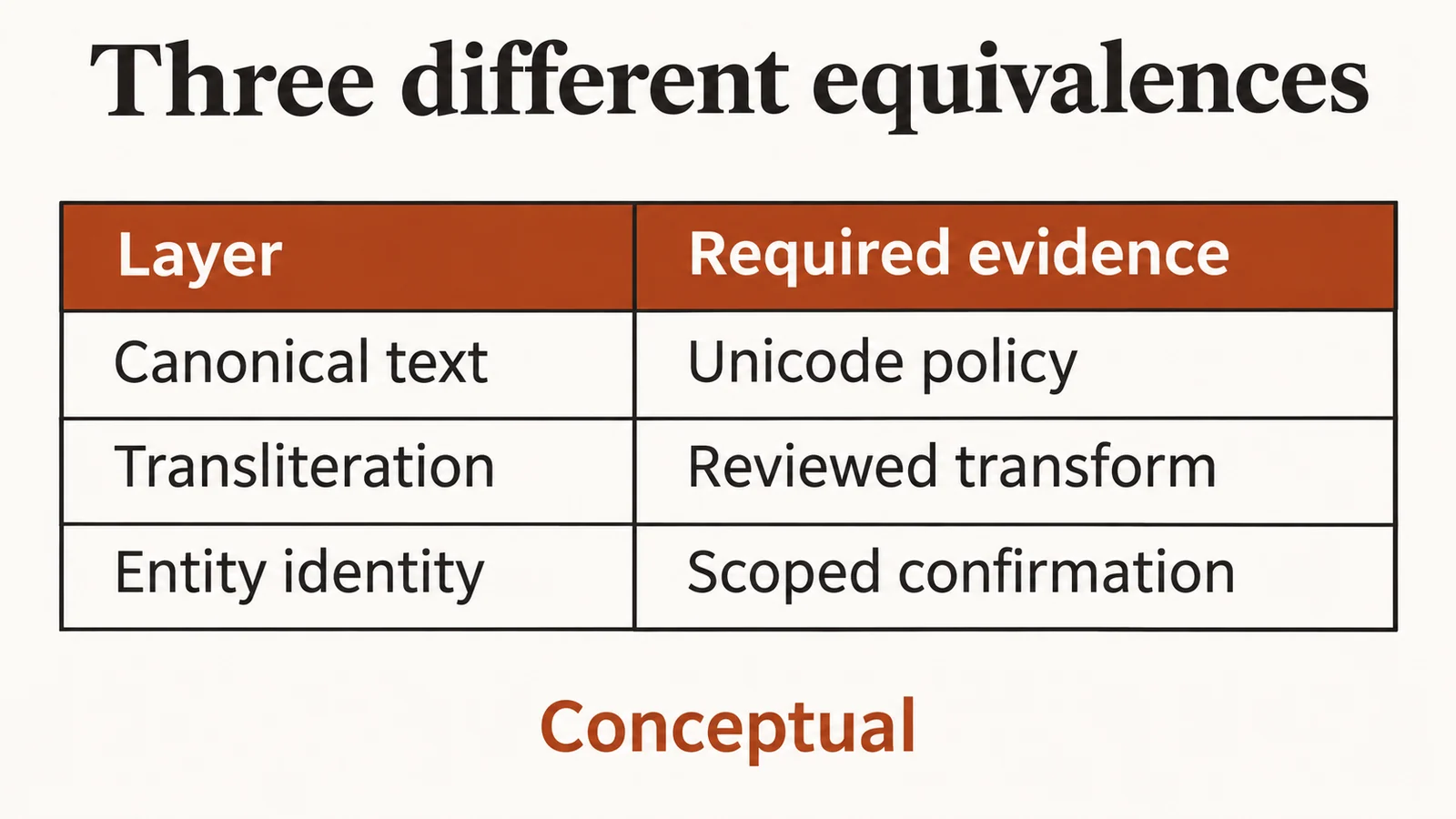
Test the normalization policy with distinct kinds of examples. Canonical-equivalent encodings should share a lookup key. A visually similar but distinct string should remain distinct unless an explicit reviewed alias connects it. An unknown alias should stay unknown even when a nearby dictionary entry looks plausible to a human reviewer.
Avoid using screenshots as the only evidence for text behavior. Fonts and shaping can make different encoded sequences appear similar, or make a valid sequence difficult to inspect. Preserve code points and the original encoded text in controlled diagnostic records so another engineer can recompute the exact transform.
Also preserve the encoding boundary around external systems. A database column, JSON serializer, browser input method and search index can apply different transforms. Check that an exported alias returns with the same raw value when the contract promises preservation, and identify any adapter that deliberately changes it.
If a search service performs its own folding, keep its candidate-generation result separate from the exact registry resolver. The service can propose a broader set for review while the scoped registry establishes which reviewed aliases currently support each entity. This avoids silently treating a search index upgrade as a change in approved identity evidence.
Record equality rules in the corpus documentation. A reviewer should know whether whitespace, punctuation, case and normalization are significant in each field. A single global string-cleaning function is easy to reuse and difficult to justify when it controls both display formatting and identity decisions.
Review transliterations and pronunciation variants
Transliteration changes a written representation between scripts under a specified transform. It is not automatically reversible. The Unicode CLDR transliteration guidelines discuss transform design, while ICU's transform documentation explains that inverse behavior depends on the transform and may not be available.
Keep the transform identity and direction when using a transliteration tool. A round trip can be informative for that transform, but a string that round-trips is not proof of personal identity. Conversely, a lossy transform can produce a useful display alias without supporting an automatic merge.
The Keypunch Tamil input request is a concrete developer discussion about script input and transliteration-based entry. It demonstrates a real representation need. It does not supply a validated pronunciation lexicon or recognition benchmark.
For personal-name tasks, establish alias relationships through an appropriate review process. A record owner or authorized data steward can supply a preferred form and permitted alternatives. Keep that evidence separate from a model-generated suggestion awaiting review.
Pronunciation variation needs its own annotation boundary. A reviewer can label two consented recordings as intended to identify the same synthetic task entity, while also recording that the spoken forms differ. Do not infer that every acoustically similar name is an alias or that every variation belongs to an accent category.
A phonetic feature extractor can generate candidates, but its output should remain candidate evidence. Adding a numeric similarity score does not resolve two people who share similar names. Preserve multiple candidates and request a discriminating authorized fact instead of treating a threshold as permission to choose.
This is where spoken confirmation design helps. A confirmation should make the discriminating value easy to understand without exposing unrelated directory details. If the distinction cannot be spoken safely, route to an approved alternative confirmation method.
Do not invent Tamil phrases merely to make the benchmark look multilingual. A synthetic corpus can begin with language-neutral alias tokens to test registry logic, then add reviewed script examples as a separately versioned layer. A qualified language review is needed before using natural-language examples as ground truth.
The same separation applies to generated audio. A synthetic voice saying a name is a test input, not evidence of how a population pronounces it. Record the synthesis configuration and preserve its status as synthetic when reporting results.
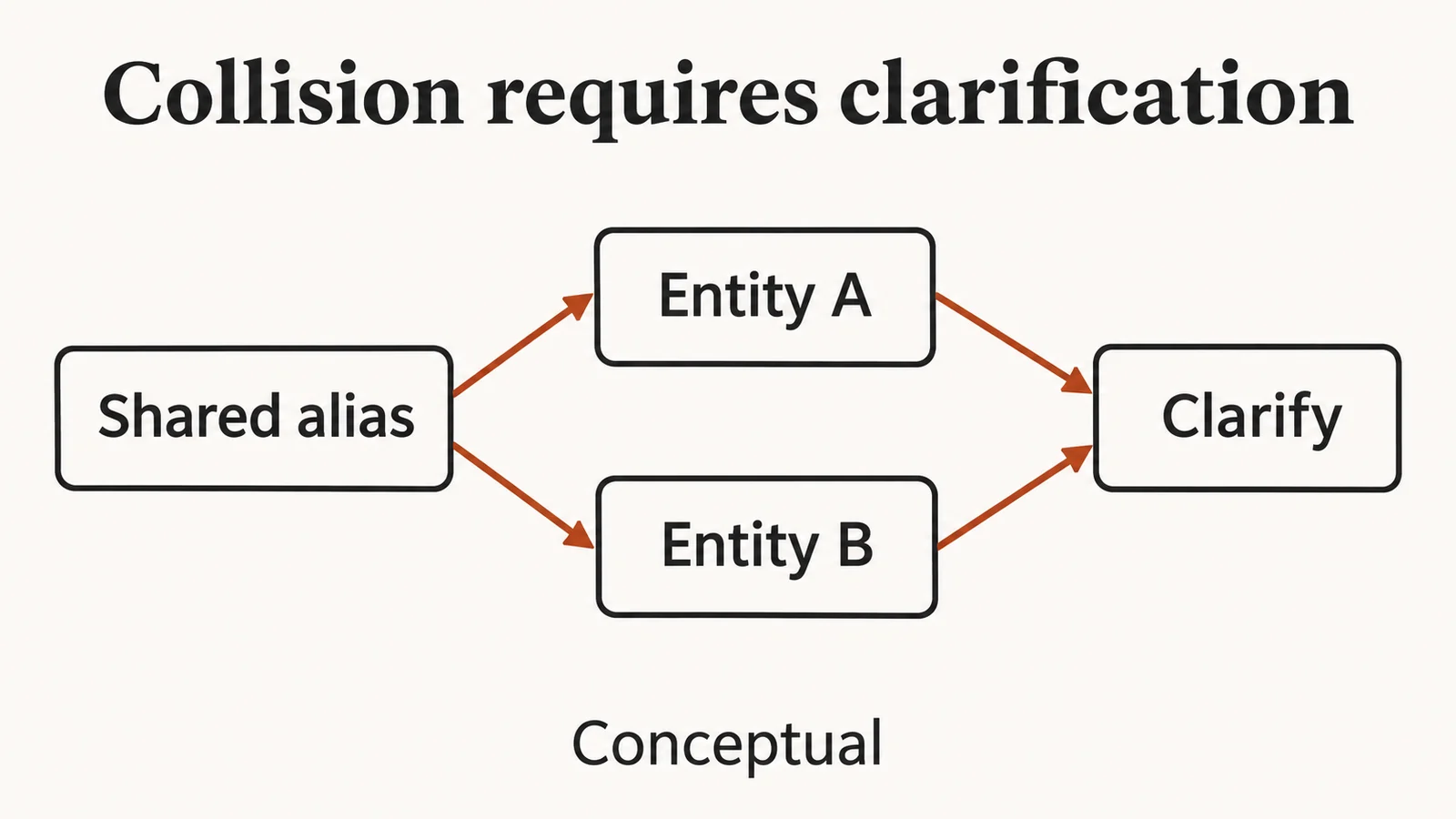
A review queue should show the proposed alias, intended entity, scope, source evidence and collisions created by admission. The reviewer needs to see competing entries before approving the change. Hiding collisions until after publication turns a review decision into an unplanned production ambiguity.
Treat phonetic suggestions as a different queue from text-normalization fixes. A normalization fix can often be verified mechanically against a standard. A proposed pronunciation relation needs qualified review of the actual authorized recording and task context. Keeping separate reasons makes the audit trail understandable without inventing a shared confidence scale.
When a reviewer cannot distinguish two entities from the permitted evidence, retain that unresolved state. Do not ask the reviewer to manufacture a preferred spelling that makes the benchmark easier. A benchmark can include successful clarification as its correct outcome and still measure useful behavior.
For a synthetic speech experiment, retain the text prompt, synthesis configuration, generated audio digest and intended entity independently. A generated voice can change pronunciation as configuration changes, so the original prompt alone does not identify the actual sound presented to the recognizer. The exact recording is the input artifact.
Avoid generalizing a result from one generated pronunciation to a language community. The experiment can show how a configured system handled that synthetic recording under its review rubric. Any broader pronunciation or accent claim requires a different sampling and evidence plan that includes real consented speakers and qualified annotation.
Build an immutable scoped alias registry
The reference implementation accepts synthetic entity IDs and reviewed aliases. It performs NFC lookup, returns the full candidate set, and binds each resolution to a scope, positive revision, and content fingerprint. It does not perform transliteration, phonetic matching, authentication, or external writes.
The input trust boundary is explicit. A trusted adapter supplies the scope and reviewed entries. The program can freeze and validate that metadata; it cannot prove that a human review occurred or that the directory represents the caller's intended real person.
Save the complete fence as scoped_aliases.py and run it with Python 3.11 or newer. All entity identifiers and alias strings are synthetic. The Tamil code-point sequence is a normalization-only fixture taken from the kind of canonical-equivalence distinction documented by Unicode.
from dataclasses import dataclass, FrozenInstanceError
from hashlib import sha256
import json
import unicodedata as ud

def text(value):
    if type(value) is not str or not value or value.isspace():
        raise ValueError("nonempty string required")
    return value

@dataclass(frozen=True)
class Registry:
    scope: str
    revision: int
    entries: tuple

    def __post_init__(self):
        text(self.scope)
        if type(self.revision) is not int or self.revision < 1:
            raise ValueError("positive integer revision required")
        owned = []
        for row in self.entries:
            if type(row) not in (tuple, list) or len(row) != 2:
                raise ValueError("entity and raw alias required")
            entity, raw = (text(v) for v in row)
            owned.append((entity, raw))
        object.__setattr__(self, "entries", tuple(sorted(set(owned))))

    @property
    def fingerprint(self):
        raw = json.dumps((self.scope, self.revision, self.entries,
                          "NFC", ud.unidata_version), ensure_ascii=True)
        return sha256(raw.encode()).hexdigest()

@dataclass(frozen=True)
class Resolution:
    scope: str
    revision: int
    fingerprint: str
    raw: str
    key: str
    candidates: tuple

    @property
    def state(self):
        return ("unknown" if not self.candidates else
                "candidate" if len(self.candidates) == 1 else "clarify")

def resolve(registry, scope, raw):
    if text(scope) != registry.scope:
        raise ValueError("scope mismatch")
    key = ud.normalize("NFC", text(raw))
    candidates = tuple(sorted({entity for entity, alias in registry.entries
                              if ud.normalize("NFC", alias) == key}))
    return Resolution(scope, registry.revision, registry.fingerprint,
                      raw, key, candidates)

def confirm(current, resolution, selected):
    if resolution.scope != current.scope:
        return "wrong_scope"
    if resolution.revision < current.revision:
        return "stale"
    if resolution.revision != current.revision:
        return "revision_mismatch"
    if resolution.fingerprint != current.fingerprint:
        return "conflicting_revision"
    # Recompute candidates instead of trusting a constructed result object.
    verified = resolve(current, current.scope, resolution.raw)
    if verified != resolution:
        return "invalid_resolution"
    if resolution.state != "candidate":
        return "clarify" if resolution.candidates else "unknown"
    return "identity_selected" if selected == resolution.candidates[0] else "mismatch"

raw = [["entity-A", "alias-a"], ["entity-B", "shared"],
       ["entity-C", "shared"], ["entity-T", "\u0bb9\u0bcb"]]
r = Registry("scope-A", 1, raw)
raw[0][1] = "changed"
raw.clear()
assert resolve(r, "scope-A", "alias-a").candidates == ("entity-A",)
assert resolve(r, "scope-A", "missing").state == "unknown"
assert resolve(r, "scope-A", "shared").state == "clarify"
assert resolve(r, "scope-A", "\u0bb9\u0bc7\u0bbe").candidates == ("entity-T",)
x = resolve(r, "scope-A", "alias-a")
assert x.raw == "alias-a"
assert confirm(r, x, "entity-A") == "identity_selected"
assert confirm(r, x, "entity-B") == "mismatch"
assert confirm(r, resolve(r, "scope-A", "shared"), "entity-B") == "clarify"
assert confirm(Registry("scope-A", 2, r.entries), x, "entity-A") == "stale"
assert confirm(Registry("scope-A", 1, [("entity-Z", "alias-a")]),
               x, "entity-A") == "conflicting_revision"
assert confirm(Registry("scope-B", 1, r.entries), x, "entity-A") == "wrong_scope"
for action in (lambda: resolve(r, "other", "alias-a"),
               lambda: resolve(r, "scope-A", ""),
               lambda: Registry("scope-A", True, []),
               lambda: Registry("scope-A", 1, [["entity", []]])):
    try:
        action()
    except ValueError:
        pass
    else:
        raise AssertionError("invalid input accepted")
try:
    r.entries = ()
except FrozenInstanceError:
    pass
else:
    raise AssertionError("registry rebinding accepted")
assert Registry("scope-A", 1, []).entries == ()
assert resolve(Registry("scope-A", 1, []), "scope-A", "alias-a").state == "unknown"
print("Synthetic alias fixtures passed; Unicode database", ud.unidata_version)
The registry constructor copies every accepted entry into an immutable tuple of strings. Mutating the original list, changing a nested alias, or rebinding the frozen registry property cannot change the admitted version. The content fingerprint includes the scope, revision, raw entries, normalization policy, and runtime Unicode database version.
A fingerprint binds a value to this example's declared content; it is not a signature or an identity credential. Persist the original manifest and its access-controlled provenance. If an attacker can replace both manifest and claimed fingerprint, the hash alone does not establish trustworthy review.
The confirmation function recomputes resolution from the current registry, rather than trusting a caller-constructed Resolution. It rejects a lower revision as stale before evaluating same-revision conflicts. A future revision is a mismatch; changed content reusing the current revision is a conflict.
There is no live authorization state or expiration clock in this pure resolver. A production workflow must add its own identity verification, permission checks, cancellation and age rules around external actions. Keep these responsibilities explicit instead of reading identity_selected as permission to mutate a real record.
Confirm a candidate without granting authority
A confirmation should refer to the current candidate and the values the caller is approving. Preserve the registry revision and resolution fingerprint in the proposed task state. If material directory content changes, resolve again and obtain whatever confirmation the task requires.
An ambiguous alias cannot become unique merely because the user says yes to a vague question. Ask for an authorized discriminating value or present a safe alternative route. Avoid reading out private facts about multiple candidates as an improvised way to discover which person the caller meant.
A caller correction is new evidence. If the caller replaces a name spelling or supplies another identifier, update the proposal revision and invalidate approval of the old candidate. The spoken self-correction method prevents earlier partial interpretations from controlling the final action.
Qualified confirmations need the same treatment. A "yes, but" response may reject the discriminating detail that made a candidate unique. Process the repair before accepting the initial affirmative word.
An action adapter that waits on a directory or tool must check current state after the wait. The registry revision, candidate, operation generation, cancellation barrier, and approval age can change while work is outstanding. A previously correct candidate does not stay approved just because its lookup began first.
Cancellation should be terminal for that operation identity. A cached candidate may remain historical diagnostic evidence, but it must not recreate a canceled authorization. The shutdown state boundary offers a related model for distinguishing preserved history from renewed permission.
If a lookup has no aliases, return an explicit unknown result. If a live approval expired, return expired under the workflow contract. Empty directory state and expired permission call for different next actions, so do not encode both as an empty candidate list in the surrounding controller.
For sensitive identifiers, an approved alternative channel can reduce ambiguity. DTMF plus voice capture describes a different input path for sequences. It is still subject to identity, permission, confirmation and outcome checks.
A confirmation controller should own a snapshot of the proposed selection. Keep the raw query, candidate set, registry revision, discriminating values and operation identity together. If one of those material values changes, create a new proposal rather than updating a dictionary that an earlier approval still references.
The next step after selection should use an explicit capability or permission result from the owning authorization layer. Do not overload the resolver's return value with both entity matching and permission. This separation makes a failure trace useful: engineers can see whether the system chose the wrong entity or acted without a valid grant.
If a tool returns after cancellation, preserve the result in restricted history where appropriate and classify it as late evidence. Do not turn it into a new live proposal. A retry can retrieve that historical result for diagnosis without recreating the canceled operation's authority.
This distinction also matters for user-facing language. An agent can say that it found a possible match only after a current lookup supports that statement. It should not announce that a record was updated until the action owner supplies a matching receipt. The truthful waiting-speech boundary provides a related rule for work still in progress.
For scheduling, bind the selected entity to the approved calendar and interval rather than confirming a name in isolation. The Nepali-English scheduling receipt method shows why a correct intermediate field cannot prove that the intended operation completed.
Evaluate name tasks with honest boundaries
Build the test corpus around intended entities and allowed uncertainty. Include unique aliases, collisions, unknown strings, canonical-equivalent encodings, wrong-scope requests, and stale confirmations. A resolver that asks for clarification in an ambiguous task can be behaving correctly.
Separate registry tests from acoustic tests. Registry fixtures begin with text and evaluate deterministic candidate handling. Speech tests begin with authorized audio and require reviewed intended entities plus documented transcription and extraction behavior. Passing the former does not establish the latter.
For acoustic work, document recording format, sample clock, channels, codec, and capture point. A transformed or clipped recording is a different artifact. The streaming audio-boundary checks help detect missing material before you attribute an error to names or pronunciation.
Do not score all phonetic variations as string mismatch. Define the intended task entity independently and retain the reviewed relation between the audio and that identity. At the same time, do not allow a phonetic label to merge distinct named entities that require clarification.
A paired language-policy experiment should use the same name task references for both policies. The Hindi-English policy ledger demonstrates immutable pairing and separate missing states. Its bookkeeping principles apply without implying that language settings solve name resolution.
Use separate measures for candidate coverage, ambiguity preservation, correct clarification, confirmed entity selection, and verified operation completion. The outcome-metrics guide explains why a correct candidate is an intermediate observation rather than an endpoint success.
Review task splits for leakage. An alias registry can leak the expected answer into one policy's context or expose the same speaker in development and evaluation. Keep participant, entity, alias, and recording identities out of every split they are meant to test so the held-out claim stays explicit. Speaker-cohort split validation provides the corresponding corpus boundary.
Publish no Tamil-English recognition ranking from the synthetic program. It validates ownership, normalization lookup, collisions and revision checks. Any report about recognition quality must describe actual recordings, qualified reference review, model configuration, sampling, and the measurement boundary.
An evaluation report needs an explicit task population. Separate deterministic text cases from speech cases, synthetic audio from consented recordings, and unique-alias tasks from ambiguous-alias tasks. Mixing these categories into one percentage can hide whether a resolver improved or the evaluated workload simply became easier.
Preserve failed and unresolved attempts when reporting coverage. If the directory does not contain the intended entity, an unknown result is a coverage observation. If a task reference is disputed, retain it outside the scored reviewed subset and publish the exclusion reason. Neither condition should disappear from the collection ledger.
For repeated speakers or repeated names, record the dependence structure. Several clips of one name do not establish coverage of several distinct entities, and several aliases for one record do not establish coverage of several speakers. Keep entity, alias, clip and participant counts separate so a reader can reconstruct the denominator.
Use controlled minimal pairs only where the review process supports them. Change one declared representation property while keeping the intended task fixed, then inspect whether the system preserves the correct candidate set. Do not invent a natural-language distinction merely because two strings look different in a text editor.
A useful release comparison keeps the same reviewed corpus and adds new negative fixtures for the corrected defect. If a new alias creates another collision, both the desired new match and the newly ambiguous case belong in the regression packet. Improvement on one row should not conceal a lost distinction elsewhere.
Debug and revise the registry safely
When a name task fails, preserve the raw alias and lookup key before changing the registry. Ask whether the error began in audio capture, transcription, normalization, candidate generation, confirmation, or action execution. A single reported name error can hide failures in several owners.
If canonical-equivalent strings produce different lookup behavior, inspect the actual code points and normalization configuration. Keep this diagnostic inside controlled tooling when the strings are personal data. A public screenshot of a name field can expose more information than a synthetic reproducer needs.
If multiple entities share one key, keep the collision visible. Unicode's security guidance addresses confusable characters and identifier concerns, but a confusable check is not a personal-identity oracle. Visual similarity can identify a review need without deciding which record the caller intended.
If a reviewed alias is missing, propose a new registry revision with source evidence and expected collision impact. Test both the intended new match and the negative cases that must remain distinct. Regression fixtures should preserve the ambiguity that originally exposed the defect.
Do not mutate the current registry in place while a confirmation is outstanding. Publish the new revision, invalidate affected proposals, and keep the old revision as historical evidence under the retention policy. A diagnosis queue can be drained without erasing the manifest needed to reproduce an earlier decision.
If an alias was added under the wrong scope, treat the correction as an ownership change. Review affected lookups and action receipts within authorized access boundaries. Memory consent and expiry provides a related distinction between retaining evidence and allowing it to influence future calls.
For a production handoff, document the registry owner, review process, normalization policy, revision rules, and confirmation boundary. Keep the small reference resolver small. It demonstrates how to preserve exact uncertainty; it does not replace a directory service, secure identity verification, or a legal data-retention policy.
Before handing a registry change to another engineer, replay the old and new manifests against the same synthetic queries. Compare candidate sets, not just whether a nonempty result appeared. A formerly unique alias that now has two candidates needs a changed confirmation path even though a simplistic found-or-missing test still passes.
Keep that comparison deterministic by sorting only the stored representation, without treating sort order as a preference among people. The reference implementation sorts candidate IDs to make reproduction stable. It does not rank them, and the first tuple entry never becomes the selected entity merely because it appears first.
Retain the registry fingerprint with each disputed result and retain the underlying manifest under its authorized access controls. A hash without retrievable content cannot explain which raw aliases produced the collision. This makes a public synthetic reproducer useful while keeping real personal records inside their proper boundary.
Frequently asked questions
Does NFC transliterate Tamil?
NFC performs canonical Unicode normalization. It does not convert Tamil writing to Latin writing or infer how a name is pronounced. Use a separately identified transliteration process when needed, retain original text, and review any resulting alias before allowing it to affect entity resolution.
Should names use NFC or NFKC?
Choose a policy based on the distinctions the application must preserve. This example uses NFC and performs no compatibility folding. If you adopt NFKC or additional transforms, record the policy revision and test newly created collisions rather than assuming the broader transform is harmless for personal names.
Why does string length differ from visible characters?
Different APIs can count code units, code points, or grapheme clusters. A user-perceived character can involve multiple encoded components. Use appropriate segmentation for UI operations, but preserve the full raw name and avoid treating visible length as an identity or alias-equivalence rule.
Can two transliterations identify the same person?
They can be reviewed aliases for one scoped record when appropriate evidence establishes that relation. The strings alone do not prove it. Keep the review source and registry revision so the application can distinguish an approved alias from a transform-generated suggestion awaiting review.
Can one transliteration identify different people?
Yes, a registry can contain several entities sharing one alias. The correct resolver output is then an ambiguous candidate set. Ask for a permitted discriminating fact or use another approved route; a convenient first result or higher fuzzy score does not remove the collision.
Should I remove punctuation from names?
Only under an explicit, reviewed matching policy. Punctuation removal can collapse distinct raw forms and change candidate sets. Preserve the original string, version the transform, and test both intended matches and the distinct entities that must not be merged after the change.
Should I strip diacritics automatically?
Do not make it an invisible default. Any folding rule changes the lookup equivalence relation and can create collisions. If your use case needs it, review its scope, record the derived key separately, and preserve ambiguity rather than converting every folded match into an identity claim.
What makes an alias reviewed?
A declared process must connect the alias to the intended scoped record using authorized evidence. Store who or what role approved it, the source, and the revision under appropriate access controls. A model suggestion or successful transliteration call is not itself evidence that this review occurred.
How do I represent uncertainty?
Return explicit unknown, candidate, or clarify states with the complete candidate set. Keep missing evidence separate from a wrong value. In a surrounding live workflow, also distinguish expired approval, stale revision and terminal cancellation, because those states require different recovery actions from an unknown alias.
Does a unique candidate authorize a booking?
No. A unique candidate supports an identity-selection step under the declared directory scope. The caller still needs whatever verification, permission and confirmation the operation requires. A booking also needs an independent receipt matching the approved candidate and current task values.
How should a caller correct a name?
Preserve the correction as new raw evidence and create a new proposal revision. Resolve again against the current registry. Do not keep approval of the old candidate merely because the correction arrived after an apparently complete transcript or while a directory lookup was outstanding.
How do registry revisions affect confirmation?
A confirmation binds to the candidate set and registry content used to propose it. If that content changes, the old confirmation may no longer describe the same decision. The example rejects stale revisions and same-revision content conflicts before accepting a current unique selection.
What is a conflicting revision?
It is changed material content presented under an identity that claims to be the same current revision. That differs from an older revision arriving late. Preserve the distinction so a historical result can be classified as stale without concealing a registry publisher that reused a revision incorrectly.
Can a fuzzy score replace clarification?
A similarity score can help generate candidates under a tested policy. It cannot prove that two similar names refer to one person or that the caller intended the highest-ranked record. Retain competing candidates and use a task-appropriate confirmation route when identity remains unresolved.
How do I avoid mixing customer scopes?
Make scope an explicit required input, bind it to the admitted registry, and reject mismatches before lookup. Do not infer it from a name or rely on a globally unique development fixture. The authorization layer must independently verify that the caller can access the selected scope.
Which Unicode version should I record?
Record the version used by the running normalization implementation, plus the policy and implementation version. Python exposes its Unicode database version through unicodedata. A link to a newer Unicode specification does not establish which tables the deployed runtime actually used for a lookup.
Can synthetic names prove pronunciation quality?
They can exercise a defined test input and registry workflow. They cannot establish population pronunciation patterns or recognition performance on real calls. Use explicitly synthetic labels and qualified review, then collect appropriately consented recordings before making acoustic or language-performance claims.
How do I preserve raw text safely?
Retain it only within the authorized evaluation and retention boundary. Preserve derived keys alongside raw values so transformations remain auditable. For public reproductions, use synthetic aliases rather than assuming that removing another identifier makes a real name or spoken recording safe to publish.
Who validates Tamil examples?
Use reviewers qualified for the Tamil content and the intended task, with a documented disagreement process. A mechanical Unicode normalization fixture needs a different proof from a natural personal-name alias. Keep those evidence types separate so a programmatic equality test does not impersonate linguistic review.
What should a reproducible failure packet include?
Include synthetic or authorized raw text, code points where relevant, normalization policy, runtime version, registry scope and revision, candidate set, confirmation state, and expected behavior. If speech is involved, add the authorized recording identity and capture conditions. Preserve enough evidence to recompute the disputed step.
Make ambiguity an explicit result
Run the complete synthetic registry tests before connecting an external directory. Add your scoped reviewed aliases, inspect collisions, and keep confirmation distinct from authority. Then test repairs and stale proposals through the actual task workflow.
A useful name resolver preserves the information needed to ask a better question. Keep raw representations, explicit transformations, and current candidate evidence together so a different script or pronunciation cannot silently turn a plausible match into an authorized identity.