
- Benchmarks
Accent cohorts without stereotypes or evaluation leakage
Build consented accent evaluation slices, detect speaker and content leakage, and keep participant and clip denominators separate.
- Author
 Udit Goenka
- Editorial date
- Reading time
- 26 min
TL;DR: Define cohorts using consented, documented metadata and keep unknown labels explicit. Validate the actual speaker and content split units, then report participant, clip, eligible-task and verified-outcome denominators separately so repeated recordings cannot impersonate independent evidence.
An evaluation spreadsheet shows a large difference between accent groups. One group contains many clips from a few participants, another contains different microphones and tasks, and some speakers appear in both development and test sets. The table cannot tell you which factor produced the difference.
Start with a manifest audit. Identify the real unit behind each pseudonymous speaker key, check split overlap, and inspect how tasks and recording conditions were assigned. The multilingual benchmark method supplies the outcome boundary; this guide focuses on whether the grouping and evidence counts support the proposed comparison.
A real Common Voice split discussion asks about contamination and release changes. Another community question about native and non-native labels illustrates a separate metadata problem: available labels need not establish a speaker's first-language identity.
The standard-library artifact below validates synthetic split records and exposes different aggregation units. It performs no accent classification and reports no dialect or speech-recognition performance for 60db Agent. Its first useful result is an explicit list of overlap violations and denominators you can inspect before drawing a group comparison.
Table of contents
- Define the decision a cohort should inform
- Collect labels without inferring identity
- Choose speaker and content split units
- Validate an owned split manifest
- Keep participant and clip aggregation separate
- Diagnose cohort differences before attribution
- Report limits and choose the next collection
- Frequently asked questions
- Audit the manifest before the score
Define the decision a cohort should inform
A cohort is a documented slice of an evaluation population. It can help identify missing task coverage, recording-condition problems, or differences worth investigating. It does not explain why a system behaved differently merely because rows share a label.
Begin with a decision you can act on. You might need to know whether a deployed task requires more reviewed examples under certain self-described speech backgrounds, or whether one capture condition is underrepresented. State that decision before choosing labels and metrics.
Avoid building a taxonomy simply because a dataset exposes optional demographic fields. A label can be incomplete, ambiguous, self-described under another rubric, or collected for a different purpose. Describe what it means in this corpus and preserve unknown when the information is unavailable.
Separate accent metadata from language tags, nationality, region, proficiency and first-language identity. Those concepts can overlap in a person's experience, but one field does not establish another. Do not infer protected or personal identity categories from a recording to make an evaluation table easier to fill.
Use a task outcome that matches the application. A transcript comparison, critical-field result, successful clarification and verified action receipt are different observations. The outcome-metrics contract helps prevent a group transcript score from being presented as a group task-completion score.
The population should also be explicit. A consented internal pilot from a particular collection process is not a random sample of everyone who speaks a language. Preserve recruitment method, eligibility, task families and recording conditions so readers can understand the scope of the observations.
Data statements for natural language processing provides a documentation framework for language data and its context. Datasheets for datasets similarly asks about composition, collection, uses and limitations. Neither framework transforms a convenience sample into representative evidence.
A useful early deliverable is a coverage map rather than a ranking. Show which consented participants, tasks and conditions have reviewed evidence, which remain unknown, and which cells would be inappropriate to expose because they identify a person. No performance number is needed to identify a concrete collection gap.
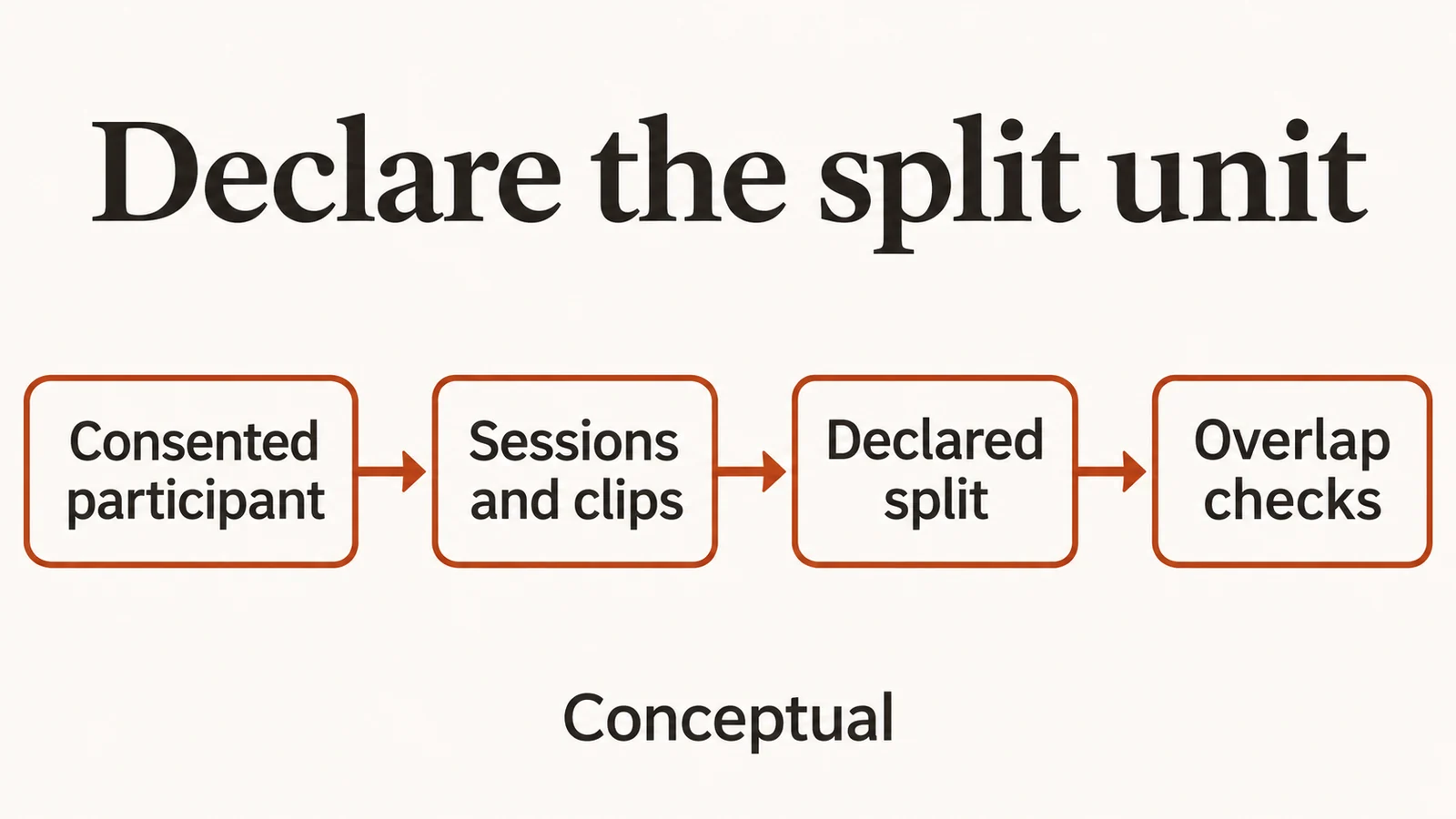
Write a short analysis contract before collection. It should name the decision, eligible tasks, grouping metadata, split boundary, aggregation unit and handling of unknown outcomes. This is enough to expose many disagreements that otherwise appear only after a score is published.
For example, an internal pilot can ask whether all declared recording conditions have reviewed identifier-capture tasks. That question may need no accent ranking at all. A different project can ask whether verified task completion differs across consented self-described slices under matched task conditions, which requires outcome receipts and a careful sampling plan.
Avoid changing the question after seeing the most dramatic difference. Exploring a pilot can reveal useful hypotheses, but exploratory findings should remain labeled exploratory. A later collection can test a chosen hypothesis with its own frozen protocol instead of presenting an opportunistic slice as the original planned result.
Keep operational changes in scope as possible explanations. A new endpoint configuration, language hint, field scorer or recording adapter can affect a group result without any change in participants. The manifest and release report should let another engineer determine which configuration produced every observation.
The practical first-value step is a coverage and provenance review. If the collection cannot establish speaker identity, task eligibility or recording conditions, fix those gaps before spending effort interpreting small differences between group averages.
Collect labels without inferring identity
Use self-description only under an appropriate consent and collection process. Explain why the field is requested, whether it is optional, who can access it, and what the label will be used to report. Preserve the vocabulary and version of the collection rubric.
Do not replace missing labels with guesses. Unknown is an explicit category, not a negative answer and not a group with zero error. A participant can also select several labels where the rubric permits it; that changes how group totals and overlapping memberships must be interpreted.
The Common Voice privacy notice describes optional metadata and recording-data practices for that project. Its public-data setting should not become a default for your own collection. An internal evaluation pilot can have a narrower purpose and access boundary.
A community response in a Mozilla discussion of account identifiers explains that a client identifier need not identify a unique real speaker. Use that narrow provenance lesson. It is not a reason to introduce demographic inference or voice cloning into an evaluation process.
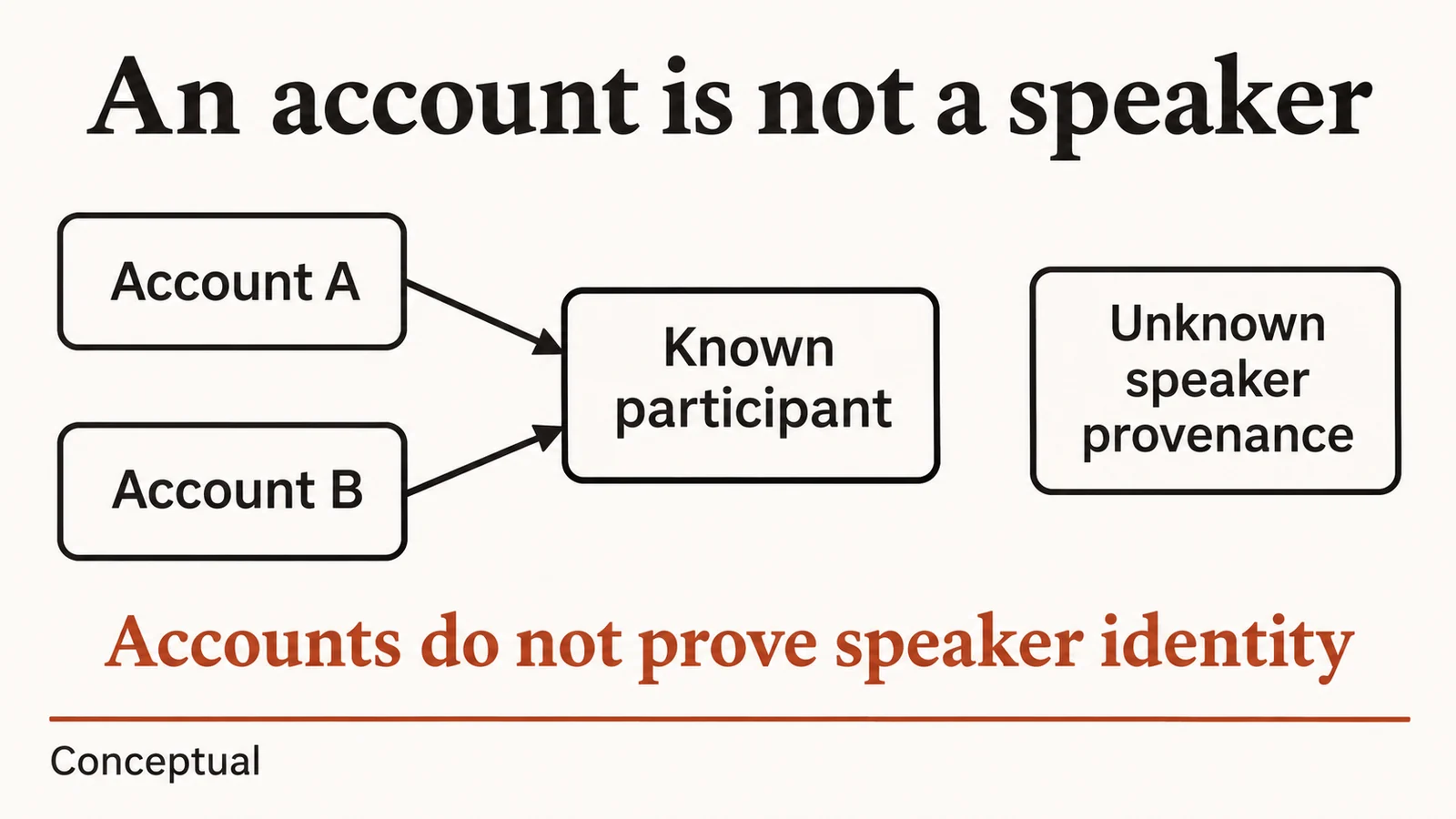
A trusted speaker key must represent the actual grouping claim. If your collection can establish that several accounts belong to one consented participant, bind them to one pseudonymous key. If it cannot establish who spoke a clip, quarantine it from person-disjoint claims rather than declaring the account ID sufficient.
Keep identity linkage in a restricted owning system. The public manifest can contain synthetic or approved pseudonymous keys while authorized collection staff retain the link needed for withdrawal and correction. Do not publish a crosswalk or infer one from a voiceprint without an appropriate separate basis.
A self-described label can change over time or differ by context. Record which revision applies to the collection instead of silently editing historical rows. The artifact requires consistent label values for a participant inside one admitted manifest; a changed rubric belongs in another manifest revision.
Annotation ownership also matters. A reviewer who labels a task outcome is not automatically authorized to assign a participant's speech identity. Keep task review, collection metadata and identity linkage as separate sources with their own correction procedures.
The consented dataset pilot method develops those collection boundaries. The shared-phone identity guide shows why a device or account can provide useful context without proving which person produced the current speech.
Use a distinct representation for not asked, declined, unavailable and invalid metadata when the collection process can support those distinctions. They have different operational meanings. Collapse them only in a documented reporting view while preserving the original admitted values in controlled records.
A label dictionary should define the collection question and allowed values without turning them into a universal account of speech identity. Preserve participant-provided text where the policy permits it, then document any reporting categories derived from that text. Do not silently relabel people to obtain equally sized groups.
The linkage process should also handle corrections. If collection staff discover that one pseudonymous key combined two speakers, version the correction and identify affected splits. Recompute the audit and any derived measures; a corrected identity map changes the basis for the generalization claim.
If two keys turn out to represent one participant, perform the same review in the other direction. Previously separate train and test records may now overlap. A row-level hash can remain unchanged while the identity evidence changes, which is why identity-map provenance belongs beside audio provenance.
Do not publish detailed linkage evidence simply to make the audit reproducible. A public synthetic case can show the logic of the correction. Authorized reviewers can inspect the real linkage under its access and retention boundary without exposing participants' account relationships or recordings.
Choose speaker and content split units
A split rule should match the claim. If you claim evaluation on unseen speakers, keep each known participant out of both development and test sets. If you claim unseen recording sessions, preserve session identity too. If you claim unseen content families, define those families before partitioning.
The GroupShuffleSplit documentation illustrates group-based rather than row-based splitting. A group splitter can enforce the keys supplied to it; it cannot establish that those keys identify real speakers or that all leakage channels have been modeled.
The Common Voice corpus-creation tooling is a primary source for one project's corpus-processing approach. Read the actual release and manifest you use. Do not assume that a tool's presence proves that a particular downloaded release meets your intended person-disjoint claim.
Mozilla's dataset-quality account describes speaker splitting and transcript quality work in a particular dataset. Its lesson is to inspect the collection and processing boundary. It does not certify every dataset assembled from a similar source.
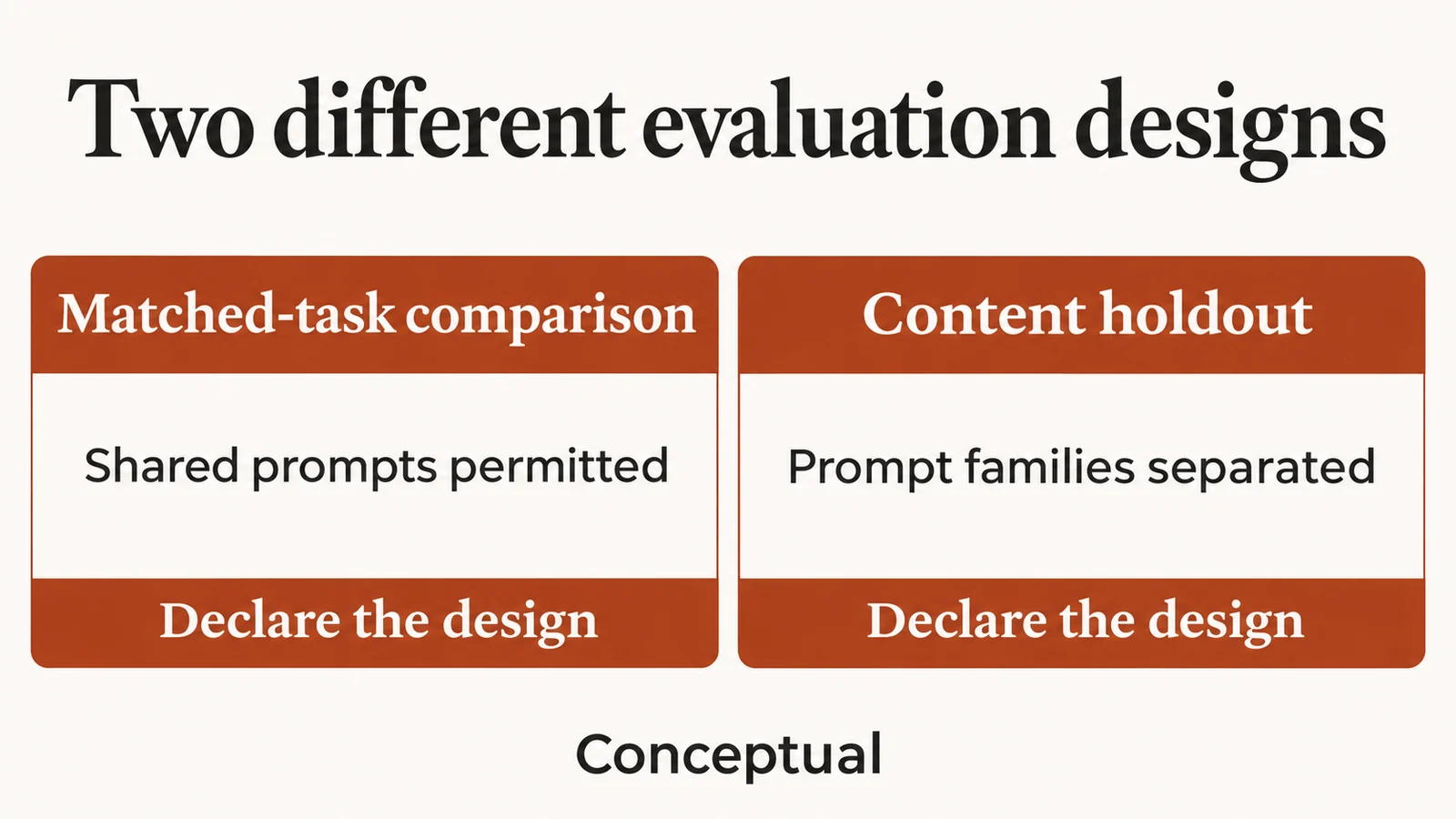
Content overlap needs a declared design. In a matched-task cohort comparison, using the same reviewed prompts across groups can be intentional because it helps control the task. In a content-holdout experiment, sharing prompt families across splits can violate the intended generalization boundary.
Do not impose content disjointness on every experiment by habit. It can remove the matched task that makes a cohort comparison interpretable. Instead, declare whether the experiment asks about different speakers on comparable content or generalization to unseen content, then validate the corresponding rule.
Exact audio digests detect identical copies. They do not detect every re-encoded, cropped, denoised or otherwise transformed copy. Preserve derivation identity where possible and use appropriate review for near duplicates; never claim that a hash-only check eliminates all leakage.
A session key should be scoped consistently. If two collection devices reuse a local session number, combine it with the owning collection identity before validation. A collision in metadata can create false overlap warnings or conceal a real relationship, depending on how adapters handle it.
The following criteria table describes narrow checks. A check means the evidence supports that property under trusted input provenance; a cross means a separate proof is required. It is not a performance or fairness ranking.
| Evidence | Known-key separation | Real-speaker identity | Causal accent explanation |
|---|---|---|---|
| Random row split | ✗ Can repeat keys | ✗ No identity proof | ✗ No causal design |
| Group split on account ID | ✓ Account keys only | ✗ Account may differ from speaker | ✗ Confounds remain |
| Consented participant linkage and split audit | ✓ For declared participant keys | ✓ Within collection evidence | ✗ Grouping alone is insufficient |
| Exact audio digest audit | ✓ Exact-copy overlap | ✗ No person identity | ✗ No cause established |
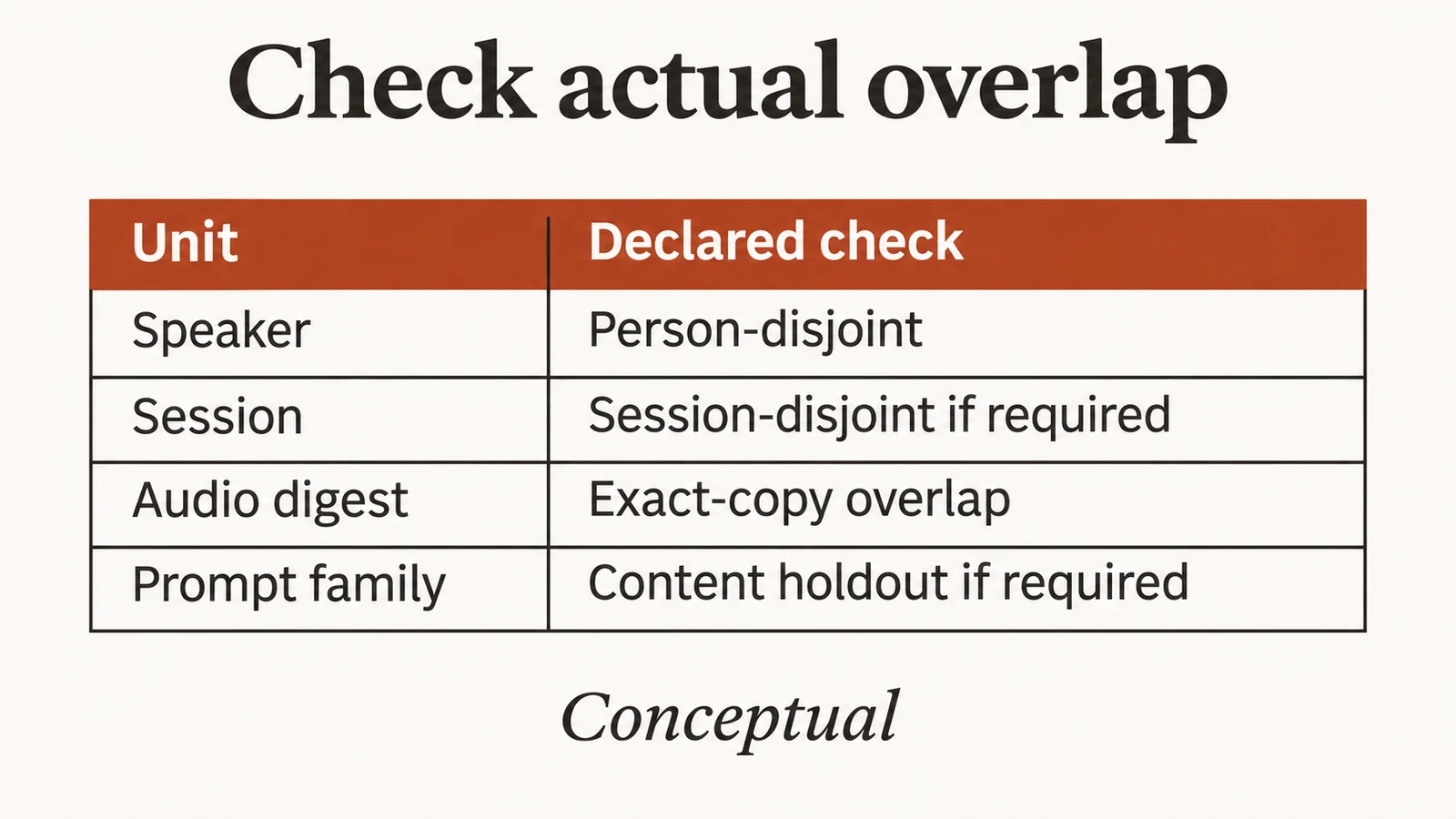
Decide what counts as a derived recording before partitioning. A resampled copy, denoised version and clipped excerpt may all originate from one source recording. Different digests identify different byte artifacts, but the source relationship can still violate an independence claim.
Preserve a source-family key when the collection process knows that relationship. The bounded validator here checks exact digests only, so its passing result must be described as exact-copy and declared-key validation. Extending it to source-family overlap requires another trusted field and negative fixtures for transformed copies.
Prompt-family identity needs similar care. Two literal strings can contain the same task template with a changed slot value. Whether they belong to one family depends on the experiment's content boundary. Record the family construction rule rather than relying on exact text equality to decide generalization.
Split revisions should be immutable. If a violation is found, publish a corrected manifest with the reason and rerun all affected measures. Do not move a difficult clip into development while keeping a test report that still claims to describe the original frozen assignment.
A release-to-release comparison also needs stable provenance. New participants, revised references and altered splits can each change results. Keep them as separate reported changes so a new model version is not credited for an easier evaluation set or a narrower scored subset.
Validate an owned split manifest
The reference validator accepts rows containing trusted pseudonymous speaker identity, session, digest, prompt family, split, optional labels and one task outcome per clip. It freezes the supported value shape before checking it. Unknown speaker rows are retained as quarantined evidence and excluded from speaker-based aggregation.
Its scope is deliberately limited. It checks declared keys and exact-copy identities, not acoustic similarity or truthfulness of collection records. It also does not execute a random splitter, classify accents, or estimate recognition accuracy.
Save the complete fence as cohort_manifest.py and run it with Python 3.11 or newer. Every record is synthetic. The fractional comparisons in the assertions illustrate how participant and clip weighting differ; they are not observations about any speech group.
from dataclasses import dataclass, FrozenInstanceError
from fractions import Fraction
from collections import defaultdict

def text(x):
    if type(x) is not str or not x:
        raise ValueError("nonempty text required")
    return x

@dataclass(frozen=True)
class Row:
    clip: str
    speaker: str | None
    session: str
    digest: str
    family: str
    split: str
    cohorts: tuple
    outcome: str

    @classmethod
    def admit(cls, r):
        speaker = r["speaker"]
        if speaker is not None:
            speaker = text(speaker)
        if type(r["cohorts"]) not in (list, tuple):
            raise ValueError("cohort collection required, not scalar text")
        cohorts = tuple(sorted(set(text(v) for v in r["cohorts"])))
        if r["split"] not in {"train", "dev", "test"}:
            raise ValueError("invalid split")
        if r["outcome"] not in {"matched", "failed", "unknown"}:
            raise ValueError("invalid task outcome")
        return cls(text(r["clip"]), speaker, text(r["session"]),
                   text(r["digest"]), text(r["family"]), r["split"],
                   cohorts, r["outcome"])

def validate(raw, content_holdout=False):
    if type(content_holdout) is not bool:
        raise ValueError("explicit boolean design required")
    rows = tuple(Row.admit(r) for r in raw)
    unique, violations = {}, set()
    speaker_split, session_split, digest_split, family_split = {}, {}, {}, {}
    speaker_labels = {}
    for r in rows:
        if r.clip in unique and unique[r.clip] != r:
            raise ValueError("conflicting clip identity")
        unique[r.clip] = r
        checks = [(session_split, r.session, "session"),
                  (digest_split, r.digest, "audio")]
        if r.speaker is not None:
            checks.append((speaker_split, r.speaker, "speaker"))
            if speaker_labels.setdefault(r.speaker, r.cohorts) != r.cohorts:
                raise ValueError("inconsistent participant labels")
        if content_holdout:
            checks.append((family_split, r.family, "content"))
        for owner, key, kind in checks:
            if owner.setdefault(key, r.split) != r.split:
                violations.add((kind, key))
    history = tuple(unique[k] for k in sorted(unique))
    return history, tuple(sorted(violations))

def aggregate(history, split="test"):
    # One eligible task per admitted clip; unknown is not a confirmed failure.
    selected = tuple(r for r in history if r.split == split)
    quarantine = tuple(r for r in selected if r.speaker is None)
    eligible = tuple(r for r in selected if r.speaker is not None)
    groups = defaultdict(list)
    for r in eligible:
        for label in r.cohorts or (None,):
            groups[label].append(r)
    result = {}
    for label, rows in groups.items():
        participants = defaultdict(list)
        for r in rows:
            participants[r.speaker].append(r)
        matched = sum(r.outcome == "matched" for r in rows)
        participant_values = tuple(Fraction(
            sum(r.outcome == "matched" for r in clips), len(clips))
            for clips in participants.values())
        result[label] = dict(participants=len(participants), clips=len(rows),
            eligible_tasks=len(rows), verified_tasks=matched,
            unknown_tasks=sum(r.outcome == "unknown" for r in rows),
            confirmed_failures=sum(r.outcome == "failed" for r in rows),
            clip_weighted_verified_per_attempt=Fraction(matched, len(rows)),
            participant_weighted_verified_per_attempt=(
                sum(participant_values, Fraction()) / len(participant_values)))
    return dict(state="empty" if not selected else "recorded",
                quarantined_clips=len(quarantine), groups=result)

def synthetic(clip, speaker, **changes):
    r = dict(clip=clip, speaker=speaker, session="session-" + clip,
             digest="digest-" + clip, family="matched-prompt", split="test",
             cohorts=["self-described-A"], outcome="matched")
    r.update(changes)
    return r

raw = [synthetic("a", "participant-A"), synthetic("b", "participant-A"),
       synthetic("c", "participant-A"), synthetic("d", "participant-B", outcome="failed")]
history, issues = validate(raw)
assert issues == ()
raw[0]["cohorts"].append("mutated")
raw.clear()
assert history[0].cohorts == ("self-described-A",)
g = aggregate(history)["groups"]["self-described-A"]
assert (g["participants"], g["clips"], g["eligible_tasks"]) == (2, 4, 4)
assert g["clip_weighted_verified_per_attempt"] == Fraction(3, 4)
assert g["participant_weighted_verified_per_attempt"] == Fraction(1, 2)
a = synthetic("a", "participant-A", split="train")
b = synthetic("b", "participant-A", split="test")
assert ("speaker", "participant-A") in validate([a, b])[1]
b = synthetic("b", "participant-B", digest=a["digest"])
assert ("audio", a["digest"]) in validate([a, b])[1]
assert validate([a, synthetic("b", "participant-B")])[1] == ()
assert ("content", "matched-prompt") in validate(
    [a, synthetic("b", "participant-B")], content_holdout=True)[1]
u = aggregate(validate([synthetic("u", None)])[0])
assert u["quarantined_clips"] == 1 and u["groups"] == {}
z = aggregate(validate([synthetic("z", "participant-Z", cohorts=[], outcome="unknown")])[0])
assert z["groups"][None]["unknown_tasks"] == 1
assert z["groups"][None]["confirmed_failures"] == 0
distinct = aggregate(validate([
    synthetic("missing", "participant-missing", cohorts=[], outcome="unknown"),
    synthetic("declared", "participant-declared", cohorts=["(unknown label)"])])[0])
assert set(distinct["groups"]) == {None, "(unknown label)"}
assert distinct["groups"][None]["unknown_tasks"] == 1
assert distinct["groups"]["(unknown label)"]["verified_tasks"] == 1
assert aggregate([])["state"] == "empty"
assert aggregate([])["groups"] == {}  # no invented zero-rate cohort
for rows in [[synthetic("a", "p"), synthetic("a", "p", outcome="failed")],
             [synthetic("a", "p"), synthetic("b", "p", cohorts=["different"])],
             [synthetic("a", "p", cohorts=[[]])],
             [synthetic("a", "p", cohorts="accidental scalar")]]:
    try: validate(rows)
    except ValueError: pass
    else: raise AssertionError("invalid manifest accepted")
try: history[0].cohorts = ()
except FrozenInstanceError: pass
else: raise AssertionError("row rebinding accepted")
print("Synthetic split and aggregation fixtures passed; no speech measurements.")
The validator reports violations instead of silently moving clips between splits. An execution pipeline must block the relevant generalization claim when violations exist. Retain the admitted history so the overlapping keys can be inspected and the corrected manifest can receive a new revision.
The aggregate is a Python mapping: missing cohort metadata uses the non-string key None, while every admitted string remains a real label, including "(unknown label)" and "null". No JSON serialization contract is supplied. An exporter must use explicitly typed records to preserve that distinction instead of coercing mapping keys to strings.
Account identifiers are deliberately absent from the proof. A trusted collection adapter must resolve consented participant identity before supplying a speaker key. If several accounts belong to one known participant, they must use that same key; if identity is unknown, use the explicit quarantine state.
The artifact treats session separation as required and content separation as an explicit optional design. If your experiment has a different session boundary, change the declared contract and negative fixtures together. Do not relax a failing check by relabeling keys after seeing the score.
Block use of a manifest for the corresponding claim when overlap violations remain. The validator deliberately returns history and issues to support diagnosis, not a ready-to-publish score. An adapter should require a clean relevant audit before invoking group aggregation for a person-disjoint report.
The manifest constructor preserves exact duplicate rows as one historical clip identity. Changed content under the same clip ID is rejected as a conflict. If an experiment intentionally repeats one clip, use explicit attempt identities and a sampling plan rather than counting duplicate delivery as independent audio coverage.
Keep the admitted source values available for recomputation. A derived count is insufficient when someone later challenges whether two clips came from one participant or whether an unknown outcome was counted as failure. Preserve the identity mapping revision, raw outcome status and task eligibility rule beside the report.
Use synthetic boundary tests before integrating the real collection. Feed one known participant into two splits, reuse one audio digest across splits, and remove speaker identity from one row. Each case should have the documented disposition, including quarantine rather than an invented participant key.
Finally, test that the application cannot change admitted labels through aliasing. The example mutates the original label list after validation, then verifies that the historical row is unchanged. That small ownership check prevents later spreadsheet edits from rewriting an earlier comparison without a manifest revision.
Keep participant and clip aggregation separate
A person who contributes many recordings can dominate a clip-weighted result. A participant-weighted result first computes each participant's declared task measure, then averages across participants. These are different questions, and neither should be mislabeled as the other.
The synthetic harness intentionally gives one participant several clips and another fewer clips. It asserts that the two weighting rules yield different fractions. Those fractions are program fixtures, not reported cohort performance, and the article makes no claim about which weighting rule is universally preferable.
The example's measure is verified completion per eligible attempt. Unknown outcomes remain in the attempt denominator and are counted separately, so the measure is a verified-completion coverage boundary rather than recognition accuracy. A different question can use known outcomes only, but it must publish that denominator and the unknown count.
Keep participant count, clip count, eligible-task count, known outcomes and verified tasks in separate fields. A task can involve several turns or recordings. This reference narrows the model to one eligible task per clip; extend the schema explicitly before using it for multiturn conversations.
For overlapping self-described labels, the same participant can contribute to several reported slices. State that groups overlap and avoid summing group counts into a supposed total population. Keep a distinct overall participant count from the underlying manifest.
A missing cohort has no measured rate. An empty slice should be represented as absent or undefined under the reporting schema. Returning zero would imply an observation that did not occur and could make an unrepresented group look unusually successful.
The cost-per-success method has a related denominator lesson. Request counts and verified outcomes answer different questions. The latency benchmark boundary similarly requires a declared start, end and workload before a percentile is interpretable.
Small groups require an explicit reporting policy. Consider both statistical uncertainty and the chance of identifying a participant through combined attributes. This guide supplies no universal minimum group size or automatic privacy threshold; define the policy for the actual collection and disclosure boundary.
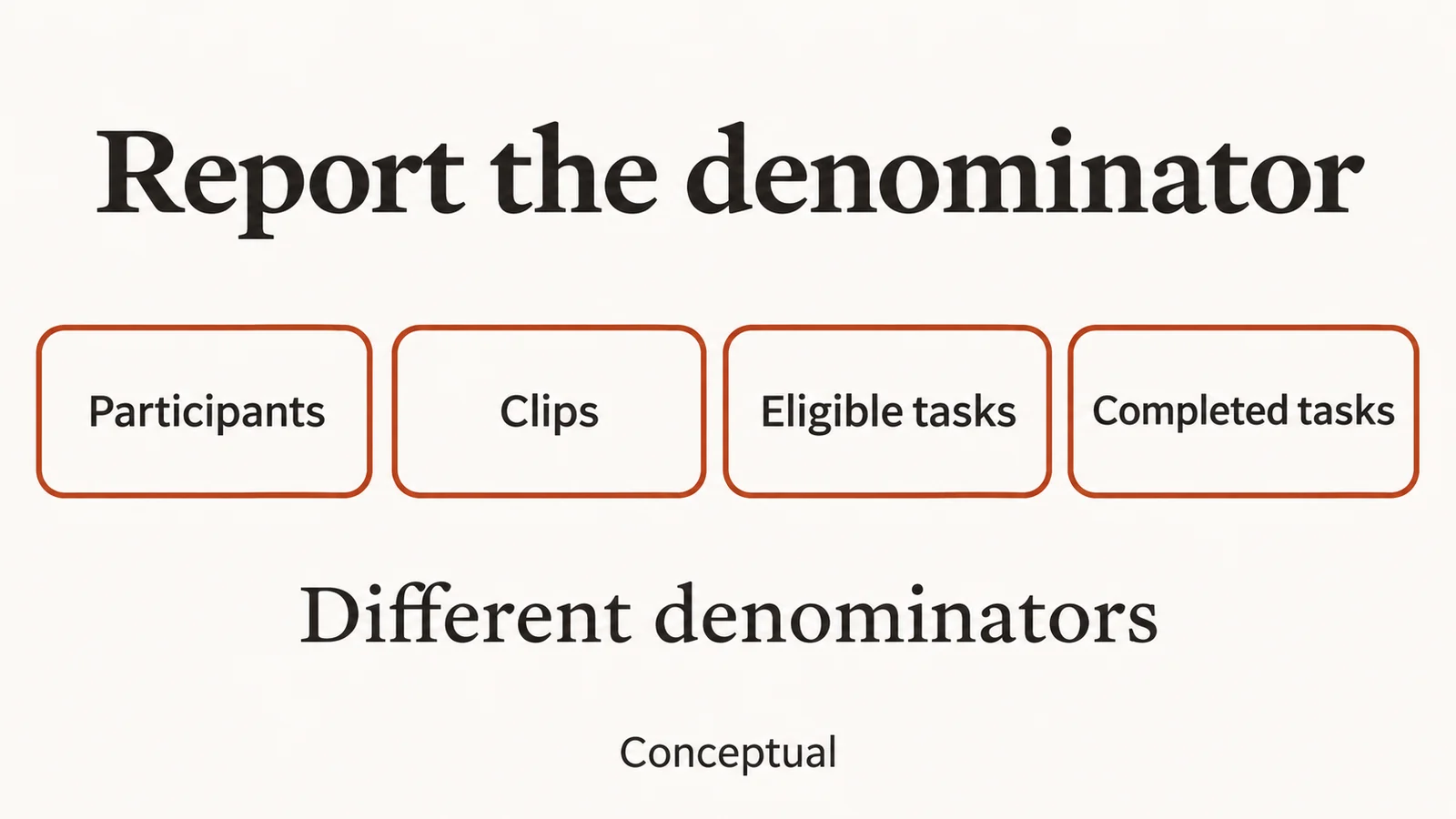
A participant-weighted measure still needs a clear within-participant rule. Someone with one known outcome and many unknown tasks should not automatically receive the same interpretation as someone with complete evidence. Report unknown counts and decide whether the intended measure is verified coverage, known-outcome accuracy or another declared quantity.
The reference chooses verified completion per eligible attempt specifically to keep that boundary observable. An unknown receipt contributes no verified completion while remaining explicitly unknown. It is a lower evidence boundary for completion, not an assertion that the task definitely failed or that recognition was wrong.
For comparisons over time, retain the same weighting definition. Switching from clip weighting to participant weighting can change a result even when every underlying outcome is unchanged. Give the revised analysis a new version and recompute comparable historical reports if you want to discuss trends.
Do not infer statistical independence from a large row count. Several recordings from one speaker, several tasks from one session and repeated prompts can create dependence. Select an uncertainty method appropriate to the actual sampling unit and study design; this synthetic program supplies no confidence intervals or significance claims.
An empty manifest and a fully quarantined manifest are different observations. The former contains no selected rows. The latter contains recorded clips whose speaker provenance cannot support the intended aggregation. Preserve that distinction so collection and identity-linkage problems receive the right next action.
Diagnose cohort differences before attribution
When group outcomes differ, first inspect the workload. Are task families, recording channels, device conditions and approval requirements comparable? A group label can be associated with these conditions without causing the observed difference.
The Fairlearn assessment documentation describes group metrics and their interpretation. Computing a disparity does not establish causality or certify fairness. Choose measures that match the task and investigate the underlying evidence before making an explanation.
Use matched tasks when that serves the decision. Keep comparable prompts and material fields across participants, and record the remaining variation. The matched-task versus content-holdout distinction belongs in the protocol, not an improvised explanation after results appear.
Inspect audio provenance before blaming speech style. A telephone-channel transformation, burst packet loss, or streaming boundary defect can alter the signal presented to the recognizer. Document format, channels, sample clock, codec and capture point for real audio trials.
Review material-field errors separately from textual differences. A name can appear in another script while preserving the intended entity, or look similar while resolving to the wrong record. The scoped alias method gives those distinctions a concrete test boundary.
Keep annotation uncertainty visible. A disputed reference is not a confirmed system error. Use qualified reviewers and an adjudication process, preserve reference revisions, and recompute affected groups when the reference changes instead of selectively updating a preferred slice.
Instrumentation should preserve the raw values required to reproduce the comparison. The observability guide helps separate stage evidence. Aggregate-only dashboards can show a difference while leaving no way to determine whether identity linkage, task composition or outcome scoring changed.
Review a difference with a compact evidence packet. Include the task family, recording identity and format, reference revision, model configuration, admitted participant metadata and outcome stage. Ask which observed boundary differs before offering an explanation tied to a cohort name.
A matched prompt is useful only if the material task is matched too. Different directory contents, availability snapshots or confirmation rules can change difficulty despite identical spoken words. Freeze authorized task context or record it as a declared condition rather than hiding it behind one prompt label.
Output delivery can also affect a conversational task. An agent may recognize a field correctly but speak an unclear confirmation or lose a reply tail. Keep playback and task evidence separate, using playback acknowledgments only for the endpoint observations they actually establish.
Investigate repairs directly. Some tasks fail after a correct initial transcript because the caller changes a material value. The self-correction contract helps locate a workflow problem that an accent label would explain poorly.
A useful diagnosis can end with uncertainty. If recording conditions and task families are confounded with group membership, say that the current collection cannot separate their effects. Plan another controlled collection rather than adding a causal story that the evidence does not support.
Report limits and choose the next collection
A useful report names the collection population, consent scope, optional-label rubric, task design, split units, unknown identities and exclusion reasons. Preserve the manifest revision and exact aggregation formula. Readers should be able to tell whether a result is weighted by clips, participants or another declared unit.
The NIST AI Risk Management Framework provides broader risk-management context for measurement and documentation. It does not prescribe an automatic accent taxonomy or turn a passing split audit into a complete fairness assessment.
Publish observations at the scope they support. A small collection can reveal a concrete missing condition or a reproducible workflow error. It cannot justify describing a community's speech as inherently difficult, nor can it establish that a model behaves the same way across all contexts associated with a label.
Choose the next collection based on a material gap. Add reviewed tasks where coverage is missing, improve participant linkage where identity is uncertain, or balance recording conditions when channel differences prevent interpretation. Keep the collection purpose and permission boundaries intact.
A voice-consistency corpus can test a different output-speech property with matched content. Keep that separate from recognition cohorts so listener judgments, input-language behavior and task receipts do not collapse into one unexplained quality score.
Keep the final release note small enough to audit. State which checks passed, which generalization boundary remains unsupported, and which collection gap will be addressed next. A documented unresolved limitation is more useful than a broad assurance that every source of bias or leakage was removed.
For an implementation using 60db Agent, apply the same external evidence contract: preserve authorized input identities, declared task conditions and independent outcome receipts. The product name does not change what the collection can prove. This article reports a synthetic validation method and no measured recognition, accent or dialect ranking.
Before approving a report, have another reviewer reconstruct one participant's contribution. They should be able to identify the admitted clips, eligible tasks, known outcomes, unknowns and weighting rule without relying on an unstored spreadsheet formula. Repeat the exercise for one quarantined clip and one overlapping-label participant.
This review catches a common reporting failure: a table heading says participants while the underlying query counts rows. The synthetic harness makes that mistake observable by giving one participant several clips. Keep that fixture even after the reporting layer becomes more sophisticated, because a later query rewrite can reintroduce the same denominator error.
Also review what the audience is expected to infer. An internal diagnostic table can guide collection without supporting a public population comparison. If the report moves to a broader audience, reassess disclosure risk, unknowns and the scope of the accompanying language rather than simply exporting the dashboard image.
The next useful action should follow from the recorded limitation. Missing participant linkage calls for better collection provenance. Missing reviewed task references calls for annotation work. Unbalanced recording conditions call for a controlled follow-up. None of those gaps can be repaired by renaming the cohort or printing more decimal places in a score.
Frequently asked questions
What is an accent cohort for?
It is a documented evaluation slice used to inform a specific collection or engineering decision. Define its metadata source and task boundary. A cohort label can help reveal a coverage gap or difference worth investigating, but it does not explain the cause of an observed system outcome.
Can accent reveal nationality?
Do not use an evaluation recording to infer nationality. Speech metadata, nationality and identity are different concepts. Use only authorized, relevant collection fields, preserve unknown values, and avoid making a demographic claim from an accent label or a model's guess about a voice.
Should an evaluator infer first language?
No inference is needed for this protocol. If first-language information is relevant and appropriately collected, document its source and optional nature. An accent field or language tag does not establish it, and missing information should not be filled by a speech classifier.
How should optional self-description be collected?
Explain the purpose, access boundary, reporting use and choice to decline. Record the rubric revision and preserve the selected values. Keep collection metadata separate from task annotation, and do not silently reinterpret an older label under a new taxonomy after seeing evaluation results.
What does unknown mean in a cohort table?
It means the declared metadata is unavailable under the collection contract. It is not zero error, a negative demographic answer or evidence of one particular speech background. Report it explicitly and keep unknown speaker identity separate from an optional label that was simply not provided.
Does an account ID identify one speaker?
Not necessarily. A person can use multiple accounts, and an account can include recordings from multiple speakers. Establish the actual consented participant linkage or quarantine the clip from person-disjoint claims. A group-splitting tool can enforce only the identity keys it receives.
Why split by speaker?
Speaker separation supports a claim about evaluation on participants absent from the corresponding development split. It prevents repeated known participant keys from crossing that boundary. It does not by itself eliminate content, session, channel or annotation leakage, so preserve and validate the other declared units too.
When should sessions also be held out?
Use session separation when the evaluation claim depends on unseen recording sessions or when shared session conditions would undermine the comparison. Declare the rule before splitting. This reference requires session separation; another design needs an explicit revised contract and corresponding negative fixtures.
Should every prompt be disjoint across cohorts?
No. Shared reviewed prompts can be intentional in a matched-task comparison because they help control content. A content-holdout experiment asks a different question and requires declared family separation. Preserve the design distinction rather than treating every repeated prompt as either harmless or forbidden.
What is content-holdout evaluation?
It evaluates declared content families absent from a development split. Define family identity and derivation rules before assigning rows. Exact string inequality is not enough when paraphrases or transformed copies share material content, and a family key is only as trustworthy as its review process.
Can a random seed prevent leakage?
A seed makes a specified random process reproducible. It does not establish speaker identity or stop related examples from crossing splits when the algorithm operates on rows. Use correct grouping keys, retain the assignment manifest and validate overlap independently of the randomization procedure.
Do file hashes detect every duplicate?
They detect exact byte identity under the chosen digest procedure. Re-encoding, clipping or other transformations can produce different bytes from related audio. Preserve derivation metadata and appropriate near-duplicate review when the claim requires it; a hash-only audit cannot certify complete independence.
How should multilingual speakers be represented?
Use the declared optional self-description rubric and allow supported multiple labels. Keep language use in a particular task separate from participant metadata. State when reported groups overlap so repeated memberships do not become a falsely inflated total participant population.
Which denominator belongs in a group error rate?
Choose the unit that matches the question and publish it explicitly. Clips, participants, eligible tasks and known outcomes are different denominators. The artifact demonstrates verified completion per attempt with both clip and participant weighting, while counting unknown outcomes separately rather than calling them confirmed failures.
What should an empty cohort return?
Return absent or undefined under the report schema, with no claimed rate. Zero would imply a measured outcome for a group with no observations. Keep the missing coverage visible so the next collection can address it rather than presenting an empty slice as perfect performance.
How small is too small to publish?
There is no universal number supplied by this guide. Define a reporting policy that addresses uncertainty and reidentification risk for the actual data and combinations of attributes. A descriptive internal audit and a public population claim can require different evidence and disclosure boundaries.
Does a group difference explain its cause?
No. Recording conditions, task composition, references, model configuration and collection method can differ with a group label. Inspect those boundaries and use an appropriate study design before offering a causal explanation. A disparity metric alone does not identify which factor produced the difference.
Can group parity certify fairness?
No single parity result certifies fairness across tasks, populations and harms. Group metrics answer defined measurement questions. Keep their limitations visible, review actual failure modes, and use a broader evaluation and governance process rather than interpreting one equal score as a complete judgment.
What should a dataset statement disclose?
Describe collection purpose, participant and task scope, consent and access boundaries, optional metadata, annotation process, split rules, revisions and limitations. Include unknown identities and exclusions. Documentation supports interpretation; it does not prove representativeness, legal sufficiency or the truth of supplied speaker keys.
How should the next collection round be chosen?
Choose a specific unresolved question or coverage gap. Add reviewed tasks or conditions that help answer it under the existing permission boundary. Preserve the earlier manifest and analysis plan so the new collection does not silently change the meaning of a previously reported comparison.
Audit the manifest before the score
Run the synthetic overlap and aggregation fixtures, then inspect one authorized collection manifest. Establish what the speaker key means, declare content and session rules, and count participants separately from clips.
Only then compute the task measures that match your decision. Preserve unknowns, raw evidence and collection limits so a useful cohort observation can lead to better coverage without becoming a stereotype or an unsupported explanation.