
- Benchmarks
Build a consented regional-speech dataset on a small budget
Plan an adult speech-evaluation pilot with scoped permissions, reviewed recordings, actual cost inputs, and withdrawal-aware manifests.
- Author
 Udit Goenka
- Published
- Reading time
- 27 min
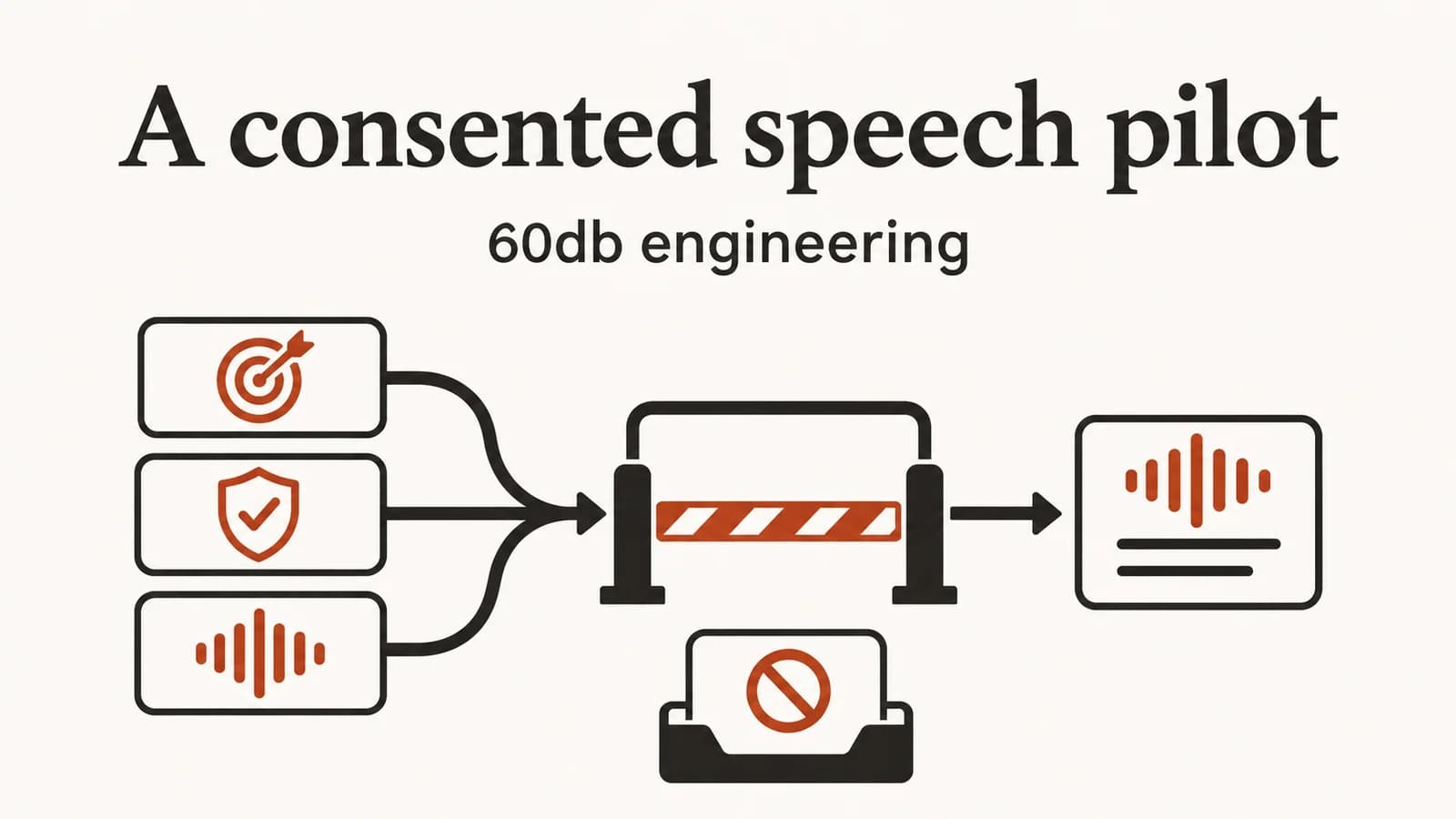
TL;DR: Start with a bounded adult internal-evaluation purpose, reviewed task coverage, and a permission record tied to each participant and recording. Count actual collection and review work, keep annotation and dataset revisions separate, and recheck current permission before issuing a release manifest.
A team collects recordings to test a regional-language workflow. Later, someone wants to use the same files for training or publish them with a demo. The filenames and audio hashes still match, but the original collection purpose does not establish permission for the new use.
Start by narrowing the pilot. Define the tasks it should inform, the adults invited to participate, the intended internal evaluation, and the access and withdrawal process. The multilingual benchmark method supplies the outcome boundary; this guide focuses on obtaining a small, inspectable collection that can support that work.
A real Piper contributor discussion asks about public dedication of recordings and where a voice may be used. That is a practical reason to explain use boundaries before collection. A license label alone does not prove that a participant understood a particular use or that all relevant permissions exist.
The runnable artifact below is a synthetic metadata gate. It distinguishes capture, evaluation, training and release purposes, scopes withdrawal to subject, recording and purpose, and rechecks after asynchronous preparation. It does not record audio, certify informed consent, issue legal advice, or report speech-model performance for 60db Agent.
Table of contents
- Choose the smallest useful evaluation purpose
- Write a participant brief with explicit boundaries
- Collect reviewed scenarios and recording provenance
- Budget actual work instead of promised volume
- Version recordings, annotations, and permissions
- Validate withdrawal-aware release manifests
- Document the pilot and plan another round
- Frequently asked questions
- Run a small auditable collection
Choose the smallest useful evaluation purpose
A useful pilot answers a specific engineering question. It might test whether a confirmation workflow preserves reviewed identifiers, whether date repairs reach the final action, or whether recording conditions cover the intended channel. Define the question before deciding how many files to collect.
Avoid collecting a broad archive because storage is cheap. Every additional recording creates review, access, provenance and withdrawal work. A smaller reviewed corpus with clear task references can be more actionable than a larger collection whose intended entities and outcomes remain disputed.
The default scope in this guide is adult participation for internal evaluation. Training, public redistribution, synthetic voice generation and other purposes require their own explicit decisions and appropriate permissions. Do not treat them as automatic extensions of a working evaluation pilot.
The collection brief should identify who owns the dataset and who can approve a change of purpose. Engineers should not have to infer that authority from a shared folder. A clear owner can reject an unapproved export before it becomes an informal dependency in another project.
Define an observable first result. For example, a reviewed task manifest can show that a synthetic date repair belongs to a new proposal revision. A real speech evaluation then needs authorized recordings and qualified references. The scheduling receipt boundary distinguishes those software and language-evidence layers.
Keep population claims modest. A pilot recruited through a particular channel does not represent everyone associated with a region, language or speech background. Preserve recruitment and collection context rather than describing a convenience sample as a complete regional dataset.
Data statements and datasheets for datasets provide useful documentation structures. Use them to explain composition, intended use and limitations. The documents do not replace the participation process or certify legal sufficiency.
The stopping rule should match the question. Stop a round when the planned task cells have enough reviewed evidence for the next engineering decision, or when a concrete collection problem requires redesign. Do not keep expanding the purpose simply because participants have already been recruited.
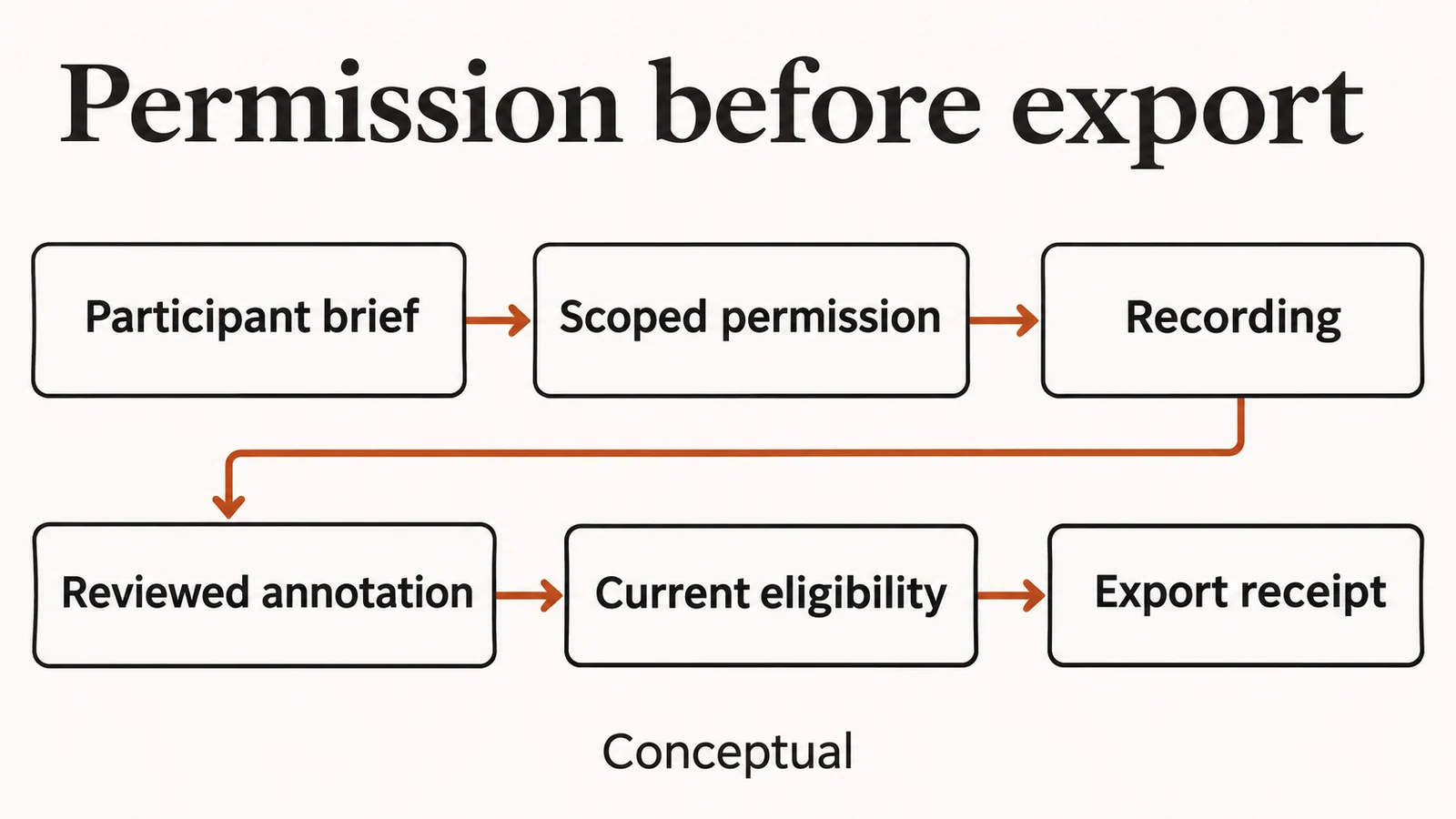
Turn the purpose into a coverage sheet. Each row should identify a task family, the material values a reviewer needs, the recording condition, and the expected safe behavior when the request is unclear. This sheet determines what should be collected and reviewed, rather than allowing convenient prompts to define the evaluation accidentally.
Keep collection tasks distinct from model-selection tasks. A pilot can establish that the recording and annotation process works before it compares recognizers. The language-policy ledger demonstrates that configuration checks, paired eligibility and recognition evidence have different boundaries.
Decide which content must remain synthetic. Public reproductions should use synthetic names, task identifiers and operational details. Real participants can perform reviewed scenarios without supplying private appointments, account numbers or customer stories merely to make the recordings sound realistic.
Define the review outcome for ambiguity. If a scenario allows several interpretations and the reference process cannot resolve them, retain it as unresolved rather than forcing a canonical answer. A collection can still teach you that a prompt needs revision without turning the disputed recording into scored ground truth.
Write a short non-goal statement in the internal brief. If the pilot does not measure dialect performance, listening preference or training benefit, state those exclusions. This keeps the dataset from gaining unsupported authority as it moves between engineering, research and presentation contexts.
Write a participant brief with explicit boundaries
Explain what will be recorded, why, who will access it, how long controlled copies are intended to remain available, and how the participant can ask questions or withdraw under the declared process. Use wording the invited participants can understand and obtain appropriate review of the brief.
Separate optional metadata from required task information. Accent self-description, age range or other personal fields should have a stated purpose and collection boundary. Do not collect them merely because another dataset does, and do not infer missing values from the voice.
The Common Voice privacy notice describes recording and optional-metadata practices for that project. It is a primary example of a documented data boundary, not a template that automatically fits an internal pilot. Some platform terms pages require separate retrieval and review; this article does not claim a complete platform legal audit.
Creative Commons' CC0 description concerns rights dedication and its scope. A copyright-related label should not be interpreted as blanket informed permission for every possible voice use. Obtain appropriate legal and organizational review for the actual collection and release rather than relying on this engineering checklist as legal advice.
State whether recordings remain internal or may be distributed outside the collection team. Explain that already distributed copies may not be fully recallable. Do not promise global deletion if the operational design cannot identify and control every recipient and derived copy.
A useful permission matrix has separate purposes and evidence. In the table, a check means the named record can support that narrow metadata decision under a trusted collection process. A cross means the decision needs additional evidence; these are not legal conclusions.
| Record available | Admit controlled capture metadata | Internal evaluation eligibility | Public release eligibility |
|---|---|---|---|
| Participant brief only | ✗ No permission record | ✗ No permission record | ✗ No release permission |
| Current capture-purpose grant | ✓ Within declared collection process | ✗ Separate purpose | ✗ Separate purpose |
| Current evaluation-purpose grant | ✗ Capture remains separate | ✓ Matching subject and recording | ✗ Separate release purpose |
| Current release-purpose grant and release review | ✗ Not retroactive capture proof | ✗ Evaluation remains separate | ✓ Metadata eligibility only |
| Withdrawn matching purpose | ✗ If capture withdrawn | ✗ If evaluation withdrawn | ✗ If release withdrawn |
The matrix should remain understandable outside the codebase. A participant or reviewer should not need to know a storage bucket name to understand the use boundary. Product implementation details belong in controlled operating records unless they help someone make a meaningful participation decision.
Keep age eligibility narrow. This pilot is scoped to adults; uncertain eligibility is a reason to stop and review, not to guess from a voice. A different project involving children requires a separate collection design and appropriate review that this article does not provide.
The memory consent and expiry guide describes a related distinction between historical evidence and current permission. A recording can exist in restricted history while no longer being eligible for a new evaluation or release.
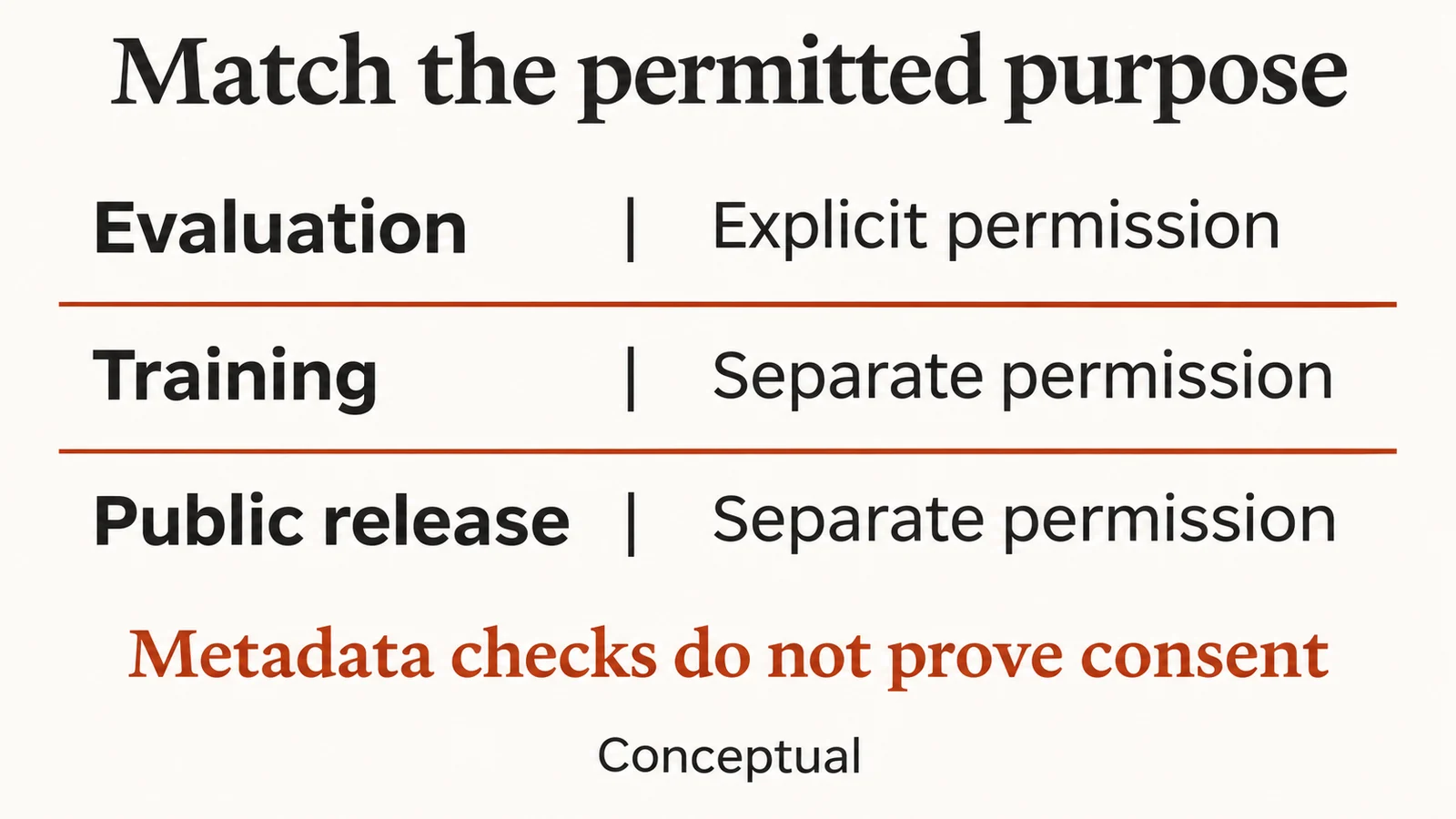
Test the brief with an appropriate reviewer before recruitment. Ask whether they can explain the intended use, optional fields, withdrawal route and distribution limits in plain language. Record the brief revision that each permission record refers to, so a later wording change does not silently rewrite what participants originally saw.
Keep the participation record separate from a transcript of the recording task. An audio clip containing a task response is not automatically evidence that the person received and accepted the collection brief. The trusted collection process must establish that connection through its own authorized records.
A shared account or phone should not be treated as sufficient participant identity. The shared-phone identity boundary applies here too: device continuity can be useful context while still leaving the actual speaker unresolved. Quarantine uncertain linkage instead of inventing a person key.
Explain operational limits honestly. If the project retains restricted audit receipts after withdrawal, describe the basis and retention process with appropriate review. If public distribution makes complete recall impossible, say that before participation rather than promising deletion that the system cannot perform.
Avoid collecting sensitive biographical details as an improvised way to improve annotations. Use the minimum task context and optional metadata needed for the stated question. A broader research question can be proposed separately with its own brief, review and permission boundary.
Collect reviewed scenarios and recording provenance
Choose task scenarios before writing prompts. Include material fields, expected repairs, ambiguity and permitted clarification. The useful reference is the intended task outcome, not a fluent sentence generated to fill a recording quota.
A historical Common Voice discussion about generated sentences raises real questions about generated prompt acceptance. Treat it as a historical community discussion rather than current platform policy. Generated prompts still need suitable rights, linguistic review and task relevance for your collection.
Use qualified reviewers for regional-language content and references. Keep disagreement records and a correction process. A syntactically valid script string does not establish that a phrase is natural, unambiguous or appropriate for the intended task.
A name task should preserve entity uncertainty and acceptable aliases. The Tamil-English name registry method separates normalization, transliteration and identity. Requiring one arbitrary written form can create a reference error that later appears to be a recognition failure.
For every real recording, capture the declared format, sample rate, channel count, codec, decoder and collection point. Preserve an exact artifact digest and any transformation history. A resampled or clipped file is a new artifact linked to its source, not an invisible replacement.
Check recording quality against the task. The Common Voice recording-quality guidance includes a useful boundary against rejecting a voice simply because an accent differs from the reviewer. A quality rubric should describe audible task requirements and recording defects without grading identity or familiarity.
For telephone deployment, make the capture path explicit. Phone audio and wideband evaluation concerns available signal information; streaming boundary checks concern missing or damaged segments. Neither problem should be explained through unsupported claims about regional speech.
Separate source recordings from annotation versions. A transcript correction changes the reference, not the original bytes. Retain both under the authorized policy so later model comparisons can distinguish changed recognition from changed ground truth.
The Common Voice corpus-creation source and Mozilla's dataset-quality account show concrete corpus-processing concerns. Their methods belong to their documented datasets; inspect your own participant linkage, split rules and annotation process rather than assuming a copied tool grants the same guarantees.
Create a recording acceptance rubric before collection. It should identify missing task content, severe clipping, unexpected channels, or other defects that affect the intended evaluation. Keep the reason specific enough that another reviewer can reproduce the decision without judging whether a speaker sounds familiar.
Preserve the original file before transformations. If an adapter converts channels, changes the sample clock or decodes a telephony codec, record the source digest, destination digest and transformation settings. A later model run should identify the exact artifact it consumed.
Also record whether an example is read, elicited through a scenario, spontaneous under a consented protocol, or generated. Those collection modes answer different questions. Do not describe a read-prompt pilot as evidence about every spontaneous repair that may occur in a live conversation.
For output-speech tasks, use a separate corpus and review rubric. The short-versus-long voice consistency method separates identity, cadence and understood content. Combining those listener judgments with an input-recognition dataset would create an unexplained quality score.
When a reference changes, preserve the reason and affected task IDs. Recompute every relevant model result under the corrected annotation revision. A selective correction that updates only one configuration would corrupt a comparison even though the underlying audio remains identical.
Budget actual work instead of promised volume
A collection budget should begin with work units you can observe. Record recruitment and briefing time, recording time, review time, annotation correction, rejected material, participant compensation and fixed operating costs. Use actual local inputs rather than invented regional rates.
Separate paid participant time from accepted audio duration. A participant can spend time understanding the brief, repeating a task or resolving a technical problem without producing more accepted minutes. Counting only accepted audio can conceal a substantial part of the collection process.
Keep review and rework visible. If a prompt is ambiguous or a reference cannot be resolved, the time spent reviewing it still belongs in the budget. Do not erase that work by removing the file from the final eligible dataset.
An operational worksheet can calculate total cost from actual durations and rates, with currency and date recorded. Keep fixed costs separate from per-task or per-minute costs. This article supplies no prices, compensation recommendations or projected model gains.
The cost-per-success method offers a useful denominator principle. Define whether the worksheet reports cost per reviewed recording, eligible task, participant or verified task outcome. Those quantities can differ without any arithmetic error.
Use the first round to identify process bottlenecks. If qualified review is scarce, adding more raw recordings can increase backlog rather than useful coverage. If recording failures dominate, improve the collection interface before recruiting a larger group.
Plan retention and withdrawal operations as real work. A process that can remove a source file but cannot identify derived manifests needs redesign before release. Include the time required to maintain provenance and respond to authorized requests rather than treating that work as free administration.
The budget's purpose is a decision. It can justify another bounded round, a narrower task scope, or a better annotation tool. It should not promise that a certain amount of recorded speech will produce a recognition improvement that has not been measured.
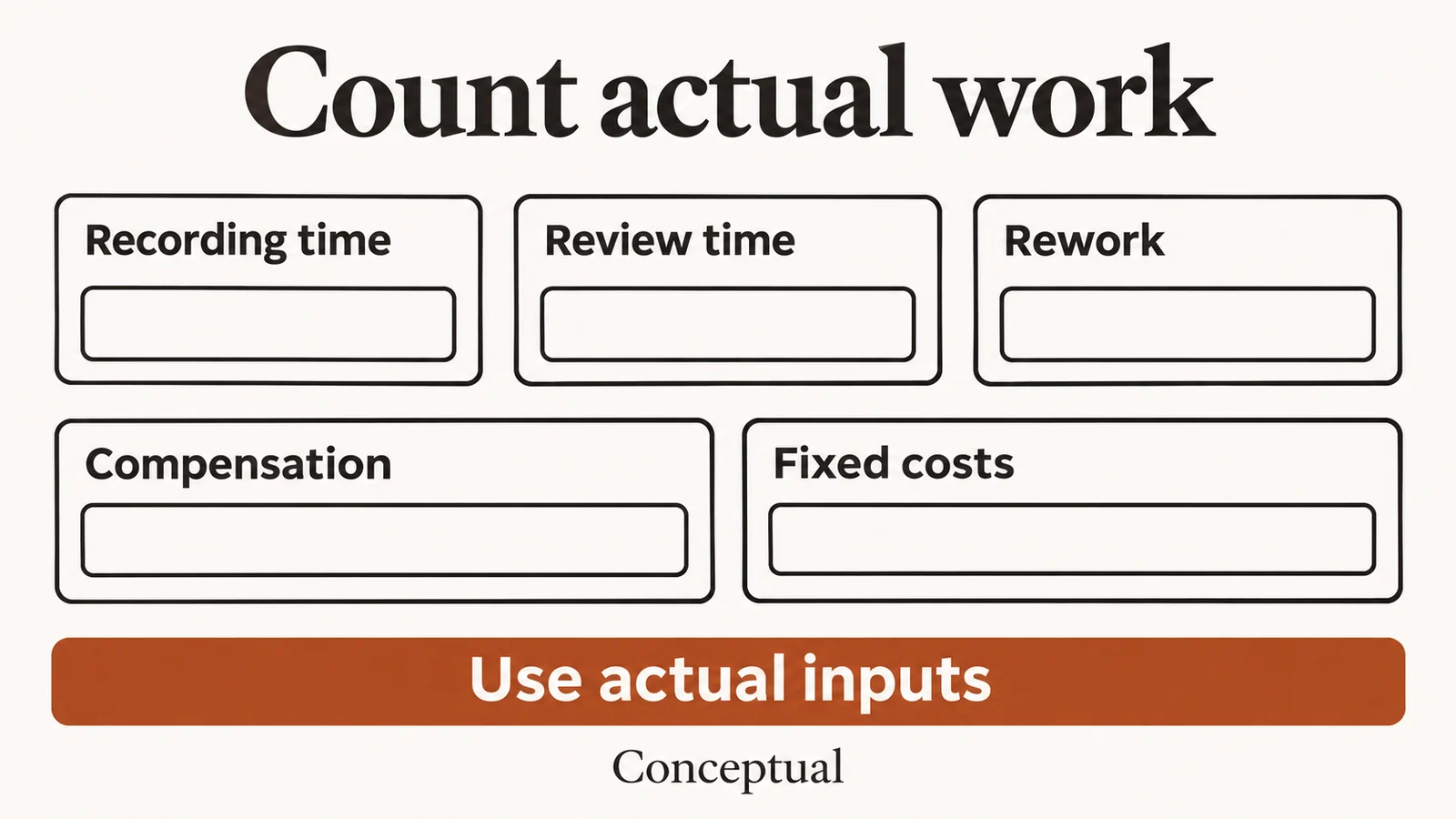
Use a worksheet with explicit units and provenance. A time entry should identify the activity and whether it measures wall-clock elapsed work or active reviewer time. A rate entry should identify its source, currency and effective date. Keep the original inputs rather than only the final total.
Do not compare two collection rounds solely by accepted minutes. One round can contain more task families, more participants or more difficult annotation decisions. Report those coverage dimensions beside cost so a lower cost per minute is not mistaken for a more useful dataset.
The worksheet can also expose the cost of uncertainty. Track unresolved annotations, technical retakes and eligibility reviews separately. These observations help improve the process without pretending that every removed item was wasted or that a guessed reference would have been cheaper evidence.
Use observability principles for the process itself: preserve the stage and reason behind each disposition. Collection dashboards should distinguish recorded, reviewed, eligible, issued for use and withdrawn. A single completed count hides where time and uncertainty accumulate.
Set the next budget from the actual bottleneck. If recording capture is reliable but review remains unresolved, fund the review process or narrow the task. If participant briefing is unclear, improve it before scaling recruitment. No speculative model-performance multiplier is required for either decision.
Version recordings, annotations, and permissions
A dataset revision should identify its source artifacts, annotation versions, split assignment and current eligibility basis. Keep those components separate. Changing a transcript is different from changing a participant's permission, even when both changes affect which tasks can be evaluated.
Bind permission to a subject, recording and purpose. An audio digest alone is insufficient: the same bytes can appear in several records or be eligible for one purpose but not another. A withdrawal for one recording's evaluation use is different from a withdrawal covering every recording associated with a subject.
The trusted collection system must establish subject and recording identity. The synthetic gate accepts those identities as inputs and cannot verify a participant's real identity, informed understanding or the authenticity of a permission record. Preserve the collection evidence in the owning access-controlled system.
Withdrawal should block new work within its declared scope and invalidate held eligibility decisions. Preserve a restricted historical receipt when the retention policy permits it, so the team can understand what was issued before withdrawal. Historical evidence must not restore current eligibility.
An exact repeated permission record can be a duplicate. A lower revision is stale. Changed content reusing the same revision is conflicting. Keep those dispositions distinct so a delayed message cannot be mistaken for a current publisher error.
The cohort split validator checks another versioned boundary: participant identity and task split assignments. A corrected linkage can change evaluation eligibility even when the audio files themselves remain unchanged.
Document which copies the collection controls. A release manifest, an exported archive, a downstream training run and a public mirror are different artifacts. Do not claim that revoking a local eligibility ticket recalls distributed files or removes effects from a trained model.
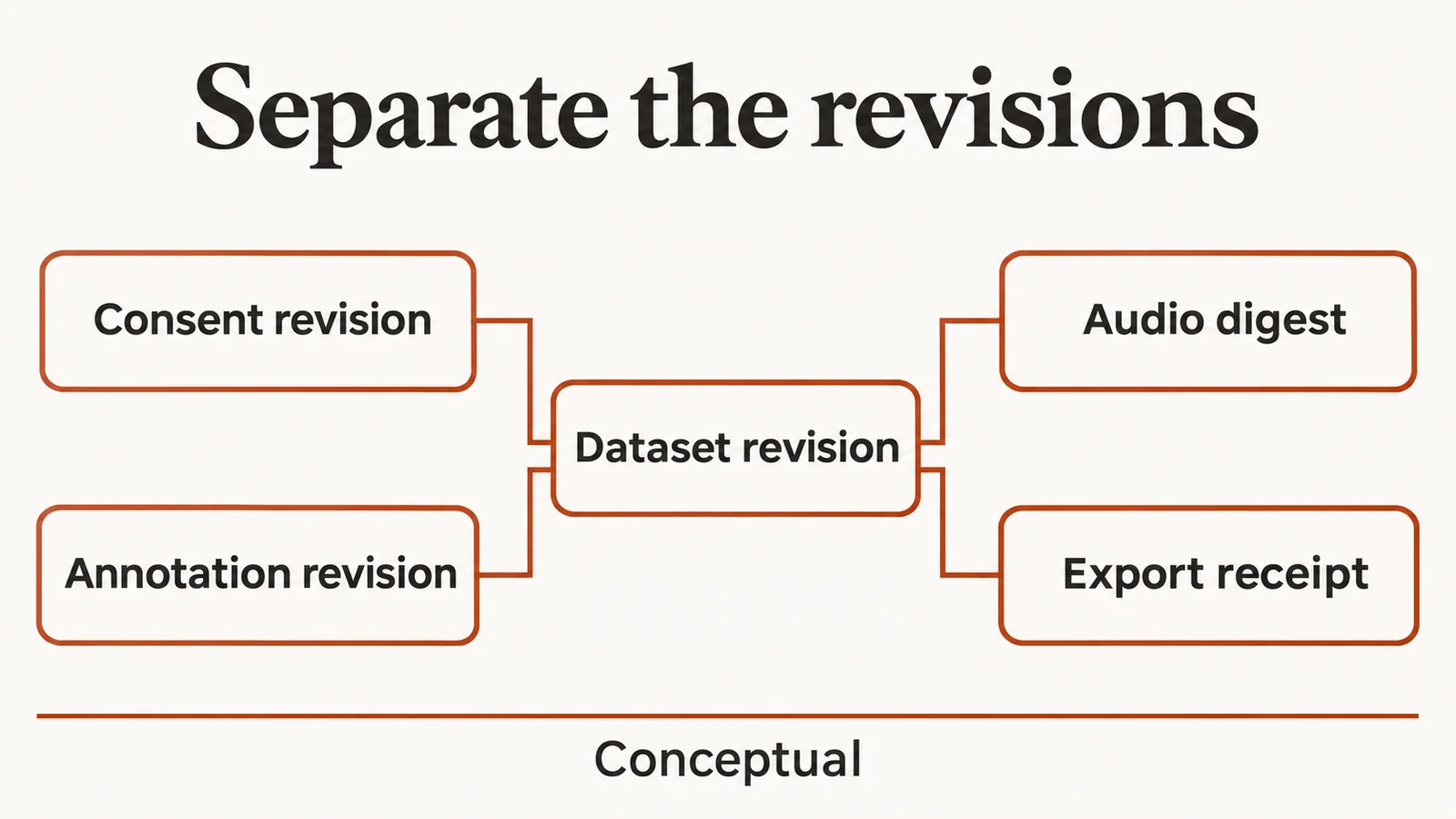
A permission correction must have an explicit owner. The engineering gate can reject inconsistent revisions, but it cannot decide whether a participant-facing record was validly obtained. Route that question to the appropriate collection and review process, and keep the resulting evidence revision in the owning system.
The same audio digest can occur in different recording records, including intentional duplicates or separately scoped uses. Do not use the digest as the withdrawal subject. Bind the action to the declared participant, recording and purpose, then use the digest only to identify the associated bytes.
Keep identity linkage corrections versioned too. If a recording was attached to the wrong participant, freeze affected uses while the owning process resolves the record. Call and settings isolation offers a related engineering lesson: shared content does not establish shared authority or ownership.
A subject-wide withdrawal is a broader operation than a single-purpose withdrawal. Its evidence should say that scope explicitly. Do not broaden a narrowly requested withdrawal by guesswork, and do not narrow a broad one merely because the storage system happens to organize files by recording.
In the reference ledger, withdrawal is terminal. A new permission discussion is a separate reviewed process outside the example, not a higher revision that overrides the tombstone. Do not manufacture another subject ID to evade a withdrawal that still applies to the same participant.
Validate withdrawal-aware release manifests
The reference gate issues metadata manifests after a local preparation callback. That callback must not distribute files or perform the release itself. After the callback returns, the gate rechecks current permission, recording identity and local ticket age before issuing a manifest.
This scope makes the race test honest. The code can prevent stale eligibility from becoming a new local manifest. It cannot undo a transfer that a callback already performed, and an actual exporter must enforce current eligibility again at its own final submission boundary.
Save the complete fence as speech_permissions.py and run it with Python 3.11 or newer. All subjects, recordings, evidence IDs and digests are synthetic tokens. The injected clock represents a local eligibility-cache and ticket-age domain, not a legal interpretation of when consent expires.
import asyncio
from dataclasses import dataclass
from math import isfinite

def text(x):
    if type(x) is not str or not x:
        raise ValueError("nonempty text required")
    return x

def number(x):
    if type(x) not in (int, float) or not isfinite(x):
        raise ValueError("finite clock value required")
    return x

PURPOSES = {"capture", "evaluate", "train", "release"}

@dataclass(frozen=True)
class Grant:
    subject: str
    recording: str
    purpose: str
    revision: int
    evidence: str
    valid_until: float

    @classmethod
    def admit(cls, row):
        revision = row["revision"]
        if type(revision) is not int or revision < 1:
            raise ValueError("positive revision required")
        purpose = text(row["purpose"])
        if purpose not in PURPOSES:
            raise ValueError("declared purpose required")
        return cls(text(row["subject"]), text(row["recording"]), purpose,
                   revision, text(row["evidence"]), number(row["valid_until"]))

class Ledger:
    def __init__(self, clock):
        self.clock = clock
        self._grants, self._captures = {}, {}
        self._withdrawals, self._history, self._queue = set(), [], []

    @property
    def history(self):
        return tuple(self._history)

    def drain(self):
        result = tuple(self._queue)
        self._queue.clear()
        return result

    def withdrawn(self, subject, recording, purpose):
        return any(s == subject and (r is None or r == recording) and
                   (p is None or p == purpose)
                   for s, r, p in self._withdrawals)

    def withdraw(self, subject, recording=None, purpose=None):
        subject = text(subject)
        if recording is not None: recording = text(recording)
        if purpose is not None and purpose not in PURPOSES:
            raise ValueError("invalid withdrawal purpose")
        self._withdrawals.add((subject, recording, purpose))

    def grant(self, row):
        g = Grant.admit(row)
        key = (g.subject, g.recording, g.purpose)
        if self.withdrawn(*key): return "withdrawn"
        previous = self._grants.get(key)
        if previous:
            if g.revision < previous.revision: return "stale"
            if g.revision == previous.revision:
                return "duplicate" if g == previous else "conflicting_revision"
        self._grants[key] = g
        return "recorded"

    def eligibility(self, key):
        if self.withdrawn(*key): return "withdrawn"
        g = self._grants.get(key)
        if g is None: return "not_granted"
        if number(self.clock()) >= g.valid_until: return "permission_expired"
        return "eligible"

    def capture(self, subject, recording, digest):
        key = (text(subject), text(recording))
        digest = text(digest)
        state = self.eligibility((*key, "capture"))
        if state != "eligible": return state
        previous = self._captures.get(key)
        if previous is not None:
            return "duplicate" if previous == digest else "conflicting_capture"
        self._captures[key] = digest
        return "captured_metadata"

    async def issue(self, subject, recording, purpose, annotation, dataset,
                    prepare, lifetime=10):
        subject, recording, purpose = map(text, (subject, recording, purpose))
        annotation, dataset = text(annotation), text(dataset)
        if purpose not in PURPOSES - {"capture"}:
            raise ValueError("evaluation, training or release purpose required")
        if number(lifetime) <= 0: raise ValueError("positive ticket age required")
        key = (subject, recording, purpose)
        state = self.eligibility(key)
        if state != "eligible": return state
        digest = self._captures.get((subject, recording))
        if digest is None: return "unknown_recording"
        grant = self._grants[key]
        deadline = number(number(self.clock()) + lifetime)
        prepared = await prepare()  # local staging only, never distribution
        if type(prepared) is not str:
            raise ValueError("staged digest text required")
        if self.withdrawn(*key): state = "withdrawn"
        elif self._grants.get(key) != grant: state = "stale"
        elif self._captures.get((subject, recording)) != digest: state = "stale"
        elif number(self.clock()) >= deadline: state = "ticket_expired"
        else: state = self.eligibility(key)
        if state == "eligible":
            state = "manifest_issued" if prepared == digest else "staging_mismatch"
        # Store only supported immutable leaves from the callback.
        entry = (grant, digest, annotation, dataset, prepared, state)
        self._history.append(entry)
        self._queue.append(entry)
        return state

def synthetic(recording="recording-A", purpose="evaluate", **changes):
    r = dict(subject="subject-A", recording=recording, purpose=purpose,
             revision=1, evidence="synthetic-evidence", valid_until=100.0)
    r.update(changes)
    return r

async def tests():
    now = [0.0]
    l = Ledger(lambda: now[0])
    async def stage(): return "same-synthetic-audio"
    assert l.capture("subject-A", "recording-A", "same-synthetic-audio") == "not_granted"
    for recording in ("recording-A", "recording-B"):
        assert l.grant(synthetic(recording, "capture")) == "recorded"
        assert l.capture("subject-A", recording, "same-synthetic-audio") == "captured_metadata"
        for purpose in ("evaluate", "train"):
            l.grant(synthetic(recording, purpose))
    raw = synthetic()
    assert l.grant(raw) == "duplicate"
    raw["evidence"] = "mutated"
    assert l.grant(synthetic(evidence="other")) == "conflicting_revision"
    assert await l.issue("subject-A", "recording-A", "release", "ann-A", "data-A", stage) == "not_granted"
    assert await l.issue("subject-A", "recording-A", "evaluate", "ann-A", "data-A", stage) == "manifest_issued"
    before = l.history
    assert l.drain() == before and l.history == before and l.drain() == ()
    l.withdraw("subject-A", "recording-A", "evaluate")
    assert await l.issue("subject-A", "recording-A", "evaluate", "ann-A", "data-A", stage) == "withdrawn"
    assert await l.issue("subject-A", "recording-A", "train", "ann-A", "data-A", stage) == "manifest_issued"
    assert await l.issue("subject-A", "recording-B", "evaluate", "ann-A", "data-A", stage) == "manifest_issued"
    assert l.grant(synthetic(revision=2)) == "withdrawn"  # terminal in this ledger
    async def withdraw_during_wait():
        l.withdraw("subject-A")
        return "same-synthetic-audio"
    assert await l.issue("subject-A", "recording-B", "train", "ann-A", "data-A", withdraw_during_wait) == "withdrawn"
    assert l.eligibility(("subject-A", "recording-B", "evaluate")) == "withdrawn"
    assert l.history[0][-1] == "manifest_issued"  # no historical recall claim
    t = Ledger(lambda: now[0])
    t.grant(synthetic(purpose="capture")); t.capture("subject-A", "recording-A", "same-synthetic-audio")
    owned = synthetic()
    t.grant(owned)
    owned["evidence"] = "mutated"
    owned["valid_until"] = 0
    async def revise():
        t.grant(synthetic(revision=2))
        return "same-synthetic-audio"
    assert await t.issue("subject-A", "recording-A", "evaluate", "ann-A", "data-A", revise) == "stale"
    assert t.grant(synthetic()) == "stale"
    async def expire():
        now[0] = 10
        return "same-synthetic-audio"
    assert await t.issue("subject-A", "recording-A", "evaluate", "ann-A", "data-A", expire) == "ticket_expired"
    now[0] = 20
    async def wrong_stage(): return "wrong-synthetic-digest"
    assert await t.issue("subject-A", "recording-A", "evaluate", "ann-A", "data-A", wrong_stage) == "staging_mismatch"
    t.grant(synthetic("not-captured"))
    assert await t.issue("subject-A", "not-captured", "evaluate", "ann-A", "data-A", stage) == "unknown_recording"
    assert await t.issue("other-subject", "recording-A", "evaluate", "ann-A", "data-A", stage) == "not_granted"
    now[0] = 100
    assert t.eligibility(("subject-A", "recording-A", "evaluate")) == "permission_expired"
    assert t.history[0][0].evidence == "synthetic-evidence"

asyncio.run(tests())
for changes in ({"revision": True}, {"valid_until": float("nan")}, {"purpose": "anything"}):
    try: Grant.admit(synthetic(**changes))
    except ValueError: pass
    else: raise AssertionError("invalid metadata admitted")
print("Synthetic permission fixtures passed; no recordings or files distributed.")
The program stores immutable grants and string digests, not caller-owned dictionaries. A grant revision cannot be changed by mutating the source mapping. Scoped withdrawal is monotonic in this ledger: a later grant message cannot restore a withdrawn subject, recording and purpose combination.
The synthetic tests use two recordings with the same audio token and several purposes. Withdrawing one recording's evaluation use leaves the other recording and a separate training grant distinct. A later subject-wide withdrawal blocks every matching purpose and recording, including held work after its await.
A separate notification queue can be drained without erasing historical manifest decisions. Those decisions prove only what metadata was issued under this local contract. They are not proof that a recipient received, deleted or stopped using a distributed file.
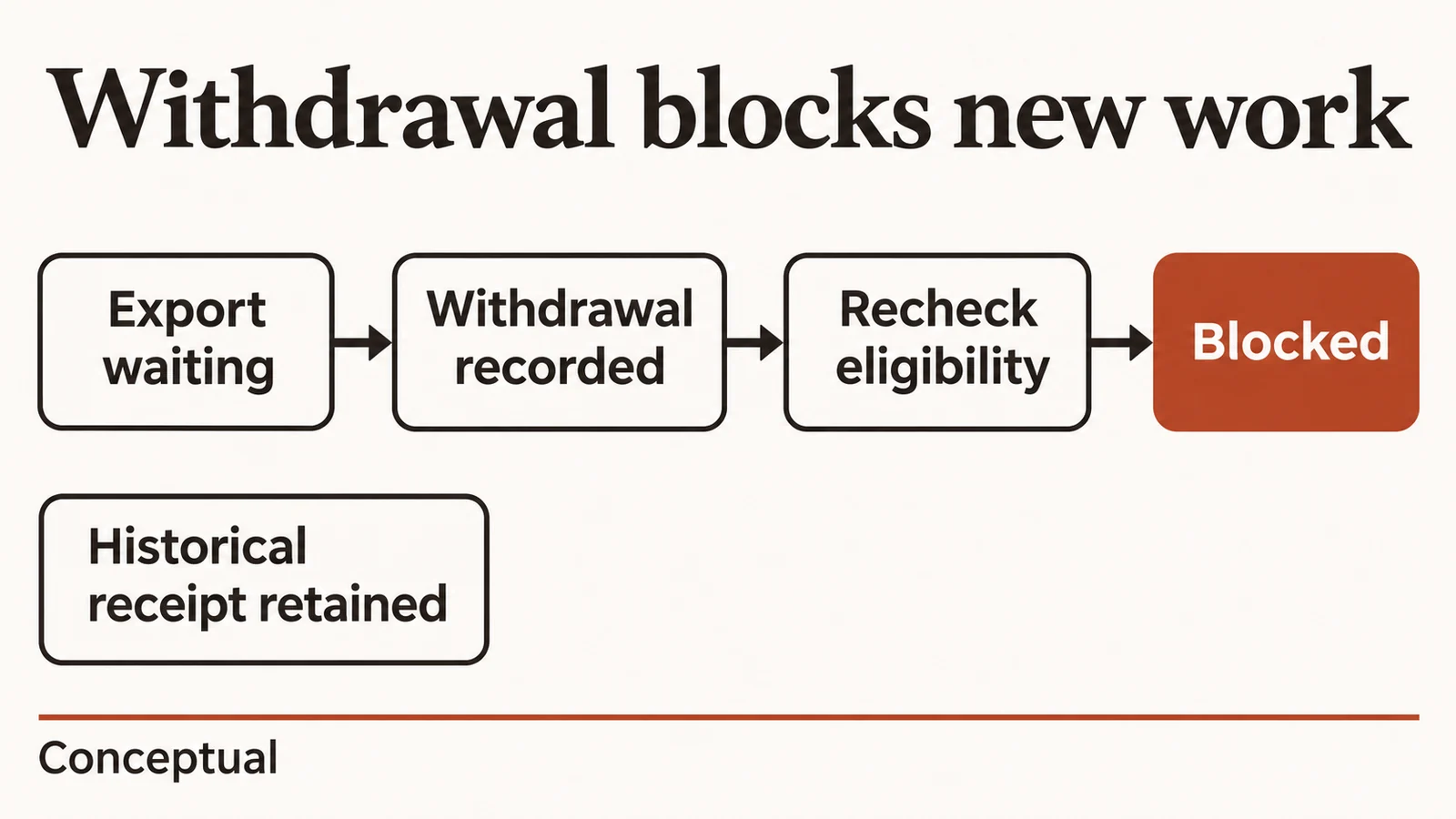
The final submission boundary belongs to the component that actually transfers or makes material available. A manifest issued after a current check can become stale while another service waits. That service needs its own generation, age and withdrawal check immediately before authorized submission, with a transaction or serialization design appropriate to its environment.
The reference callback is explicitly local staging. It returns a digest and must not distribute data. This avoids claiming that a post-await check can prevent a transfer that already happened inside the awaited function. Preserve this boundary when replacing the callback with an actual adapter.
Cancellation of processing and withdrawal of permission are related but distinct states. The terminal shutdown contract explains why old cached work must not recreate authority. A production export controller can add task cancellation while keeping the underlying purpose-specific permission record separately owned.
An empty batch also differs from expired permission. A batch wrapper should return an explicit empty result when no recordings were requested, while the single-record gate returns unknown recording or a permission disposition for a named request. Do not encode all of those recovery cases as an empty list.
Preserve original counters and identities if you add export statistics. Issued manifests, transferred archives and acknowledged recipients are different counts. The endpoint evidence distinction is analogous: local acceptance and remote observation support different delivery claims.
Document the pilot and plan another round
A pilot handoff should include the purpose, participant eligibility, prompt rights, recording format, annotation process, permission schema, withdrawal route, controlled-copy inventory and dataset revision. Include unresolved references and excluded recordings with reasons rather than hiding them from the process record.
A historical community data-download discussion illustrates that participants can have different expectations about account data and recordings. Describe your own export and access process plainly, including which material a response contains and which operations require a separate request.
The NIST AI Risk Management Framework provides wider context for documentation and risk management. It does not certify this pilot or prescribe a universal legal consent form. Use appropriate organizational and legal review for actual participant-facing and release decisions.
Keep evaluation claims attached to real measurements. Regression testing can establish software behavior on fixed fixtures, while outcome metrics require their declared receipts. A collected dataset is an input to an evaluation, not evidence that a model improved.
The next round should address a concrete gap: missing reviewed tasks, insufficient participant provenance, unclear recording conditions, or a reference disagreement. Preserve the first revision and its limitations. Do not broaden the use purpose to justify another collection without updating the brief and permission process.
Before another collection round, replay the withdrawal fixtures through the real operating route using synthetic records. Verify that a narrowly scoped withdrawal leaves unrelated purposes distinct, that a subject-wide withdrawal affects all linked recordings, and that an old eligibility cache cannot issue new work after either change.
Ask another reviewer to reconstruct one issued manifest from its original evidence records. They should find the participant linkage, recording digest, permission purpose and revision, annotation revision, dataset revision and local decision disposition. If one value is available only in an engineer's memory, fix the record before relying on it.
Keep the final report's vocabulary precise. Collected audio is not automatically reviewed audio; reviewed audio is not automatically eligible for a new purpose; issued metadata is not proof of distribution. These distinctions make the pilot useful to another team without turning its internal process into an unsupported legal or performance claim.
A collection handoff should include a worked synthetic withdrawal example in addition to the successful release path. Show which subject, recording and purpose were affected, which held decision became invalid, and which historical records remained restricted evidence. This lets the next operator test the process without exposing a real participant.
Also verify the operational contact route using nonparticipant test data. A clear request channel is useful only when the owning team can identify the relevant controlled records and carry out the stated process. Record the responsible role and procedure in the internal operating material rather than promising a response that no one owns.
Keep the collection's limitations beside its intended uses when sharing a manifest. Another engineer should see the unresolved annotation scope, the synthetic-versus-real distinction and any unsupported use purpose at the same point they see the files. A separate presentation slide is too easy to lose when a dataset becomes a dependency.
Frequently asked questions
How small can a useful pilot be?
Small enough to answer a clearly bounded engineering question with reviewed references and visible limitations. This guide supplies no universal recording count. Define the task cells and stopping rule, then inspect whether the collected evidence supports the next decision rather than treating volume as the goal.
Why start with one evaluation purpose?
It makes the brief, access boundary and permission checks understandable. Training and public release create different uses and operational consequences. Keep them explicit so a working internal evaluation does not silently become authorization to distribute recordings or build another voice-related system.
What should the participant brief explain?
Explain the recording, intended uses, optional metadata, access, retention approach, contact route and withdrawal limits. Use understandable language and appropriate review. Do not place implementation jargon in the participation flow unless it helps someone make a meaningful decision about the actual use.
Does a license prove recording consent?
No. A license record concerns a defined rights or usage boundary and cannot by itself prove the participant's understanding or every relevant permission. Preserve the participation process and obtain appropriate review for the actual use rather than treating a metadata validator as legal certification.
Does CC0 authorize every use of a voice?
Do not interpret a copyright dedication as blanket informed permission for every possible voice use. Review the actual scope, rights and participation process with appropriate expertise. This engineering guide separates purpose records but does not provide a legal conclusion about a particular recording or jurisdiction.
Should a small pilot include children?
This pilot is scoped to adults. Uncertain age eligibility should stop admission pending review. A project involving children needs a separate collection design and appropriate safeguards and review, which cannot be obtained by copying an adult permission field or inferring age from a voice.
Can private customer calls be reused?
Not on the basis of this guide or an internal evaluation purpose alone. Resolve the actual authorization, participant expectations, data rights and access boundaries first. The examples use synthetic identifiers and explicitly consented collection concepts, not private customer recordings or assumed secondary-use permission.
How should prompts be licensed?
Keep prompt source, rights evidence and review status in the corpus record. Generated text still needs linguistic and task review, and third-party text needs an appropriate usage basis. Do not assume that public availability or a historical community discussion grants rights for your collection.
Can generated prompts replace linguistic review?
No. They can propose scenarios, but they do not establish naturalness, task meaning or a valid regional-language reference. Use qualified reviewers, preserve disagreements and mark generated material synthetic. The deterministic metadata fixtures in this article do not validate language content.
What recording conditions should be documented?
Record format, sample rate, channels, codec, decoder, capture point and known transformations. Keep artifact identity and task context. These values help distinguish a signal defect from a language or workflow error and prevent transformed audio from silently replacing the original evaluation input.
Who reviews regional-language annotations?
Use reviewers qualified for the language content and task domain, with a documented correction and disagreement process. A script-valid string is not automatically a correct reference. Keep annotation revision separate from recording identity so a correction can be recomputed across all affected results.
What costs belong in the worksheet?
Include actual recruitment, briefing, recording, review, rework, participant compensation and fixed operating inputs, with units, currency and date where relevant. Count work on rejected or unresolved material too. This guide provides no invented regional prices or predicted recognition gains per recording minute.
How should rejected recordings be counted?
Keep them in the collection process record with the review reason and actual work spent. Exclude them from a scored eligible subset only under a declared rule. Removing the file from the released corpus should not erase its cost or conceal a recurring collection-interface problem.
Which dataset components need separate versions?
Separate source audio identity, annotations, task references, split assignments, permissions and release manifests. A change in one component can alter eligibility or scores without changing the others. Preserve the mapping so a later report can distinguish a model change from a reference or permission change.
What makes a recording eligible for export?
The actual process needs appropriate current permission, reviewed material, declared purpose and release controls. The example checks metadata eligibility for a subject, recording and purpose before issuing a local manifest. It does not prove informed consent, file delivery or the sufficiency of a real release process.
What if permission changes during preparation?
Recheck current scope, revision, withdrawal state and ticket age after awaiting preparation. Reject stale or withdrawn work before issuing the manifest. Any later asynchronous exporter needs its own final check; a local gate cannot undo distribution that a callback already performed.
How should withdrawal affect cached work?
Invalidate held eligibility within the declared subject, recording and purpose scope. Preserve terminal withdrawal so an old cache or later stale grant cannot restore it. Historical manifest receipts can remain restricted evidence under the retention policy without becoming permission for another use.
Can distributed recordings always be recalled?
No such guarantee is made here. The collection may control some copies while public or downstream copies remain outside its reach. Explain that limit before participation and document actual distribution and withdrawal operations rather than claiming that a local metadata flag deletes every copy or derived effect.
What should a dataset datasheet disclose?
Describe purpose, composition, recruitment, recording conditions, annotation, rights and permission boundaries, split rules, versions, access, withdrawal process and limitations. Keep unknowns explicit. A datasheet supports interpretation and accountability but does not itself establish representativeness or legal sufficiency.
When is another collection round justified?
When it addresses a concrete unresolved task or provenance gap under an appropriate purpose. Use actual first-round observations to improve the process. Preserve the previous revision and update the brief and permissions if the intended use changes, rather than treating existing participation as open-ended authorization.
Run a small auditable collection
Write the bounded purpose and participant brief, choose reviewed tasks, and run the synthetic permission fixtures before collecting real audio. Keep actual work units, artifact provenance and annotation corrections visible from the first round.
Before issuing any manifest, verify current subject, recording and purpose eligibility. A useful small dataset is one whose permitted use and limits remain understandable when another engineer receives it, including the recordings that are unresolved or no longer eligible.