
- Benchmarks
Confidence scores are not automatically calibrated probabilities
Audit confidence bins, accepted risk and coverage with a runnable worksheet that preserves unknown labels and untouched holdouts.
- Author
 Udit Goenka
- Editorial date
- Reading time
- 28 min
TL;DR: A score becomes a probability claim only after you define the event, population and evidence supporting that interpretation. Audit fixed bins, accepted-case risk and coverage separately; preserve missing labels and keep threshold selection away from the final holdout.
A voice workflow receives a high recognition score and immediately confirms a captured identifier. Later, the identifier fails a lookup. The score was present, finite and above the configured threshold, but none of those facts established the probability of capturing the intended account correctly.
Start by writing the event next to the score: exact transcript, exact identifier, correct intent, permitted action or completed task. Those events need different labels and may have different populations. A single number cannot inherit all their meanings.
The useful first artifact is an evidence worksheet. Keep case identity, split, model and rubric versions, score, adjudicated outcome and threshold provenance. Compute what that evidence permits, and explicitly return unavailable when a denominator or label set cannot support a result.
The task-outcome discussion develops the gap between transcript quality and successful work. Here, a small standard-library program audits synthetic binary outcomes. It does not fit a calibration model, call a recognizer or measure 60db Agent performance.
Table of contents
- Name the event before interpreting the score
- Separate ranking from probability
- Freeze the evidence partitions
- Define every denominator
- Run the bounded calibration worksheet
- Read the emitted synthetic report
- Handle empty bins and exact edges
- Preserve unknown outcomes
- Choose an operating policy outside the holdout
- Make acceptance criteria reviewable
- Keep subgroup evidence visible
- Version the score-producing instrument
- Connect confidence to safe clarification
- Distinguish a worksheet from calibration fitting
- Review the evidence lifecycle
- Frequently asked questions
- Begin with an auditable decision
Name the event before interpreting the score
A probability refers to an event under stated conditions. For a binary worksheet, the label must mean the same event in every row. Mixing exact transcript labels with downstream completion labels produces arithmetic over incompatible observations.
Suppose a recognizer scores an utterance containing an order code. The application may care about literal code correctness, including a leading zero. Transcript plausibility and code correctness overlap, but one cannot replace the other. The literal identifier guide explains why ordinary text cleanup can change the target itself.
Google's Speech-to-Text v1 request guide describes confidence on recognition alternatives, including availability limits and the fact that ranking does not depend on confidence alone. That documented field should not be silently renamed a probability of business success.
Write a label contract before collecting scores. Specify the observable event, the adjudication procedure, how disagreements are resolved and when an outcome remains unknown. Record whether the evaluator saw final audio, a transcript, a proposed field or a completed downstream operation.
Be precise about the unit of observation as well. An utterance-level score, a token-level score and a conversation-level outcome cannot be pooled simply because all three appear between zero and one. If one conversation supplies several utterances, record their shared origin in the external evidence manifest. Counting them as independent task attempts would change both the event and the apparent amount of support.
A field can be textually correct while its use remains unauthorized. The caller-authentication guide addresses that separate boundary. Calibration of recognition correctness supplies no permission to access an account or change a booking.
Also state the population to which the claim applies. A score checked on short read speech has not thereby been checked on noisy telephone corrections. An application may reuse the numeric representation, but it must retain the narrower evidence scope until another evaluation supports expansion.
Separate ranking from probability
A ranking score asks whether stronger candidates tend to appear ahead of weaker ones. A calibrated probability asks whether cases assigned a particular probability exhibit the corresponding event frequency under the evaluation conditions. These are related questions with different tests.
Multiplying every ranking score by a positive constant can preserve ordering while changing its probability interpretation. Conversely, a coarse probability forecast can look reasonable on broad bins while failing to discriminate among cases that matter to the operating policy.
Scikit-learn's calibration guide explains reliability diagrams and the relationship between probability estimates and observed frequencies. Its discussion also warns that proper scoring rules reflect more than calibration alone. A lower aggregate score does not isolate which property improved.
The worksheet therefore reports a binary mean squared probability error alongside explicit bins. This convention is stated directly rather than delegated to a library default. The Brier score API documents scaling options whose binary and multiclass interpretation needs attention when comparing implementations.
An application threshold adds another question: what happens when cases cross a decision boundary? A score can rank cases usefully while the selected boundary exposes too many important errors. Review acceptance risk and coverage with the costs of clarification and escalation, not only the prettiness of a reliability plot.
The regional speech cohort guide supplies a related warning. A convincing aggregate ordering does not establish consistent behavior across task, channel or speaker cohorts that were not adequately represented in the evidence.
Freeze the evidence partitions
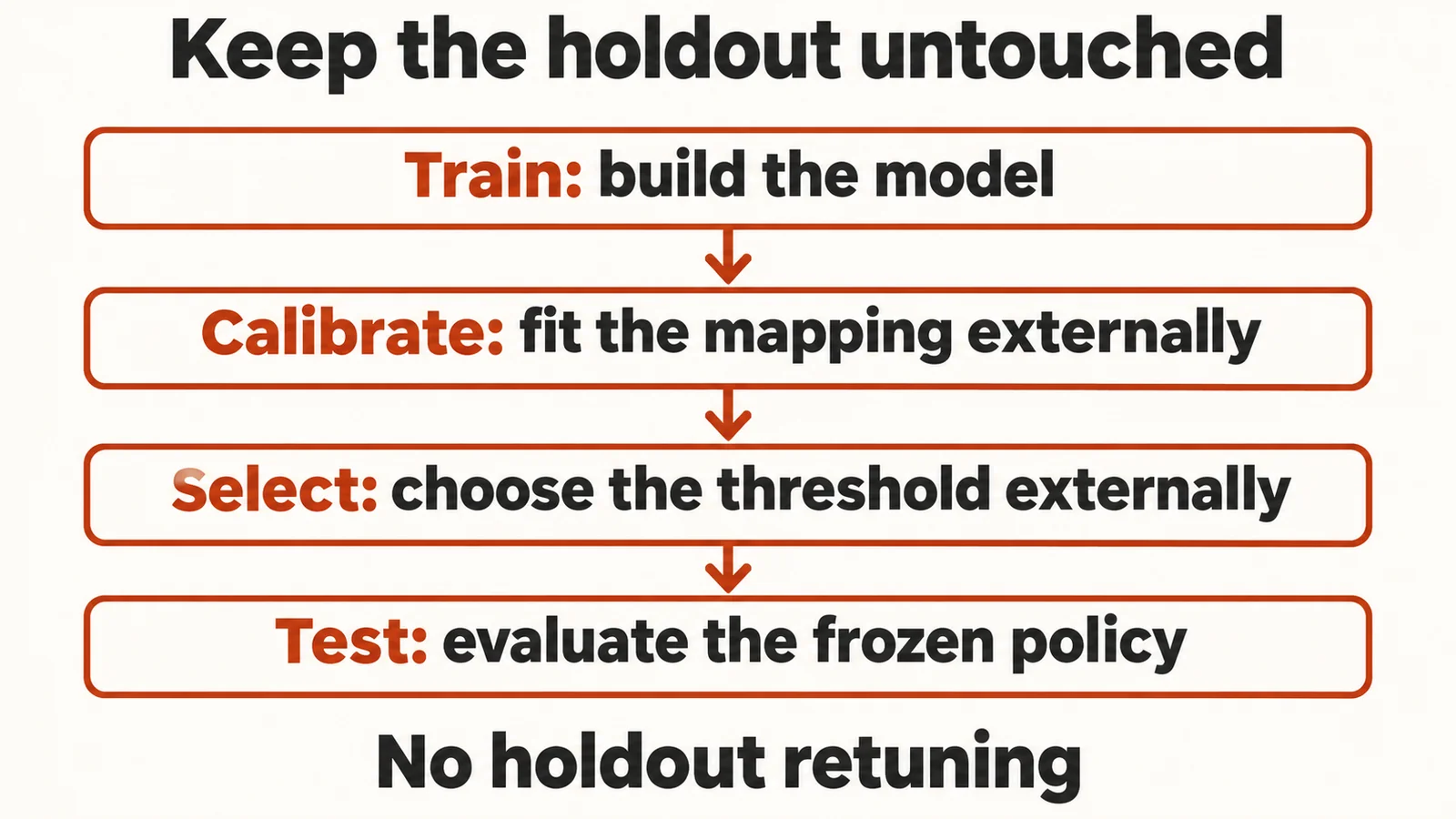
Separate model training, calibration fitting, operating-threshold selection and final testing. Their exact sizes depend on available data and statistical design; the important engineering boundary is that the final test does not become another tuning surface.
The program accepts externally produced policy provenance. Its calibration and selection identity tuples must refer to cases in the corresponding partitions. It rejects duplicate case identities anywhere in the supplied worksheet, including identities reused across different splits.
This identity check detects declared overlap. It cannot discover two recordings of the same speaker when their lineage metadata was discarded, nor prove that a model provider never trained on the underlying content. Those are dataset and provider evidence obligations.
The consented dataset guide explains why provenance should be recorded when recordings enter a collection. Recovering speaker or source relationships after evaluation can be substantially harder than preserving them at admission.
The policy includes an explicit holdout-retuned flag. The worksheet refuses a policy whose provenance admits test-driven retuning. A false declaration can still bypass this local check; the field is an auditable assertion, not cryptographic proof of the evaluation process.
Review the actual selection record before running the holdout. Keep the threshold, mapping version, rubric version and allowed score domain fixed. If the final result leads to a policy change, retire that result as a final untouched test and obtain another appropriately independent evaluation.
Define every denominator
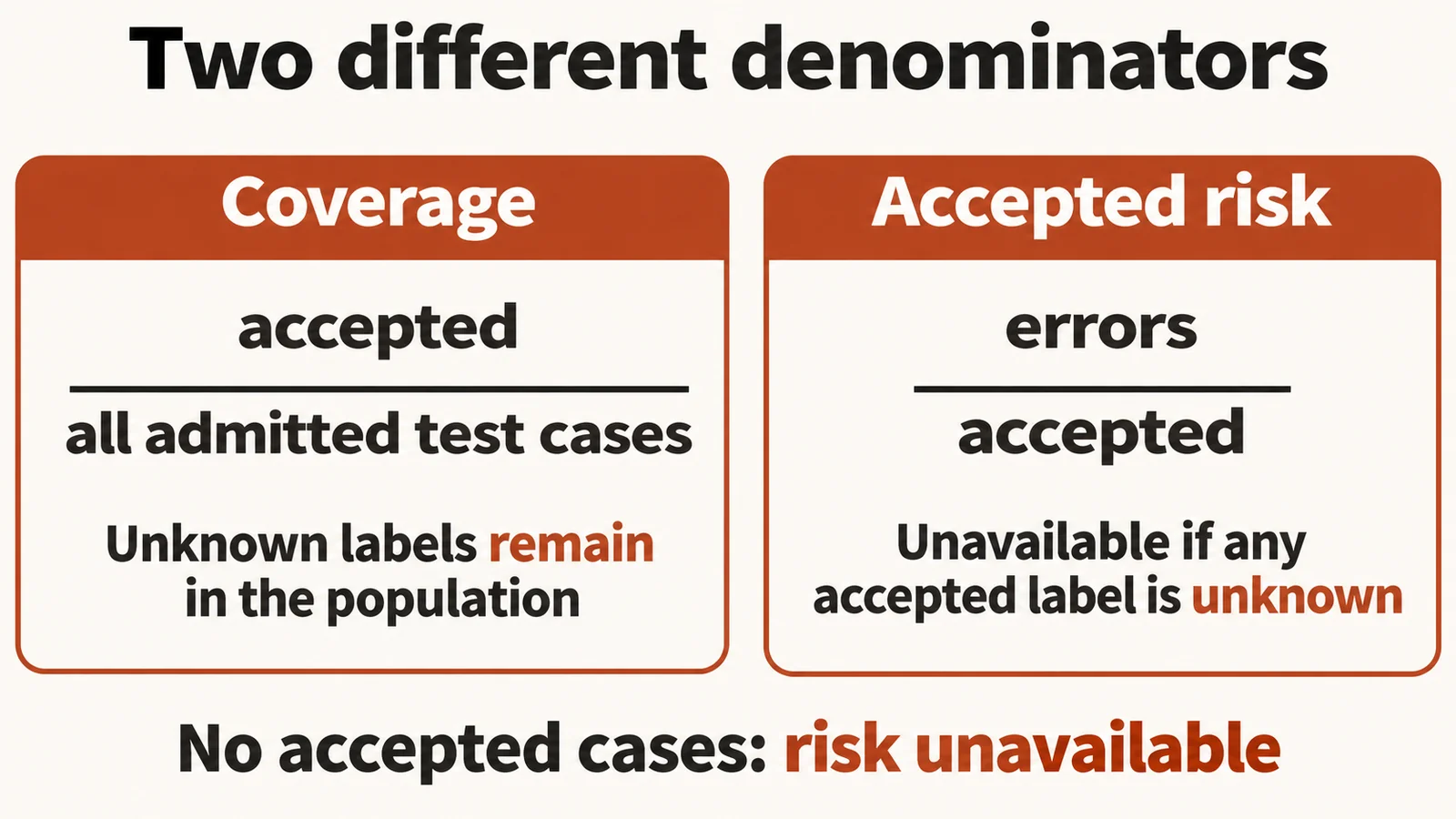
Coverage answers how many score-bearing test cases the threshold accepts. In this worksheet it is accepted cases divided by all admitted test cases, including cases whose outcome is still unknown. That makes the decision population visible without inventing labels.
Accepted risk answers a different question: how many accepted cases are wrong divided by accepted cases. The program emits that fraction only when every accepted case has an adjudicated binary outcome. Otherwise it reports null and separately preserves accepted unknowns and known errors.
This conservative policy avoids presenting a labeled subset as the full accepted population. A different estimator could use a documented missingness model or explicitly report conditional labeled-case risk, but it must not silently rename that estimate population risk.
Bin means and positive frequencies use the same labeled cases within each bin. Each bin also exposes its total score count and unknown-label count, so the reader can see how much of the admitted bin contributed to the comparison.
The Brier denominator is labeled test cases only. That is an explicit descriptive statistic on available adjudications, not an estimate corrected for nonrandom missing labels. If hard cases disproportionately lack outcomes, its apparent improvement may reflect changing ascertainment.
Keep decision coverage separate from evidence coverage. The first tells you what the threshold would accept from the admitted score population; the second tells you how much of that population has usable adjudication. A release review needs both. An operating policy that accepts many cases can still have insufficient evidence to estimate its accepted risk, and a thoroughly labeled evaluation can still describe a policy that accepts almost nothing.
The evaluator drift audit applies the same discipline to paired judge results. A usable pair denominator should not conceal missing runs, abstentions or invalid responses simply because they complicate the headline.
Run the bounded calibration worksheet
Save the complete fence as calibration-worksheet.py and run it with Python 3.11 or newer. It validates immutable records, audits partition provenance and prints a reusable report after executing its boundary tests. The only dependencies are in the standard library.
The trusted adapter supplies real model versions, distinct case identities, adjudicated labels and truthful partition provenance. This code checks the declared shape and relationships. It does not authenticate those declarations, fit a mapping or select a threshold.
from dataclasses import dataclass, replace
import json
import math


def text(value):
    if type(value) is not str or not value.strip():
        raise ValueError("nonempty text required")
    return value


@dataclass(frozen=True)
class Row:
    case_id: str
    split: str
    model: str
    rubric: str
    score: float
    label: int | None
    subgroup: str | None

    def __post_init__(self):
        for value in (self.case_id, self.model, self.rubric):
            text(value)
        if type(self.split) is not str or self.split not in {
            "train", "calibrate", "select", "test"}:
            raise ValueError("unknown split")
        if type(self.score) not in (int, float):
            raise ValueError("numeric score required")
        if not 0 <= self.score <= 1 or not math.isfinite(self.score):
            raise ValueError("score outside finite unit interval")
        if self.label is not None and (
            type(self.label) is not int or self.label not in (0, 1)
        ):
            raise ValueError("integer binary label or None required")
        if self.subgroup is not None:
            text(self.subgroup)


@dataclass(frozen=True)
class Policy:
    model: str
    rubric: str
    mapping_version: str
    threshold: float
    calibration_ids: tuple[str, ...]
    selection_ids: tuple[str, ...]
    holdout_retuned: bool = False

    def __post_init__(self):
        for value in (self.model, self.rubric, self.mapping_version):
            text(value)
        if type(self.threshold) not in (int, float):
            raise ValueError("numeric threshold required")
        if not 0 <= self.threshold <= 1 or not math.isfinite(self.threshold):
            raise ValueError("invalid threshold")
        for ids in (self.calibration_ids, self.selection_ids):
            if type(ids) is not tuple or not ids:
                raise ValueError("nonempty immutable provenance required")
            for item in ids:
                text(item)
            if len(set(ids)) != len(ids):
                raise ValueError("duplicate provenance identity")
        if type(self.holdout_retuned) is not bool or self.holdout_retuned:
            raise ValueError("untouched holdout declaration required")


def audit(rows, policy, bins=4):
    if type(policy) is not Policy:
        raise ValueError("exact policy required")
    if type(bins) is not int or not 1 <= bins <= 100:
        raise ValueError("bounded positive bin count required")
    owned = tuple(rows)
    if any(type(row) is not Row for row in owned):
        raise ValueError("exact rows required")
    identities = [row.case_id for row in owned]
    if len(set(identities)) != len(identities):
        raise ValueError("duplicate identity within or across splits")
    by_id = {row.case_id: row for row in owned}
    for ids, split in ((policy.calibration_ids, "calibrate"),
                       (policy.selection_ids, "select")):
        for case_id in ids:
            row = by_id.get(case_id)
            if row is None or row.split != split:
                raise ValueError("provenance references wrong partition")
    if any((row.model, row.rubric) != (policy.model, policy.rubric)
           for row in owned):
        raise ValueError("model or rubric mismatch")
    test = tuple(row for row in owned if row.split == "test")
    labeled = tuple(row for row in test if row.label is not None)
    accepted = tuple(row for row in test if row.score >= policy.threshold)
    unknown_accepted = sum(row.label is None for row in accepted)
    errors = sum(row.label == 0 for row in accepted)
    bin_report = []
    for index in range(bins):
        lower = index / bins
        upper = (index + 1) / bins
        upper_inclusive = index == bins - 1
        members = tuple(row for row in test
                        if lower <= row.score and
                        (row.score <= upper if upper_inclusive else row.score < upper))
        known = tuple(row for row in members if row.label is not None)
        bin_report.append({
            "index": index, "lower": lower, "upper": upper,
            "upper_inclusive": upper_inclusive,
            "total": len(members), "labeled": len(known),
            "unknown": len(members) - len(known),
            "mean_score_labeled": (sum(r.score for r in known) / len(known)
                                   if known else None),
            "positive_frequency_labeled": (
                sum(r.label for r in known) / len(known) if known else None),
        })
    groups = []
    # Missing metadata uses None, never an admitted text sentinel.
    keys = set(row.subgroup for row in test)
    for key in sorted(keys, key=lambda k: (k is not None, k or "")):
        members = [row for row in test if row.subgroup == key]
        groups.append({"subgroup": key, "total": len(members),
                       "labeled": sum(r.label is not None for r in members)})
    return {
        "evidence": "synthetic worksheet; no fitted-model performance claim",
        "model": policy.model, "rubric": policy.rubric,
        "mapping_version": policy.mapping_version,
        "threshold": policy.threshold,
        "calibration_ids": list(policy.calibration_ids),
        "selection_ids": list(policy.selection_ids),
        "test_ids": [row.case_id for row in test],
        "total": len(test), "labeled": len(labeled),
        "unknown": len(test) - len(labeled),
        "accepted": len(accepted), "accepted_unknown": unknown_accepted,
        "known_accepted_errors": errors,
        "coverage": len(accepted) / len(test) if test else None,
        "accepted_risk": (errors / len(accepted)
                          if accepted and not unknown_accepted else None),
        "brier_labeled": (sum((r.score - r.label) ** 2 for r in labeled)
                          / len(labeled) if labeled else None),
        "bins": bin_report, "subgroups": groups,
        "external_task_outcome": "unmeasured",
    }


def expect_rejected(function):
    try:
        function()
    except ValueError:
        return
    raise AssertionError("expected rejection")


def fixture():
    base = [Row("cal", "calibrate", "m1", "r1", .5, 1, None),
            Row("sel", "select", "m1", "r1", .5, 1, None)]
    scores = (("zero", 0.0, 0, None), ("edge", .5, 1, "unknown"),
              ("high", .9, 0, "telephone"), ("one", 1.0, 1, "telephone"))
    return base + [Row(case, "test", "m1", "r1", score, label, group)
                   for case, score, label, group in scores]


def tests():
    rows = fixture()
    policy = Policy("m1", "r1", "external-map-1", .5, ("cal",), ("sel",))
    result = audit(rows, policy)
    assert result["accepted"] == 3 and result["accepted_risk"] == 1 / 3
    assert result["coverage"] == 3 / 4
    assert [b["total"] for b in result["bins"]] == [1, 0, 1, 2]
    assert result["bins"][1]["mean_score_labeled"] is None
    assert result["bins"][-1]["upper_inclusive"] is True
    decimal_edge = replace(rows[-1], case_id="decimal-edge", score=.29)
    edge_report = audit(rows[:2] + [decimal_edge], policy, bins=100)
    assert edge_report["bins"][28]["total"] == 0
    assert edge_report["bins"][29]["total"] == 1
    assert result["subgroups"][0]["subgroup"] is None
    assert any(g["subgroup"] == "unknown" for g in result["subgroups"])
    for bad in (float("nan"), float("inf"), -.1, 1.1, 10**10000,
                True, "0.9"):
        expect_rejected(lambda: replace(rows[-1], score=bad))
        expect_rejected(lambda: replace(policy, threshold=bad))
    expect_rejected(lambda: replace(rows[-1], label=True))
    expect_rejected(lambda: replace(rows[-1], label="1"))
    expect_rejected(lambda: audit(rows + [replace(rows[0], split="test")], policy))
    expect_rejected(lambda: audit(rows, replace(policy, selection_ids=("zero",))))
    expect_rejected(lambda: replace(policy, holdout_retuned=True))
    expect_rejected(lambda: audit(rows, policy, bins=True))
    expect_rejected(lambda: audit(rows, policy, bins=0))
    expect_rejected(lambda: audit(rows, object()))
    unknown = rows[:-1] + [replace(rows[-1], label=None)]
    report = audit(unknown, policy)
    assert report["accepted"] == 3 and report["accepted_unknown"] == 1
    assert report["accepted_risk"] is None and report["unknown"] == 1
    none_accepted = [replace(r, score=0) if r.split == "test" else r for r in rows]
    assert audit(none_accepted, policy)["accepted_risk"] is None
    empty = audit(rows[:2], policy)
    assert empty["coverage"] is None and empty["brier_labeled"] is None
    snapshot = audit(rows, policy)
    rows.clear()
    assert snapshot["total"] == 4


if __name__ == "__main__":
    tests()
    frozen_policy = Policy("m1", "r1", "external-map-1", .5, ("cal",), ("sel",))
    print(json.dumps(audit(fixture(), frozen_policy), indent=2, allow_nan=False))
The records are frozen and the function snapshots the input collection before computing. Returned dictionaries are fresh reports, not mutable approved policies. The exact-record guard prevents unrelated objects from being recursively serialized into the output.
Read the emitted synthetic report
The fixture deliberately includes scores at zero, the threshold, a high-score error and one. Its accepted set contains three synthetic test identities, one known error and no unknown accepted labels. The printed risk is therefore the arithmetic fraction one divided by three, not a measured deployment error rate.
Coverage is three divided by four because all four score-bearing test cases belong to that denominator. The bin totals are one, zero, one and two under four equal-width bins. Those counts can be recomputed directly from the printed test identities and the source fixture.
The report also emits calibration and selection provenance, threshold, mapping version and an explicit unmeasured external task outcome. That last field prevents a consumer from treating an available calibration statistic as evidence that a business action completed.
Retain the source fixture or a controlled evidence manifest with the report. A list of derived averages without original score and label evidence cannot support independent recomputation. For a real evaluation, use approved deidentified evidence references rather than publishing raw caller material.
When integrating the function into a command-line workflow, keep admission errors separate from evaluation results. A rejected malformed file should produce a failed audit invocation, not an empty successful report. Likewise, a missing required provenance row should remain an explicit failure. A surrounding batch runner can retain that failed attempt in its ledger while continuing unrelated audits, but it must not replace the missing result with a favorable default.
The telemetry-redaction guide discusses the tension between privacy and useful diagnostics. Public documentation can show synthetic rows while a restricted audit system retains only the authorized evidence needed for the actual task.
Do not compare this fixture's values with a provider dashboard. The fixture exists to expose arithmetic, boundary handling and output shape. It has neither representative sampling nor a real score-producing model, so it cannot rank recognizers or justify a production threshold.
Handle empty bins and exact edges
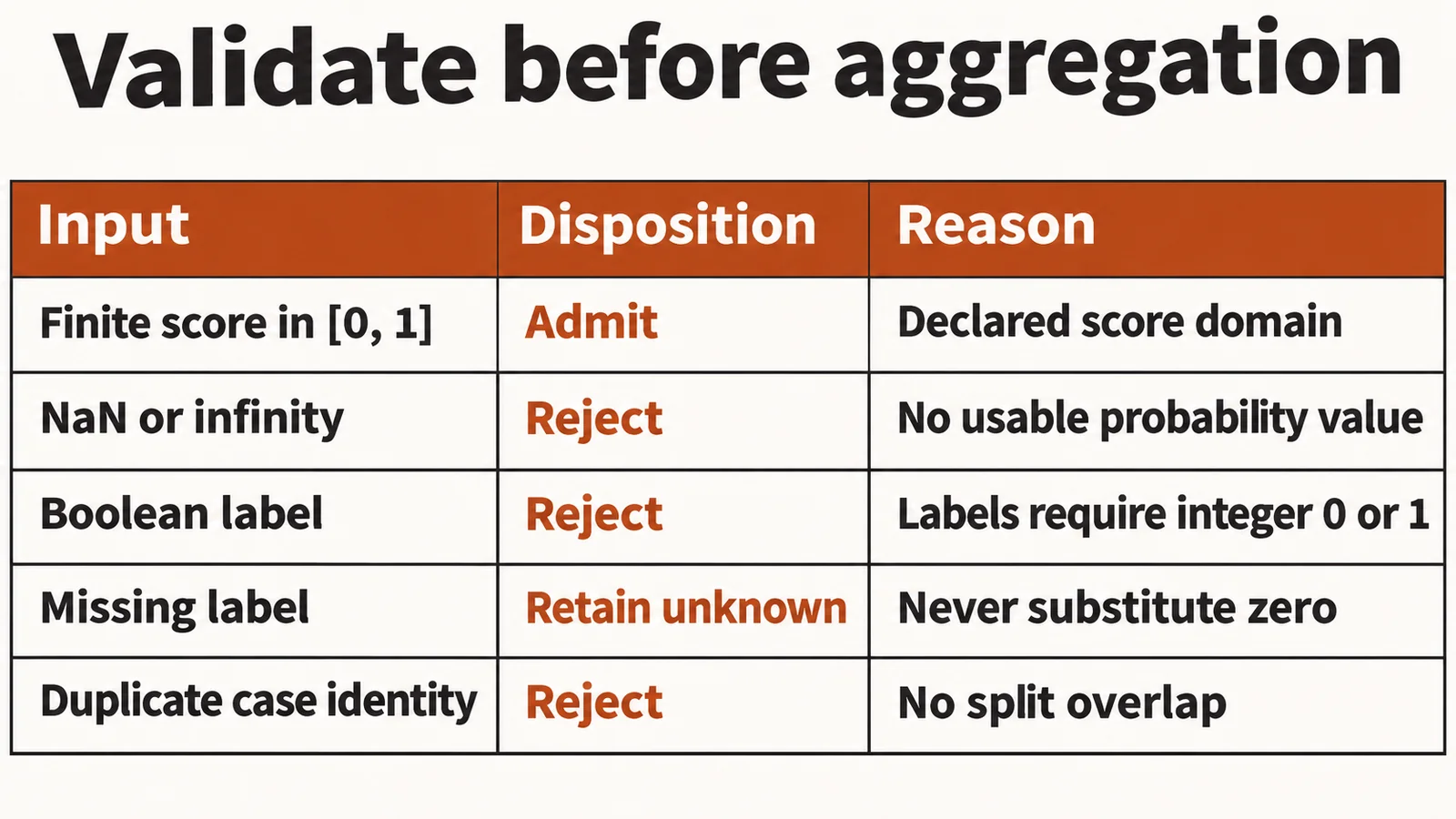
A fixed binning policy makes boundary behavior reviewable. This implementation uses left-inclusive intervals and includes the final upper edge in the last bin. Zero and one are admitted values; neither is confused with missing data or counted in two bins.
The threshold comparison is also explicit: equality is accepted. Changing greater-than-or-equal to strictly greater changes the accepted population at the boundary. Include exact-threshold cases in a regression suite rather than assuming floating-point test data will encounter them accidentally.
Scikit-learn's calibration-curve API documents uniform and quantile binning and notes that empty bins do not appear in its returned arrays. This worksheet intentionally retains empty bins with null statistics to make the full declared partition visible.
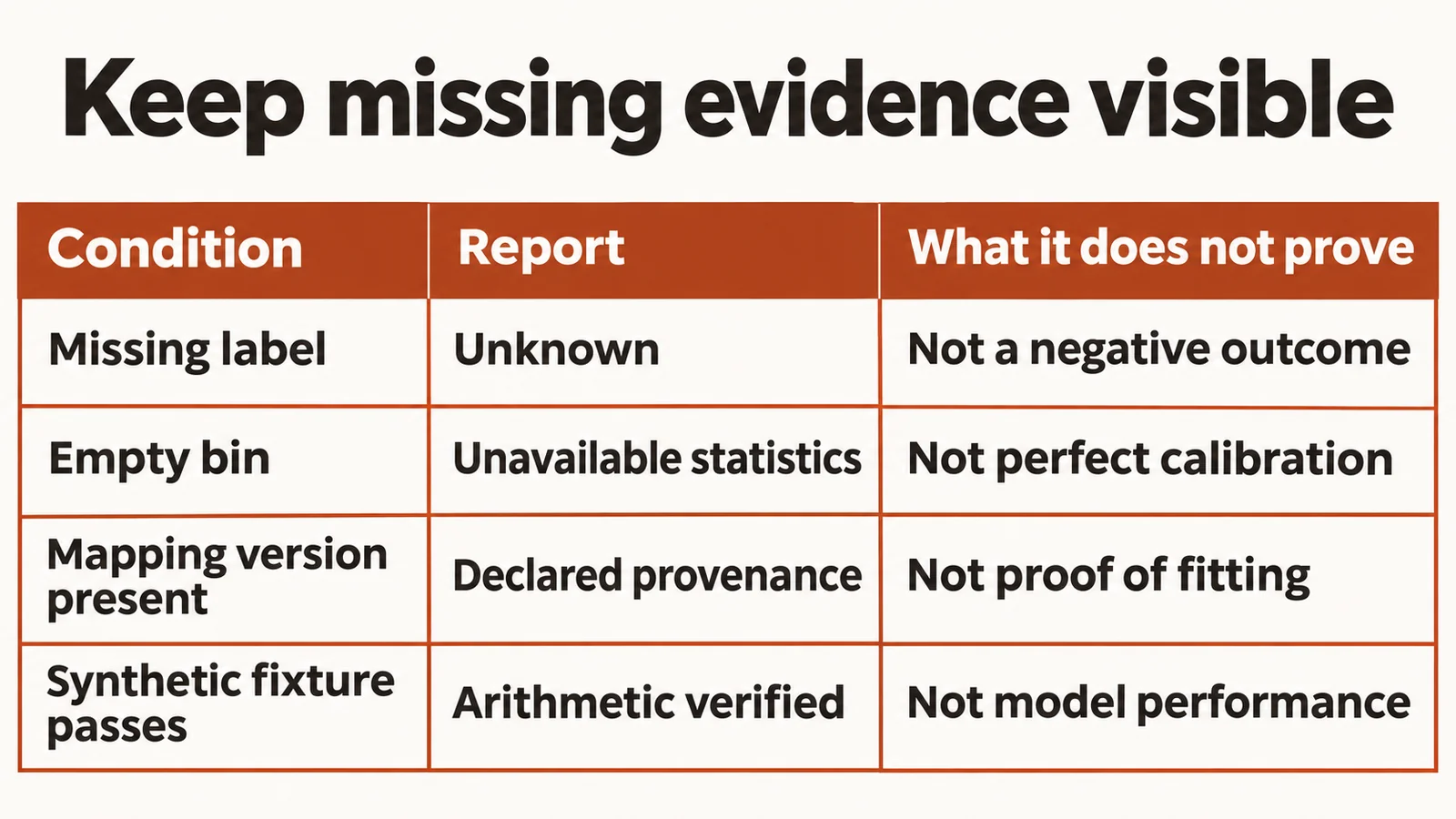
An empty bin is not a perfectly calibrated bin. It contains no evidence for the comparison. Filling its frequency with zero would draw a meaningful-looking point where the evaluation observed nothing, especially misleading near a high operating threshold.
The choice of bins also influences what the reader sees. A coarse bin can combine subpopulations with different behavior; many narrow bins can produce sparse observations. Keep the policy fixed for the declared audit and examine sample support before treating a visual pattern as stable.
The bounded bin count is also a resource policy. A caller cannot request an arbitrarily large table and accidentally turn a small audit into unbounded work. This does not make the function suitable for streaming millions of observations: it snapshots the input and repeatedly scans it for clarity. For a larger collection, retain the same statistical contract while separately evaluating memory, iteration cost and evidence storage requirements.
Preserve unknown outcomes
Missing labels are data about the evaluation process. A caller may stop before an outcome is observable, an adjudicator may disagree with another reviewer, or a downstream system may never provide completion evidence. None of those situations automatically means the target event was false.
The program admits None as an unknown label and keeps it distinct from integer zero. It rejects Boolean values even though Python treats booleans as integer-like in many operations. A typed boundary prevents accidental truthiness from becoming an evaluation policy.
Unknown subgroup metadata also remains separate from the literal subgroup string unknown. A team may legitimately use that text as a category name. Reserving the same string as a missing-value sentinel would silently merge different evidence states.
The partial-transcript guide illustrates another version of this principle. An incomplete observation should remain incomplete until the required final evidence arrives; it should not acquire final semantics merely because a consumer expects a scalar.
Track where unknowns occur. If high-score accepted cases disproportionately lack adjudication, the accepted-risk field becomes unavailable here even when lower-score cases are thoroughly labeled. That inconvenience is useful: it identifies an evidence collection problem before a misleading percentage enters a release decision.
If the operating team needs a bounded best-case and worst-case analysis, add it as a separately named calculation with explicit assumptions. Do not overwrite unavailable risk with a midpoint or quietly count unknown labels as correct to preserve an attractive trend.
Label revision needs its own history. If a reviewer later resolves an unknown case, produce another evidence revision that references the original case and adjudication decision. Do not rewrite an earlier report and leave its timestamp unchanged. The new report can legitimately have an available accepted-risk value, but the difference reflects additional outcome evidence as well as any change in the scoring system.
Choose an operating policy outside the holdout
A threshold reflects operating costs and available recovery behavior. An identifier capture workflow can clarify an uncertain digit; a realtime backchannel may need a different response. There is no universal threshold that transfers unchanged across these decisions.
Use a selection partition to compare candidate operating policies under a declared objective. Record what counted as an error, what clarification cost, which unknown outcomes were excluded from an estimate and which constraints took priority. The code deliberately leaves this optimization outside its bounded audit.
The clarification guide for unfamiliar surnames provides an example where guessing can change identity. A threshold should connect to a concrete fallback that preserves the candidate and asks a useful question, rather than merely lowering a score in a log.
Keep the final holdout out of this loop. Looking at a test result, changing the threshold and reporting the improved result on the same cases changes the role of that data. The program's provenance checks make the declared boundary visible, but process review must establish that the declaration is truthful.
The spoken correction guide adds a temporal dimension. A high score on an earlier candidate does not authorize using it after a caller changes the value. Evidence binds to the candidate version and event definition, not to the conversation indefinitely.
When a policy changes, generate a new immutable policy record. Retain the old report for historical comparison, including failures. Replacing only the displayed threshold while retaining a prior holdout result makes the evidence appear to support a policy it never evaluated.
Make acceptance criteria reviewable
The table uses ✓ to mean that the bounded worksheet directly checks or reports the criterion. A ✗ means that it requires external evidence or another implementation; it is not a claim that the criterion is unimportant.
| Criterion | Local worksheet | Required evidence |
|---|---|---|
| Finite score in the declared unit interval | ✓ | Explicit scalar guards and negative fixtures |
| Zero and one assigned to exactly one bin | ✓ | Boundary fixtures and full bin totals |
| Duplicate declared identities across splits rejected | ✓ | Global identity check before aggregation |
| Accepted-risk denominator includes every accepted case | ✓ | Unknown accepted labels make risk unavailable |
| Calibration mapping was genuinely fitted independently | ✗ | External fitting record and review |
| Cases are independent at speaker and source level | ✗ | Dataset lineage beyond local case IDs |
| Score predicts successful authorized task completion | ✗ | Separately defined task outcomes and authorization |
| Published policy remains valid after deployment drift | ✗ | Continued collection and revalidation |
Use this table during review to separate implementation claims from process obligations. Passing a strict type check does not compensate for an incorrectly adjudicated label. A carefully fitted mapping does not compensate for an accidentally reused holdout.
OpenAI's evaluation best practices emphasize task-specific evaluation and continued evaluation as systems evolve. The worksheet supports a small part of that practice: reproducible accounting for a frozen set of declared binary observations.
The model, prompt and carrier regression guide shows why change isolation matters when a result moves. If several components changed, the new worksheet result may be real while its explanation remains uncertain.
Keep subgroup evidence visible
Aggregate calibration can conceal a slice with little evidence or different error behavior. Record task-relevant subgroup metadata before evaluating, and keep missing metadata visible. Avoid inferring a speaker's region, identity or competence from an accent label.
The code reports subgroup totals and labeled counts, not subgroup calibration confidence intervals. A group containing one case appears as one case. It does not acquire a stable rate merely because its descriptive fraction can be computed.
The Emirati Arabic-English task guide and Egyptian Arabic versus MSA guide illustrate why language, dialect and task definitions need specificity. A broad language tag cannot stand in for the actual evaluation population.
Predeclare important slices where possible. Continually searching many tiny groups after seeing the results can produce alarming or reassuring patterns by chance. Keep exploratory findings separate from the confirmatory evidence used to select an operating policy.
Also examine whether missing labels or rejected inputs cluster in a slice. Reporting only admitted, fully labeled cases can erase the exact channel or task condition that causes the application to struggle. The validation ledger should preserve exclusion reasons alongside the statistical report.
Choose subgroup dimensions for a reason that can change an engineering action. Channel, task type and capture mode may suggest different recovery work. A large collection of incidental labels can increase privacy exposure and encourage speculative explanations without improving the policy. Keep the minimum metadata needed for the declared analysis and verify that combinations do not expose identifiable small groups.
The phone-audio guide provides a concrete channel boundary. Evidence from wideband inputs should not silently become a probability claim for narrowband telephone audio, even when the model exposes the same confidence field.
Version the score-producing instrument
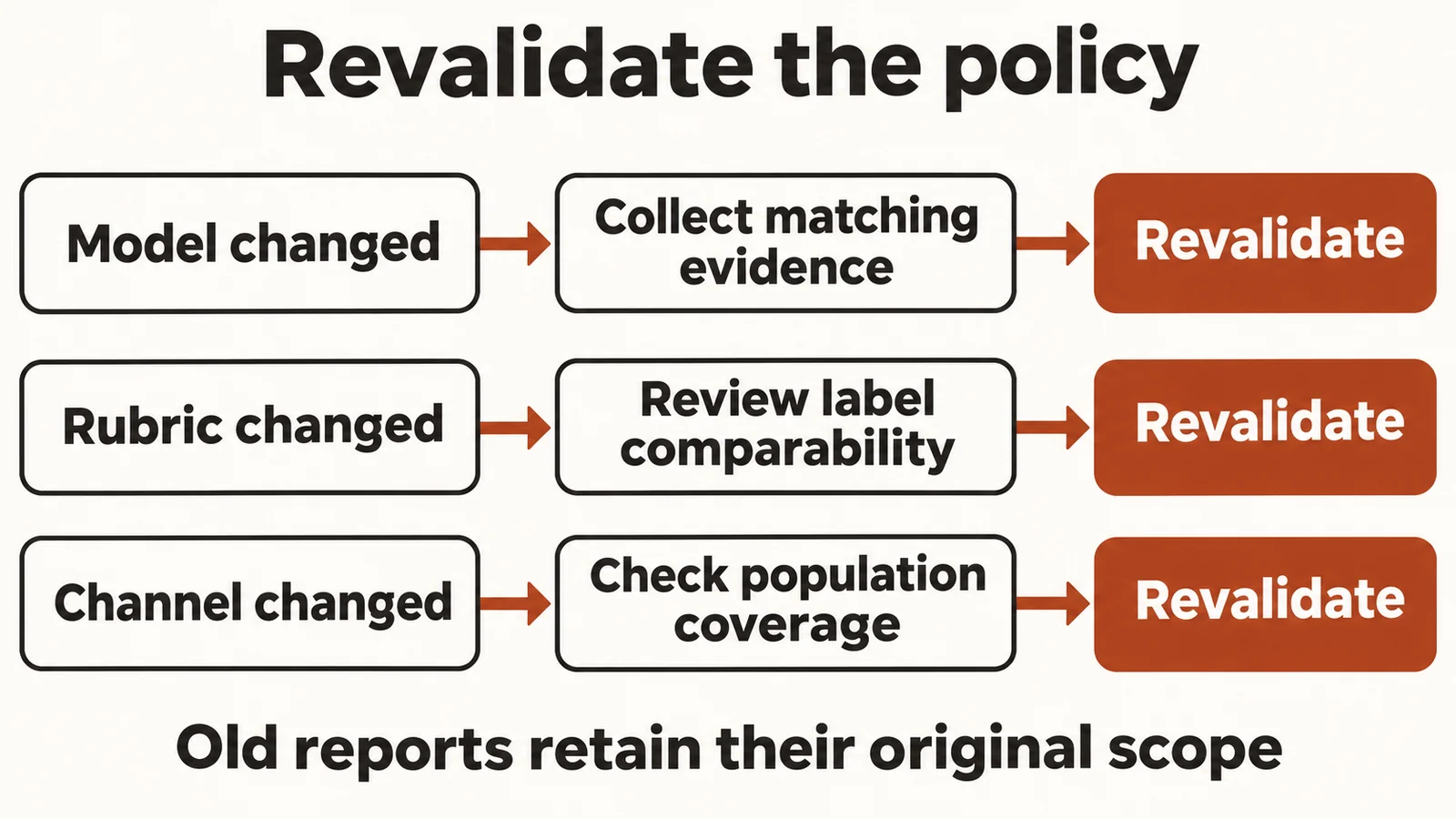
A score's interpretation depends on the system producing it and the process labeling outcomes. Preserve model version, mapping version, rubric version, threshold and relevant input policy. A provider alias alone may not identify the precise deployed behavior over time.
The worksheet compares model and rubric across every supplied row, including provenance partitions. This is intentionally strict for a small example. A more sophisticated design may support several model strata, but it must not pool them accidentally under one mapping without evaluation.
An evaluator update can alter observed labels while frozen outputs remain unchanged. The judge-update audit separates that measuring-instrument change from a system quality regression. A new calibration curve may reflect changed adjudication rather than changed recognition.
Input policy matters too. Altering digit normalization, language hints or a pronunciation dictionary can move the target distribution or candidate semantics. The versioned pronunciation guide shows how a seemingly local text rule can affect spoken output and require new evidence.
Store provenance as immutable values. Do not reuse a mutable settings dictionary and let later edits retroactively alter the meaning of an earlier report. Fresh report dictionaries are convenient outputs, but the underlying policy and admitted observations should retain their original version identity.
The example's tuple provenance is deliberately simple. Real evidence manifests may use controlled content digests and restricted references, but a digest alone does not prove that a dataset is appropriate, consented or independent. Treat content identity as one part of provenance. The process still needs an owner who can explain where the cases came from and why the event labels are credible.
For comparison, distinguish stable policy settings from an individual audit run identifier. Two runs can evaluate the same policy without having the same run ID. Conversely, identical display names do not prove that the mapping, model or rubric settings remained equal.
Connect confidence to safe clarification
A confidence threshold should route to an explicit behavior, such as clarification, escalation or continued collection. It should not bypass semantic validation, authorization or a caller correction. The application needs those contracts independently of whether the score appears convincing.
For example, a high-scoring code with a leading zero must retain that zero. The ZIP and PIN guide describes why numeric conversion can destroy an otherwise well-recognized identifier. Calibration cannot repair a field parser that changes the target.
Amounts need currency and unit context. The ambiguous spoken-number guide explains how a plausible value can still represent the wrong transaction. A score over transcription alternatives does not supply missing currency intent.
Dates need explicit calendar and timezone semantics at the appropriate boundary. The cross-locale scheduling guide keeps date capture separate from resolving an instant. A high-confidence date-only string does not justify inventing midnight.
Design the clarification prompt around the uncertainty that matters. Asking a caller to repeat an entire sentence may be less useful than confirming the ambiguous character or unit. Keep the original candidate and evidence available so a repair does not erase the reason clarification was requested.
Finally, verify completion through the downstream system that owns the action. The duplicate-booking guide addresses a different identity and concurrency problem. A recognition probability cannot prove that a booking occurred once or that a retry is safe.
Distinguish a worksheet from calibration fitting
The program's mapping version is externally declared. No optimizer, isotonic regression or logistic calibration is hidden in the code. Supplying the string external-map-1 does not establish that a mapping exists, was fitted correctly or improves the underlying model.
This separation makes the tool small enough to inspect. It audits arithmetic and declared provenance after a fitting process. A real fitting adapter must preserve its training procedure, parameter output, input versions, calibration data identity and validation evidence.
Similarly, the worksheet does not calculate uncertainty intervals. The printed counts help a reviewer see support, but they do not provide a sampling model, account for dependent recordings or quantify uncertainty caused by adjudicator disagreement.
NIST's AI Risk Management Framework treats measurement and management in context rather than reducing trustworthiness to one scalar. The Generative AI Profile provides additional risk-management context. Neither document turns a toy fixture into deployment validation.
A real developer question about visualizing calibration appears in Yellowbrick's calibration-curve discussion. It is historical community context, not evidence that a current voice model is calibrated. The useful question persists: what evidence should the plot expose rather than hide?
Inspect a proposed fitting integration in two stages. First establish that its output has the promised shape and that the same mapping is applied to the calibration, selection and test evidence under the intended protocol. Then assess whether the empirical result supports the intended probability claim. Passing the first stage is necessary for reproducibility, but it is not the result of the second stage.
Avoid turning a mapping name into a quality label. A deployment manifest can truthfully say which externally fitted mapping produced a score without claiming that the mapping is adequate for every task. Preserve the evaluation scope next to that version so a future integration cannot inherit a broader promise from a short identifier.
Review the evidence lifecycle
Before collecting the holdout, document the candidate policy and event definition. During evaluation, preserve every scheduled case and its admission or exclusion disposition. Afterward, retain original evidence references, the full report and the policy identity that produced it.
Revalidation should be triggered by meaningful changes, including a new model version, revised rubric, changed input channel or a materially different task population. A calendar reminder alone cannot identify whether the old evidence still applies, but a documented review cadence can complement change-triggered checks.
The synthetic-versus-real speech guide distinguishes deterministic fixture coverage from real-speech evidence. Keep synthetic arithmetic tests in the software suite while separately maintaining an appropriately consented evaluation collection for empirical probability claims.
When a report changes, inspect its counts before its averages. Did accepted cases change? Did unknown outcomes grow? Did a subgroup disappear? Did malformed-score rejection increase? A score trend with a shifting denominator may be describing a different evaluation workload.
Assign an owner to each unresolved evidence gap. A missing adjudication requires a labeling decision; malformed scores require an adapter investigation; absent channel coverage requires new collection or a narrower release claim. Sending all three problems to threshold tuning conceals their different causes and can make a numerical adjustment appear to repair an evidence failure.
Preserve failures rather than replacing them with successful retries. A corrected evaluation run can have its own identity and a clear relation to the earlier attempt. Erasing the earlier result hides repeatability and data-quality problems that may matter to the release decision.
Before a threshold is retired, preserve enough of its evidence contract to interpret historical decisions. This does not require retaining raw audio indefinitely. It requires an explicit retention policy for permitted evidence references, versioned summaries and deletion records. A later reader should be able to distinguish an unavailable historical source from an observation that was never collected, without the public report revealing private caller material.
Frequently asked questions
What does a confidence score measure?
Its meaning comes from the producing interface and the event it was designed to score. Read the documented contract. A recognition alternative score does not automatically measure literal field correctness, authorization or completed task probability.
When is a score a calibrated probability?
When appropriately collected outcome evidence supports its probability interpretation for a defined event and population. Calibration remains an empirical property under those conditions, not a permanent guarantee attached to the numeric field.
How is a reliability diagram constructed?
Group probability forecasts under a declared binning rule, then compare mean forecast with observed positive frequency using compatible labeled cases. Retain support counts and explain empty bins. This worksheet emits the underlying table instead of manufacturing a measured plot.
Why can a lower Brier score hide poorer calibration?
The score reflects more than calibration, including discrimination and outcome uncertainty. A change in its aggregate value does not identify the source of improvement. Examine reliability evidence and population changes alongside the declared scoring convention.
What is the denominator for selective risk?
It is the accepted population for the declared policy. Here, any accepted unknown label makes the full accepted-risk fraction unavailable. The program retains known errors and accepted unknowns rather than silently computing a labeled-only surrogate.
How is coverage different from accuracy?
Coverage measures how much of the admitted population the policy accepts. Accuracy measures correctness under a stated label denominator. A policy can reduce errors among accepted cases by accepting fewer cases, so review both outcomes together.
What happens when no cases pass the threshold?
Coverage is zero when the test population is nonempty, and accepted risk is null because its denominator is empty. A missing risk value does not mean perfect performance; the policy made no accepted-case observations.
Should thresholds be selected on test data?
Use a separate selection process before the final holdout. If test feedback changes the threshold, that dataset has influenced selection. Preserve the history and obtain another suitable evaluation rather than describing the reused data as untouched.
How should empty calibration bins be shown?
Show their count as zero and their mean and frequency as unavailable. Do not invent a zero-frequency observation. If a chart omits empty bins, retain the complete bin policy and support table so the omission is understandable.
How do missing labels affect calibration?
They reduce the observed outcome evidence and may bias descriptive statistics if missingness is systematic. Report their location and count. The example uses labeled cases for Brier and bin comparisons while exposing unknowns explicitly.
Can speech recognition confidence authorize an action?
No. Authorization requires the task's identity, permission and confirmation evidence. Recognition confidence may help decide whether to clarify a captured value, but it cannot grant access or prove a downstream operation was permitted.
How should score zero differ from an absent score?
Zero is an admitted endpoint in the declared probability domain. An absent score is unavailable evidence and requires a separate admission policy. This worksheet requires a finite score for every admitted row rather than replacing absence with zero.
Why does a small subgroup need separate uncertainty?
Its descriptive fraction can change substantially with little additional evidence, and dependent recordings may provide less information than their count suggests. Keep subgroup support visible and avoid claiming stable performance from a tiny slice.
How should costs influence escalation thresholds?
Define the consequences of incorrect acceptance, unnecessary clarification and unresolved work for the actual task. Select a policy on separate evidence under that objective. The worksheet audits a supplied threshold; it does not choose business costs.
How do calibration and ranking quality differ?
Ranking concerns relative order; calibration concerns numerical probability interpretation. A monotonic score transformation can preserve order while changing calibration. Evaluate the property needed for the operating decision instead of treating the terms as interchangeable.
When should a deployed threshold be revisited?
Review it after changes to the model, mapping, rubric, input policy, channel or task population, and under a documented ongoing evaluation process. A threshold inherits only the scope of evidence collected for its exact policy.
How can drift invalidate a previous calibration?
The relationship between scores and outcomes can change when the input distribution or producing instrument changes. Preserve versions and compare appropriate new evidence. A changed evaluator can also alter labels without any change to frozen system outputs.
Can synthetic labels establish production accuracy?
No. They can verify arithmetic, admission rules and output shape in a reference implementation. Production accuracy needs representative, appropriately obtained outcome evidence from the actual task boundary and a defensible evaluation design.
Which versions belong in a calibration record?
At minimum retain model, mapping, rubric, threshold and evidence partition identities. Add relevant input and preprocessing policy versions in the real adapter. Keep per-run audit identity separate from the stable policy being evaluated.
What should happen when the score is malformed?
Reject it before aggregation and preserve an exclusion reason in the surrounding evaluation ledger. Do not sort, clamp or convert arbitrary text into a score without a declared adapter contract. Nonfinite and Boolean values are negative fixtures here.
Begin with an auditable decision
Take one confidence-driven branch in the application and write its target event, accepted denominator and fallback behavior. Run the worksheet's boundary fixtures, then connect it to a controlled evidence adapter without changing the meaning of unknown labels.
Before claiming calibrated probabilities, obtain and review the external fitting record, independent threshold-selection evidence and untouched holdout. Before claiming task success, obtain the separate downstream outcome. The first useful improvement is a decision whose evidence can be recomputed and whose limits remain visible.