
- Engineering
Technical abbreviations: API, S3, GPU, and context
Render API, S3 and GPU with reviewed context rules while protecting identifiers, URLs, original text and revision-bound spans.
- Author
 Udit Goenka
- Editorial date
- Reading time
- 27 min
TL;DR: Select abbreviation renderings using an exact token, trusted context, locale and reviewed dictionary snapshot. Bind selected spans to the original text and revision, protect literal identifiers and URLs, and reject stale or overlapping edits before constructing speech.
A global replacement makes a developer explanation easier to hear, then expands the same substring inside an order ID or URL. Another request reuses offsets after a caller repair and changes the wrong characters. Both bugs can produce fluent speech while losing the intended literal value.
Start with a bounded projection: an owned original string, explicit field kind, approved rule scope and spans tied to that exact source revision. The selected token is evidence about one occurrence, not permission to rewrite every matching substring.
SSML 1.1 offers different ways to influence rendering, including substitution and interpretation controls. It does not decide the application's semantic context. The brand and URL preservation method supplies the canonical-value boundary needed before a pronunciation rule is selected.
The standard-library example below performs exact scoped selection and safe literal XML construction for synthetic inputs. It is not a semantic classifier, general tokenizer, phonetic authority or measured speech comparison for 60db Agent. Its first useful output is an immutable plan showing which original spans were admitted and why a literal or clarification path remains necessary.
Table of contents
- Define the occurrence before the pronunciation
- Choose an explicit scoped rendering
- Bind spans to original text and revision
- Protect literal fields and declared ranges
- Construct an inspectable speech projection
- Treat repairs and retries as different operations
- Review actual output under a pinned voice
- Diagnose the smallest failed boundary
- Frequently asked questions
- Release a scoped abbreviation rule
Define the occurrence before the pronunciation
A token's spelling does not determine its meaning. API can appear in an explanation, a catalog label or a literal field. S3 can appear as a standalone storage term or inside another identifier. The application must identify the occurrence before selecting a reviewed spoken form.
Trusted context should come from the owning workflow or a separately evaluated interpretation layer. Do not let arbitrary caller text declare that every occurrence belongs to an approved technical context. A context label is a control input with an explicit source, not a property inferred by a replacement function.
Field kind is another control. A complete literal identifier should remain unchanged by this example, even if its characters resemble a familiar abbreviation. A natural-language field can contain declared protected ranges that also remain outside replacement scope.
The order-ID capture contract preserves the code rather than a convenient verbal expansion. Postal-code preservation makes the same point for numeric-looking strings. Reuse their ownership principle without pretending that all identifiers share one grammar.
A useful rule record includes exact token, locale, context and alias or rendering mode. Keep review and dictionary identity attached. An unreviewed suggestion can enter a review queue, but it should not become approved merely because a TTS engine accepted its text.
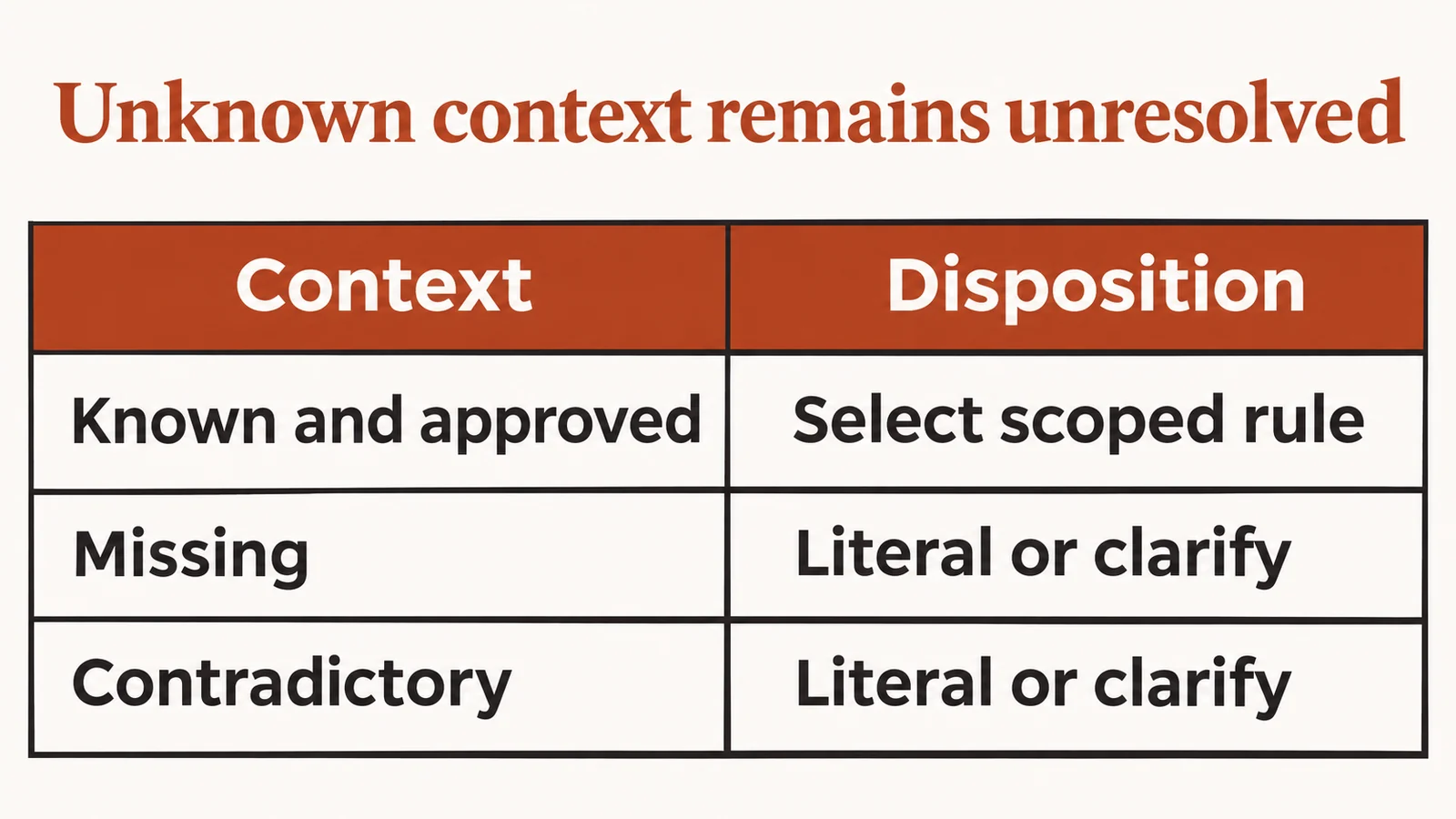
Unknown or contradictory context needs a declared outcome. This artifact returns clarification when a natural-language occurrence lacks a matching rule. It does not make a semantic guess, and it does not partially apply some edits while hiding another unresolved occurrence.
Choose whether the entire field is literal before asking for spans. If the application labels a whole value as an identifier, the constructor returns an unchanged plan without interpreting edit requests. The field owner has already forbidden this transformation.
A synthetic first test can use one standalone term and the same letters inside a longer identifier. The expected difference is selection behavior, not a claim that one universal pronunciation is correct. Preserve the original string in both cases so the test can identify accidental corruption directly.
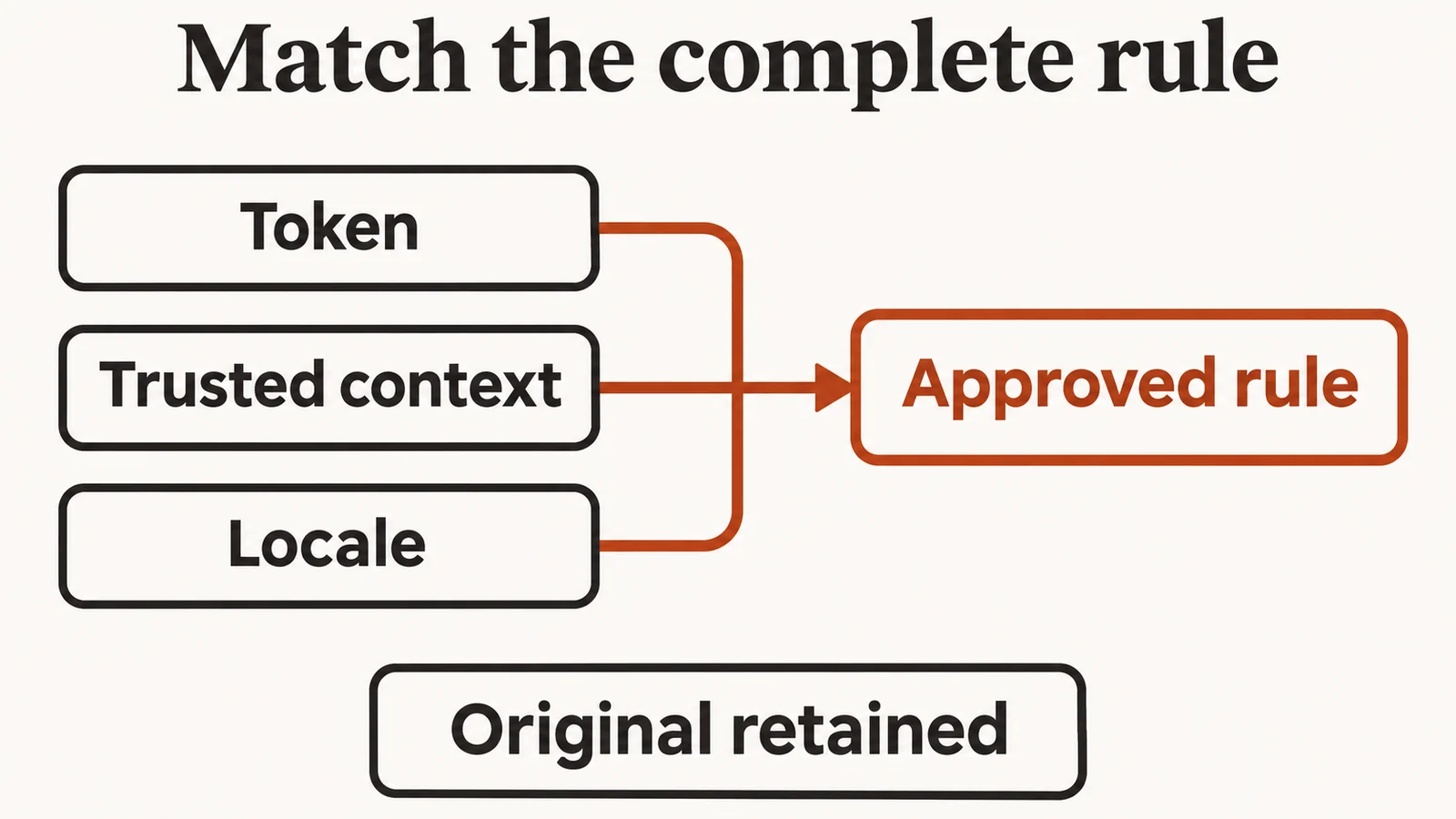
Define the operation as a projection, not an edit to application storage. A returned sentence can contain a reviewed expansion while the original remains the value used by the task owner. Keep the relationship visible in the result so downstream code does not accidentally persist the spoken form as a repaired identifier.
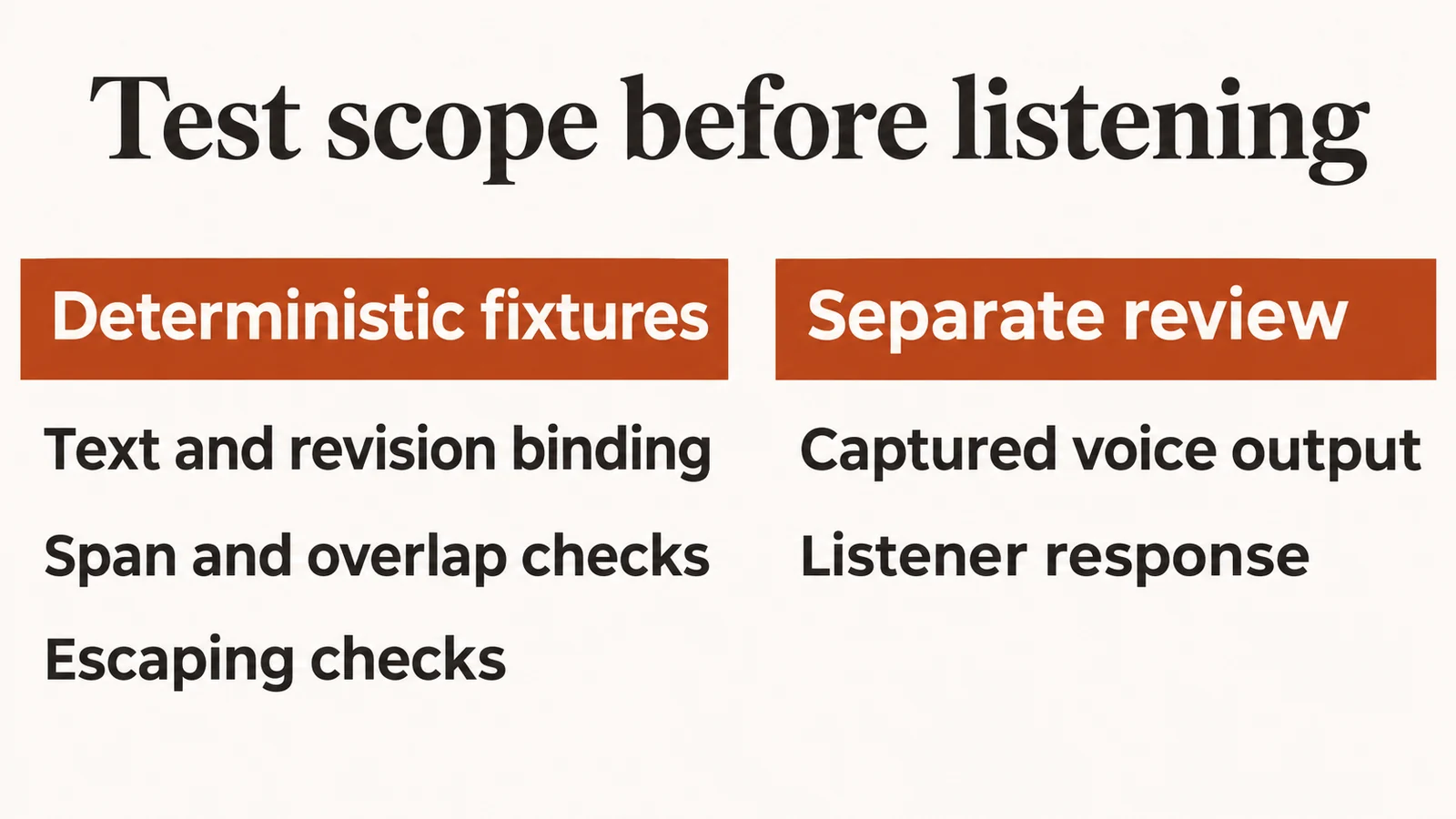
The scope also determines what is not being evaluated. A deterministic alias-selection fixture does not measure how a model infers context from a conversation. If another component supplies that context, test its own inputs and outcomes separately rather than crediting the projector for semantic understanding.
Include one explicit missing-context case in the first integration. It should lead to the documented literal or clarification path without selecting an arbitrary familiar expansion. This gives an adapter a useful contract before any broad abbreviation vocabulary is added.
Keep the original offset unit in the schema. A byte index from a network payload is not automatically a code-point index after decoding. Preserve a controlled source representation and perform a verified mapping at the adapter boundary when another system uses different indexing conventions.
Choose an explicit scoped rendering
Possible policies include characters, an expanded phrase, an approved phoneme or a literal fallback. Choose according to the task and documented target support. Do not describe any one rendering of API, S3 or GPU as universally correct across speakers, contexts and interfaces.
Google's SSML guide illustrates interpretation and substitution controls under its documented interface. Support is a provider contract, not a promise that every listener will distinguish the resulting audio. Preserve the voice and request configuration for any actual review.
The Pronunciation Lexicon Specification represents aliases and phonemes and includes mechanisms related to lexical roles. It does not grant your application a complete context classifier. A standards-defined representation still needs a scoped selection decision and target implementation support.
Amazon Polly's lexicon documentation describes its own resource scope and synthesis use. Do not infer a provider-neutral lexicon precedence rule from one product's examples. A real adapter should retain its selected resource and target configuration.
This article's executable schema uses reviewed alias strings only. Other rendering modes are discussed as design choices, not implemented capabilities. Keeping that limit explicit avoids a small example pretending to validate arbitrary phonetic alphabets or produce every vendor's SSML.
Version rules with the dictionary release contract. A release digest should identify exact content and target scope, and the review should bind to that digest. A filename alone cannot establish which expansion was selected after the file changes.
Keep per-item review history separate from stable rule scope. Different token occurrences can have their own audit records while using one dictionary snapshot. An item's review revision must not accidentally make it look like another provider or language configuration.
The following table describes evidence requirements. A check means sufficient for the stated narrow property; a cross means another boundary needs proof. It is not a pronunciation ranking.
| Evidence | Exact occurrence selected | Reviewed rendering bound | Caller understood intended value |
|---|---|---|---|
| Global substring match | ✗ Can alter larger literals | ✗ Scope absent | ✗ No listening evidence |
| Source-bound span and protected-range checks | ✓ Within declared grammar | ✗ Rule still needs review | ✗ No listening evidence |
| Matching reviewed snapshot rule | ✓ With validated span | ✓ Trusted rule scope | ✗ Support is not comprehension |
| Captured output and reviewed task response | ✗ Keep selection evidence too | ✗ Keep snapshot evidence too | ✓ Within actual review boundary |
A historical Azure lexicon question reports an abbreviation receiving an unexpected expansion. Use it to motivate inspection of actual selection and configuration. Its report does not establish a current provider defect or justify a universal workaround.
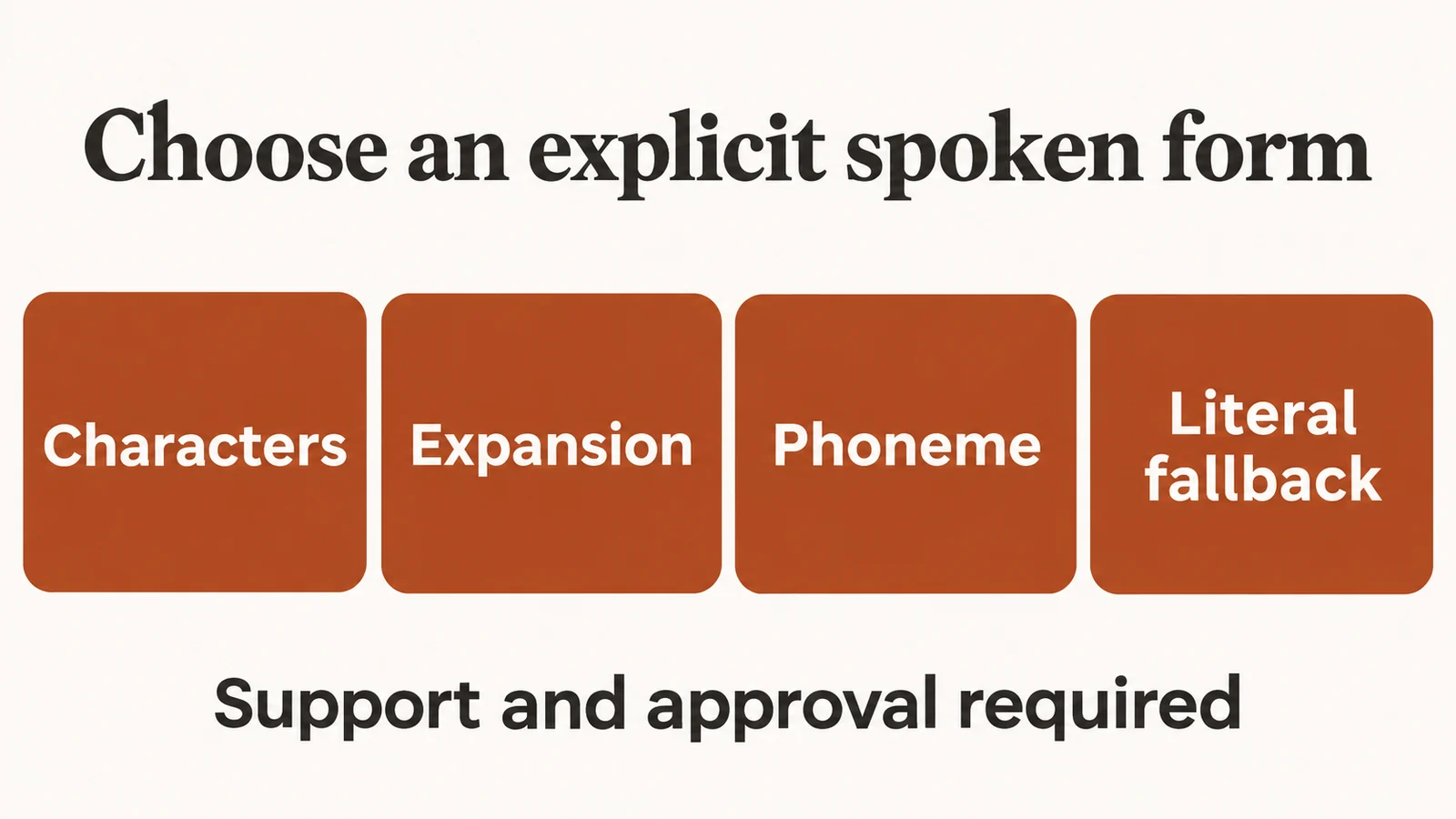
Choose a review question appropriate to the term's role. In an explanation, a longer expansion can make the concept easier to follow. In a literal resource name, expansion can make the exact value harder to recover. Neither observation establishes one generally preferred pronunciation independent of the interaction.
Treat the selected voice as part of the later review condition. A text alias that appears transparent to its author can be rendered unexpectedly by another voice or locale. Keep actual audio identity with the source plan rather than attaching an old listening judgment to every request that shares the token spelling.
Do not infer rule quality from whether a provider accepted the request. Acceptance establishes an interface observation under its documented contract. It does not prove that a caller heard the audio, understood the intended term or approved a business operation involving it.
The dictionary release should preserve removed entries too. If a previously approved expansion is withdrawn from current selection, historical plans still need the exact old value for reproduction. A lookup in retained history is different from permission to use that rule in a new interaction.
Bind spans to original text and revision
A span has meaning only relative to an exact source. Store a digest of the original text and its task revision with every requested edit. Validate both before using the offsets, then verify that the selected slice equals the expected token.
Use a declared offset unit. This artifact uses Python string indices, which count code points rather than encoded bytes or user-perceived grapheme clusters. A browser or another language runtime needs an explicit adapter if its selection offsets use a different unit.
The mixed-script preparation method preserves source and projection separately. Normalizing text before applying old offsets can change the relationship between an occurrence and its index. Either select against the admitted source or recompute a separately bound selection after an authorized transformation.
Validate all index values before sorting. An invalid string offset mixed with integer offsets should cause a controlled validation error, not a sorting exception that prevents the adapter from handling valid evidence according to its contract. This pure constructor rejects the whole edit plan on malformed ranges.
After type checks, enforce range boundaries and nonempty selections. A negative index has valid Python slicing behavior but is not accepted by this schema. An end beyond the source length must not silently truncate and look like a valid occurrence.
Reject overlap before applying changes. Two edits that cover some of the same source characters have ambiguous ordering under this simple policy. The artifact admits adjacent nonoverlapping spans but supplies no priority or merge rule for overlaps.
Apply admitted changes against the original offsets, not against a progressively edited string whose lengths have changed. Reverse-order replacement is one simple technique when spans are nonoverlapping. Preserve the admitted edits in original order for inspection.
The partial-transcript revision boundary is relevant whenever text can change during recognition. A span computed against a partial value is not automatically valid for the final corrected value, even when its token spelling still appears somewhere.
Validate source binding before interpreting span order. A repaired paragraph can retain every old offset within its new length while assigning those offsets to different content. Exact slice verification catches one class of mismatch, while the digest and revision reject an old selection even if the same token still appears at those positions.
Require the expected token itself in the request. Otherwise a range can select the wrong occurrence and still receive whatever rule happens to match the new slice. Comparing the admitted token with the source keeps the selector's claim observable and rejects accidental rebinding.
Keep range validation independent of sorting. A malformed index should produce the declared validation error before Python attempts to compare unlike values. Test negative, out-of-bounds and noninteger positions, including boolean values if the schema expects real integers.
Adjacent edits are not overlapping edits. The simple controller can accept two nonempty intervals whose boundaries touch, while rejecting duplicates and partially intersecting spans. If an application needs precedence among overlapping linguistic rules, define another contract rather than relying on incidental sort order.
Protect literal fields and declared ranges
A token boundary needs a documented grammar. Python's regular-expression documentation distinguishes Unicode and ASCII behavior, but a word-boundary shortcut is not a complete application tokenizer. This example explicitly uses adjacent Unicode letter, mark and number categories plus underscore as its word-like boundary.
That grammar protects an occurrence embedded in a longer word-like identifier. It does not recognize every URL, product code or punctuated domain expression. The trusted adapter must supply protected ranges for such literals when they appear inside natural-language text.
The entire-field literal policy is stronger and simpler. If a value is an order ID or URL field, return its exact source without abbreviation edits. The URL speech constructor shows why path and query components should not inherit natural-language substitution rules.
For a paragraph containing a URL, the adapter can mark that exact range protected. Bind that range to the same source and validate its indices before use. A selection intersecting a declared protected range is rejected rather than partially edited or quietly moved to another occurrence.
Do not claim a complete URL detector from this range interface. The code verifies the ranges it receives; their completeness and field classification remain trusted adapter responsibilities. A missing protected range can leave an unintended occurrence eligible under the limited token grammar.
Unknown rules return clarification before any replacement. That all-or-nothing policy avoids a paragraph containing some expanded terms and one silently guessed occurrence. Another design can preserve unresolved terms literally, but it needs an explicit disposition per occurrence rather than hiding the fallback.
Keep protected spans owned. Copy supported index pairs into immutable tuples before computing a result. A later caller edit must not change what the completed plan says it protected, just as changing a mutable dictionary should not rewrite approved speech settings.
Name resolution has a related ambiguity rule. Similar-looking tokens are candidates for review, not evidence of entity equality. A familiar abbreviation should not turn a literal field into an inferred product or account identity.
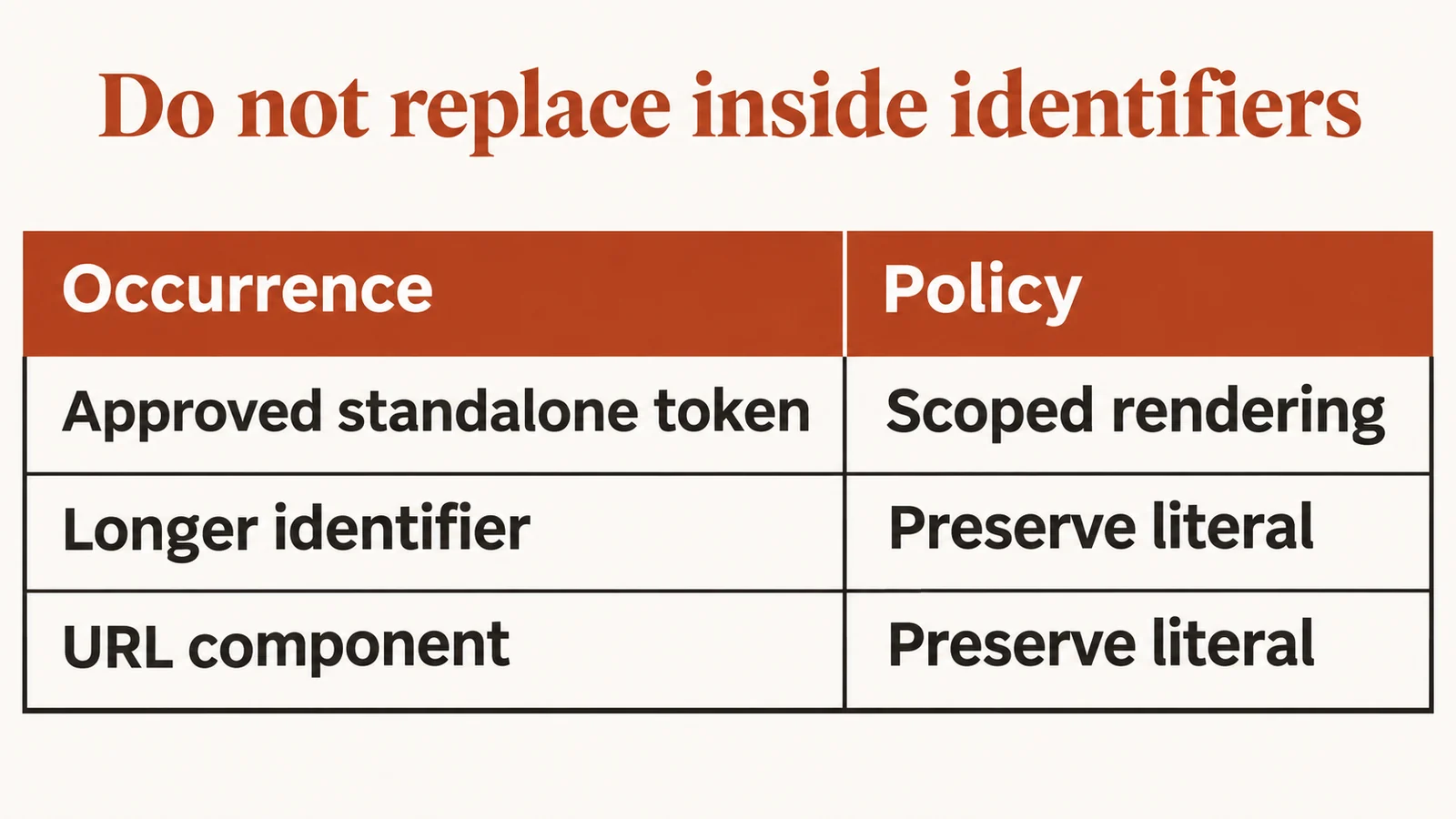
Protection is an ownership decision, not a heuristic confidence score. A trusted field owner can declare that a complete string is literal, and a trusted paragraph adapter can identify ranges that belong to URLs or codes. The projector verifies those controls without claiming to discover every protected object itself.
This boundary should remain visible in the final handoff. If a URL range was not supplied, the limited token grammar cannot promise that every matching token inside it will be protected. An adapter that cannot establish the range should preserve the whole field or ask for clarification under its policy.
Keep literal preservation tests separate from token-boundary tests. An order identifier containing hyphens can contain a standalone-looking substring under a word-like grammar while still being a protected literal field. The whole-field policy is what prevents its replacement in the synthetic fixture.
A rejected edit plan should not become a partially applied sentence. The example validates all supported requests before replacement and returns clarification for an unmatched rule. A surrounding adapter can present the original under an approved fallback, but it should not hide which selection could not be justified.
Construct an inspectable speech projection
The reference function validates one source-bound plan, selects alias-only rules and returns immutable evidence. It serializes the resulting projection as text inside a trusted element. It does not fetch resources, synthesize audio or infer semantic context.
ElementTree provides the construction boundary. An alias containing XML-looking characters remains literal content. Permission to use an abbreviation rule does not permit the rule value to create an audio, lexicon or arbitrary markup element.
Save the complete fence as abbreviation_spans.py and run it with Python 3.12 or newer. All identifiers, contexts and rule values are synthetic policy examples. The emitted plan demonstrates selection and preservation, not preferred pronunciation or comprehension.
from dataclasses import dataclass, FrozenInstanceError
from hashlib import sha256
import unicodedata as ud
from xml.etree import ElementTree as ET

SUPPORTED_LOCALES = frozenset({"en-US", "en-GB"})

def text(x):
    if type(x) is not str or not x:
        raise ValueError("nonempty text required")
    for c in x:
        n = ord(c)
        if not (n in (9, 10) or 0x20 <= n <= 0xD7FF or
                0xE000 <= n <= 0xFFFD or 0x10000 <= n <= 0x10FFFF):
            raise ValueError("unsupported XML character")
    return x

def digest(raw):
    return sha256(text(raw).encode("utf-8")).hexdigest()

def revision(value):
    if type(value) is not int or value < 1:
        raise ValueError("positive integer revision required")
    return value

def interval(a, b, size):
    if type(a) is not int or type(b) is not int or not 0 <= a < b <= size:
        raise ValueError("invalid code-point interval")
    return (a, b)

def word_like(c):
    return c == "_" or ud.category(c)[0] in "LMN"

@dataclass(frozen=True)
class Plan:
    original: str
    projection: str
    source_digest: str
    source_revision: int
    rule_version: str
    context: str | None
    locale: str
    edits: tuple
    protected: tuple
    disposition: str
    xml: str

def project(raw, rev, field_kind, context, locale, rule_version, rules,
            requests=(), protected=()):
    raw, locale, rule_version = text(raw), text(locale), text(rule_version)
    if locale not in SUPPORTED_LOCALES:
        raise ValueError("locale outside configured supported subset")
    rev = revision(rev)
    context = None if context is None else text(context)
    if field_kind not in {"natural_language", "literal_identifier"}:
        raise ValueError("declared field kind required")
    source = digest(raw)
    def result(value, edits, ranges, state):
        root = ET.Element("speak", {"xmlns": "http://www.w3.org/2001/10/synthesis",
                                    "version": "1.1", "xml:lang": locale})
        root.text = value
        return Plan(raw, value, source, rev, rule_version, context, locale, edits, ranges, state,
                    ET.tostring(root, encoding="unicode"))
    if field_kind == "literal_identifier":
        return result(raw, (), (), "literal")
    if any(type(values) not in (list, tuple) for values in (rules, requests, protected)):
        raise ValueError("explicit rule, request and range collections required")
    ranges = []
    for pair in protected:
        if type(pair) not in (list, tuple) or len(pair) != 2:
            raise ValueError("protected interval pair required")
        ranges.append(interval(pair[0], pair[1], len(raw)))
    ranges = tuple(ranges)
    approved = {}
    for row in rules:
        if type(row) not in (list, tuple) or len(row) != 4:
            raise ValueError("token/context/locale/alias rule required")
        token, scope, language, alias = (text(x) for x in row)
        key = (token, scope, language)
        if key in approved: raise ValueError("duplicate rule")
        approved[key] = alias
    admitted = []
    for row in requests:
        if type(row) is not dict or set(row) != {"digest", "revision", "start", "end", "token"}:
            raise ValueError("source-bound selection schema required")
        if row["digest"] != source or revision(row["revision"]) != rev:
            raise ValueError("stale source binding")
        a, b = interval(row["start"], row["end"], len(raw))
        token = text(row["token"])
        if raw[a:b] != token: raise ValueError("selected token mismatch")
        if (a and word_like(raw[a-1])) or (b < len(raw) and word_like(raw[b])):
            raise ValueError("embedded word-like token")
        if any(a < y and x < b for x, y in ranges):
            raise ValueError("protected literal range")
        admitted.append((a, b, token))
    admitted.sort()  # every index has already been type-checked
    if any(left[1] > right[0] for left, right in zip(admitted, admitted[1:])):
        raise ValueError("overlapping edits")
    if context is None or type(context) is not str or not context:
        return result(raw, (), ranges, "clarify")
    if any((token, context, locale) not in approved for _, _, token in admitted):
        return result(raw, (), ranges, "clarify")
    edits = tuple((a, b, token, approved[token, context, locale]) for a, b, token in admitted)
    value = raw
    for a, b, token, alias in reversed(edits):
        value = value[:a] + alias + value[b:]
    return result(value, edits, ranges, "projected" if edits else "literal")

def selection(raw, begin, finish, rev=1, **changes):
    row = dict(digest=digest(raw), revision=rev, start=begin, end=finish, token=raw[begin:finish])
    row.update(changes)
    return row

rules = [["API", "developer", "en-US", "synthetic API rendering"],
         ["GPU", "developer", "en-US", "synthetic GPU rendering"]]
raw = "API, GPU."
requests = [selection(raw, 0, 3), selection(raw, 5, 8)]
p = project(raw, 1, "natural_language", "developer", "en-US", "rules-A", rules, requests)
assert p.original == raw and p.projection == "synthetic API rendering, synthetic GPU rendering."
assert ET.fromstring(p.xml).attrib["{http://www.w3.org/XML/1998/namespace}lang"] == "en-US"
for language in SUPPORTED_LOCALES:
    literal = project("ORD-S3-X", 1, "literal_identifier", None, language, "A", [])
    root = ET.fromstring(literal.xml)
    assert root.tag == "{http://www.w3.org/2001/10/synthesis}speak"
    assert root.attrib == {"version": "1.1", "{http://www.w3.org/XML/1998/namespace}lang": language}
requests[0]["token"] = "mutated"
rules[0][3] = "mutated"
assert p.edits[0][2:] == ("API", "synthetic API rendering")
assert project("ORD-S3-X", 1, "literal_identifier", None, "en-US", "A", []).projection == "ORD-S3-X"
assert project("API", 1, "natural_language", None, "en-US", "A", [], [selection("API", 0, 3)]).disposition == "clarify"
url = "https://example.com/API"
for source, reqs, protected in (
    ("xAPI", [selection("xAPI", 1, 4)], ()),
    (url, [selection(url, len(url)-3, len(url))], ((0, len(url)),)),
    ("API", [selection("API", 0, 3, revision=2)], ()),
    ("API", [selection("API", 0, 3, digest="old-digest")], ()),
    ("API", [selection("API", 0, 3, start="0")], ()),
    ("API", [selection("API", 0, 3), selection("API", 0, 3)], ())):
    try: project(source, 1, "natural_language", "developer", "en-US", "A", rules, reqs, protected)
    except ValueError: pass
    else: raise AssertionError("invalid span plan accepted")
malicious = [("API", "developer", "en-US", "</speak><audio/>")]
m = project("API", 1, "natural_language", "developer", "en-US", "A", malicious, [selection("API", 0, 3)])
tree = ET.fromstring(m.xml)
assert len(tree) == 0 and tree.text == "</speak><audio/>"
assert project("API", 1, "natural_language", "developer", "en-GB", "A", rules,
               [selection("API", 0, 3)]).disposition == "clarify"
for bad_locale in ("en_US", "", " ", "en-US\n", "<en-US>", "fr-FR", True):
    try: project("API", 1, "literal_identifier", None, bad_locale, "A", [])
    except ValueError as error:
        assert "configured supported subset" in str(error) or bad_locale in ("", True)
    else: raise AssertionError("locale outside configured subset accepted")
try: p.original = "changed"
except FrozenInstanceError: pass
else: raise AssertionError("plan rebinding accepted")
print("Synthetic span plan:", p)
print("Span fixtures passed; no semantic classification or synthesis performed.")
All requested edit indices are validated before sorting, and every selected slice is checked against its source binding. The returned plan owns edit and protected-range tuples and retains the actual context and locale values. It does not retain the mutable request or rule lists used by the caller.
Protected-range completeness remains the adapter's responsibility. The code enforces declared ranges and the whole-field literal policy; it does not identify every URL in free text. That limitation is part of the public contract rather than an invisible promise of a general tokenizer.
The program emits the actual synthetic plan, including original values and selected edits. Its XML test confirms that alias text cannot become another element. No output from these fixtures should be described as a measured pronunciation, semantic interpretation or caller-comprehension result.
The fixed SSML root also carries the admitted declared locale as xml:lang. This teaching example deliberately supports only the canonical tags en-US and en-GB, rejecting every other value before literal or projected output. A tag such as fr-FR is outside this configured subset, not claimed to be globally invalid. The allowlist is not language inference or a general BCP 47 validator.
Inspect immutable outputs as well as rejection paths. The plan should retain the exact original, revision, source digest, selected rule version and admitted edits. Without those values, a later reviewer may know the final sentence but have no way to establish which occurrence the selector intended to change.
The constructor copies rule values used by the completed plan into immutable edit tuples. The test mutates the caller's rule and request collections afterward and verifies that the earlier plan remains unchanged. This is an ownership guarantee, not a claim that the caller's entire dictionary was globally frozen.
Safe XML construction applies to reviewed aliases too. A rule value can contain an ampersand or tag-looking text without being malicious. It still belongs in text content. Review approval cannot turn that string into permission to create arbitrary elements or fetch external resources.
If the application adds another rendering mode, preserve the same source and scope checks. A phoneme or character mode needs its own supported attributes and review evidence; it should not bypass literal protection simply because its output is structured differently from an alias string.
Treat repairs and retries as different operations
A repaired source needs a new task revision and newly bound selections. Reusing a previous span just because it remains in range can target another occurrence after an insertion or deletion. Exact text digest matching detects that mismatch even when the token spelling still looks plausible.
Spoken self-correction handling keeps material updates explicit. An output plan derived from the earlier source remains history; it should not become the current spoken confirmation after a repair.
An exact retry can preserve its original request identity and immutable payload. A new confirmation after a repair needs a new identity. Reusing an earlier event key can make a valid repaired confirmation appear to conflict with its own historical attempt.
A qualified affirmative may replace the intended token or context. Interpret the whole repair before accepting approval of an earlier expansion. The pronunciation layer should not decide that the initial affirmative word completed the task.
The pure projector contains no expiry clock or asynchronous work. A live adapter must enforce current deadlines before policy selection or replacement admission and after every wait. A higher revision must not revive an expired operation identity.
Terminal state handling keeps canceled work from returning through a cache or late result. Retaining a previous projection for diagnosis is useful, but it is not renewed authority to speak it in the current interaction.
Bind cached audio to the exact source, rule version and target conditions. The cache-key method prevents another context's approved expansion from becoming a silent default. A matching token string alone is insufficient scope for reuse.
Keep per-attempt evidence outside transient queues where appropriate. Draining a notification queue should not erase which source revision and edits produced the output. That history helps distinguish a late delivery from a current plan without guessing from the final sentence.
Review actual output under a pinned voice
A local alias plan does not establish what a target voice will say. Capture the actual output with provider, voice, locale, rule snapshot and source identity. Keep those conditions fixed when the question concerns one abbreviation rule.
Confirmation prosody helps distinguish a pleasant rendering from a useful one. A listener may recognize an abbreviation in an explanation yet need characters for a literal sequence. Define the task before asking whether the sample sounds correct.
A historical phonetic TTS question asks how to render supplied pronunciations. It illustrates that provided spelling and desired sound can differ. It does not establish a universal phonetic input format or current browser capability.
Preserve recording format, sample clock, channels, codec, decoder and capture point for acoustic work. A clipped boundary can remove a material sound after selection succeeded. Do not fix a transport defect by changing an unrelated abbreviation rule.
Speaking rate is another review condition. Changing rate and expansion together makes the observation a joint configuration result. Preserve those values rather than crediting the dictionary alone for a clearer sample.
Consented corpus practices apply to listener responses and real recordings. Synthetic task fixtures are useful for software regression, but they do not establish permission to capture or publish real call material.
Keep pronunciation preference separate from task success. The outcome-metrics contract requires independent action evidence where the task includes a business operation. A correctly spoken term cannot prove that the right account, document or resource was selected.
No listening measurement is reported here. The executable aliases are explicitly synthetic rendering tokens chosen to test selection. An actual product review should use qualified source and listening evidence, record disagreement, and avoid manufacturing a score from text assertions.
Use matched text when comparing old and new rendering rules. A changed source sentence can alter what a listener expects, and a different surrounding explanation can make an abbreviation easier to infer. Keep source identity and permitted context stable when the question concerns the rule alone.
Record uncertainty in listener responses. A forced choice can conceal that the sound was ambiguous. Keep the actual instructions, unresolved responses and review population in the report instead of converting every hesitation into a guessed correct or incorrect label.
If a task includes an exact identifier, ask a task-specific question about that identifier rather than only whether the voice sounded natural. A pleasant rendering can still corrupt the literal. The selection and protection fixtures address source correctness, while the listening protocol addresses what was understood.
A useful next experiment changes one material condition. Keep voice and source fixed for a rule change, or keep the rule fixed for a voice comparison. No confidence score or invented performance number is required to explain which uncertainty the new review is intended to resolve.
Diagnose the smallest failed boundary
If an abbreviation is wrong, begin with the original source and selected span. Check digest, revision, offset unit, exact slice, field kind and protected ranges before looking at the speech engine. A wrong occurrence cannot be repaired by adjusting pronunciation alone.
Then inspect the scoped rule. Confirm token, context, locale and dictionary version. A missing rule can correctly produce clarification; a global fallback might instead hide the absence and speak a guessed expansion.
Inspect generated XML and the actual provider request separately. Escaped text can be correct locally while an adapter sends it in the wrong field. Retain the exact request representation under the authorized diagnostic boundary and use synthetic examples in public reproductions.
If the plan is correct but audio differs, preserve target configuration and captured output. The voice-consistency method distinguishes output properties that selection does not establish. An old cached sample can also explain a disagreement after a rule update.
Use the observability boundary to keep stage evidence attached to the same attempt. A final transcript or a success counter alone cannot show whether source selection, rule lookup, synthesis or delivery changed.
Do not infer semantic context from a favorable result after the fact. If the application lacked a trusted context, the correct diagnosis can be missing input evidence. Add an explicit adapter contract and test it rather than broadening replacement until a demonstration happens to sound plausible.
Before release, have another engineer reproduce one projected sentence using only its original source, revision, trusted context, locale, rule snapshot and admitted edits. They should be able to determine which characters changed and which literals were protected without relying on the selector's current mutable state.
Repeat the exercise for an unchanged clarification result. The absence of edits should have a concrete reason: missing context, unavailable scoped rule or a whole-field literal policy. Do not label every unchanged sentence successful pronunciation merely because no exception occurred.
A useful public failure packet remains synthetic. Preserve the exact logical source, selected token and index values while replacing private account or resource information with reserved examples. Removing a person's name alone does not make a URL, task identifier or proprietary document reference safe to publish.
Keep implementation and review changes separate in the release note. A new boundary grammar, a corrected span adapter and a changed alias each affect a different mechanism. Report which one changed and rerun its neighboring negative cases so a fix to selection does not quietly weaken literal protection or markup construction.
The next action should follow the observed failure. A stale digest calls for fresh selection, an unknown context calls for the owning interpretation route, and an unclear but correctly selected rendering calls for qualified listening review. Printing more confident language or another arbitrary expansion cannot resolve those missing pieces of evidence.
Frequently asked questions
Why can one abbreviation need several spoken forms?
Its occurrence and task context can differ. A standalone technical term, literal identifier and catalog label need not share a presentation policy. Keep exact token, trusted context, locale and reviewed rule identity together instead of making one substring trigger a universal expansion.
Should API always be spelled out?
No universal rule is asserted. Select a reviewed rendering under the actual task and target voice. The example uses synthetic aliases to validate selection mechanics; it does not claim that one spoken form is preferred by every listener or correct in every occurrence.
How should S3 be handled in storage instructions?
Use the declared technical context and a reviewed target-specific rule if that is the intended occurrence. Preserve the original source and evidence of selection. Do not infer the context from the token alone or reuse the rule inside a URL or identifier without its owner's authority.
What if S3 is part of an order ID?
Treat the whole field as a literal identifier or supply the appropriate protected range. A natural-language abbreviation rule should not rewrite its canonical value. The reference's whole-field literal path returns the exact original without interpreting requested edits.
Should GPU be expanded or spoken as letters?
Choose according to the reviewed task and documented interface, then test actual output. The executable schema implements alias selection only. Character and phoneme modes require their own supported adapter contract and evidence rather than being assumed from a general speech-plan label.
What supplies the context label?
A trusted workflow owner or separately evaluated interpretation component supplies it. The projector does not infer semantics. Missing or contradictory context must remain explicit so a caller string cannot quietly grant itself an approved technical scope.
Can a global replace damage URLs?
Yes, it can change a matching substring inside a literal destination. Preserve whole URL fields and enforce declared protected ranges inside natural-language text. The example verifies supplied ranges but does not claim a complete URL detector or permission to fetch any destination.
What token boundaries does the example support?
It rejects adjacent Unicode letters, marks, numbers and underscore as word-like continuation. That is a declared limited grammar, not a complete tokenizer. Punctuated identifiers and embedded URLs still require trusted field classification or protected ranges from the owning adapter.
How should punctuation be handled?
Apply the documented boundary grammar and preserve punctuation outside admitted spans. The fixture permits a standalone token next to punctuation. Do not strip punctuation globally, because it can carry material meaning in URLs, identifiers or the source representation needed for reproduction.
What happens when context is missing?
The natural-language path returns an unchanged clarification plan before applying edits. It does not guess a rule or partially replace other occurrences. A different application can choose literal fallback explicitly, but should record that disposition rather than hiding missing semantic evidence.
Does a lexicon infer semantic context automatically?
Do not assume that it does. Standards can represent lexical distinctions, while actual selection depends on the target implementation and supplied context. The offline projector requires a trusted context label and performs no semantic classification or provider lexicon lookup.
How do SSML say-as and sub differ?
They express different forms of rendering control under the standard and provider interface. Interpretation hints and substitution aliases should not be treated as interchangeable capabilities. The executable example uses a text alias projection inside trusted XML and does not implement every SSML control.
When should a phoneme rule be used?
When an approved requirement, supported target alphabet and qualified review justify it. This alias-only schema does not validate phonemes. Add a separately scoped representation and tests if needed, rather than accepting arbitrary phonetic text and claiming universal pronunciation control.
Can vendor SSML subsets differ?
Verify the documented endpoint and voice rather than assuming universal support. A local XML parse proves structure, not provider compatibility or intelligibility. Keep the exact configuration in the review packet and treat unsupported modes as explicit outcomes.
Who approves an abbreviation rule?
Use the application's declared review owner and bind evidence to the exact dictionary content and target scope. A model suggestion or successful synthesis request is not proof of review. Personal-name preferences need a separate person/session and retention boundary.
Why retain the canonical text?
It establishes what the application actually meant to present and lets another engineer recompute source-bound edits. A speech projection can differ intentionally. Without the original, stale offsets, global replacements and lossy presentation changes become difficult to distinguish from a caller correction.
How do I prevent markup injection?
Select trusted elements in application code and serialize alias and caller values as text. Validate the supported XML character subset and permit no implicit external-resource references. Rule approval and text escaping are distinct controls; neither should be mistaken for permission to parse caller markup.
What should locale mismatches do?
They should fail to select the cross-scope rule and follow an explicit clarification or literal policy. This example returns clarification. A matching token alone cannot authorize reuse of an alias reviewed for another locale or target voice.
That clarification applies when the locale is inside the example's configured subset but lacks a matching rule. A locale outside the configured en-US/en-GB subset is rejected before an SSML document is created rather than copied into xml:lang or silently normalized.
Can fixture success prove natural pronunciation?
No. It establishes the software properties tested on synthetic values. Naturalness, intelligibility and preference require actual captured output and qualified review under the intended task. Preserve disagreement and missing evidence instead of converting text equality into an acoustic score.
Which listening comparisons should reviewers perform?
Compare the actual admitted old and new rules under matched source text, target voice and task conditions. Include a protected literal negative case and record listener instructions. Keep selection correctness, pronunciation preference and verified task outcome as separate observations with their own evidence.
Release a scoped abbreviation rule
Run the complete source-binding, overlap, literal-protection and escaping fixtures before using real content. Preserve the original and emit the selected edits so another engineer can inspect which occurrence changed.
Then capture actual target output under an authorized review process. The useful rule is one whose scope and limits remain clear when context is missing, the caller repairs the text or a literal value happens to contain familiar letters.